The story
The 60-second version
- Mexico is the backbone of the U.S. winter produce supply. The majority of the fresh vegetables and a huge share of the fruit Americans eat from late fall through spring is grown south of the border.
- The flow is seasonal and predictable: Most of the volume lands in a tight November–May window, because Mexico’s growing seasons are built to fill the gap when U.S. fields go dormant.
- Produce season is a freight event. When that volume concentrates, it pulls refrigerated capacity toward the border, and reefer is a smaller, more specialized pool than dry van, so it tightens fast.
- Reefer ≠ produce. The same trailers haul meat, dairy, processed and frozen food, and beverages year-round. Produce season is a surge on top of a busy shared pool, so even shippers that never touch produce feel it.
- The mistakes that hurt most are operational, not strategic, like vague equipment specs, stale rate benchmarks, and the assumption that an open load board will solve sourcing.
1) Why Mexico owns the U.S. winter produce aisle
The U.S. and Mexico have complementary growing seasons. When U.S. fields go dormant in winter, Mexican fields are at peak. As the USDA puts it: “Mexico’s growing seasons largely complement those of the United States….many types of produce that the United States does not grow in winter are grown during that time in Mexico” (USDA ERS).
The scale is hard to overstate:
- Mexico supplied 63% of U.S. vegetable imports and 47% of U.S. fruit-and-nut imports in 2023, and by volume it was 77% of U.S. fresh-vegetable imports (USDA ERS).
- For several fruits Mexico is effectively the entire import market: strawberries ~99%, other berries ~97%, lemons ~91%, avocados ~86%, mangoes ~56% of U.S. imports by value.
- U.S. horticultural imports from Mexico reached about $19.7 billion in 2023, up roughly 257% since 2007–09 (USDA ERS, EB-48). Berries and avocados were the fastest-growing categories; raspberry and blueberry imports each grew more than 1,000% over that span.
- About 91% of all of Mexico’s horticultural exports head to the United States, so this is, overwhelmingly, a northbound story.
2) What actually moves
When people say “Mexican produce,” they flatten a very diverse mix. The core categories:
- Winter vegetables including tomatoes (by far the largest single commodity), bell peppers and chiles, cucumbers, and squash. Mexico supplies roughly 80% of U.S. import volume for peppers, cucumbers, squash, and snap beans, and is the leading source of bell peppers.
- Berries: strawberries, blueberries, raspberries, and blackberries. These have become a dominant share of U.S. imports in barely a decade.
- Avocados and limes move in meaningful volume in every month of the year. Less “seasonal spike” and more “always on.”
- Spring and summer fruit. Mangoes and table grapes fill out the back half of the season.
And here’s the part most produce season write-ups miss: Reefer isn’t just produce. The refrigerated trailers rolling out of Mexico also carry meat and poultry, dairy, processed and frozen foods, candy and bakery, beverages, and even temperature-sensitive non-food cargo. Fresh produce is only one slice of the refrigerated mix, and it’s a seasonal slice layered on top of freight that moves all year. That’s why the season tightens capacity for everyone, not just produce shippers.
3) The seasonal calendar, when it comes north
Most of Mexico’s produce volume lands in a tight window, and the pattern repeats year after year. The U.S. government tracks it closely:
- Vegetables and berries cluster in late fall through spring. USDA notes squash and bell pepper imports from Mexico “usually peak in the winter and spring months.”
- Blueberries are a clean example of counter-seasonality: Imports from Mexico are lowest in June–August (when U.S. production is on the market) and highest in March–May (USDA ERS, EB-48).
- Even year-round commodities swing by month. Mexico’s share of U.S. fresh-tomato shipments ran about 70% in January, dipped to ~49% in August, and climbed back to ~59% by December in 2023: high in winter and spring, lower in summer when domestic supply competes.
- Mangoes and grapes carry the spring-into-summer handoff; avocados and limes stay heavy all year.
The takeaway for freight: The bulk of the volume hits in a concentrated window and that window collides with other seasonal freight (Mother’s Day floral, summer beverages, the start of domestic U.S. produce) competing for the same refrigerated equipment.
4) Why produce season is a freight event, not just an ag story
When produce volume concentrates, three things happen in sequence:
- Origin output ramps: fields and greenhouses hit peak.
- Capacity gets pulled toward the border: refrigerated trucks and driver hours concentrate where the freight and the money are.
- The ripple spreads: adjacent markets and non-produce reefer shippers feel “mysterious” tightness, because they’re all bidding for the same trucks.
Produce season doesn’t just add loads. It changes where trucks choose to be. And because reefer is a smaller, more specialized pool than dry van, it tightens hard and fast.
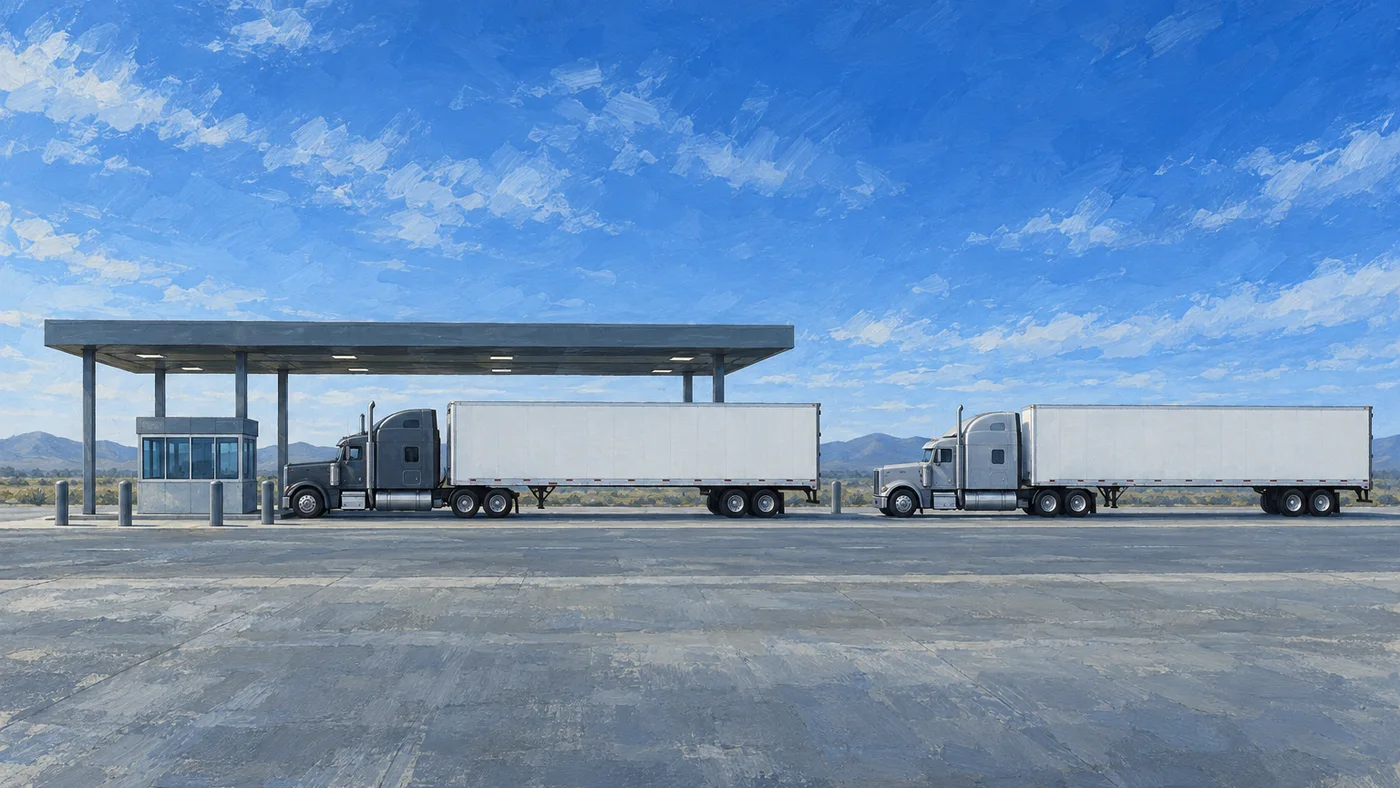
And the market signature is consistent: When produce volume concentrates, refrigerated capacity tightens fastest at the produce crossings, rates climb, and tender acceptance falls. The squeeze isn’t limited to produce shippers, because the same trailers move meat, dairy, CPG, and beverages year-round, everyone hauling temperature-controlled freight out of Mexico is competing for the same trucks. Cargado’s own market analysis shows the deeper driver: Northbound reefer demand runs roughly 2x–3× southbound, so the round trip rarely pencils on its own, and capacity concentrates around the strong-paying headhaul origins.
5) The gateways: geography of the squeeze
The crossings are not interchangeable. Each has its own infrastructure, carrier ecosystem, and downstream distribution.
- Pharr–Reynosa (South Texas) is the #1 U.S. land port for produce. The bridge’s own operators put it at roughly 60% of Texas fresh-produce imports and about 30% of all U.S. produce, avocados, tomatoes, berries, citrus, asparagus and more, out of roughly $50B in annual trade (about 70% manufactured goods, 20% produce/perishables, 10% energy).
- Nogales/Mariposa (Arizona) is the gateway for West Mexico (Sinaloa, Sonora) produce, handling roughly 37% of all Mexican produce entering the U.S. Its season is sharply defined: heaviest November–May, peaking January–March, with thousands of produce trucks a day at peak (Produce Business, Blue Book).
- Otay Mesa and Calexico (California) feed the West Coast cold chain.
- Laredo is the largest crossing overall, but it skews to manufactured goods. That matters here because the year-round reefer base, meat, dairy, CPG, leans on Laredo, so when the produce surge hits the produce crossings, the whole regional reefer pool gets pulled tight.
6) What to watch out for when you move this freight
This is where deals are won or lost. Most produce-season failures are operational, not strategic.
Spell out the equipment and the temperature: every single time. The classic, expensive failure: A carrier bids a load thinking it’s dry van, then realizes it’s reefer and falls off at the worst possible moment in a tight market. Reefer-vs-dry-van confusion is real and it’s common. Put the equipment, the exact temperature setpoint and acceptable range, continuous vs. cycle-sentry, and any pulp-temp or pre-cool expectations right on the load. Ambiguity gets priced, and vague freight gets skipped.
Don’t quote off last month’s number. Market-rate tools are trailing indicators. They reflect roughly the last several weeks and lag badly during fast moves. In peak season, when border lanes can jump double digits in a week, a stale benchmark puts you underwater on the quote. Pull current bids before you commit to a rate.
Plan capacity to the calendar, not the spot market. The window builds from late fall and peaks through winter into spring. Line up committed capacity before the ramp: by the time the market is screaming “shortage,” you’re already paying the premium.
Assume the ripple. If you move any temperature-controlled freight within a few hundred miles of Pharr, Nogales, or Calexico during the season, expect tightness and rate volatility: even if you ship zero produce. You’re competing for the same trucks.
Respect that reefer capacity is scarce and selective, not just expensive. When the market tightens, the best carriers cherry-pick the cleanest, best-paying, lowest-hassle freight. They prioritize their regular customers, avoid border-dwell risk, and want complete information up front. Thin, specialized pools don’t reward improvisation.
Have a border plan. Cross-border perishables isn’t “a dry-van load with an extra step”: it’s a chain with multiple failure points: dwell at the crossing, the trans-loading or relay handoff, cold-chain integrity through inspection. Produce season punishes any plan that assumes you’ll “figure it out at the border.” Decide your through-trailer/drop-and-hook/transload approach in advance.
Build the carrier pool before you need it. The reefer pool, especially the cross-border-capable, equipment-honest one, is thinner than dry van and largely relationship-driven. An open load board alone won’t cover you when it’s tight; the time to build those relationships is before the peak.
Know the cross-border norms. Documentation, insurance, and theft-risk realities differ on the Mexico side. If your process assumes domestic-U.S. rules apply unchanged, the season will teach you otherwise.
Bottom line
Mexico’s produce season is the most predictable capacity event on the cross-border calendar. Treat it like one: Know the commodities and their windows, respect that reefer is a thin and specialized pool, spell out exactly what you’re shipping, price off current data instead of last month’s, and line up capacity before the peak, not the week of.
If you move Mexico freight and you’ve got a produce-heavy customer (or you’re about to), the best time to tighten the playbook was last fall. The second best time is now.
The commodity view of the same season, including the gateways it concentrates through: shipping fresh produce.
How a reefer posting reaches carriers on Cargado: how the Cargado marketplace works.