Reefer in three countries
Carriers based in Mexico, the U.S. and Canada declare reefer equipment, and they run reefers in all three countries. Canada is an especially deep source: Canadian reefer carriers outnumber U.S. ones on the network.
Heated trailers are their own type. Heated loads are posted for the U.S. and Canada and carriers bid on them. Double-trailer reefer loads are posted for Mexico and bid on in the U.S., and multi-axle reefers are a Canada-only type. For heated or either of those, confirm the trailer with the bidder.
Where reefer freight posts
Reefer freight is posted out of every region of Mexico on the network: Baja California and the northwest, the north central states, the northeast, the Bajío, western and central Mexico, the east and the southeast. In Canada it is posted out of Ontario, Quebec, Atlantic Canada and the west. In the U.S. it is posted out of every region, from the South Central states and the West to the Midwest, Southeast and New England.
Read that as where freight is posted, not where carriers are based. Home base is not coverage, and the carrier who hauls a reefer out of the Bajío may be based elsewhere. Frozen and refrigerated food is posted in every direction across the three countries, mostly for reefer. Fresh produce posts mostly for reefer too, northbound from Mexico and on most other lanes.
Reefers and the border crossings
Reefer freight is posted through Laredo, Pharr (Hidalgo), Brownsville, Calexico East, El Paso, Nogales and Otay Mesa, and carriers with reefer equipment also declare Del Rio, Douglas, Eagle Pass, San Luis and Tecate. Laredo carries the most crossing freight on the network.
Which crossing fits depends on the origin, the destination and the inspections. Brokers can flag USDA, FDA, CBP Agriculture, SENASICA, SADER and other inspections on a load. The flag tells carriers what the load needs; it does not mean a carrier is certified for any of them. The crossing pages explain each port.
Temperature, records and heated loads
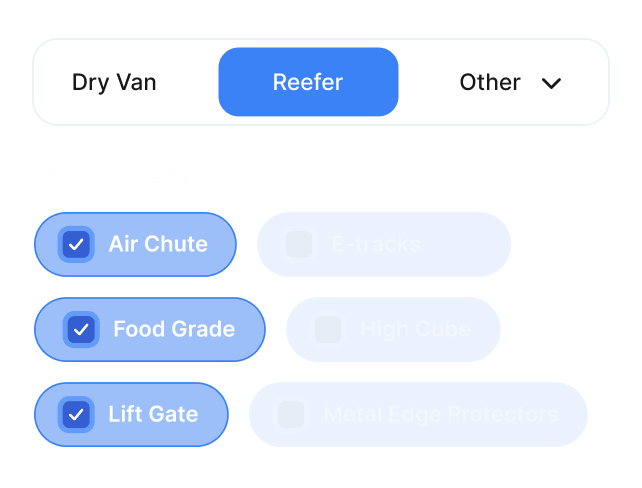
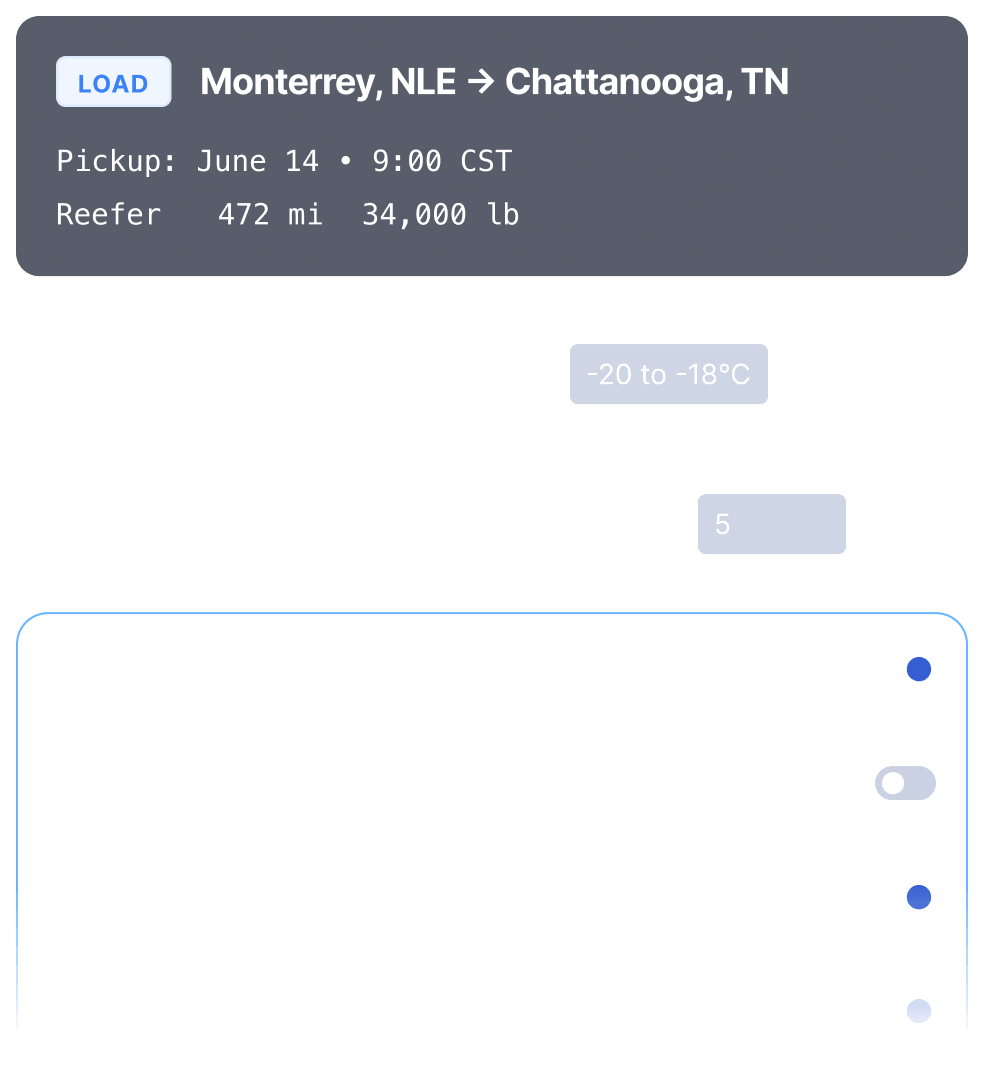
Temperature is set on the load, not on the carrier. A posting can ask for frozen, chilled or protect from freeze, a set temperature range in Fahrenheit or Celsius, and a continuous run. Reefer loads can also call for food grade, an air chute on U.S. loads and a CTPAT-compliant trailer on Mexico and U.S. loads. Carriers do not declare temperature ranges on their profiles, so the posting is where the requirement lives.
There is no platform field for temperature records. Some carriers have linked a telematics provider such as Samsara, Motive or Geotab, but few have, so do not assume tracking on every load. If a shipper needs temperature logs, say so in the posting and confirm with the carrier before you accept.
What to confirm on a reefer load
Confirm the setpoint, the continuous setting and any food-grade need against the shipper's instructions, and ask for the records the shipper expects. Certifications are declared by carriers, with documents our team reviews. If you require C-TPAT, check each bidder's status directly. U.S. authority is verified with FMCSA and our team approves every carrier, but reefer unit condition and pre-cooling are yours to confirm.
On Cargado
How a broker reaches reefer capacity on Cargado
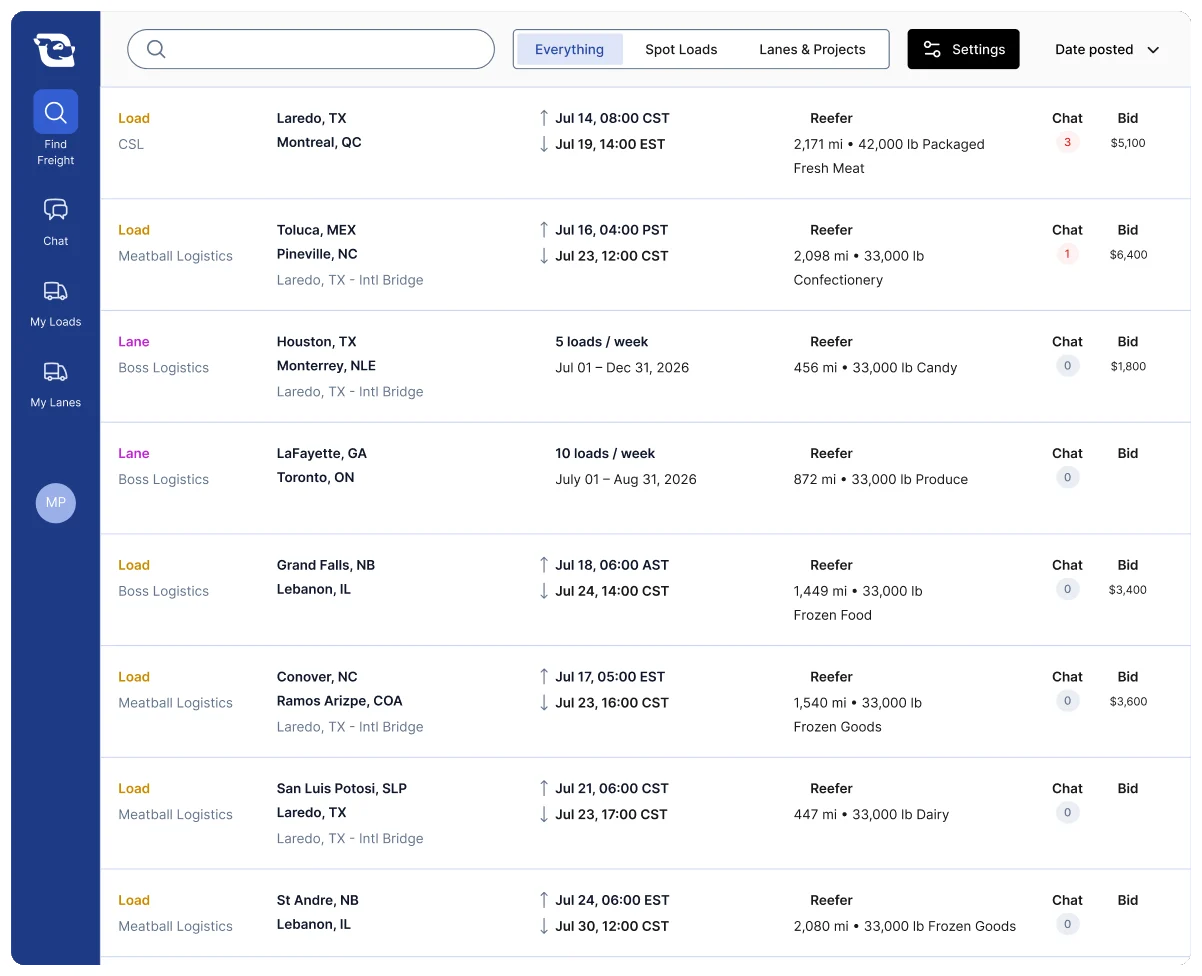
Post the load with reefer as the trailer type and set the temperature on the load: frozen, chilled or protect from freeze, the setpoint or range, and continuous if the product needs it. Every bidder sees those settings, because carriers do not declare ranges of their own. Add food grade, an air chute, a CTPAT-compliant trailer or an inspection flag if the load needs one. Reefer carriers whose saved searches, service areas or open trucks match are notified. In suggested carriers, "Available truck" means an open reefer posted near your pickup, and "Preferred lane" means a saved search on your lane. For a U.S. or Canadian winter load that only must not freeze, allow heated as well. Cargado does not take a cut.























.webp)