
Know what Mexico and Canada freight should cost.
Benchmark what you pay on Mexico and Canada lanes against what carriers are actually bidding, refreshed every week.
Get your freight benchmarked →


What rates you can see
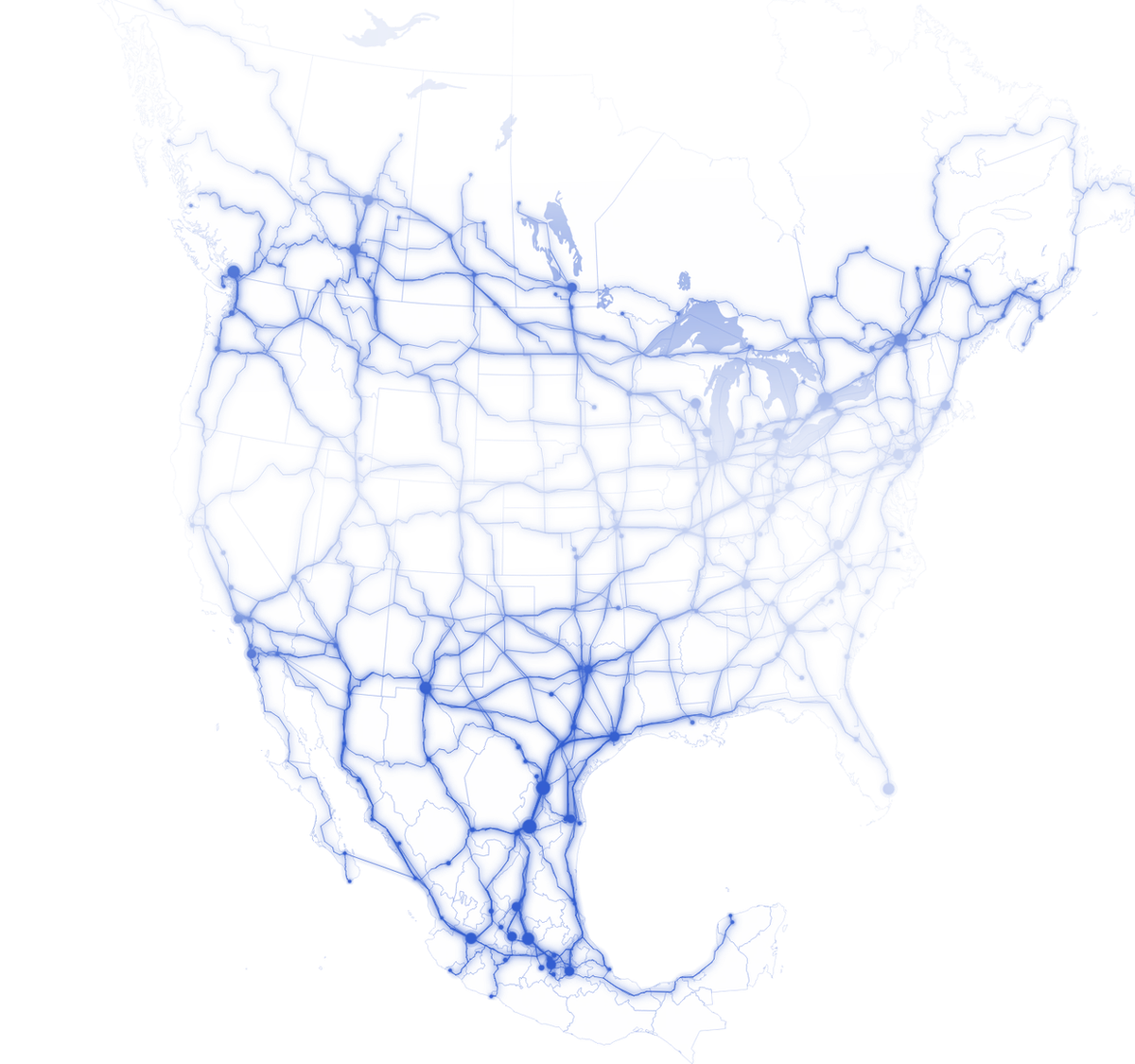
Cross-border Mexico
Both directions across the U.S. and Mexico border.
Domestic Mexico
Moves between points inside Mexico.
Cross-border Canada
Both directions across the U.S. and Canada border.
How shippers get Cargado rates
Direct with Cargado
Subscribe directly and the benchmarks live in your workflow, in-platform. The most direct way to put real market data behind every rate conversation.
Through partner platforms
Already run procurement in one of the platforms we partner with? Add a Cargado subscription and the same benchmarks appear alongside your carrier bids.
Read your market
See how your lanes sit against the wider market, notice where conditions have shifted, and go into every rate conversation with context instead of guesswork.
How Cargado builds a rate band
Every rate on Cargado is a band, not a rate card: a low, a mid and a high for one lane and one trailer type, built from carrier bids over the trailing 12 weeks and refreshed weekly. Here is where the numbers come from and how to read them.
Where the numbers come from
Carrier bids on real postings
Brokers and forwarders post real loads and lanes in Cargado's marketplace. Vetted Mexico and Canada carriers bid on them. Those bids are the data. Not a survey, not a scraped load board, not invoices collected after the fact.
The last 12 weeks, refreshed every week
Each band is built from bids over the trailing 12 weeks and rebuilt every week, so it describes the market you are buying in now, not the one from last quarter.
Priced from the lane, or estimated from the markets around it
Every lookup is priced by trailer category between the market your origin sits in and the market your destination sits in. When a market has too few recent bids on its own, Cargado uses a wider area around it and labels the result "extended market". The confidence label tells you which one you are looking at.
How to read the band
Low, mid and high
The middle half of recent carrier bids sits between low and high. Mid is the center of that range. Committed volume with real lead time tends to land toward the low end. Short notice and tight pickup windows land toward the high end.
One total per load, fuel included, in your currency
The band is a total per load, not per mile, and it includes fuel. Add the fuel surcharge to any linehaul quote before you compare. Price it in U.S. dollars, pesos or Canadian dollars; the app suggests one for the lane.
The confidence label
Strong, Medium or Lower Confidence comes from the lane's margin of error: how far the true middle could sit from the one Cargado observed, based on how many bids stand behind the lane and how much they vary. A thin lane gets a lower label, not a made-up number. A lane with too few recent bids shows no rate at all.
Where your quote sits
Below the band
A quote under the low end sits below what carriers have been bidding on that lane. Worth understanding why before you plan around it, because a rate well under the market usually reflects something specific about that load rather than the lane itself.
Inside the band
In line with the market. Expect the low end for committed volume with lead time, and the high end for short notice.
Above the band
A quote above the high end sits above the range carriers have been bidding on that lane. Usually there is a reason worth knowing: lead time, equipment, seasonality, or a lane that runs empty in one direction. Read it with the confidence label.
The band is a guide built from real recent bidding, not a guarantee of what any one carrier will accept.
Other ways to get these rates
Pull the same bands into the tools you already price in, so nobody logs into one more system to see what a lane is going for.
Price a bid file in Excel
Pull low, mid and high bands straight into your bid sheet and drag them down a lane list. No copying between tabs, no re-keying.
Pull rates into your own system
Call the Market Rates API from your TMS, your pricing engine or your own tools and get the same bands back, refreshed weekly. It also works with AI assistants and any other tool that can call an API.
Already in a partner platform
Some procurement platforms carry Cargado benchmarks natively, so the bands show up next to your carrier pricing. GoodShip is live today, with more to be announced soon.
See all partnerships →Cross-border rate intelligence for shippers
See what Mexico and Canada lanes actually cost, and how rates are moving.
Guides for buying cross-border freight
How loads cross, what the rate covers, and how one 3PL found hazmat capacity.
Common questions
What shippers ask about Cargado rate benchmarks
Have a question we didn't cover?
Our team is happy to talk through how the benchmarks fit your freight
Contact UsCargado is built for Mexico and Canada freight. U.S. and Mexico in both directions is where the bidding is deepest, on lanes like Laredo–Monterrey and Guadalajara–Laredo, alongside Mexico–Canada, U.S.–Canada, domestic Mexico and freight within Canada. There is rate data for U.S. freight moving to and from border cities like Laredo and El Paso, while U.S. domestic freight away from the border stays out of scope by design. Coverage is full truckload in dry van, reefer, open deck and straight truck; partials, power-only and hazmat aren't priced. Depth varies by equipment and lane, so check the confidence score on the combination you care about.
Cargado subscriptions are value-based and scale with usage: from teams doing occasional rate lookups to enterprise plans with unlimited access. Every plan includes unlimited users. Talk to us to find the right fit for how your team buys freight.