
What metals and building-materials freight should cost across the Mexico border
See what your metals and building-materials lanes should cost, from real carrier bids, and check what you pay, free. Brokers post the loads and vetted carriers bid; shippers use the rate data those bids produce. Cargado is not your broker.
44% of metals and building-materials postings ride open deck (flatbed or step deck), four times the marketplace share. Dry van still carries about half, coils and tubing included.
Monterrey leads on the Mexican side, with the Bajío and Coahuila behind it. Laredo is the crossing on 62% of loads; Houston is the largest U.S. market beyond the border yards.

Share your Mexico or Canada lanes and we price them against Cargado Market Rates, free, with no commitment.
Get a benchmarkSee Market RatesThe metals and building-materials market on Cargado
Metals and building materials · 12 months to Oct. 27, 2026 · Cargado postings
About 7 in 100 loads, and rising
Nov. 2025Oct. 2026
Metals and building materials were about 7% of all postings on the marketplace in the year, about 9 a business day. The monthly share climbed from about 5% to 6% in late 2025 to 8% to 9% in August through October 2026, and monthly postings roughly doubled.
Both ways across the border
- 40% U.S. to Mexico
- 33% Mexico to the U.S.
- 13% within the U.S.
- 7% U.S. and Canada
- 7% within Mexico, within Canada, and Mexico and Canada
About 73% of metals and building-materials postings cross the U.S.-Mexico border, in both directions. Share of postings by direction.
Laredo on 62 of every 100 loads
Laredo is the crossing on 62% of metals and building-materials loads, above the 54% for all freight on the marketplace. Otay Mesa, serving Tijuana, is next at about 4.5%.
Open deck on 44% of loads
Share of postings for flatbed or step deck. Dry van still carries about half of this freight, and metals and building materials are about a quarter of all open-deck postings on the marketplace.
About 45% of metals and building-materials postings drew at least one carrier bid in the year, against 42% for all freight, from hundreds of carriers. Source: Cargado postings, Oct. 28, 2025 to Oct. 27, 2026, grouped by commodity description. Shares are of postings, not of revenue or tonnage.
How metals and building-materials shippers use Cargado
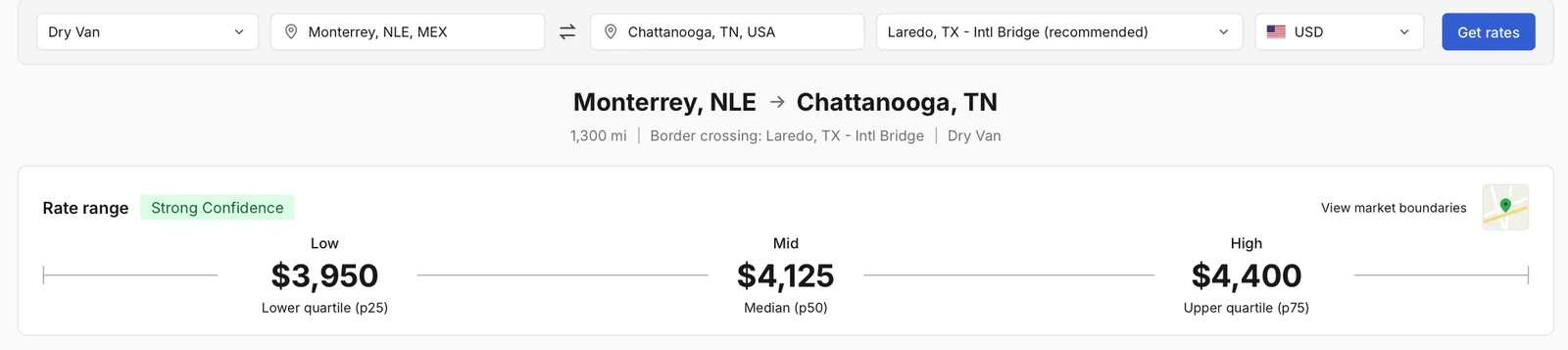
Shippers do not post loads on Cargado; brokers post them and vetted carriers bid. What a shipper gets is the rate data those bids produce: a low, mid and high band for a lane, refreshed weekly, with 12 weeks of history, in USD, MXN or CAD, wherever enough carriers have bid recently. A thin lane gets a lower confidence label or is priced from a wider area, and a lane with too few recent bids shows no rate. Dry van, reefer and flatbed are priced separately, so a flatbed lane and a dry van lane each carry their own band; step deck and Conestoga are trailers a broker names on a posting, not separate bands.
Price flatbed and dry van lanes separately
A building-materials distributor prices its palletized tile and fixtures on the dry van band and its structural steel on the flatbed band for the same lane, Monterrey to Houston or the Bajío to Texas. Run the whole bid file through the Excel Add-In and set target rates by trailer before bids come back.
Benchmark what you pay
Share your metals or building-materials lanes or recent loads, with the trailer on each. We price them against Market Rates and show where you sit against what carriers bid on the same lanes, and which lanes are too thin to price. No charge, no commitment.
Budget for duties and the border
Twelve weeks of history on each lane shows direction, not just this week's price, and a flatbed band that includes the Laredo transfer tells you what a split or transloaded coil load really costs against a through move. For which way steel is moving under the current duties and what the border adds, read the steel and metals market guide.
Get rates where you work
In the Cargado app, in Excel through the Add-In, through the API, or inside GoodShip.
Where metals and building-materials freight concentrates
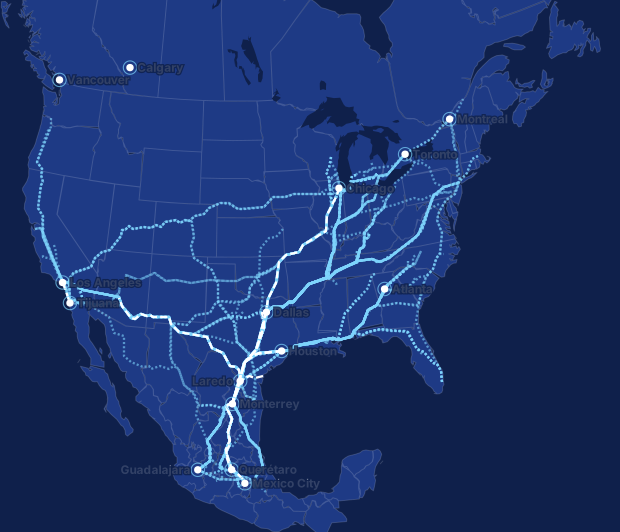
Monterrey and the rest of Nuevo León are the largest Mexican market at both ends of this freight on Cargado: the top origin of metals and building-materials postings in the year and, after the Laredo border yards, the top destination. Taken as one region, the Bajío (Guanajuato, Querétaro and San Luis Potosí) receives more of these postings than Nuevo León and ships nearly as many; Coahuila is a steady destination for southbound steel but a small origin. North of the border the freight lands in Texas, with Houston the largest U.S. market beyond the border yards and Kentucky behind it; Houston and Corpus Christi are the leading U.S. origins. Tijuana and the Otay Mesa crossing carry a smaller West Coast flow. Laredo shows up as both an origin and a destination, the mark of loads that break at the border yards rather than running through on one trailer.
How metals and building materials move
- Coils. Skidded or eye-to-the-sky, chained and sometimes on coil racks. In the U.S., metal coils weighing 5,000 lb or more, alone or together, fall under their own securement rule, 49 CFR 393.120, and coil-qualified carriers are a narrower pool than flatbed carriers, which shows in lead time and in the bid.
- Plate, tubing, rebar and structural shapes. Ride flatbeds with chains, binders and edge protection, tarped when the product must stay dry. Coated and finished metal increasingly moves under Conestoga rolling tarps, which protect it without hand-tarping.
- Dry van for about half of it. About half of metals and building-materials postings are dry van. Coils, tubing and palletized goods ride in vans when the product needs a closed trailer or the receiver unloads from a dock, alongside wire, fixtures, hardware and tile.
- The weight gap at the border. Mexico allows a five-axle tractor-trailer about 102,500 lb gross on its main highways; the U.S. Interstate cap is 80,000 lb. A coil load built to Mexican limits is split into two trucks, transloaded at a border yard, or run on a designated overweight corridor, and each option costs money or a day. Some freight runs through-trailer; the rest breaks at Laredo or another border yard, and the choice changes the rate and the handling.
What to ask your carrier or broker
Open-deck lanes reward specificity, and the questions below are where the rate and the service level get decided.
- Which trailer is on the posting? Flatbed is the common open-deck trailer at a Mexican plant; step decks and Conestogas run in the U.S. and Canada, and loads touching Mexico for them are posted and bid on. The trailer named decides which carriers bid. For pricing, Market Rates covers dry van, reefer and flatbed, so a step deck or Conestoga move is priced against the flatbed band; say so in the RFP.
- Is the securement on the posting? Open-deck postings on Cargado list straps, chains, tarps and blocking and bracing, and on a U.S. or Canada posting coil racks and edge protectors. Ask your broker to put the product, the piece count, the weight per piece and the tarp requirement on the posting; that is what open-deck carriers price.
- Does the weight cross? Ask whether the load is built to the U.S. 80,000 lb limit or will be split or transloaded at the border, and who pays for the yard.
- Cargo insurance and C-TPAT. On Cargado, a broker can require C-TPAT and set a minimum cargo insurance on the posting. Ask whether yours does, and whether the minimum matches the value of the steel.
- Who can see your freight? A broker can limit a posting's bidders to carriers it has already onboarded, and a load that stays inside Mexico goes to Mexican carriers only. If you expect either, ask for it.
New to the market? The Mexico 101 guides cover crossings, documents and carrier vetting, the lanes pages show the corridors this freight runs, and open-deck coverage explains how flatbed, step deck and Conestoga loads are posted.
On the Cargado network
Industry guides
Where this freight ships from, what the border adds to its cost, and how carrier bids moved out of its markets:
- Why does more steel now move south into Mexico than north?
- Furniture and building materials from Mexico, beyond the carrier's rate
- Mexico-U.S. tariffs and trade rules
More questions
What equipment moves metals across the border?
About half dry van and 44% open deck (flatbed or step deck) on Cargado in the last 12 months, against 11% open deck for all freight. Coils, plate, tubing and rebar ride open deck with chains, tarps and sometimes coil racks, though coils and tubing also move in vans; wire, fixtures, hardware and tile are usually dry van. Make sure your broker names the trailer on the posting so the right carriers bid, and price a flatbed lane on its own Market Rates band.
What does a benchmark cost?
Nothing. Share a list of your Mexico or Canada lanes or recent loads and we price them against Market Rates and show where you sit, with no commitment. Ongoing Market Rates access is a subscription, direct or through partners such as GoodShip.
See what your metals lanes should cost
Share a list of your Mexico or Canada lanes or recent loads, coil or palletized. We price them against Cargado Market Rates and show where you sit, before you commit to anything.
Get a benchmarkSee Market RatesCommon questions
Can a shipper post loads or get carrier bids on Cargado?
No. Brokers post loads and vetted carriers bid on them. Shippers use Cargado for the rate data those bids produce: Market Rates bands for a lane, a free benchmark of what you pay, and rates inside Excel, the API or GoodShip. Cargado is not your broker and takes no margin on your loads.
Where do the metals and building-materials rates come from?
From real carrier bids on loads posted to the Cargado marketplace, where metals and building materials are about 7 in 100 loads and about a quarter of all open-deck postings. Each lane shows a low, mid and high band, refreshed weekly, with 12 weeks of history, in USD, MXN or CAD. Dry van, reefer and flatbed are priced separately.
Moving this kind of freight?
Cargado connects hundreds of brokers with 2,400+ vetted carriers moving Mexico and Canada freight every day.