
San Diego, CA freight lanes
San Diego is the U.S. side of Otay Mesa, the West Coast's commercial gateway to Tijuana and the third-largest truck port with Mexico by value in 2025 (BTS). Pick a lane in the directory to open its guide, and read how the Otay Mesa handoff and the Southern California distribution market work together. Cargado is a marketplace where brokers post Mexico and Canada truck freight and vetted carriers bid on it.
Otay Mesa
9.1%
11
Dry van
Corridors out of San Diego
Southbound into Mexico
Across the U.S.
To Canada
Corridors into San Diego
Northbound from Mexico
From the U.S.
What moves through the San Diego market
Otay Mesa carried $58.6 billion of truck freight in 2025, 9.1 percent of U.S.-Mexico truck trade by value (BTS Transborder Freight Data Annual Report: 2025), which makes San Diego the third-largest truck gateway on the border. Tijuana manufacturing sets the mix: medical devices, electronics, aerospace components and furniture northbound, components and packaging southbound, much of it bound for or coming from the Los Angeles basin and the Inland Empire. Tijuana EDC's August 2025 profile counts more than 44 medical device companies and 42,000 direct manufacturing jobs in the region, and attributes half of Mexico's medical device exports to Baja California. San Diego's own market adds consumer goods and food distribution, and the I-5 and I-8 corridors connect it with Phoenix, Portland and the rest of the West.
What ships from the San Diego area
Plants, mills, packing houses and distribution centers within about 100 miles of San Diego are among the area's main freight sources. The commodities below are ranked by employment in public business-establishment data, and each is tied to a named facility, cluster or growing region.
- Medical devices. BD makes medication dispensing cabinets across the border in Tijuana, and Alphatec Spine is based in Carlsbad.
- Electronics. Foxconn Baja California makes electronics in Tijuana that cross northbound at Otay Mesa.
- Aerospace components. Safran Cabin builds aircraft cabin equipment in Tijuana.
- Port cargo. The Port of San Diego's Tenth Avenue Marine Terminal handles refrigerated containers, breakbulk and bulk cargo.
On the road, dry van carries medical devices, electronics and aerospace components; reefer carries port cargo. Post the commodity, weight and trailer type with each load so carriers can price it.
The corridor groups San Diego anchors
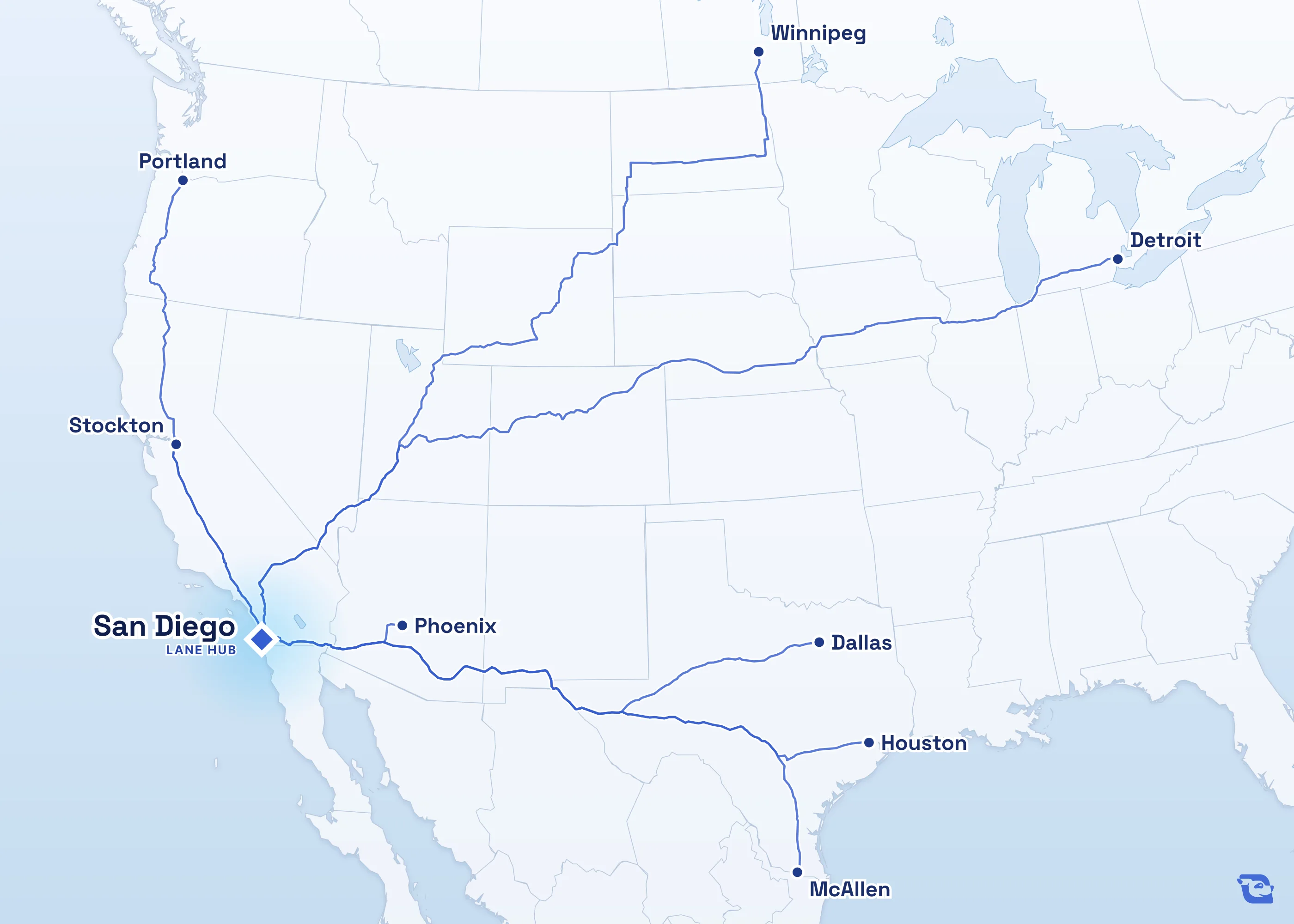
The Mexico guides run both ways between San Diego and Tijuana, the short cross-border shuttle. U.S. guides run to Phoenix and Portland outbound, and from Dallas, Detroit, Houston, McAllen, Phoenix and Stockton inbound; a San Diego endpoint may be a warehouse leg or part of a longer Tijuana move. One Canada guide runs to Winnipeg; for it, confirm the Canadian customs broker, the ACI filing, the PARS release and the carrier's authority. For each lane, confirm whether you need the border shuttle, the U.S. linehaul or the door-to-door move, because that decides which carriers can bid.
Covering San Diego freight: what a broker needs to know
Otay Mesa is the crossing
Commercial trucks cross at Otay Mesa, east of San Ysidro. Tecate, further east, is a small alternate that only works when your carrier and customs broker confirm cargo eligibility, hours and a receiving yard there. State the confirmed crossing on a Tijuana posting and name the yard or dock on each side.
Transfer carriers run the shuttle
Tijuana plants commonly move on a transfer model: a Mexican carrier drops the trailer at a Tijuana yard, a transfer tractor crosses it, and a U.S. carrier picks up in Otay Mesa or San Diego. A transload instead moves the cargo to a U.S. trailer at an Otay Mesa dock. Post the leg you need covered and check what each bid includes: the transfer, any transload, trailer use and detention.
Customs on both sides
Northbound, a U.S. customs broker usually files the U.S. entry; southbound, a licensed Mexican customs broker files the Mexican entry. Confirm the commercial invoice, packing list and, for the Mexico leg, who issues the CFDI with Carta Porte details when required. Agree on free time and detention before dispatch, because a missing document parks the truck at the port.
Common questions about San Diego freight
Which crossing does San Diego freight use?
Commercial trucks cross at Otay Mesa, the West Coast's main truck port of entry into Tijuana. Tecate is a small alternate to the east. Each Mexico lane guide on this hub names the crossing it uses.
Is a San Diego lane a border move or a domestic move?
Both appear on this hub. San Diego to Phoenix or Houston to San Diego are domestic U.S. moves for a carrier with U.S. authority that is eligible for domestic hauling. San Diego to Tijuana needs a carrier with Mexican operating authority for the Mexico leg, usually with a transfer at Otay Mesa. Post the leg you need covered so the right carriers bid.
How do I find carriers for a San Diego lane on Cargado?
Post the pickup and delivery, the date, the equipment and the leg you need covered. For a Mexico move, include the crossing and the handoff plan; for a Canada lane, the customs broker and the release arrangement. Vetted carriers that run the corridor bid, and you compare what each bid covers before you book. Where a corridor has enough bid history, Cargado Market Rates gives you a reference built from carrier bids before you quote.
What equipment runs San Diego corridors?
Dry van leads, carrying Tijuana manufacturing freight and Southern California distribution. Reefer demand comes from produce and food, and open deck from machinery. Post the trailer type with the weight, dimensions and loading requirements so carriers can price the load.
What freight ships out of San Diego?
Facilities within about 100 miles of San Diego mainly ship medical devices, electronics, aerospace components and port cargo. On the road, dry van carries medical devices, electronics and aerospace components; reefer carries port cargo.
Moving freight through this market?
Post it to 2,400+ vetted Mexico and Canada carriers, or check market rates built from real carrier bids before you quote.