
Torreón, Coahuila freight lanes
Torreón anchors the Laguna region, a dairy and manufacturing market between Monterrey and Chihuahua. Pick a lane in the directory to open its guide, and read how a Torreón load reaches Laredo and what the Mexican leg needs. Cargado is a marketplace where brokers post Mexico and Canada truck freight and vetted carriers bid on it.
Laredo
Dairy and equipment
6
Reefer and dry van
Corridors out of Torreón
Northbound into the U.S.
Within Mexico
What moves through the Torreón market
Torreón and its twin cities Gómez Palacio and Lerdo, across the state line in Durango, form the Laguna region, a desert market known for dairy and for a manufacturing base that has grown around it. Lala, one of Mexico's largest dairy companies, is headquartered here, and the region hosts plants for John Deere and Johnson Controls and automotive suppliers alongside textiles, steel and mining (MexFacts). Reefer loads of dairy and food move to Mexico City and the north; dry van loads of auto parts, machinery and consumer goods move to the U.S. through Laredo. Federal Highway 40 links Torreón east to Saltillo and Monterrey and Highway 49 runs south to Zacatecas and the Bajío.
What ships from the Torreón area
Plants, mills, packing houses and distribution centers within about 100 miles of Torreón are among the area's main freight sources. The commodities below are ranked by employment in public business-establishment data, and each is tied to a named facility, cluster or growing region.
- Dairy products. Lala runs its dairy complex in Torreón.
- Refined metals. Peñoles' Met-Mex complex refines zinc, lead and silver in Torreón.
- Engines and farm equipment parts. John Deere builds engines and axles in Torreón.
- Auto parts. Auto parts plants across the Laguna region rank high in establishment data.
- Apparel. Garment makers are the largest industry in the Torreón area in establishment data.
On the road, flatbed or open deck carries refined metals and engines and farm equipment parts; dry van carries auto parts and apparel; reefer carries dairy products. Post the commodity, weight and trailer type with each load so carriers can price it.
The corridor groups Torreón anchors
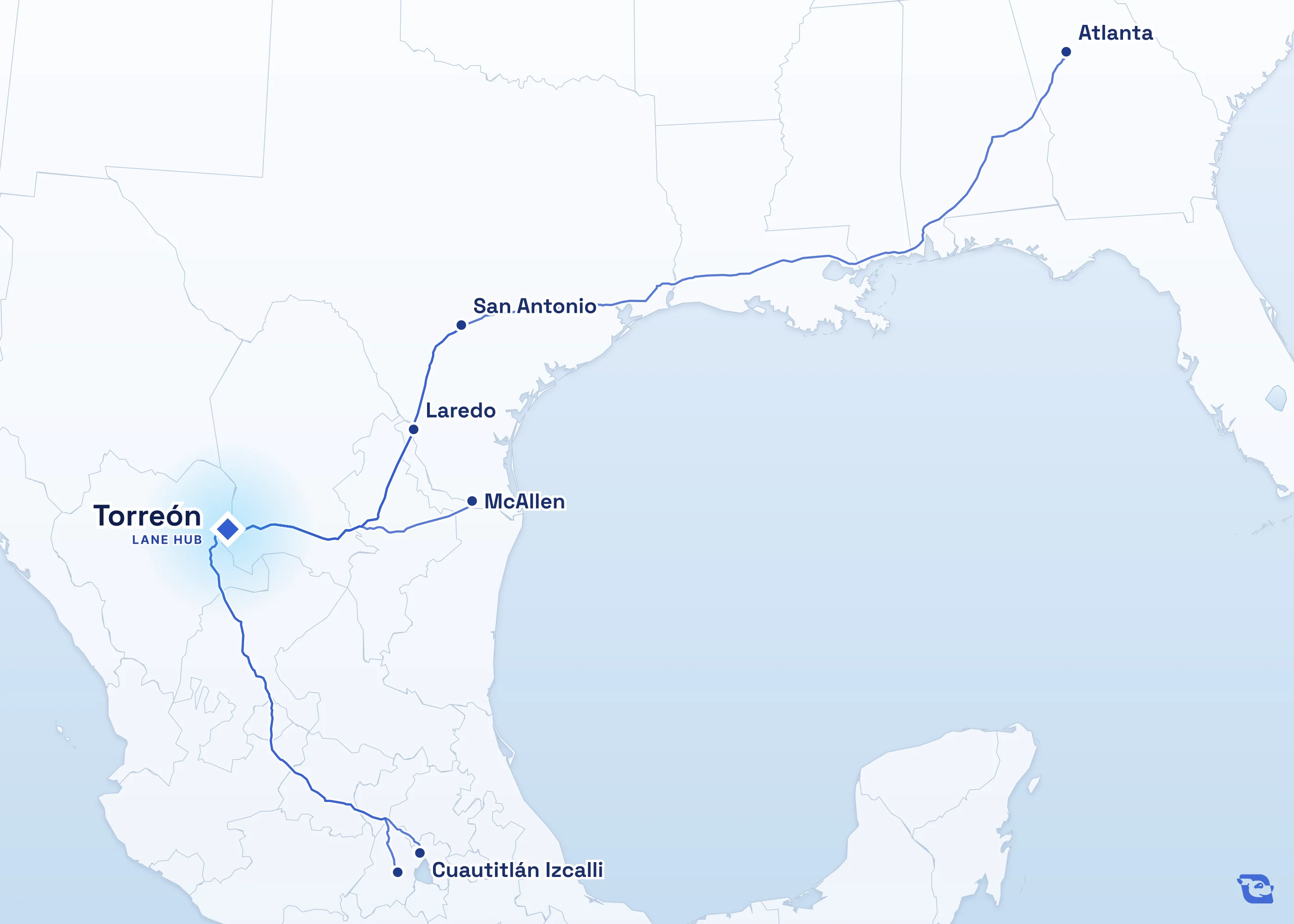
This hub has six outbound guides and no inbound guides yet. Mexico guides run Torreón to Cuautitlán Izcalli and Toluca, domestic reefer and dry van corridors into the Valley of Mexico. U.S. guides run Torreón to Laredo, McAllen, San Antonio and Atlanta, which cross at Laredo or Pharr, as each lane guide names, and continue on a carrier with U.S. authority. If you move freight into Torreón, post it on Cargado with the real origin; the Laredo and Monterrey hubs carry the nearest inbound guides. Confirm whether you need the Mexico leg, the U.S. leg or the door-to-door move before you post.
Covering Torreón freight: what a broker needs to know
The route to the border
A Torreón load for the U.S. usually runs east on Federal Highway 40 through Saltillo and Monterrey and on to a Nuevo Laredo yard, then transfers across the World Trade Bridge to a U.S. carrier; Rio Grande Valley freight can cross at Pharr instead. Post the leg you need covered, the Mexican linehaul, the U.S. leg or the door-to-door move, and check what each bid includes: the transfer, any transload, trailer use and detention.
Dairy and food need a cold chain plan
Ask whether the product is chilled, frozen or shelf-stable before selecting equipment, then state the temperature range, continuous or cycle cooling, and whether the load is palletized. Laguna summers are hot, so confirm reefer pre-cooling and fuel policy, and agree on free time at the receiver.
Mexican authority, CFDI and customs
Any leg inside Mexico needs a carrier with Mexican operating authority, and for every Mexican leg confirm who issues the CFDI, Mexico's electronic tax document, with Carta Porte details when required. Northbound, a U.S. customs broker usually files the U.S. entry at the crossing. Agree on free time, detention and storage at the border yard before dispatch.
Common questions about Torreón freight
Which border crossing does Torreón freight use?
Torreón lanes into the U.S. usually run east through Saltillo and Monterrey to cross at Laredo; freight for the Rio Grande Valley can cross at Pharr. Each cross-border lane guide names the crossing it uses. The domestic lanes to Cuautitlán Izcalli and Toluca have no crossing.
Do I need a Mexican carrier for a Torreón lane?
Yes, for any leg inside Mexico: it needs a carrier with Mexican operating authority. A lane to a U.S. city usually runs Torreón to a border yard on a Mexican carrier, then a transfer and a carrier with U.S. authority to destination. For a Canadian destination, also confirm U.S. transit paperwork, Canadian entry and each carrier's authority. State the leg you need covered when you post on Cargado.
How do I find carriers for a Torreón lane on Cargado?
Post the pickup and delivery, the date, the equipment and the leg you need covered. For a Mexico move, include the crossing and the handoff plan; for a Canada lane, the customs broker and the release arrangement. Vetted carriers that run the corridor bid, and you compare what each bid covers before you book. Where a corridor has enough bid history, Cargado Market Rates gives you a reference built from carrier bids before you quote.
What equipment runs Torreón corridors?
Reefer carries the region's dairy and food, and dry van carries auto parts, machinery and consumer goods. Post the trailer type with the weight, dimensions, loading requirements and, for refrigerated freight, the temperature range so carriers can price the load.
What freight ships out of Torreón?
Facilities within about 100 miles of Torreón mainly ship dairy products, refined metals, engines and farm equipment parts, auto parts and apparel. On the road, flatbed or open deck carries refined metals and engines and farm equipment parts; dry van carries auto parts and apparel; reefer carries dairy products.
Moving freight through this market?
Post it to 2,400+ vetted Mexico and Canada carriers, or check market rates built from real carrier bids before you quote.