
Winnipeg, MB freight lanes
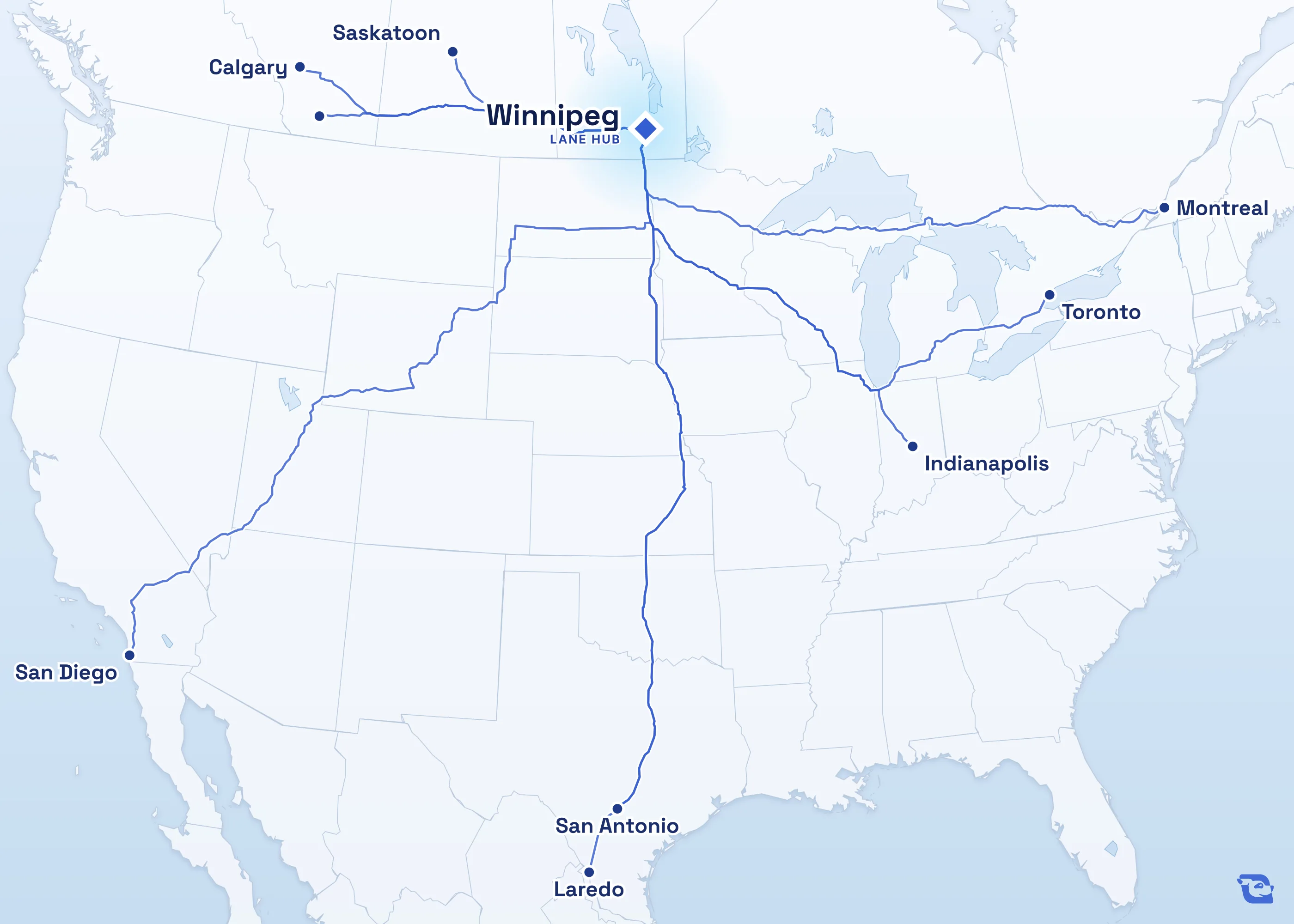
Winnipeg sits at the center of the continent, where the Trans-Canada Highway meets the north-south road network into the U.S. and CentrePort's trimodal inland port. Pick a lane in the directory to open its guide, and read how customs, carrier authority and winter work on Winnipeg freight. Cargado is a marketplace where brokers post Mexico and Canada truck freight and vetted carriers bid on it.
CentrePort Canada
4,300+
9
Dry van
Corridors into Winnipeg
Northbound from the U.S.
- Indianapolis, IN to Winnipeg
- Laredo, TX to Winnipeg
- San Antonio, TX to Winnipeg
- San Diego, CA to Winnipeg
Within Canada
What moves through the Winnipeg market
Winnipeg is Manitoba's distribution center and a bus, aerospace, agricultural equipment and food manufacturing city. CentrePort Canada, the 20,000-acre inland port on the city's northwest edge, offers direct CPKC rail access, CN and BNSF access through interswitching, and a 24-hour cargo airport that recorded more than 4,300 cargo flights in 2024 (CentrePort Canada). Southbound, expect pork and food products, agricultural equipment, buses and machinery for the Midwest and Texas; northbound, produce, consumer goods and components from the U.S. and Mexico. South of the border, I-29 connects the Manitoba highways to Fargo, Kansas City and the I-35 corridor to Laredo.
What ships from the Winnipeg area
Plants, mills, packing houses and distribution centers within about 100 miles of Winnipeg are among the area's main freight sources. The commodities below are ranked by employment in public business-establishment data, and each is tied to a named facility, cluster or growing region.
- Buses. New Flyer builds transit buses in Winnipeg.
- Farm equipment. Versatile builds tractors at its Winnipeg plant.
- Aerospace components. Boeing's Winnipeg plant makes composite parts for the 737 and 787.
- Grain. Manitoba's canola and wheat move through Winnipeg elevators and CentrePort.
On the road, driveaway and flatbed moves cover buses; flatbed or open deck carries farm equipment; dry van carries aerospace components; hopper and bulk trailers carry grain. Post the commodity, weight and trailer type with each load so carriers can price it.
The corridor groups Winnipeg anchors
Every guide on this hub is inbound so far. Canada guides run into Winnipeg from Toronto, Montreal, Calgary, Saskatoon and Lethbridge. U.S. guides run into Winnipeg from Indianapolis, San Antonio, San Diego and Laredo; a Laredo pickup may start there or continue an earlier Mexico move, so confirm the scope. If you move freight out of Winnipeg, post it on Cargado with the real destination; an inbound guide does not describe the reverse move. For each lane, confirm whether you need a domestic Canadian leg, the U.S. move or a two-border move, and who handles customs on the importing side.
Covering Winnipeg freight: what a broker needs to know
Prepare customs before dispatch
For a U.S. lane, the carrier needs an ACE eManifest southbound or an ACI eManifest northbound, filed before arrival, and the importer or its customs broker arranges release, with a PARS or PAPS reference when one is used. Provide the invoice information the importing country requires and any USMCA certification of origin needed to claim preferential treatment, and put the broker and release arrangement on the posting so the carrier can file. Missing paperwork holds the truck at the border, so agree on free time and detention up front.
Cross-border authority and cabotage
A Canadian or U.S. carrier with cross-border authority can run a lane between the two countries. Cross-border authority does not by itself allow domestic hauling in the other country, so before booking a domestic Canadian leg confirm the carrier's domestic operating authority, driver eligibility and cabotage compliance. Post the leg you need covered so the carriers authorized for it bid, and check what each bid includes: fuel, border wait, and any drop or reload at a terminal.
Plan for winter on the booked route
Winter closures and chain-up requirements on the route the carrier books can add transit days, so check conditions on that route and build a weather margin into delivery windows. For refrigerated freight, state the shipper's temperature range and operating mode on the posting, and request freeze protection only when the product requires it.
Common questions about Winnipeg freight
Do I need a Canadian carrier for a Winnipeg lane?
A lane between Canada and the U.S. can run on a Canadian or a U.S. carrier with cross-border authority, and the carrier files the ACE or ACI manifest before arrival. A lane that stays inside Canada, such as Winnipeg to another Canadian city, is domestic work: cross-border authority does not by itself allow it, so confirm the carrier's domestic operating authority, driver eligibility and cabotage compliance before booking. State the leg you need covered when you post on Cargado.
Do these guides cover freight leaving Winnipeg?
The directory currently lists inbound Winnipeg guides. For freight leaving Winnipeg, post the actual pickup, destination, equipment and date, and confirm the carrier's eligibility and any customs responsibilities for that shipment; an inbound guide does not describe the reverse move.
How do I find carriers for a Winnipeg lane on Cargado?
Post the pickup and delivery, the date, the equipment and the leg you need covered. For a U.S. lane, include the customs broker and the PARS or PAPS arrangement. Vetted carriers that run the corridor bid, and you compare what each bid covers before you book. Where a corridor has enough bid history, Cargado Market Rates gives you a reference built from carrier bids before you quote.
What equipment runs Winnipeg corridors?
Dry van leads, carrying consumer goods, packaged food and components. Reefer carries pork and produce at the shipper's specified temperature, and open deck carries agricultural and industrial equipment. Post the trailer type with the weight, dimensions and loading requirements so carriers can price the load.
What freight ships out of Winnipeg?
Facilities within about 100 miles of Winnipeg mainly ship buses, farm equipment, aerospace components and grain. On the road, driveaway and flatbed moves cover buses; flatbed or open deck carries farm equipment; dry van carries aerospace components; hopper and bulk trailers carry grain.
Moving freight through this market?
Post it to 2,400+ vetted Mexico and Canada carriers, or check market rates built from real carrier bids before you quote.