
The story
- Name the laneInside Mexico, to the border city, or deep into the U.S.
- Lane 1Book a U.S. carrier, onboard it as usual
- The handoffA Mexican partner, then a B1 driver or a transfer
- Lane 2The Mexican carrier, or its U.S. sister company
- Lane 3RFC and SCT only, paid in pesos
- Before dispatchPartner name, plates, SCAC and CAAT
What are the three types of Mexico lanes?
Mexico freight is less exotic than it looks. The lane type tells you which carrier to book, and on most of the freight you will see, you book a U.S. carrier and onboard it exactly the way you already onboard everyone else.
Cross-border door-to-door
Monterrey, NL to Chicago, IL · Louisville, KY to Tijuana, BC
See the route: B1 driver or transfer carrier
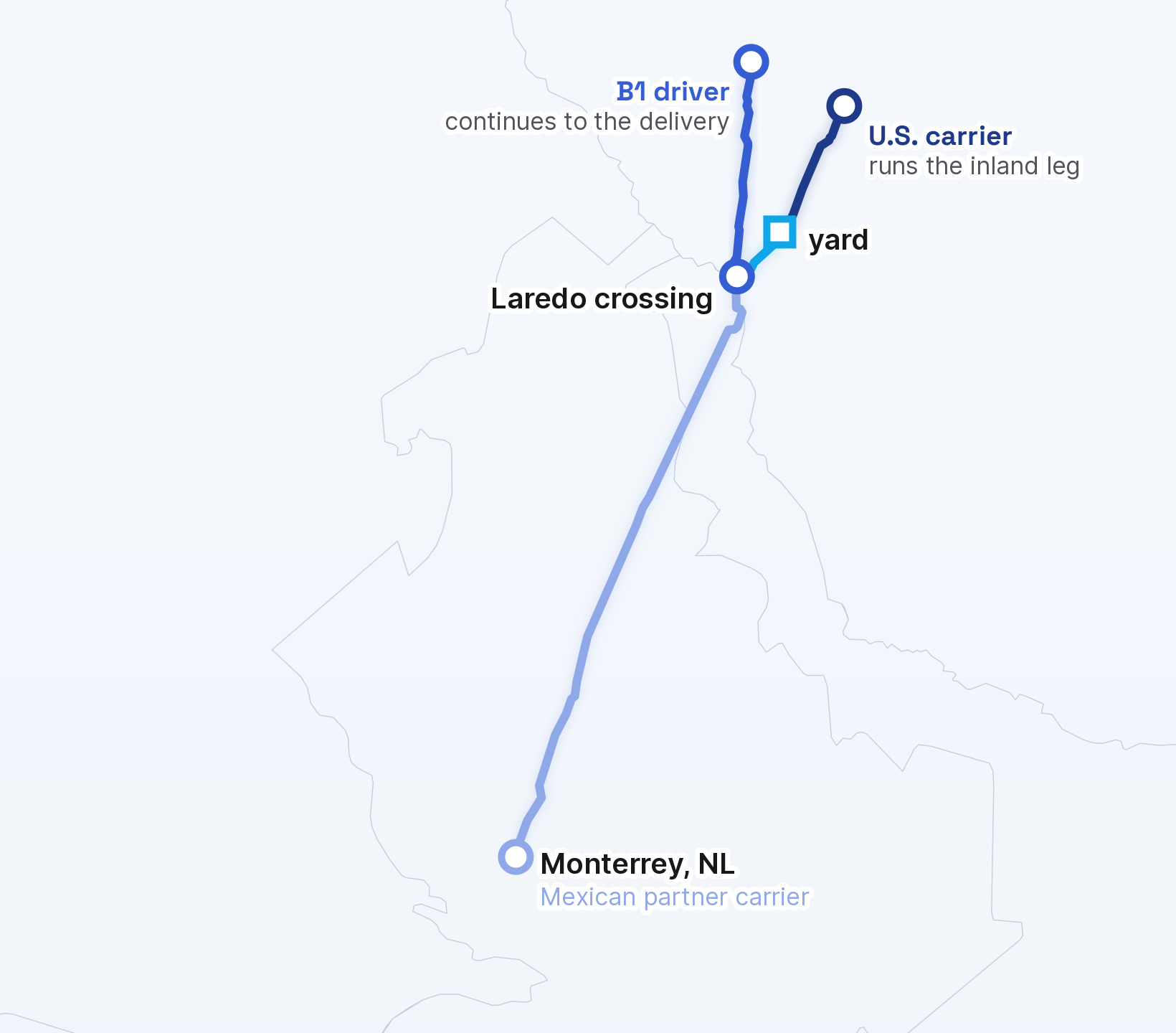

Same lane, same trailer: the difference is who is driving north of the border. B1 drivers are the bulk of cross-border capacity, so a customer who insists on a CDL driver for the U.S. leg will see fewer trucks and a higher rate. On a transfer, your customer’s customs broker needs that transfer carrier’s name, SCAC and CAAT.
To or from a border city
Monterrey, NL to Laredo, TX · El Paso, TX to Chihuahua, CHIH
See the route and the transfer carrier
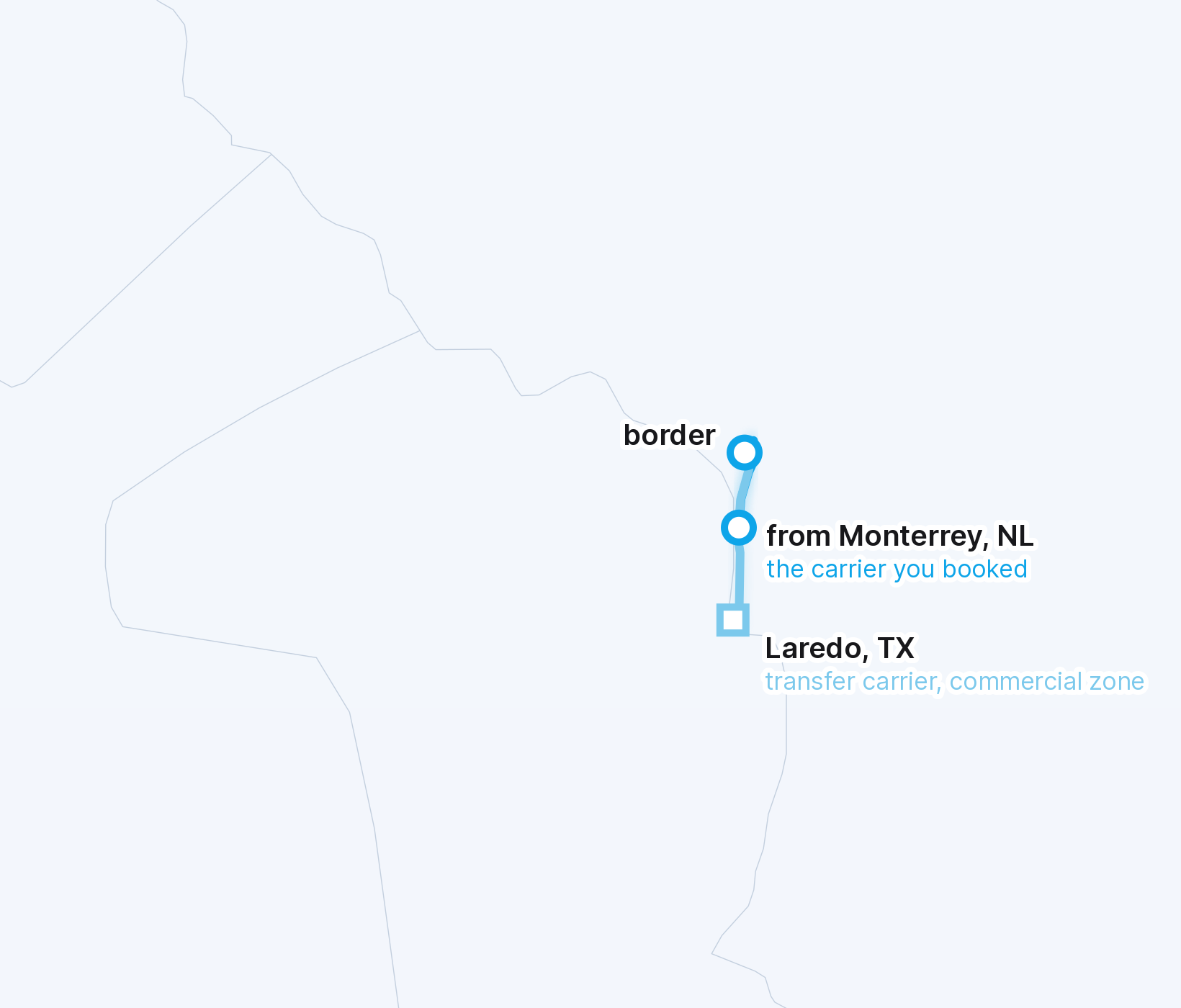
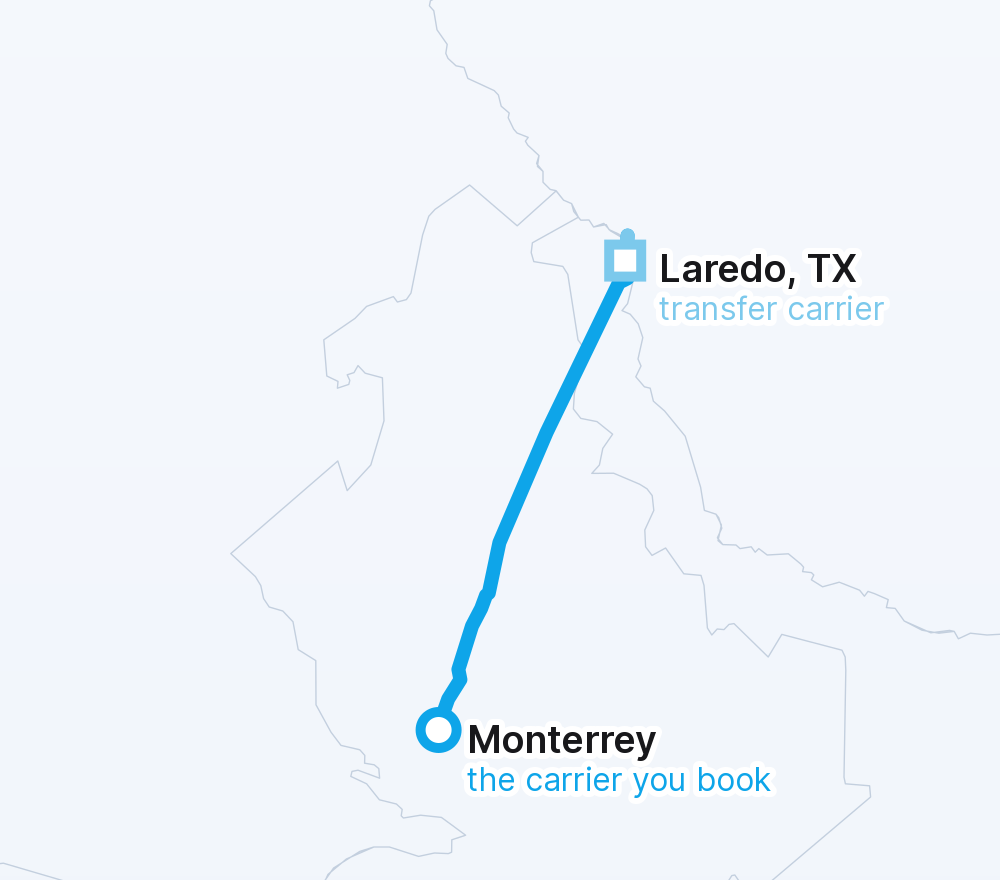
The carrier you booked runs the lane to the border. The last few miles into Laredo are handled by an authorized transfer carrier working inside that crossing’s commercial zone.
Why the delivery address decides the lane
A transfer carrier operates inside the crossing city’s commercial zone. A delivery in Laredo is that lane. A delivery a few miles past the zone is not. It needs a carrier authorized for the inland leg, which changes who you book and what it costs.
Domestic Mexico
Ramos Arizpe, COAH to Guadalajara, JAL · Lázaro Cárdenas, MICH to Mexico City, CDMX
See the route inside Mexico
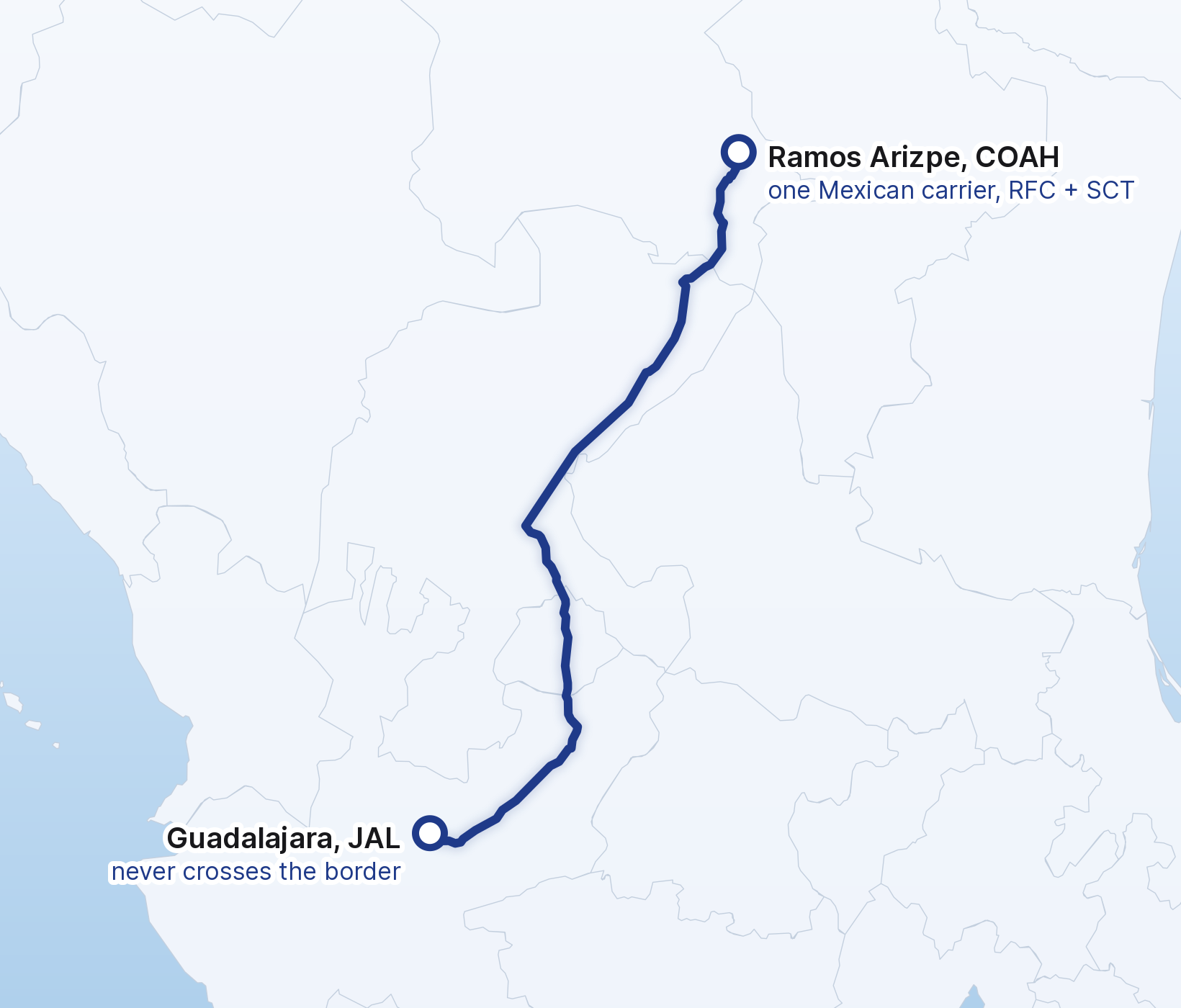

One Mexican carrier runs it end to end with its own trucks and drivers. The load never reaches the border, which is why a U.S. carrier cannot haul it.
Lane 1 is most of the Mexico freight a U.S. broker sees. Lane 2 is the one brokers most often assume is marginal, and it is the one that covers most reliably, because the carriers who run it are the ones who live at that crossing.
Lane 1: cross-border door-to-door
The load picks up in Mexico and delivers well inside the U.S., or the reverse. Monterrey to Chicago runs about 150 miles in Mexico and about 1,390 miles in the U.S. Louisville to Tijuana runs about 2,100 miles in the U.S. and about 10 in Mexico.
Who you book: a U.S.-based carrier that services Mexico. It has a USDOT and an MC number, you onboard it in the system you already use, and you pay it in U.S. dollars. Nothing about your onboarding process has to change.
Who they use: a Mexican partner carrier. That partner pulls the U.S. carrier's trailer from the pickup to the border. Mexico allows a temporarily imported trailer to be pulled by an authorized Mexican truck, as long as the import paperwork and return deadline are in order.
You do not onboard that partner. It is an extension of the carrier you booked, and the carrier you booked is responsible for it. What you do need is its name, before dispatch.
From the border, the load moves one of two ways.
- A B1 driver crosses and delivers. A properly licensed Mexican driver admitted on a B1 visa can take international freight across and continue to the delivery, under the operating carrier's authority for the whole route. B1 drivers are the bulk of cross-border capacity, so a customer who insists on a CDL driver for the U.S. leg will see far fewer trucks and a higher rate. B1 status never permits a domestic U.S. load.
- A transfer carrier crosses, and a U.S. driver delivers. An authorized transfer carrier takes the trailer across to an agreed yard, and a carrier authorized for the inland leg delivers it.
What to collect before dispatch. The facility in Mexico will ask who is coming for the load, and your customer's customs broker needs to know who physically crosses:
- The Mexican partner carrier's name
- Truck number and trailer number
- License plates
- For the transfer carrier: company name, SCAC and CAAT
On Cargado you choose between "Transfer by carrier," where the carrier arranges the crossing, and "Pre-set transfer," where your customer's customs broker arranges it. A pre-set transfer rules out most B1 options, so use it only when the customer requires it. Give the crossing one or two days in your plan, not three: three days of float is how a load sits.
Lane 2: to or from a border city
The load crosses, but the U.S. end is the border city where it crosses. Monterrey to Laredo, Laredo to Guadalajara, El Paso to Chihuahua. Almost all the mileage is in Mexico.
Who you book: the Mexican carrier, or its U.S. sister company. Many Mexican carriers run a U.S. company with its own USDOT and MC number, which you onboard like any U.S. carrier and pay in U.S. dollars. Your network is considerably larger if you can also work with carriers that hold only Mexican registration, an RFC and an SCT permit, because most Mexican carriers have no U.S. federal registration at all.
Who they use: an authorized transfer carrier, usually subcontracted, for the pickup or delivery on the U.S. side. That is normal and it is fine.
- You do not onboard the transfer carrier.
- You do not pay it. The carrier you booked pays it.
- You do need to know who it is, because the customs broker needs the name, SCAC and CAAT to prepare the paperwork.
- Sometimes the carrier you booked owns that transfer company outright.
What to check: the delivery address. A transfer carrier operates inside that crossing city's commercial zone, so an address a few miles outside it is a different lane with a different carrier.
Lane 3: domestic Mexico
Both ends are inside Mexico. Ramos Arizpe to Guadalajara, Zacatecas to Chihuahua, Lázaro Cárdenas to Mexico City.
Who you book: a Mexican carrier registered with an RFC and an SCT permit. The RFC is the federal taxpayer ID issued by SAT. The SCT permit is the federal permit to haul on Mexico's federal highways: the agency is SICT now, though nearly everyone still says SCT. A U.S. carrier cannot haul this freight. A Mexican international permit does not cover domestic service.
You pay in pesos. On Cargado, selecting a Mexican origin and a Mexican destination prices the load in pesos automatically. If your company can only pay in dollars through a third party, that friction shows up as margin, so it is worth solving before you quote domestic lanes.
What you vet. A Mexico-only carrier may have no U.S. federal registration to check, so plan for a manual review of Mexican credentials: the constancia de situación fiscal showing the RFC, the acta constitutiva, the SCT permit, a comprobante de domicilio, and the legal representative's ID. Check liability and cargo coverage separately, and agree payment currency and terms before booking. For a standard paid transport service, confirm the carrier issues its CFDI with the Carta Porte supplement before the truck moves.
Brokers turn this freight away more often than they realize, usually because they assume they have no way to quote it.
What should you check before you book any Mexico lane?
Before you book, confirm every operating carrier, its authority and insurance, each handoff, and who is responsible for the transport and customs documents.
- Name the lane first. Does it stay inside Mexico, end at the border city, or run deep into the U.S.? That answers who you book.
- Match the authority to the leg. A border-zone carrier stays inside the U.S. commercial zone. Freight inside Mexico needs a Mexican federal cargo permit. A U.S. carrier operating inside Mexico needs a Mexican international permit.
- Name the operating partners. Get the Mexican partner's name and any transfer carrier's name, document how their authority and insurance were checked, and send the pickup details to the facility.
- Check cargo coverage for every leg, including in Mexico, at the crossing, and in any yard. Mexican carriers often carry modest cargo limits, and many shippers insure the freight themselves.
- Confirm the crossing plan: B1 driver or transfer carrier, and where the trailer changes hands.
- Get introduced to the customs broker early. In cross-border freight that is the most valuable relationship you have when something goes wrong, and they will ask for the same carrier details on every load.
- Assign the crossing paperwork. Know who issues each Mexican transport document, including any CFDI with Carta Porte. Northbound, the carrier that physically crosses, or its filer, submits the U.S. truck manifest, and the customs broker confirms the entry or in-bond filing matches it.
Cargado is the modern marketplace for Mexico and Canada freight, and it is the only place you can source carriers for all three of these lane types. Every carrier is vetted before it can bid. Tell us about your Mexico lanes.