
El Paso, TX freight lanes
El Paso and Ciudad Juárez form the second-largest truck gateway on the U.S.-Mexico border, and the Ysleta port of entry carried 17.5 percent of U.S.-Mexico truck trade by value in 2025 (BTS). Pick a lane in the directory to open its guide, or read below how the crossing, the transfer and customs work here. Cargado is a marketplace where brokers post Mexico and Canada truck freight and vetted carriers bid on it.
Ysleta-Zaragoza
17.5%
12
Dry van
Corridors out of El Paso
Southbound into Mexico
Across the U.S.
To Canada
Corridors into El Paso
From the U.S.
- Allentown, PA to El Paso
- Charlotte, NC to El Paso
- Cotulla, TX to El Paso
- Green Bay, WI to El Paso
- Ontario, CA to El Paso
- Phoenix, AZ to El Paso
From Canada
What moves through the El Paso market
El Paso is the U.S. side of one of the border's largest manufacturing clusters, the Ciudad Juárez maquiladoras, the export assembly plants that build for the U.S. market. In 2025, $112.4 billion of truck freight crossed at the Ysleta port of entry, 17.5 percent of U.S.-Mexico truck trade by value and up 34.8 percent on the year; a further $33.0 billion crossed at Santa Teresa, New Mexico, and $12.1 billion at the El Paso port of entry itself (BTS Transborder Freight Data Annual Report: 2025). Most of it is manufacturing freight tied to Ciudad Juárez plants: wire harnesses, electronics and automotive components northbound; components, plastics and packaging southbound. El Paso also stages freight for Chihuahua city and, by I-10, connects Texas with Phoenix and Southern California.
What ships from the El Paso area
Much of the outbound freight in the El Paso area is made across the river in Ciudad Juárez and crosses northbound. The ranking comes from employment in public establishment data on both sides of the border, and each commodity is tied to a named plant.
- Electronics. Foxconn assembles electronics in Ciudad Juárez, across the river from El Paso.
- Auto parts. Aptiv runs several manufacturing plants and its Mexico Technical Center in Juárez.
- Medical devices. Johnson & Johnson MedTech manufactures medical devices in Ciudad Juárez.
- Electrical equipment. Siemens builds energy measurement and distribution products in Juárez.
On the road, dry van carries electronics, auto parts, medical devices and electrical equipment. Post the commodity, weight and trailer type with each load so carriers can price it.
The corridor groups El Paso anchors
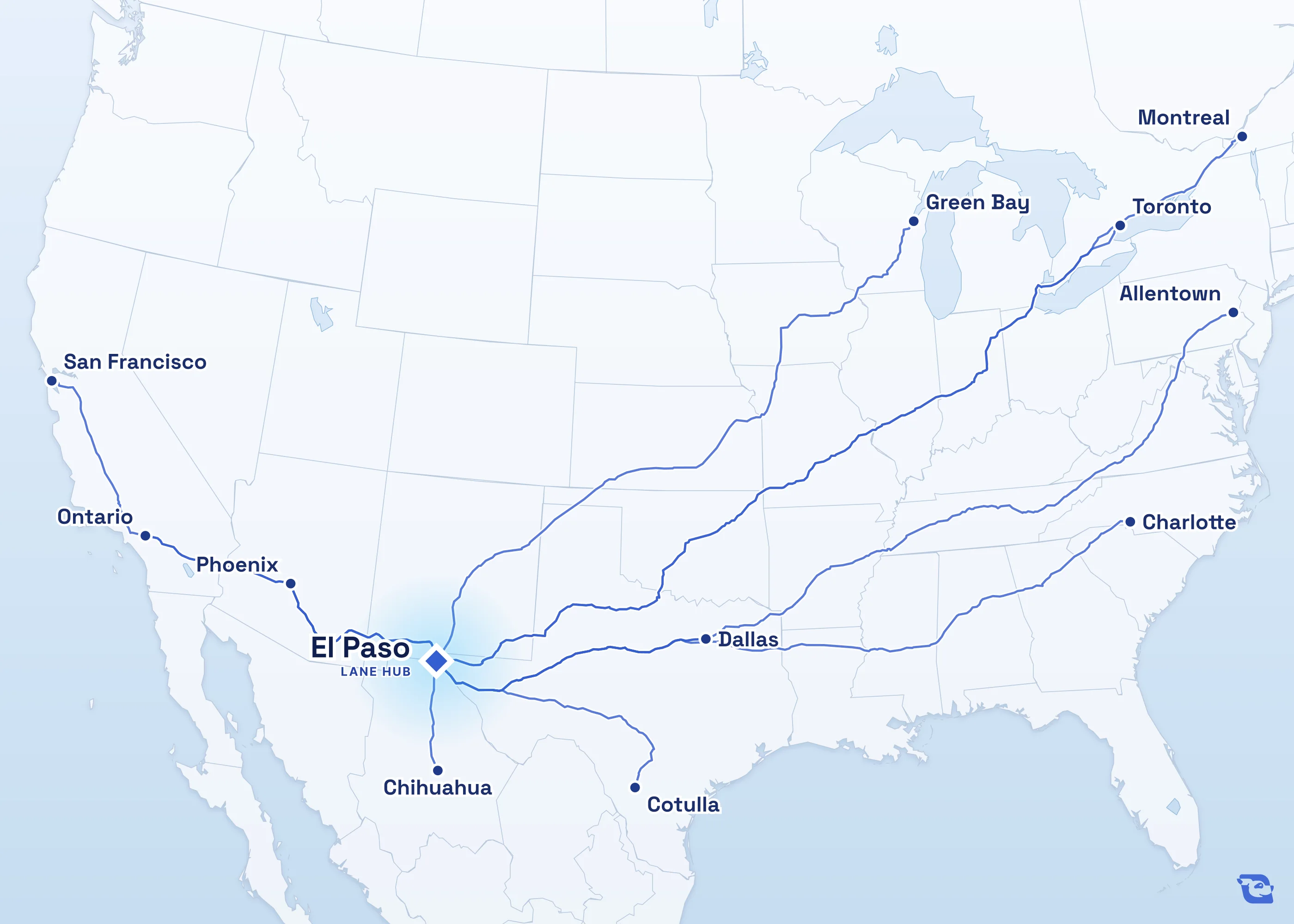
The Mexico guide on this hub runs El Paso to Chihuahua, the state capital about four hours south on Mexico Federal Highway 45; Ciudad Juárez freight has its own hub. U.S. guides connect El Paso with Dallas, Phoenix and San Francisco outbound, and with Allentown, Charlotte, Cotulla, Green Bay, Ontario, California, and Phoenix inbound. Canada guides run to Toronto and from Montreal; for those, confirm the customs broker, the ACE or ACI filing and the carrier's cross-border authority. For each lane, confirm whether you are covering a domestic U.S. leg or a move that continues into Mexico, because that decides which carriers can bid and what the border handoff costs.
Covering El Paso freight: what a broker needs to know
Choose between three crossings
Ysleta-Zaragoza is the default commercial bridge into Ciudad Juárez and carries most of the value. Santa Teresa, New Mexico, west of the city, serves plants on the west side of Juárez and avoids city traffic; the Bridge of the Americas is closer to downtown, but GSA plans to end commercial processing there during its modernization, so confirm availability for the shipment date. The right choice depends on where the Juárez plant or yard sits and which crossing your Mexican carrier and customs broker are set up at. Name the crossing on the posting so bids match it.
Transload or through-trailer
Juárez plants commonly run on transfer carriers: a U.S. carrier drops the trailer at an El Paso yard, a transfer tractor shuttles it across, and a Mexican carrier delivers. A transload moves the cargo to another trailer at a dock on either side instead. Post the leg you need covered, the El Paso to plant shuttle, the U.S. linehaul or the door-to-door move, and check what each bid includes: the transfer, any transload, trailer use and detention.
Customs on both sides
Southbound, the importer's licensed Mexican customs broker, or an authorized representative, files the Mexican entry; northbound, a U.S. customs broker usually files the U.S. entry. Confirm the commercial invoice, packing list and, for the Mexico leg, who issues the CFDI with Carta Porte details when required. Agree on free time and detention before dispatch, because a missing document parks the truck at the bridge.
Common questions about El Paso freight
Which crossing does El Paso freight use?
Most commercial freight crosses at the Ysleta-Zaragoza bridge into Ciudad Juárez. Santa Teresa, New Mexico, serves the west side of Juárez, and the Bridge of the Americas sits closer to downtown, though GSA plans to end commercial processing there during its modernization. Confirm which crossing the Mexican carrier and customs broker are set up at before you post, and state it on the posting.
Is El Paso a border move or a domestic move?
Both. Guides on this hub include domestic U.S. lanes such as El Paso to Dallas or Phoenix, where a U.S. carrier with the right authority can bid, and Mexico lanes such as El Paso to Chihuahua, where the Mexico leg needs a carrier with Mexican operating authority. Post the leg you need covered so the right carriers bid.
How do I find carriers for an El Paso lane on Cargado?
Post the pickup and delivery, the date, the equipment and the leg you need covered. For a Mexico move, include the crossing and the handoff plan; for a Canada lane, the customs broker and the release arrangement. Vetted carriers that run the corridor bid, and you compare what each bid covers before you book. Where a corridor has enough bid history, Cargado Market Rates gives you a reference built from carrier bids before you quote.
What equipment runs El Paso corridors?
Dry van leads, carrying Juárez manufacturing freight in both directions. Reefer demand comes from produce and food, and open deck from machinery and metals. Post the trailer type with the weight, dimensions and loading requirements so carriers can price the load.
What freight ships out of El Paso?
Facilities within about 100 miles of El Paso mainly ship electronics, auto parts, medical devices and electrical equipment. On the road, dry van carries electronics, auto parts, medical devices and electrical equipment.
Moving freight through this market?
Post it to 2,400+ vetted Mexico and Canada carriers, or check market rates built from real carrier bids before you quote.