
General freight
FAK, carga general, and palletized dry goods make up the marketplace's flexible everyday volume: mixed freight moving in dry vans across every major corridor.
General freight is the archetypal dry van load: palletized, non-hazardous mixed goods within legal dimensions and weight.
FAK and general-cargo postings concentrate in the highest-volume markets: Monterrey, Guadalajara, Laredo, and Houston, with the same palletized dry goods profile in Toronto.

Not every load has a neat commodity name. A large share of the freight posted on the Cargado marketplace is general cargo: postings labeled FAK, general cargo and legal dims, carga general, general merchandise, or dry goods palletized. It is the everyday circulatory volume of cross-border trade (mixed pallets, consolidated products, distribution freight) and it moves on every major corridor in the network.
What FAK actually means
FAK (freight all kinds) signals that a load is mixed or unspecified general merchandise rather than a single named commodity, priced as ordinary dry freight rather than by its specific contents. Its Spanish-language cousin carga general does the same work, and the recurring phrase legal dims in the data refers to the shipment's dimensions; weight and hazard status still have to be confirmed separately. What FAK is not: a license to hide what is on the trailer. Carriers still need to know the freight is non-hazardous, how it is packaged, and what it weighs.

Where general freight concentrates
General cargo is everywhere, but it clusters in the biggest markets: Monterrey and Guadalajara lead FAK and general-cargo postings in Mexico, with Laredo and Houston carrying the pattern on the U.S. side and Toronto showing the same palletized dry goods profile in Canada. That distribution tracks the category's nature: wherever total volume is high, general freight is high.
Posting general freight well
- Dry van, palletized. General freight is the archetypal dry van load: palletized, non-hazardous, within legal dimensions.
- Disclose what you can. A blank or vague commodity field measurably suppresses bids. Even general merchandise, palletized, non-haz, 40,000 lbs beats an empty field.
- Post the true origin. General freight posted from a border stop instead of the real Mexican origin confuses carriers about the actual work involved.
- Price to the band. Because general freight is the most liquid category, market-rate visibility is strongest here: postings inside the band get covered fastest.
General freight is also the easiest place to start on the marketplace: the capacity pool is deepest and the requirements are simplest. See the Mexico 101 guides for crossing basics, and the lanes pages to find carrier depth on your corridors.
On the Cargado network
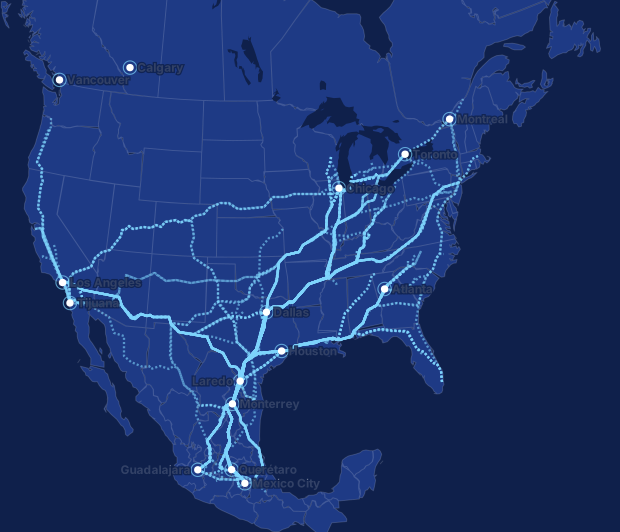
How general freight moves on the network
Two groups sit on this page: general freight with no special handling, and consumer goods and retail. Each is posted in all seven directions: Mexico to the U.S., the U.S. to Mexico, Canada to the U.S., the U.S. to Canada, and within Mexico, within Canada and within the U.S. In each direction most loads are posted for dry van. This is the plainest freight on the network.
With no special handling, the choices that matter sit on the load rather than the product. Is it a full truckload or a partial? Postings in these same directions ask for partial loads in every one, and for power-only capacity in four: Mexico to the U.S., the U.S. to Mexico, within Mexico and within the U.S. Some also ask for a C-TPAT carrier or round-the-clock carrier support. Those are direction-level requests, not specific to general freight.
Carriers do not declare a product, so no list of general freight carriers exists. The two sets are our own grouping of the descriptions brokers write on postings.
General freight by group
- General freight with no special handling: posted in seven directions, mostly for dry van.
- Consumer goods and retail: posted in seven directions, mostly for dry van.
- Partial loads: requested in all seven directions.
- Power only: requested in four, Mexico to the U.S., the U.S. to Mexico, within Mexico and within the U.S.
- Domestic loads: they stay with carriers based in the same country.
How to reach general freight capacity on Cargado
Post the load with a plain description, the weight or pallet count, the trailer and the true origin and destination. Mark it as a partial or power only when it is one, and give the pickup and delivery dates, since carriers bid against them. Each suggested carrier shows why it was picked: an available truck, a preferred lane or its service areas. Ask bidders about partials or power only directly.
At a glance
Freight posted on Cargado
- General freight is posted in seven directions, and most loads are posted for dry van.
- Consumer goods and retail freight is posted in seven directions, and most loads are posted for dry van.
- Shippers post partial-load requests in every one of the seven directions.
- Shippers post power-only requests from Mexico to the U.S., from the U.S. to Mexico, and within Mexico and the U.S.
- Shippers post loads that ask for a C-TPAT carrier in six of the seven directions.
How the marketplace works
- The commodity grouping is Cargado's own classification of unstructured commodity descriptions, not a platform field.
- Carriers do not declare a product; the general freight and consumer goods sets are derived from posting descriptions.
- Freight within a country goes only to carriers based in that country.
More questions
Does general freight move within Canada on Cargado?
Yes, in both groups, mostly for dry van, alongside the cross-border directions. A load that starts and ends in Canada is shown only to Canadian carriers.
What equipment is used for consumer goods and retail freight?
Dry van, in every direction. Add the spec you need to the posting, such as e-tracks, logistics posts or air ride, and the pickup and delivery dates, so carriers bid against your dates.
Common questions
What carriers move general freight between Mexico and the U.S.?
Any vetted carrier whose trailer, authority and drivers fit the lane. General freight posts both ways between Mexico and the U.S., mostly for dry van, so the trailer on your posting decides who bids. Carriers are not sorted by product.
Can I post a partial load on Cargado?
Yes. Postings in the same directions ask for partial loads, for general freight and consumer goods alike. Say on the posting that the load is a partial, with the pallet count or weight, so carriers that take partials bid.
Moving this kind of freight?
Cargado connects hundreds of brokers with 2,400+ vetted carriers moving Mexico and Canada freight every day.