
Nuevo Laredo, Tamaulipas freight lanes
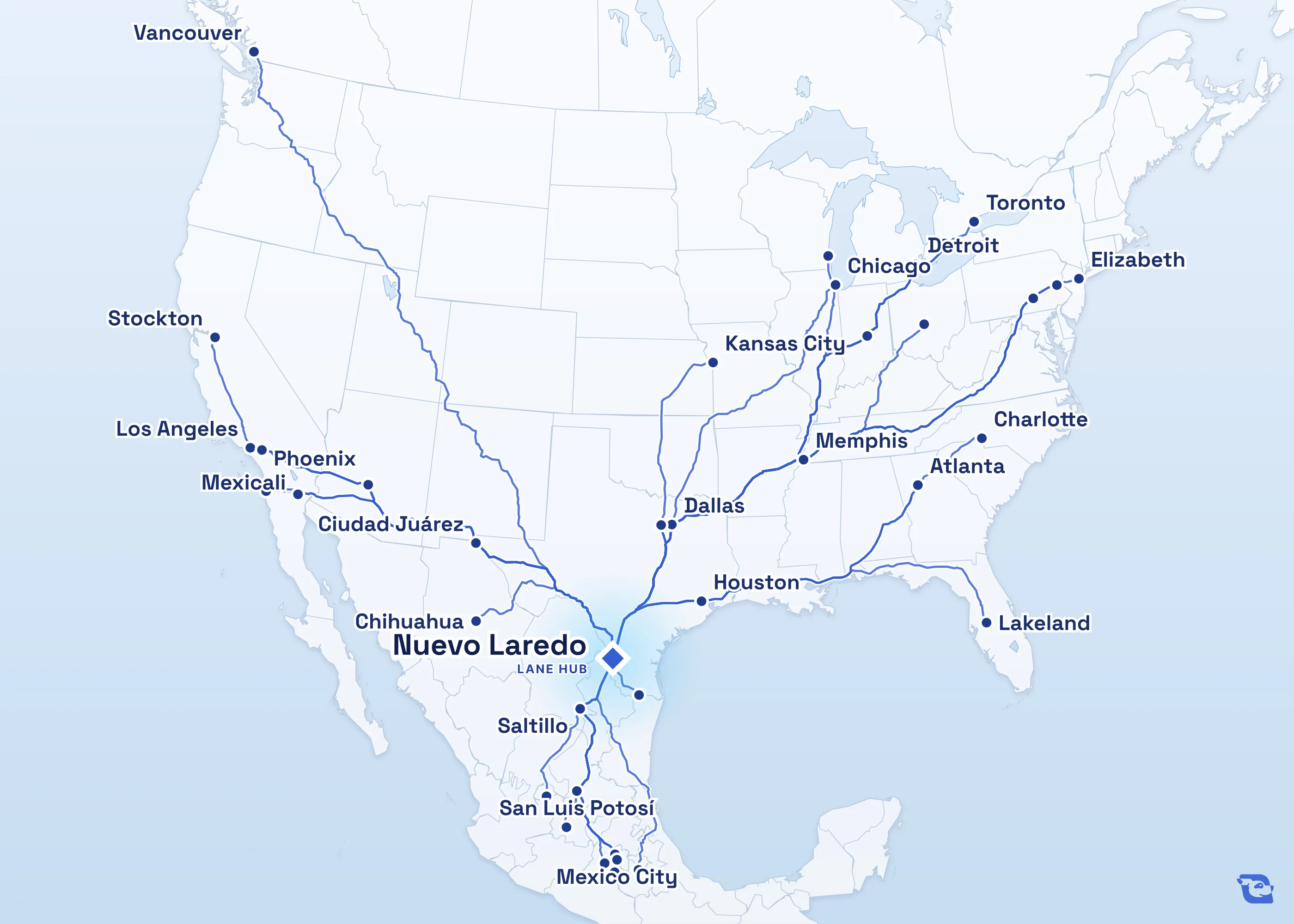
Nuevo Laredo is the Mexican side of the Laredo gateway, where 46.1 percent of U.S.-Mexico truck trade by value crossed in 2025 (BTS). Pick a lane in the directory to open its guide, northbound or southbound, and read how the transfer yards, customs brokers and CFDI work on this side of the river. Cargado is a marketplace where brokers post Mexico and Canada truck freight and vetted carriers bid on it.
World Trade Bridge
46.1%
56
Dry van
Corridors out of Nuevo Laredo
Northbound into the U.S.
- Nuevo Laredo to Allentown, PA
- Nuevo Laredo to Atlanta, GA
- Nuevo Laredo to Charlotte, NC
- Nuevo Laredo to Chicago, IL
- Nuevo Laredo to Dallas, TX
- Nuevo Laredo to Detroit, MI
- Nuevo Laredo to Elizabeth, NJ
- Nuevo Laredo to Fort Worth, TX
- Nuevo Laredo to Houston, TX
- Nuevo Laredo to Kansas City, MO
- Nuevo Laredo to Lakeland, FL
- Nuevo Laredo to Laredo, TX
- Nuevo Laredo to Los Angeles, CA
- Nuevo Laredo to Memphis, TN
- Nuevo Laredo to Milwaukee, WI
- Nuevo Laredo to Ontario, CA
Within Mexico
- Nuevo Laredo to Aguascalientes
- Nuevo Laredo to Chihuahua
- Nuevo Laredo to Ciudad Juárez, Chihuahua
- Nuevo Laredo to Cuautitlán Izcalli, Estado de México
- Nuevo Laredo to Irapuato, Guanajuato
- Nuevo Laredo to Puebla
- Nuevo Laredo to Saltillo, Coahuila
- Nuevo Laredo to Tijuana, Baja California
- Nuevo Laredo to Toluca, Estado de México
To Canada
Corridors into Nuevo Laredo
Southbound from the U.S.
- Atlanta, GA to Nuevo Laredo
- Chicago, IL to Nuevo Laredo
- Columbus, OH to Nuevo Laredo
- Dallas, TX to Nuevo Laredo
- Detroit, MI to Nuevo Laredo
- Elizabeth, NJ to Nuevo Laredo
- Fort Worth, TX to Nuevo Laredo
- Harrisburg, PA to Nuevo Laredo
- Houston, TX to Nuevo Laredo
- Indianapolis, IN to Nuevo Laredo
- Kansas City, MO to Nuevo Laredo
- Laredo, TX to Nuevo Laredo
- Memphis, TN to Nuevo Laredo
- Milwaukee, WI to Nuevo Laredo
- Ontario, CA to Nuevo Laredo
- Phoenix, AZ to Nuevo Laredo
- Stockton, CA to Nuevo Laredo
Within Mexico
- Aguascalientes to Nuevo Laredo
- Cuautitlán Izcalli, Estado de México to Nuevo Laredo
- Cuernavaca, Morelos to Nuevo Laredo
- Mexicali, Baja California to Nuevo Laredo
- Mexico City to Nuevo Laredo
- Puebla to Nuevo Laredo
- Reynosa, Tamaulipas to Nuevo Laredo
- Saltillo, Coahuila to Nuevo Laredo
- San Luis Potosí to Nuevo Laredo
From Canada
What moves through the Nuevo Laredo market
Nuevo Laredo is the logistics center on the Mexican side of the Laredo gateway, where $296.2 billion of truck freight crossed in 2025, 46.1 percent of U.S.-Mexico truck trade by value (BTS Transborder Freight Data Annual Report: 2025). The city itself is more logistics than manufacturing: transfer carriers, customs brokerages, bonded warehouses and cross-docks that receive trailers from Monterrey, Saltillo, the Bajío and central Mexico and move them across the World Trade Bridge. Automotive parts, metals, appliances and machinery lead northbound; components, raw materials and consumer goods lead southbound.
What ships from the Nuevo Laredo area
Much of the freight that moves through Nuevo Laredo is made elsewhere in Mexico and crosses here. The factories in the city itself ship the commodities below, each tied to a named plant.
- Auto parts. TS Tri-Con makes automotive trim covers at its Nuevo Laredo plant.
- Medical devices. Medline makes respiratory products in Nuevo Laredo.
- Remanufactured engine parts. Caterpillar remanufactures injectors and turbochargers in Nuevo Laredo.
- Appliance components. Robertshaw, a maker of valves, thermostats and controls for appliance makers, has a plant in the city.
On the road, dry van carries auto parts, medical devices, remanufactured engine parts and appliance components. Post the commodity, weight and trailer type with each load so carriers can price it.
The corridor groups Nuevo Laredo anchors
Mexico guides connect Nuevo Laredo with Saltillo, Aguascalientes, the Bajío, Puebla, Toluca, Cuautitlán Izcalli and, inbound, Mexico City, Cuernavaca, San Luis Potosí and Reynosa; Tijuana appears outbound and Mexicali inbound. U.S. guides connect Nuevo Laredo with Laredo, Texas markets and the Midwest, Southeast, Northeast and West Coast. Canada guides run each way with Toronto and London, Ontario, and to Vancouver. A U.S. or Canada lane from Nuevo Laredo is usually the border-to-destination leg of a longer Mexican move, so confirm whether you need that leg or the door-to-door move, and who covers the crossing.
Covering Nuevo Laredo freight: what a broker needs to know
Which bridge, and which yard
World Trade Bridge is the commercial default. Colombia-Solidarity, west of the city in Nuevo León, takes oversize or overweight freight after you confirm the permits, and overflow when queues build, provided your carrier and customs broker confirm hours, customs arrangements and a receiving yard at Colombia. Name the bridge and the Nuevo Laredo yard on the posting.
Transfer carriers and transloads
Much freight moves through-trailer: a Mexican linehaul carrier drops at a Nuevo Laredo yard, a transfer carrier crosses the trailer, and a U.S. carrier picks up in Laredo. A transload moves the cargo to another trailer at a dock on either side. Post the leg you need covered, and before comparing bids check what each covers: the transfer, any transload, trailer use and detention.
The Mexican customs broker and the CFDI
Southbound, the importer's licensed Mexican customs broker, or an authorized representative, files the Mexican entry. Northbound, the Mexican export side is handled here and a U.S. customs broker usually files the U.S. entry. Confirm who issues the CFDI, Mexico's electronic tax document, with its Carta Porte transport details when required, and agree on free time, detention and storage before dispatch.
Common questions about Nuevo Laredo freight
Which bridge does Nuevo Laredo freight use?
Most commercial freight crosses the World Trade Bridge into Laredo. The Colombia-Solidarity Bridge, west of the city in Nuevo León, is the alternate for oversize or overweight loads and for days when World Trade Bridge queues build, once your carrier and customs broker confirm hours and a receiving yard at Colombia. Each cross-border lane guide on this hub names the crossing it uses; domestic Mexico lanes have no crossing.
Do I need a Mexican carrier for a Nuevo Laredo lane?
For the Mexico leg, yes: it needs a carrier with Mexican operating authority. A lane from Nuevo Laredo to a U.S. city usually starts with the transfer across the bridge and continues on a U.S. carrier. State the leg you need covered when you post on Cargado so the carriers authorized for it can bid.
How do I find carriers for a Nuevo Laredo lane on Cargado?
Post the pickup and delivery, the date, the equipment and the leg you need covered. For a border move, include the bridge and the handoff plan. Vetted carriers that run the corridor bid, and you compare what each bid covers before you book. Where a corridor has enough bid history, Cargado Market Rates gives you a reference built from carrier bids before you quote.
What equipment runs Nuevo Laredo corridors?
Dry van leads, with reefer demand for produce, food and beverage and open deck demand for steel, coils and machinery. Post the trailer type with the weight, dimensions and loading requirements, and the temperature range for refrigerated freight, so carriers can price the load.
What freight ships out of Nuevo Laredo?
Facilities within about 100 miles of Nuevo Laredo mainly ship auto parts, medical devices, remanufactured engine parts and appliance components. On the road, dry van carries auto parts, medical devices, remanufactured engine parts and appliance components.
Moving freight through this market?
Post it to 2,400+ vetted Mexico and Canada carriers, or check market rates built from real carrier bids before you quote.