
Cargado vs DAT for Mexico and Canada freight
DAT offers a load board. Cargado is a marketplace for Mexico and Canada freight, and the reason to run it alongside DAT is the quote: rate benchmarks built from carrier bids on Mexico and Canada lanes, then vetted carriers to cover the lane you priced. (Source: DAT's load board page, dat.com/load-boards, verified September 2026.)
- DAT offers a load board. (Source: DAT's load board page, dat.com/load-boards, verified September 2026.) Cargado is a marketplace for Mexico and Canada freight, including the U.S. legs that feed it.
- DAT publishes separate carrier and broker plans on its own pricing page. (Source: DAT's pricing page, dat.com/pricing, verified September 2026.) Cargado sells one broker subscription with unlimited users, and carriers join at no cost.
- Quote Mexico and Canada lanes from benchmarks built from carrier bids, each with a confidence score that shows how much bid data sits behind the number.
- Use Cargado alongside DAT. Evaluate it against the Mexico and Canada lanes your customers need quoted and covered.
Different tools for different freight
| DAT | Cargado | |
|---|---|---|
| Built for | Load board | Marketplace for Mexico and Canada freight, with rate benchmarks from carrier bids |
| Plans | Separate carrier and broker plans, plus combined plans, on its own pricing page | One value-based broker subscription, unlimited users |
| Carrier cost | Paid carrier plans | No cost to join and bid |
What carriers and brokers have done on Cargado
Two published customer stories, in their own numbers.
This broker grew Mexico revenue 1,400% in just 4 months.
This carrier grew from 1 to 6 trucks and 50 customers using only Cargado.
Exactly when Cargado fits
Keep DAT for the freight you already quote and cover well. Add Cargado when a Mexico or Canada quote is the problem, for example in one of these cases:
- A shipper asks for a Laredo to Monterrey rate and the team has no bid data to anchor the number.
- A Toronto to Chicago quote goes out on a domestic benchmark and comes back wrong once currency, customs brokerage and the crossing wait are in it.
- An RFP lands with forty Mexico and Canada lanes and a two-day deadline.
- Mexico volume from an existing customer goes to a second broker because nobody on the team can price it with confidence.
- A customer needs Dallas to Laredo capacity priced and coordinated with the next leg of a Mexico shipment, and the team quotes it like any other domestic load.
If none of that sounds like your team, DAT alone may be enough. If it does, Cargado adds rate context and vetted carriers for those lanes.
Mexico
Quoting a Laredo to Monterrey move means pricing more than a linehaul. The shipment may run through-trailer or transload at the border, it needs a customs broker, and the shipper's security requirements change by corridor. Check the rate data available for the specific lane you are quoting before you commit a number.
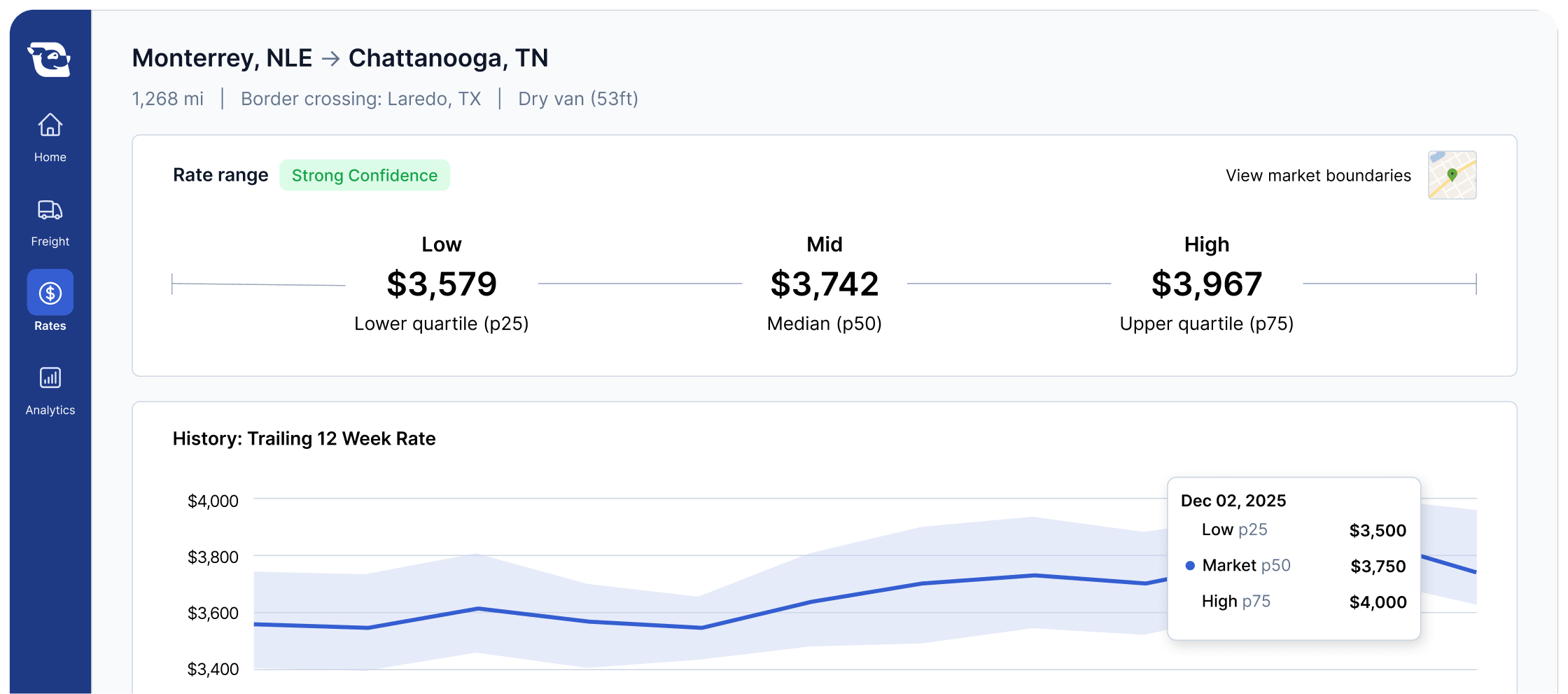
Cargado's Mexico benchmarks are built from bids vetted carriers placed on real freight, published by corridor as low, mid and high bands over a trailing 12-week window. Each benchmark carries a confidence score showing the strength of the underlying bid data, so a thin lane is visible before you quote it.
The carriers behind those bids are on the same marketplace. Carrier profiles show equipment and service details, and for Mexico freight that includes the crossings a carrier runs and whether it moves door-to-door or through a transload partner, so the lane you quoted can be posted to carriers that fit it.
Canada
Canada quotes carry their own inputs: the currency the carrier quotes in, fuel by the liter on the Canadian portion, customs brokerage, and a Quebec receiver who dispatches in French. Check how any benchmark you use handles those inputs on your lanes.
Cargado's U.S. to Canada and domestic Canada benchmarks are newer than the Mexico corridors and expanding. Each available lane shows its confidence score, so you can see where the bid data is deep and where it is still thin. Canadian carriers pass the same verification as the rest of the network, and chat translates between English, French and Spanish.
How Cargado is built
How the plans are built. DAT publishes separate carrier and broker plans on its own pricing page, with combined plans alongside them. Cargado has one model: brokers, 3PLs and forwarders pay a value-based subscription, every plan includes unlimited users, and carriers join and bid at no cost. (Source: DAT's pricing page, dat.com/pricing, verified September 2026.)
Who gets in. Every company passes a quality and compliance check. We vet every carrier before it can bid and meet with every broker before onboarding. A broker's workspace is private: postings reach matched vetted carriers and never another broker.
What the rates are made of. Cargado's benchmarks are built from bids vetted carriers placed on real Mexico and Canada freight. They are available in the platform, in an Excel add-in for RFPs, and over the API into a TMS.
Run both
You can use Cargado alongside DAT. Keep DAT for the freight it already covers for you, and quote and cover Mexico and Canada freight, plus the U.S. legs feeding it, on Cargado. Cargado connects to your TMS over API, does not broker freight, does not own trucks and does not take a cut of a load.
Price three Mexico or Canada lanes against carrier bids
Bring three lanes you quote today. We will check the available rate data and carrier coverage for each, including any gaps. Carrier access is at no cost.
Common questions
Is Cargado a replacement for DAT?
No. DAT offers a load board. (Source: DAT's load board page, dat.com/load-boards, verified September 2026.) Cargado is a marketplace for Mexico and Canada freight, including the U.S. legs to and from border cities such as Dallas to Laredo. You can use Cargado alongside DAT.
How are Cargado broker plans priced?
Cargado broker plans are value-based and include unlimited users. Contact Cargado for a quote. Vetted carriers join and bid at no cost. DAT publishes its own carrier and broker plans on its pricing page. (Source: DAT's pricing page, dat.com/pricing, verified September 2026.)
How are Cargado carriers vetted?
Carriers complete multi-step onboarding before they can bid. Cargado checks the carrier's broker references and the applicable operating-authority records, and tracks CTPAT, OEA and FAST credentials on the profile.
Where do Cargado's Mexico and Canada rates come from?
From bids vetted carriers placed on real Mexico and Canada freight, shown as low, mid and high bands over a trailing 12-week window. Each benchmark carries a confidence score showing the strength of the underlying bid data.
Can I use Cargado alongside my TMS?
Yes. Cargado connects over API, including to proprietary platforms, and the TMS stays the system of record. A practical first step is Market Rates inside the quoting workflow.