
All chapters
The first load is about coordination and gating. Confirm the crossing, confirm the customs brokers, confirm the documents are ready, confirm who owns each leg, and confirm who is covering the freight. Most Mexico failures come from moving freight before customs is ready or assuming "we'll figure it out at the border."
It starts with three phone calls
Your first load takes three phone calls. Everybody else in the chain has done this before. You're the only new person, and the people who do this every day will tell you what they need if you ask.
- Ask your customerwho their contact is at the plant in Mexico and who their customs broker is. They already have both. You're asking for an introduction, not building a network.
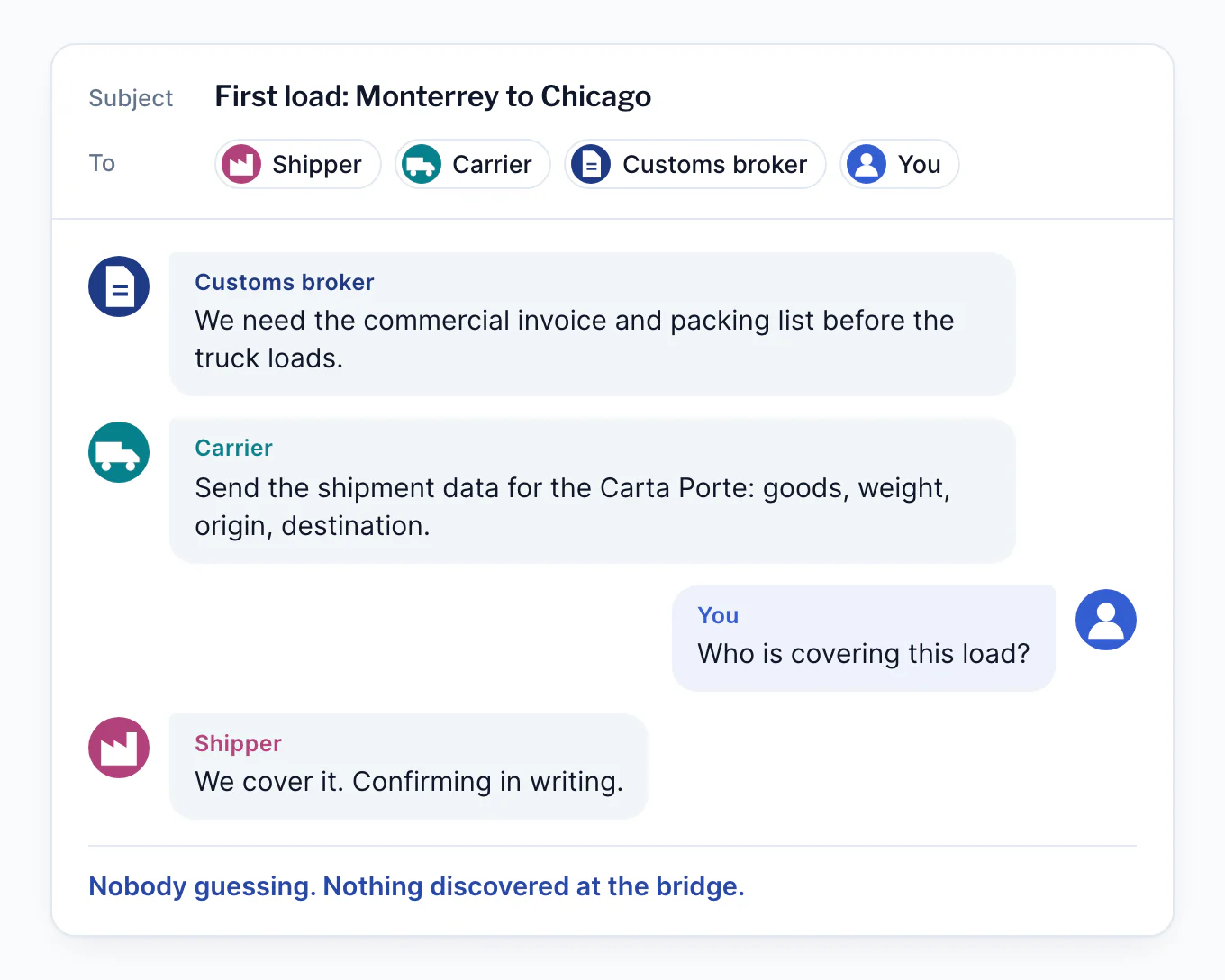
- Open one email chainwith the shipper, the carrier, the customs broker and you. Each party names what it needs, so nobody is guessing and nothing gets discovered at the bridge.
- Ask about security:CTPAT, seals, GPS, escorts and any carrier-specific rules. This is where first loads go wrong. It costs one question and saves a day.
Your first load checklist
Before you quote
- Confirm origin, destination and likely crossing
- Confirm who controls the crossing today
- Ask whether B-1 drivers are acceptable for the crossing
- Confirm the commodity and cargo value
- Ask who is covering the load, and price cover in if your customer wants you to arrange it
After you book the carrier
- Get the carrier's details to the customs brokers on both sides
- Make sure the shipper's shipment data (goods, weight, origin, destination) reaches whoever issues the Carta Porte, which on an ordinary contracted move is the Mexican carrier. The Carta Porte is a complement to the carrier's CFDI, Mexico's electronic invoice
- Confirm the carrier's border process and escalation contact
- Get the names of the partner carriers on each leg
Before the truck loads
- Confirm the customs broker at the crossing
- Confirm the commercial invoice and packing list have reached the customs broker
- Confirm the CFDI with its Carta Porte complement has been issued (or the carrier has confirmed an exception applies), and the required filings are in progress or complete
- Confirm the shipper is ready to load
As the load approaches the border
- Confirm the U.S. entry is filed (northbound)
- Confirm the carrier filed the e-manifest in time; CBP needs it before the truck reaches the port
- Confirm DODA readiness (as applicable)
- Before the truck leaves the port area, confirm customs release, or the CBP authorization for an in-bond move
After crossing to delivery
- Confirm the delivery appointment and final ETA
- Confirm any special tracking expectations were met
- Capture what broke so the next load is easier
Common operational mistakes and how to avoid them
| Mistake | How to avoid it |
|---|---|
| Mistake 1: Picking up without a confirmed customs broker | To prevent it: confirm the broker before the truck loads. |
| Mistake 2: Carrier and shipment details sent too late | To prevent it: as soon as you confirm a carrier, get its details (company, SCAC or CAAT code, truck, trailer and driver) to the customs brokers, and make sure the shipment data reaches whoever issues the Carta Porte. On an ordinary contracted move that's the Mexican carrier, and it can't issue the Carta Porte without accurate shipment data. Outside SAT's narrow exceptions, a truck without a valid, accurate Carta Porte can't legally move the freight in Mexico (Chapter 9). Small mismatches, like mixing up a SCAC and a CAAT or a truck number and a trailer number, cost whole days. |
| Mistake 3: Commercial invoice missing or late | To prevent it: make sure your customer sends it to the customs broker before the freight arrives at the border. |
| Mistake 4: Promising the best-case crossing | To prevent it: ask your customer what their crossing has averaged historically and quote that. One to three days at the border is typical, not guaranteed. Four or more usually means something is stuck. |
| Mistake 5: Not settling who covers the cargo | To prevent it: ask your customer directly, "Who is covering this load?" Get the answer in writing before pickup. |
Cargo insurance and claims
This is the question brokers new to Mexico ask most, and the answer is the biggest difference from a domestic load.
| In the U.S., cargo insurance is the norm | In Mexico, the carrier's liability is capped by weight |
|---|---|
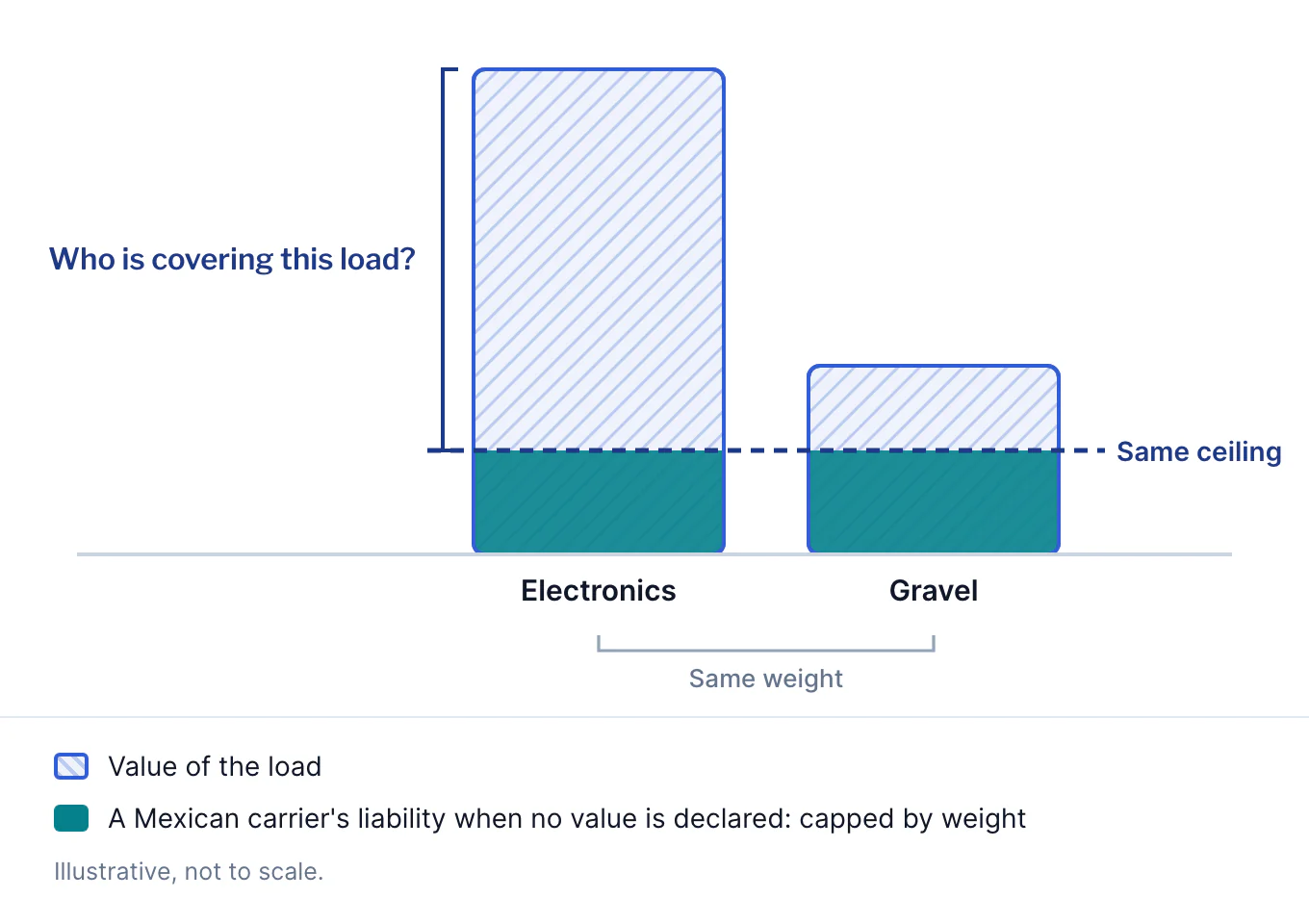
| On a domestic load, your customer expects the carrier to carry cargo insurance, and most broker-carrier contracts require it. That expectation comes from contracts and the market. Federal rules require cargo insurance filings only from household goods carriers and household goods freight forwarders. It's still so standard that most brokers never think about it. | Mexican carriers aren't expected to carry cargo insurance the way U.S. carriers are. When the shipper doesn't declare a value, Mexican federal transport law limits the carrier's liability by the weight of the freight, not by what's on the trailer. It's a ceiling on a claim, not a guaranteed payout, and it is low compared with the value of most loads. The ceiling is calculated the same way for electronics as for gravel. What a shipper actually recovers depends on the loss, the liability rules and the transport contract. |
So ask who is covering the load
"Is the carrier insured?" is the wrong question. "Who is covering this load?" is the right one. You'll hear one of three answers:
If there's a claim
A claim goes faster when you already know which company had the freight on which leg. Before the first load, get the names of the Mexican partner and any transfer carrier from the carrier you booked, and keep them with the load records.
This also explains why Mexican facilities can be strict about security protocols, advance notice and driver verification. With liability capped, prevention matters more.
What to document after load one
Keep it short. Capture what makes the second load easier:
- Crossing used and what "normal" looked like
- Customs broker contacts
- Document timing that worked
- Carrier contacts, partner carriers on each leg and the escalation path
- Who covers the cargo, and on what terms
- Tracking cadence expectations
Ready to see Mexico market rates and vetted carriers?
The guide covers the playbook. A demo shows it running.