
All chapters
Start with a list of companies that already have Mexico supply chains. These three plays build it, and most of the shippers on it will be U.S. companies you can call in English. Nobody in Mexico required.
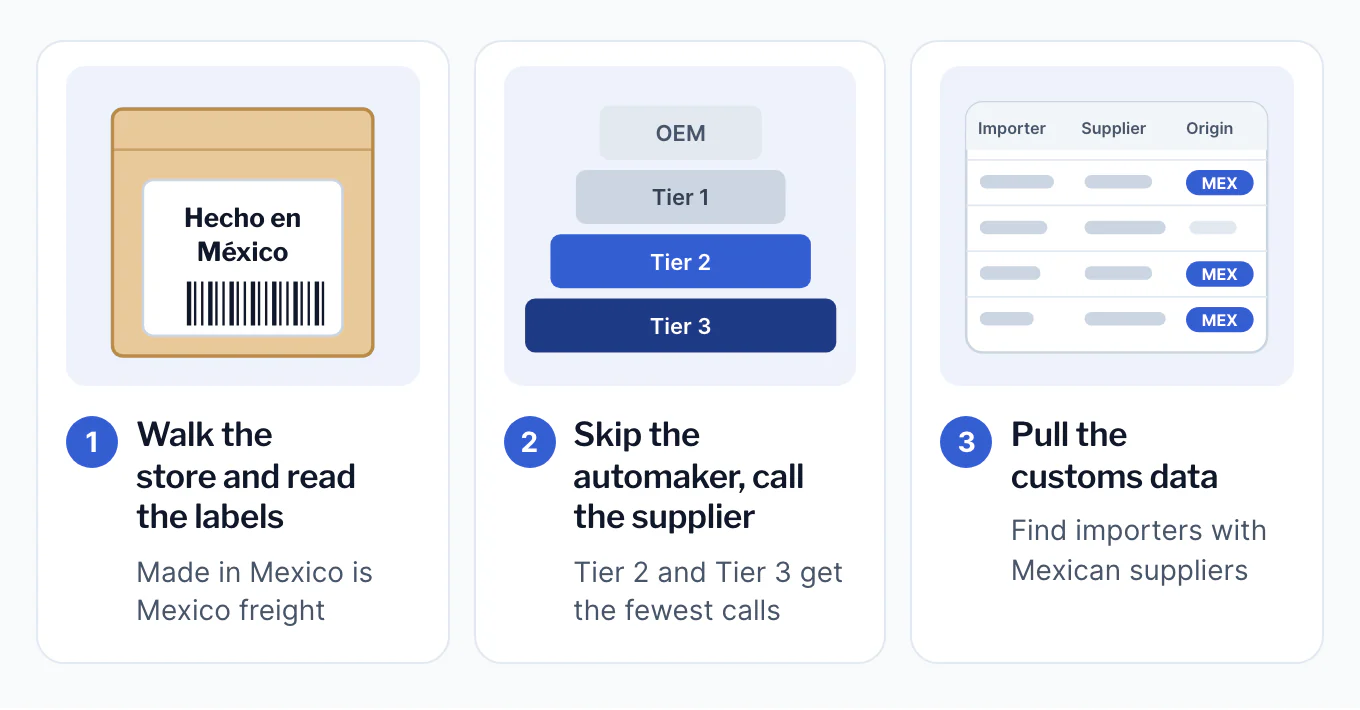
1) Walk the store and read the labels
Go to any retailer, say Home Depot, Lowe's or a grocery store, and turn the box over. Look for "Hecho en México," which means "Made in Mexico." What you're holding is Mexico freight. Take a photo, then trace it back: Who's the manufacturer? Where's their U.S. distribution? Who's handling their transportation?
The photo is your opener. "I just saw your product at the store and noticed it's made in Mexico" beats any cold call.
2) Skip the automaker, call the supplier
Everyone calls Ford, GM and Volkswagen. Almost nobody calls the companies that supply them.
A finished vehicle is thousands of parts, and many of them crossed the border before the car did. Automotive supply chains run in tiers:
- OEM:the automaker's assembly plants. Every broker already has their number.
- Tier 1:sells complete systems (seats, dashboards, brake assemblies) straight to the OEM. Big, sophisticated, mostly well covered.
- Tier 2:makes the components inside those systems (stampings, castings, wire harnesses, molded plastic). Thousands of companies, many U.S.-based, shipping to and from Mexico every week. Call here.
- Tier 3:raw and basic materials (steel coil, resin, fasteners, glass). The widest layer, the least called, and the freight repeats on a schedule.
Two ways to build the supplier list:
- Search "Nissan Sentra suppliers" and you'll find a diagram of the car with supplier logos pointing at each part. Many of those suppliers receive parts from or ship parts to Mexico, often on a steady schedule. Verify each one's Mexico lanes and decision-maker before you pitch.
- Pull up Google Maps around a major plant. The Volkswagen plant in Chattanooga has an industrial park around it full of suppliers such as Gestamp, Yanfeng, Grupo Antolin, Faurecia and Schnellecke. Few brokers call them about Mexico freight.
3) Pull the customs data
Customs-data tools such as ImportYeti and RevenueVessel let you search import records by product, supplier or importer. Check which data a tool covers before you rely on it: U.S. bill-of-lading records come from ocean shipments, so truck freight from Mexico won't show up in them directly. They still surface importers with Mexican suppliers and companies with plants in Mexico, which is your list. Verify each company's current Mexico truck lanes on the call. Then go back to your own book and look for freight stopping at the border (Chapter 2).
Pick the industries that match your trailers
Mexico freight sorts itself by trailer. Start with the equipment you already run:
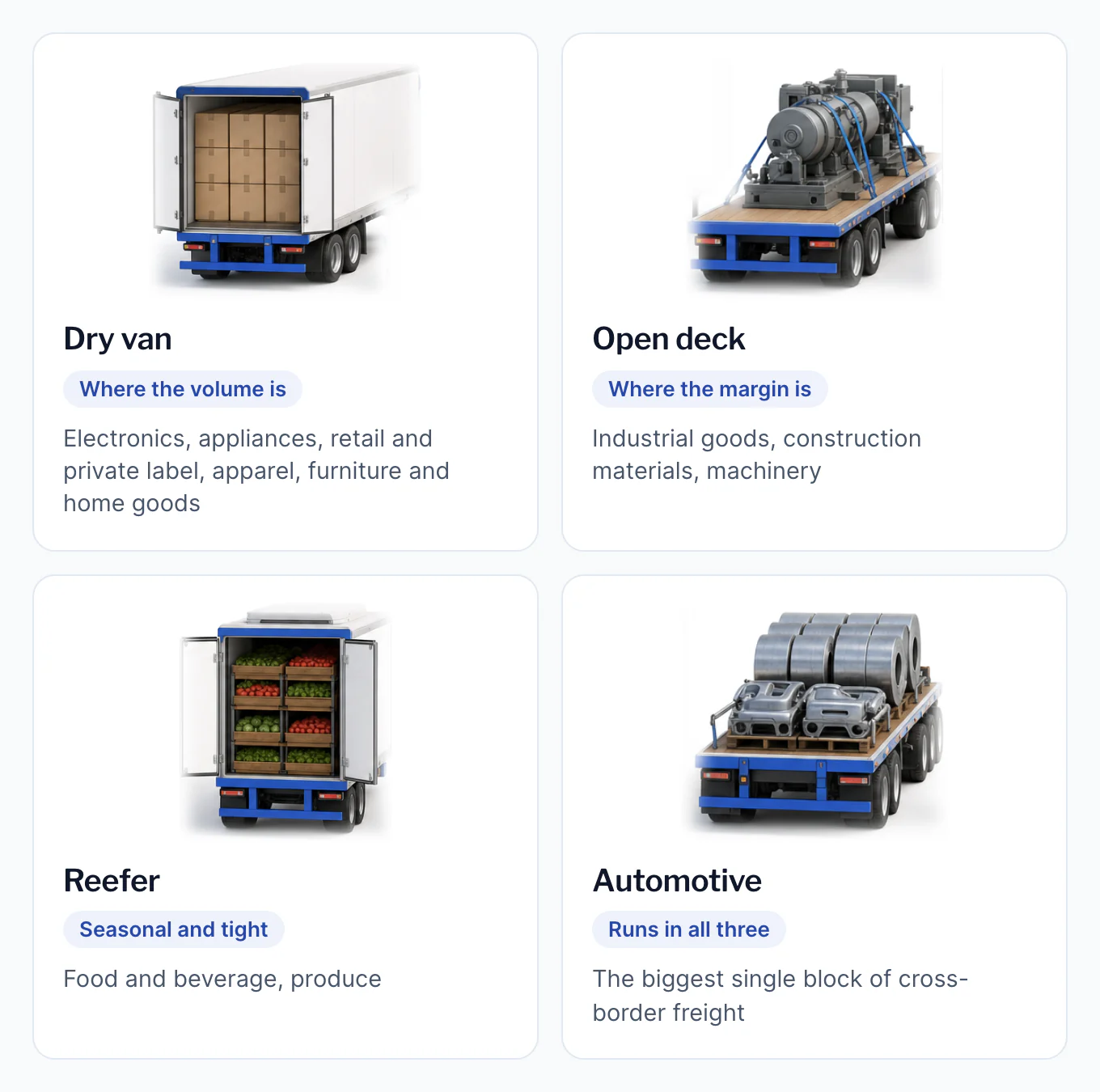
For what changes when you move beyond dry van, see Chapter 8.
Here's your talk track
"I saw you manufacture in [Mexico region or city] and distribute in the U.S. We help shippers run Mexico freight with reliable capacity and strong execution. Are you the right contact for Mexico lanes?"
One more rule: call in English. Don't run a cold email through Google Translate and send it to a shipper in Mexico. Chapter 4 covers who to call instead.
Ready to see Mexico market rates and vetted carriers?
The guide covers the playbook. A demo shows it running.