The story
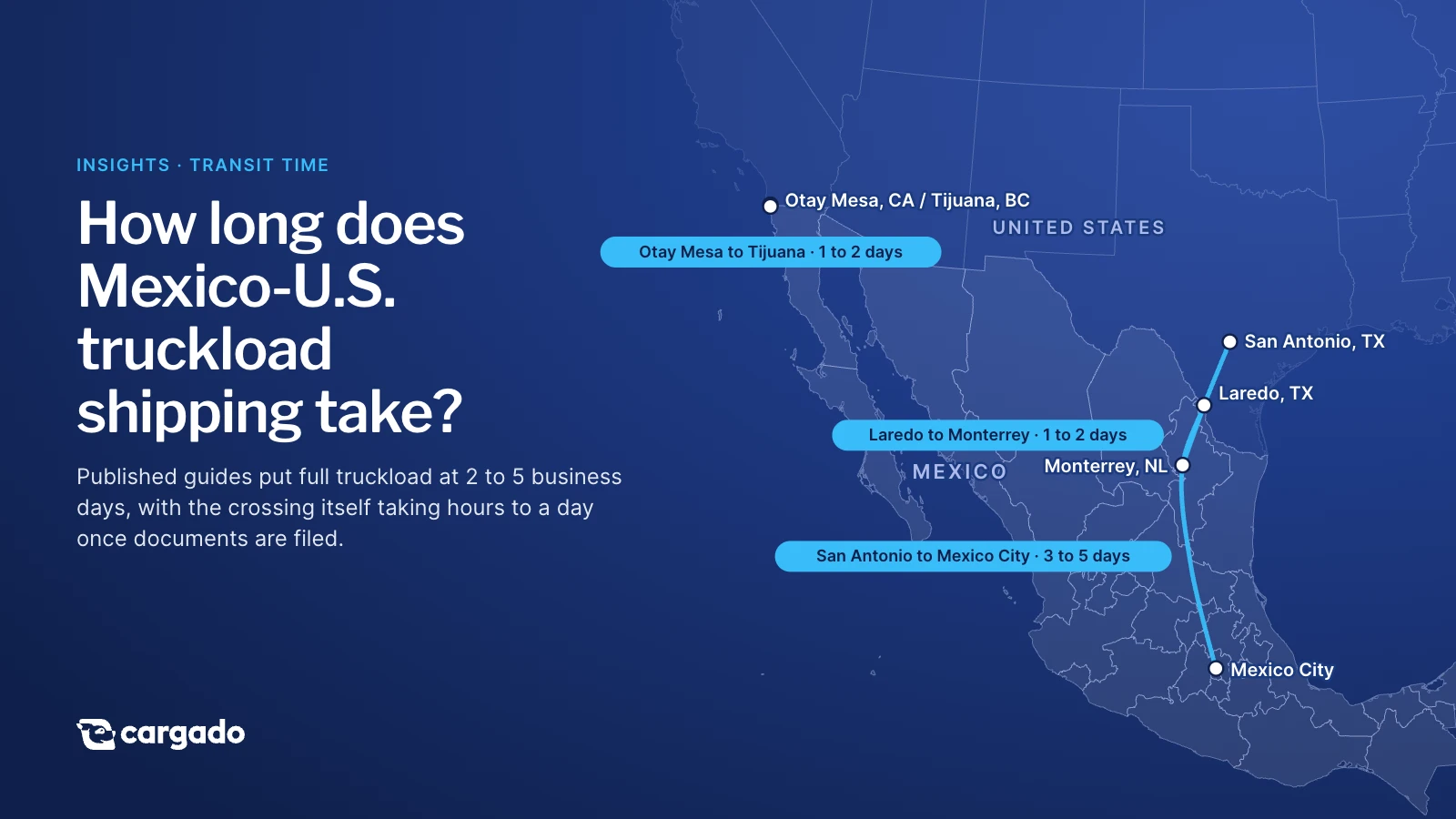
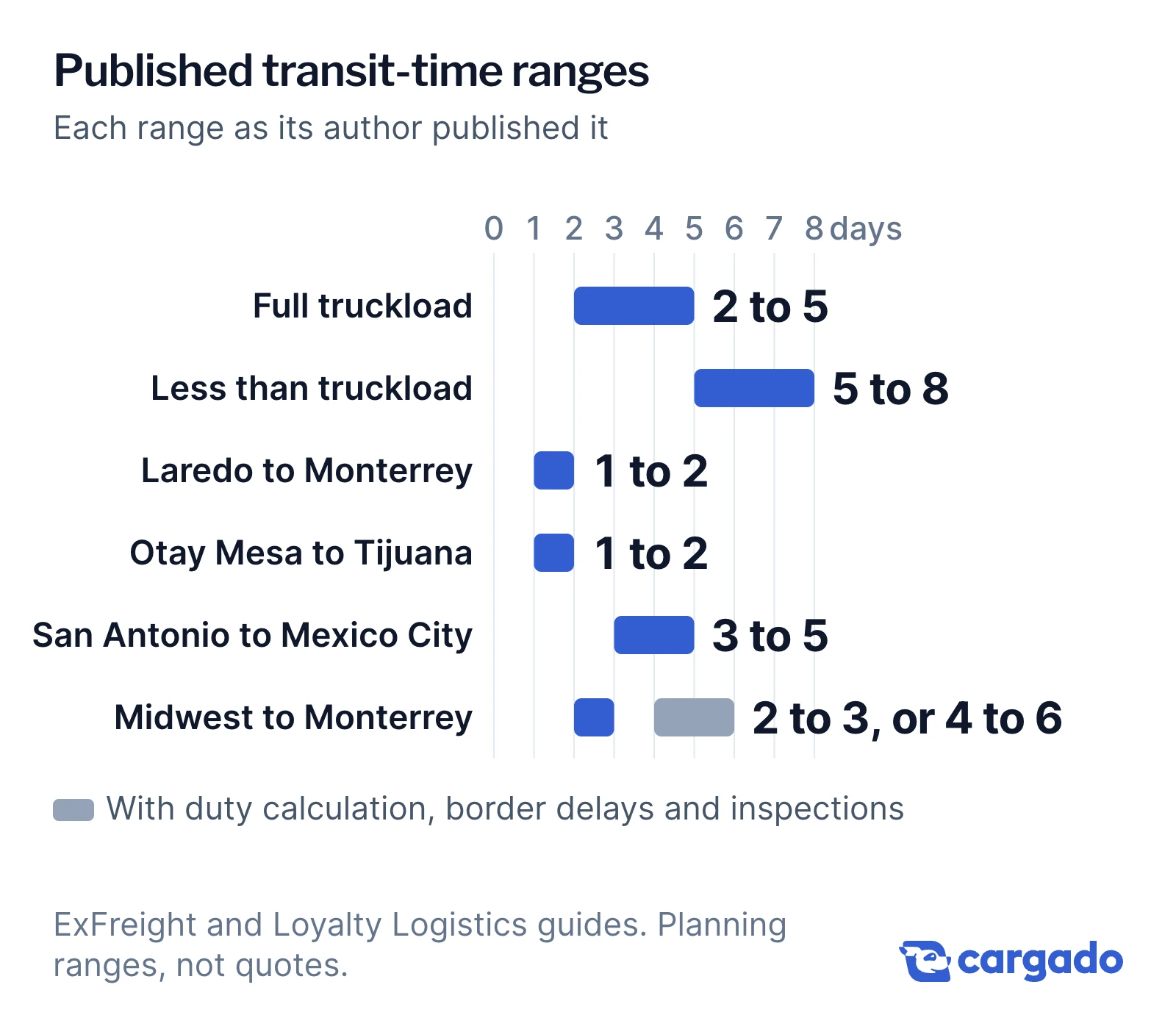
A full truckload between the United States and Mexico takes about 2 to 5 business days in published carrier and forwarder guides, with the border crossing itself taking a few hours to a day once the paperwork is right. Short lanes run faster: Laredo to Monterrey is about 1 to 2 days, and Otay Mesa to Tijuana about 1 to 2 days. Long lanes run slower: San Antonio to Mexico City is about 3 to 5 days, and one guide puts the Midwest to Monterrey at 2 to 3 days in normal conditions and 4 to 6 with border delays and inspections. Most of the variance is at the border, not on the road. The ranges below are from public guides, each attributed; they are planning ranges, not quotes.
What are the published transit-time ranges?
| Move | Published range | Source |
|---|---|---|
| Cross-border full truckload (FTL) | 2 to 5 business days | ExFreight guide (June 16, 2026) |
| Cross-border less than truckload (LTL) | 5 to 8 business days | ExFreight guide (June 16, 2026) |
| Laredo to Monterrey, FTL | 1 to 2 days | ExFreight guide (June 16, 2026) |
| San Antonio to Mexico City, FTL | 3 to 5 days | ExFreight guide (June 16, 2026) |
| Otay Mesa to Tijuana, FTL | 1 to 2 days | ExFreight guide (June 16, 2026) |
| Midwest to Monterrey | 2 to 3 days normally; 4 to 6 with duty calculation, border delays and inspections | Loyalty Logistics, Texas-to-Mexico border guide |
| Customs clearance at the border | Usually 1 to 2 business days | ExFreight guide (June 16, 2026) |
| The physical crossing, documents in order | 2 to 5 hours (RXO); 1 to 4 hours at World Trade Bridge (Load One) | RXO cross-border guide; Load One customs guide |
| Customs processing, per RXO | Half a day to a full day | RXO cross-border guide |
Source: Cargado analysis of the published guides listed. Ranges are each author's own and were not averaged.
Where does the time go?
Three places.
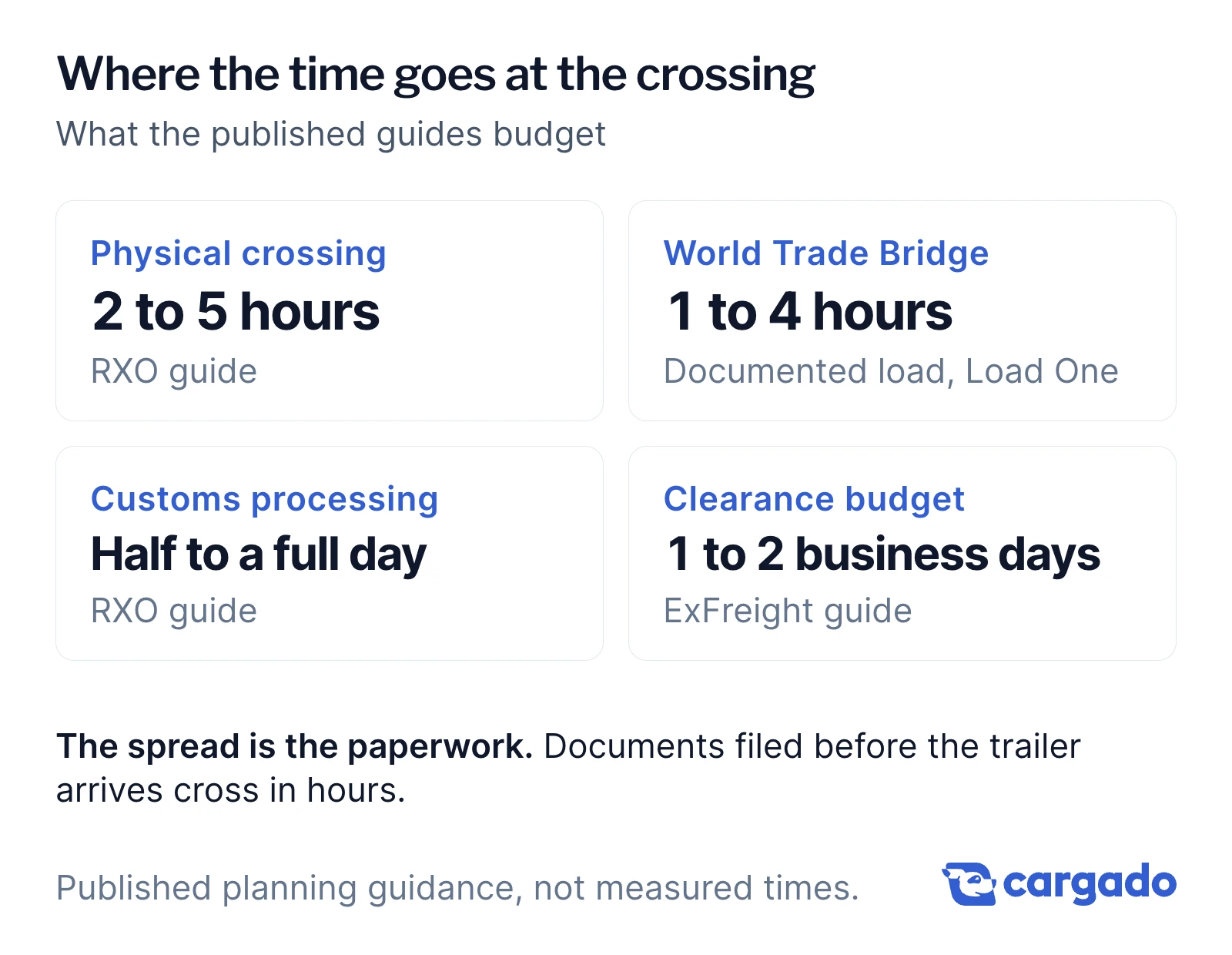
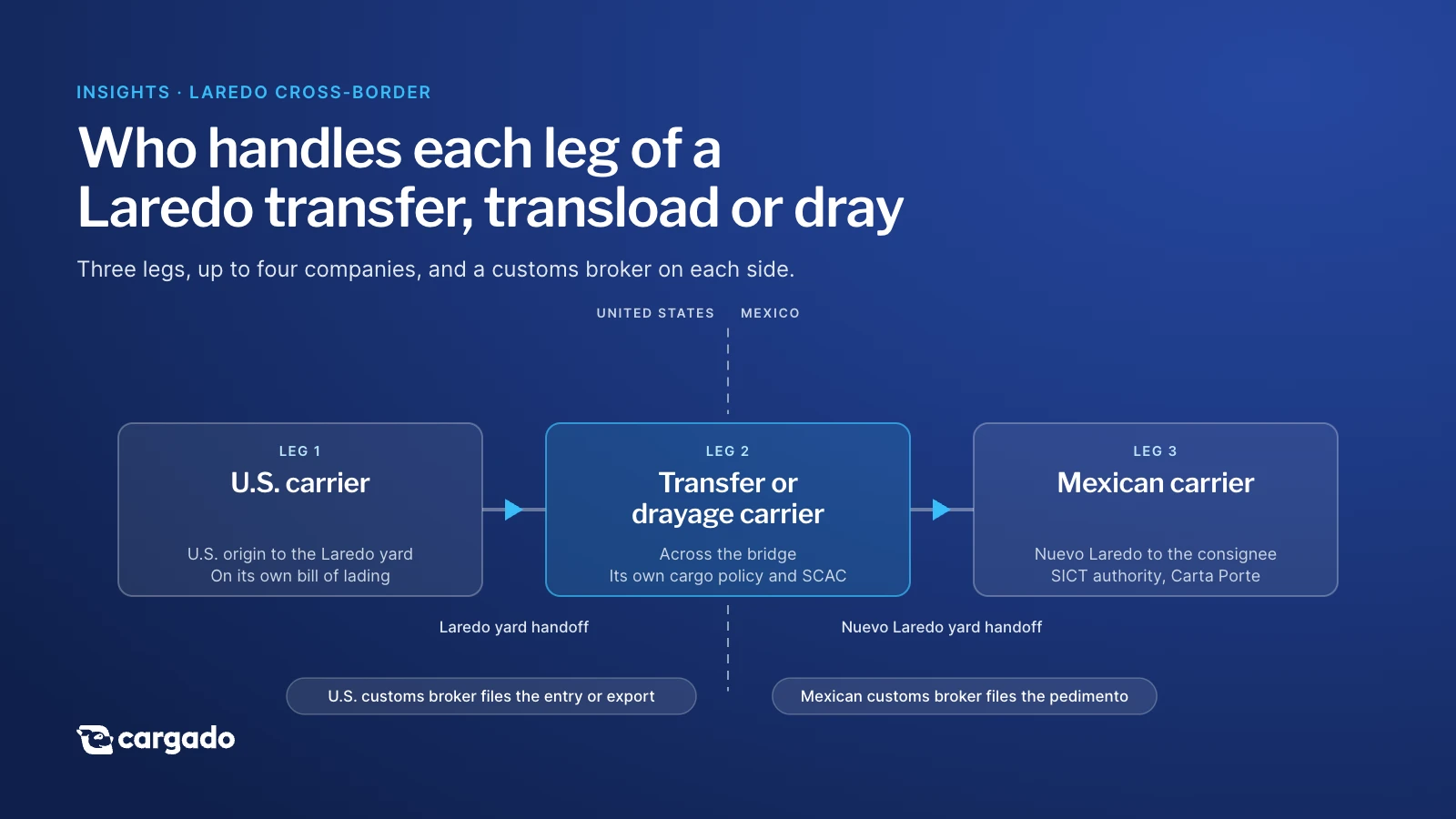
The border. A crossing is a handoff between a U.S. carrier, a transfer carrier and a Mexican carrier, with a customs broker filing on each side. RXO's guide says the crossing itself typically takes 2 to 5 hours and customs processing half a day to a full day; Load One puts a documented load through the World Trade Bridge in 1 to 4 hours. ExFreight budgets 1 to 2 business days for clearance. The spread between "4 hours" and "2 days" is the paperwork: a load whose commercial invoice, packing list and pedimento are filed before the trailer arrives crosses in hours, and a load that arrives before its documents waits. How the handoff works is covered in transloading vs through-trailer, and the two filings that gate it are the pedimento and, on inspection, the previo.
The road. Laredo to Monterrey is about 140 miles, Laredo to Mexico City about 700, and Mexican federal highways run slower than U.S. interstates, with more stops along the way. A single driver covers the Monterrey leg the same day; Mexico City, Guadalajara and the Bajío are longer runs, which is why the long-lane ranges are 3 to 5 days and not 2.
The calendar. Customs brokers and border yards often work reduced hours on weekends and Mexican public holidays. A load that reaches Laredo Friday afternoon may cross Monday, and a load that reaches the yard the afternoon before a Mexican holiday may wait two days. The transit clock a shipper sees is calendar days; the ranges above are business days, which is why a "2 to 5 day" lane can show up as a week on a calendar. Events can add more: during the October 26 to 27, 2026 driver protests, some highways, mostly in central and southern Mexico, closed for parts of two days, and no border bridge or customs closure was confirmed. Published ranges do not include events like that, which is why a quote carries a buffer.
Which direction is faster?
No published source measures it. The guides cited here do not split their ranges by direction, so treat them as covering both. What differs is the filing. Northbound, the carrier's ACE e-manifest and the U.S. broker's entry are filed electronically before the truck arrives. Southbound, the crossing waits on the Mexican customs broker's pedimento and on Mexico's random inspection (the semáforo fiscal), where a red light means a physical inspection. In both directions, documents filed before the trailer arrives matter more than which way it is going.
How do I check the border today?
CBP publishes live wait times for every commercial crossing at bwt.cbp.gov, with separate lanes for standard, FAST and ready-lane traffic. It covers the northbound (U.S. entry) queue only; Mexico does not publish a comparable southbound feed. The border wait times glossary entry explains how to read it and what it does not include (customs broker time, yard time, inspection).
How should a broker quote transit?
- Quote a range, and name the crossing. "3 to 4 business days via Laredo" is a promise a carrier can keep; "3 days" is not.
- Separate the border day. Shippers who hear "2 days" assume road time. Say explicitly that one day is the crossing and clearance.
- Ask the customs broker when the pedimento will be ready. That date, not the pickup date, sets the crossing date.
- Check the calendar. Mexican holidays, Friday afternoon arrivals, and the fourth-quarter peak.
- Add a buffer for first-time lanes. A shipper's first move through a new crossing or a new customs broker runs long; the second one runs to the range.
What do the published ranges leave out?
Published ranges also leave out the yard. Time in a border yard waiting for a transfer slot, a customs broker appointment or a Mexican carrier is counted by nobody and is often the largest single piece of a slow crossing. Ask the carrier how it books the transfer and whether the trailer drops or crosses live.
This page does not report measured transit times. The ranges are published planning guidance from carriers and forwarders, and each is attributed so you can read the assumptions behind it. If you need a time for a specific lane, ask the carriers running it; on Cargado, brokers post the lane and verified cross-border carriers reply with their own rate and transit, at cargado.com.