The story
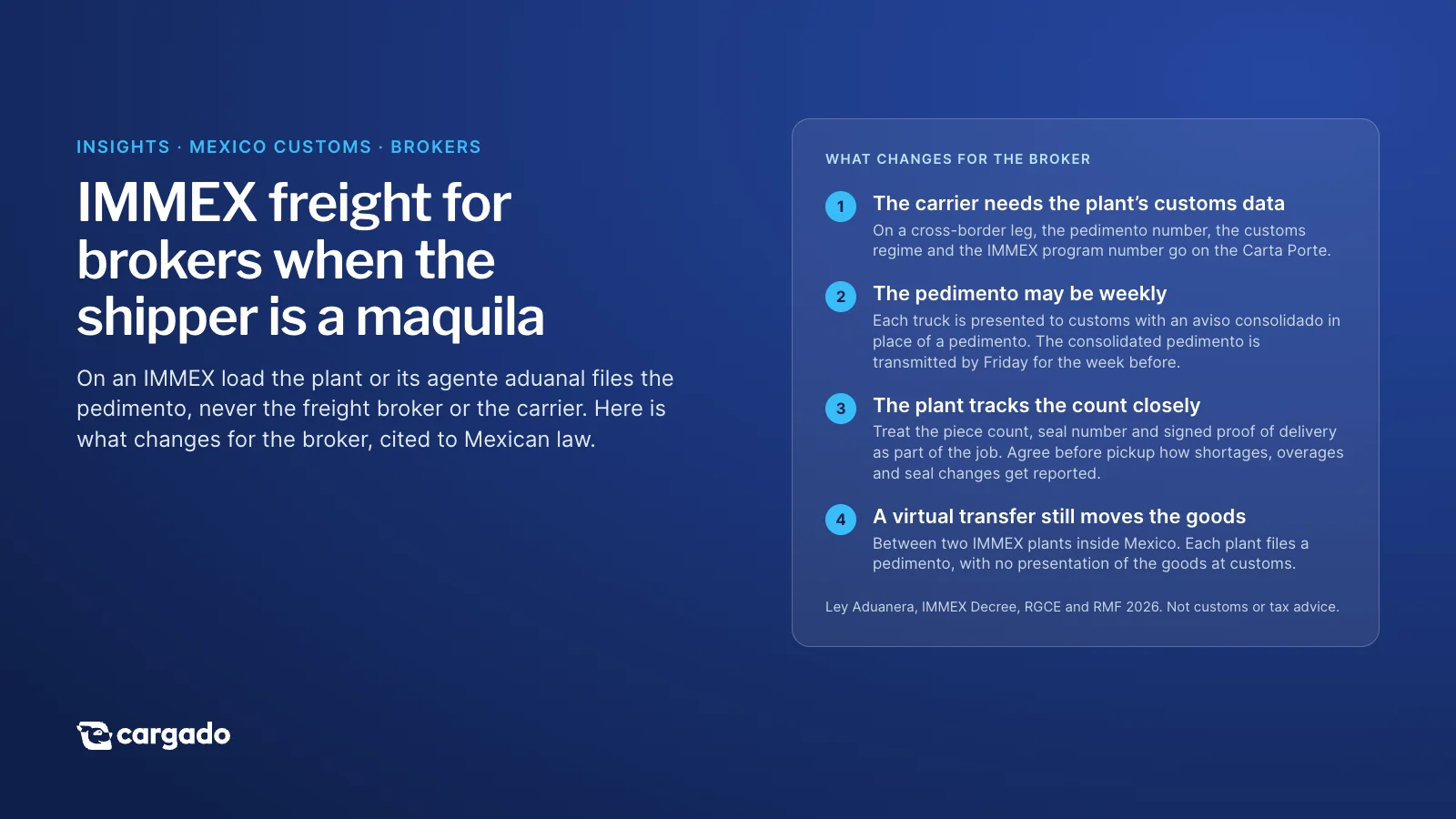
On an IMMEX load, the plant or its agente aduanal files the pedimento, never the freight broker or the carrier. What changes for the broker is the customs data the carrier needs for the Carta Porte, the timing of the pedimento, and how closely the plant tracks the count, because its goods are in Mexico under temporary import and have to return abroad or change customs regime within a fixed term.
This page is for U.S. freight brokers who quote a maquila's freight. It is not customs or tax advice, and the call on a specific shipment belongs to the plant and its agente aduanal. Rules checked as of November 16, 2026, against the Ley Aduanera (last amended in the DOF on November 19, 2025), the IMMEX Decree (Secretaría de Economía reference text to August 28, 2025), and the 2026 Reglas Generales de Comercio Exterior (RGCE) and Resolución Miscelánea Fiscal (RMF) with their published modifications. A decree published in the DOF on October 23, 2026 amends the Ley Aduanera from January 1, 2027. The section on declared value below covers what it changes for IMMEX.
What does IMMEX mean for the freight?
IMMEX is an authorization the Secretaría de Economía grants to a Mexican company under the IMMEX Decree. With it, Article 108 of the Ley Aduanera lets the company import goods temporarily, process or repair them, and return them abroad. Foreign-trade taxes are not paid on temporary imports, with the exceptions Article 104 lists, and any applicable antidumping duties are still paid.
The base terms depend on what the goods are (Article 108; IMMEX Decree, Article 4):
- Up to 18 months for raw materials, parts, components, packaging, labels and materials consumed in production.
- Up to two years for containers and trailer boxes.
- The life of the program for machinery, equipment, tools and molds.
Within its term the goods must return abroad or move to another customs regime. After it, Article 108 treats them as being in Mexico illegally. Companies certified as Operador Económico Autorizado get longer terms for materials (RGCE rule 7.3.3).
On the pedimento, Anexo 22 of the RGCE codes these operations IN (temporary import for processing), AF (fixed assets), RT (return abroad) and V1 (transfer between plants).
IMMEX is separate from U.S. in-bond freight, a CBP procedure covered in our guide to bonded carriers and in-bond freight.
Who files the pedimento on an IMMEX load?
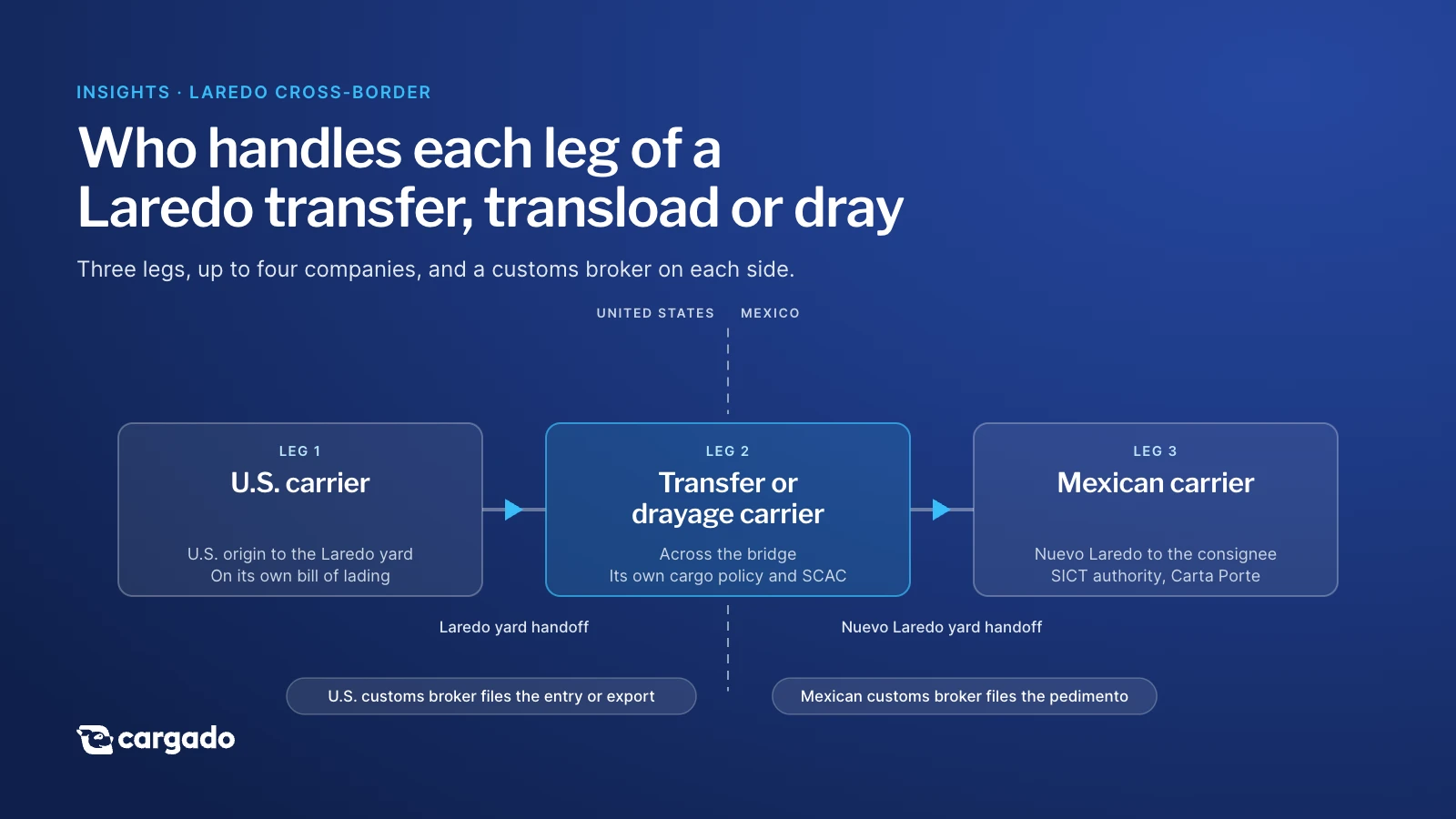
The plant that holds the program does, through its agente aduanal. Article 40 of the Ley Aduanera gives clearance to the importer or exporter, acting through an agente aduanal, an agencia aduanal or its own legal representative. A freight broker or a carrier is not on that list. Our Laredo transfer guide covers who clears and who moves each leg.
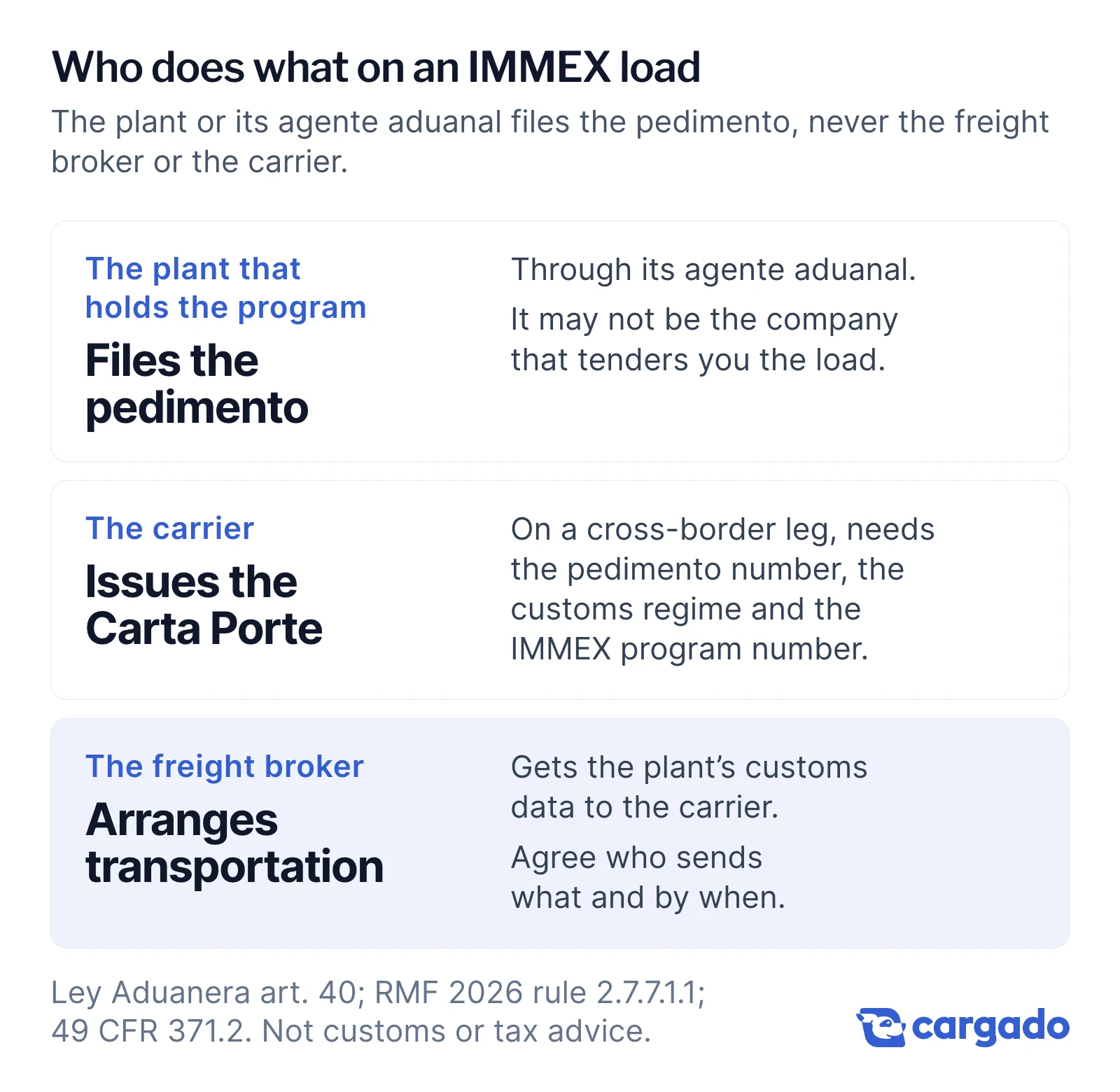
The importer on the pedimento is the program holder, which may not be the company that tenders you the load. The decree includes a shelter (albergue) modality in which foreign companies supply the technology and production materials and do not operate the program themselves. Ask whose program the load moves under. The Secretaría de Economía publishes a directory of current IMMEX programs and their plants, updated in the second week of each month.
The U.S. side is a separate filing. A freight broker arranges transportation by an authorized motor carrier (49 CFR 371.2), and transacting customs business for others in the United States takes a CBP customs broker license (19 CFR 111.2). Neither role files a Mexican pedimento.
What is different about the timing?
The pedimento may be weekly. Article 37 of the Ley Aduanera lets exporters, and companies importing under an export program, put many operations on one consolidated pedimento. Each truck is presented to customs with an aviso consolidado in place of a pedimento, and the consolidated pedimento is transmitted by Friday for the operations of the week before (Article 37-A). An IMMEX load can cross on the aviso before that week's pedimento is transmitted, so ask the agente aduanal which the plant uses. On a consolidated load, confirm the aviso consolidado is ready before the truck crosses.
The plant has to account for what it imports. It must declare what it returned, what share of its temporary imports that represents, and the scrap and waste that did not return (Article 109), and keep an automated, permanent inventory control (Article 59; RGCE rule 4.3.1). Treat the piece count, seal number and signed proof of delivery as part of the job, and agree before pickup how shortages, overages and seal changes get reported.
The program has its own calendar. Each program holder files an annual report with the Secretaría de Economía by the last business day of May. A late report suspends its temporary imports, and the program is canceled as of September 1 if the report is still missing at the end of August (IMMEX Decree, Article 25). Once notified of a cancellation, the company has 60 calendar days to return the goods or import them definitively (Article 108). Our page on Mexico-U.S. tariffs and trade rules mentions the 2026 cancellation lists, and the MVE calendar has the date temporary imports start needing an electronic Manifestación de Valor.
What changes for declared value in 2027?
Starting January 1, 2027, Article 177, section XII of the Ley Aduanera presumes an infraction when a customs audit finds that goods under a regime that determines duties without paying them, such as an IMMEX temporary import, were declared at a value 20% or more below the transaction value of identical or similar goods, if a definitive import at that value would have underpaid duties. The line is 50% through December 31, 2026.
The declared value belongs to the plant and its agente aduanal, not to the freight broker or the carrier. Transport, insurance and handling costs up to the border are part of the customs value when the importer pays them and they are not already in the price (Article 65), so ask whether the plant needs your freight invoice for its value file. Our post on declaring customs value under the 2027 rule covers the seizure and audit changes.
What does the carrier need for the Carta Porte and the crossing?
Under Article 146 of the Ley Aduanera, a CFDI that covers foreign goods in transport must carry the Carta Porte complement. RMF rule 2.7.7.1.1 lets the carrier prove the goods are legally in the country with it, if it shows the pedimento number or customs document. The same rule obliges whoever hires the transport to give the carrier accurate data, and each side answers for the data it supplied.
SAT's Carta Porte instructions have an appendix for IMMEX, which says to issue an international Carta Porte when the plant clears on consolidated pedimentos. The data moves in both directions, so agree who sends what and by when.
| Data | Who has it | Where it goes |
|---|---|---|
| Pedimento number or other customs document | Plant's agente aduanal | Carta Porte. Document type 01 covers every kind of pedimento, consolidated included. |
| IMMEX program number | Plant | Carta Porte goods description, as $IMMEX- plus the number, ahead of the description. |
| Customs regime | Plant's agente aduanal | Carta Porte. The key for IMMEX temporary imports is ITE. |
| Trailer or container number, plates, CAAT code, seal numbers | Carrier | Crossing document the agente aduanal transmits (RGCE rules 3.1.32 and 3.1.33). |
| Carta Porte folio fiscal | Carrier, once it issues the Carta Porte | The same crossing document. It must match the goods presented to customs. A foreign carrier without a permanent establishment in Mexico may cover the move with the documents Article 146 of the Ley Aduanera lists, in place of a Carta Porte (RMF rule 2.7.7.1.5). |
The crossing document is changing. Under RGCE rule 3.1.33 it is the DODA, and on imports a printed DODA travels with the goods to their destination. On November 5, 2026, SAT posted an advance version of rule 3.1.43, under which an Aviso de Cruce (AVC) with the same transport data replaces the DODA in the operations ANAM announces. Ask the agente aduanal which document applies at your crossing.
What is a virtual transfer, and does a truck still move?
Yes, or a rail car. RGCE rule 4.3.21 allows carts, forklifts or conveyors only between plants close enough that road or rail is not needed, and only if they hold SAT's IVA and IEPS certification. A plant may transfer temporarily imported goods to another IMMEX plant in place of returning them abroad. The plant that transfers files an export pedimento and the plant that receives files a temporary import pedimento (Ley Aduanera, Article 112). Under RGCE rule 4.3.21 both clear once validated and paid, with no presentation of the goods at customs, and Anexo 22 calls the operation virtual. The rule sets terms for the move inside Mexico:
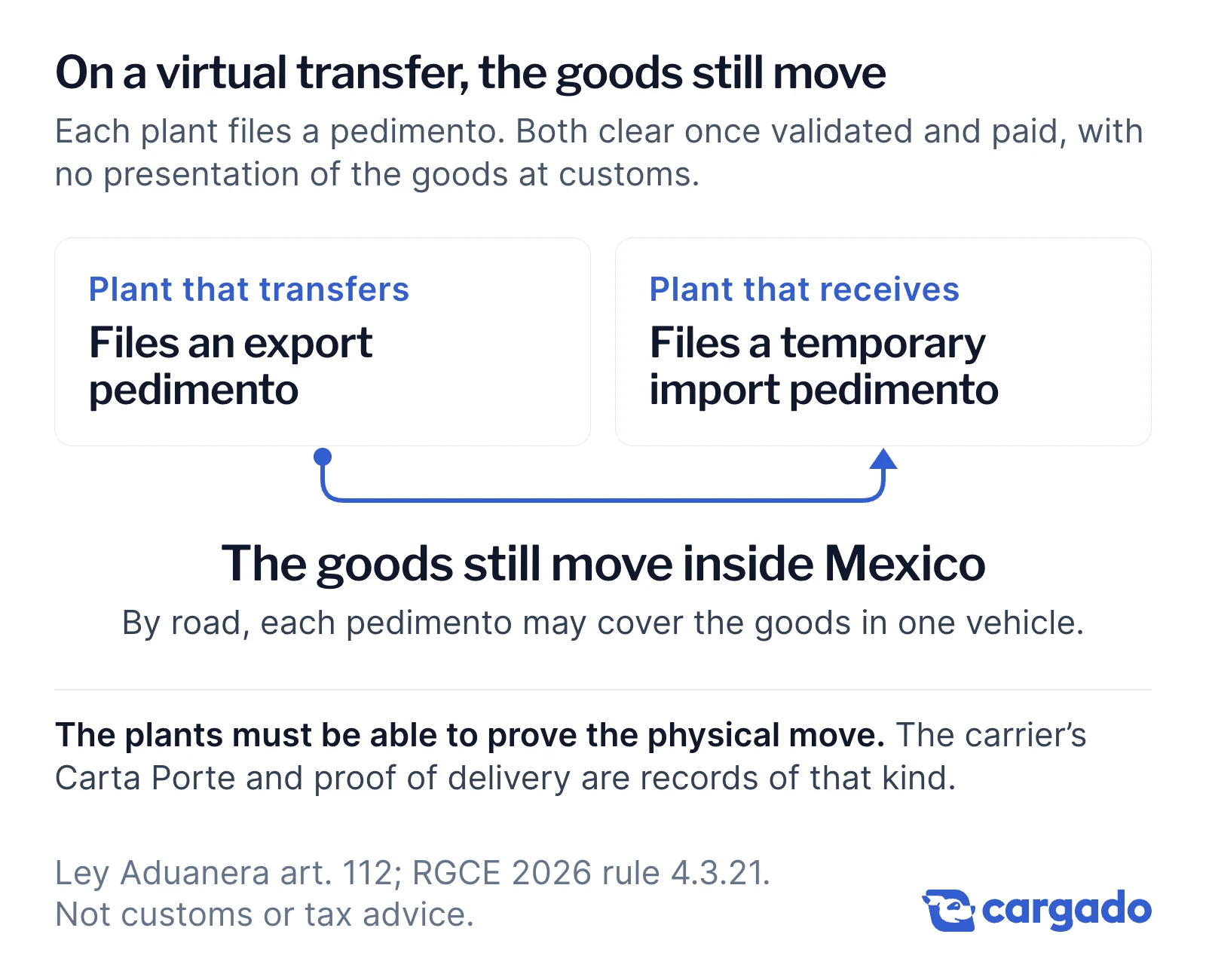
- By road, a pedimento covers the goods in one vehicle, within the weight limits of NOM-012-SCT-2-2017. On a weekly or monthly consolidated pedimento, the weight limit applies to each transfer.
- From the border strip or region to the interior, a copy of the receiving plant's temporary import pedimento travels with the goods, or the CFDI when the plants use consolidated pedimentos.
- The receiving plant has six months to return the goods or import them definitively, with exceptions such as certified Operador Económico Autorizado companies.
- The plants must be able to prove the physical move, with records such as transport payments, transport documents and proof of delivery to the consignee.
On a leg between two plants, the carrier's Carta Porte and proof of delivery are records of that kind.
Does the plant pay IVA when the goods enter?
The answer belongs to the plant's agente aduanal. In outline, the Ley del IVA counts a temporary import for a maquila or export program as an import (Article 24). A company SAT has certified gets a tax credit equal to 100% of that IVA, and one without the certification may guarantee the tax with a bond (Article 28-A). No duty or IVA figure belongs in a freight quote.
What should a broker ask before quoting an IMMEX load?
- Who holds the IMMEX program this load moves under, and what is the program number?
- Who is the plant's agente aduanal, and which crossing will they use?
- Does the plant clear on a consolidated pedimento? Who sends the carrier the pedimento number, and when?
- Is this a cross-border leg or a virtual transfer between plants inside Mexico?
- What does the agente aduanal need from the carrier, and by what time?
- How does the plant want counts, seal changes and the proof of delivery reported?
If an answer is still open, say so in the quote.
Where does Cargado fit?
Cargado is a cross-border freight marketplace and network for brokers, carriers and shippers. It is not a customs broker in Mexico or the United States. It does not file pedimentos, act as an agente aduanal or give customs advice. Once the plant and its agente aduanal have the customs side set, brokers post Mexico loads to vetted carriers in our marketplace and check the low, mid and high rate for a supported lane in Market Rates, built from bids carriers place on real postings. For Mexico rates and capacity each month, you can sign up for the Market Update.
Sources
- Ley Aduanera, artículos 37, 37-A, 40, 56, 59, 65, 104, 108, 109, 112, 146 y 177 (texto vigente, última reforma DOF 19-11-2025), Cámara de Diputados
- Diario Oficial de la Federación, Decreto por el que se reforman y adicionan diversas disposiciones de la Ley Aduanera (October 23, 2026)
- Decreto IMMEX, artículos 2, 3, 4, 24 y 25 (documento referencial al 28 de agosto de 2025), Secretaría de Economía, SNICE
- Secretaría de Economía, SNICE, Directorios de beneficiarios de Programas de fomento (IMMEX; actualización mensual)
- Reglas Generales de Comercio Exterior para 2026, reglas 1.1.2, 3.1.32, 3.1.33, 4.3.1, 4.3.21 y 7.3.3, DOF 27 de diciembre de 2025
- SAT, Anexo 22 de las RGCE para 2026, Apéndice 2 (claves de pedimento IN, AF, RT y V1)
- SAT, Normatividad RMF y RGCE 2026 (resoluciones de modificaciones publicadas y versiones anticipadas)
- SAT, Tercera Resolución de Modificaciones a las RGCE para 2026, segunda versión anticipada (regla 3.1.43, Aviso de Cruce)
- ANAM, Aviso de Cruce (AVC)
- Resolución Miscelánea Fiscal para 2026, regla 2.7.7.1.1 (DOF 28 de diciembre de 2025), copia del SAT
- SAT, Instructivo de llenado del CFDI con complemento Carta Porte, Autotransporte, versión 3.1, Apéndice 16 IMMEX
- Ley del Impuesto al Valor Agregado, artículos 24 y 28-A (texto vigente, última reforma DOF 12-11-2021), Cámara de Diputados
- U.S. Customs and Border Protection, Customs Brokers
- 19 CFR 111.2, License and permit required (eCFR)
- 49 CFR 371.2, Definitions, Broker (eCFR)
- 19 CFR 111.1, Definitions (eCFR)