The story
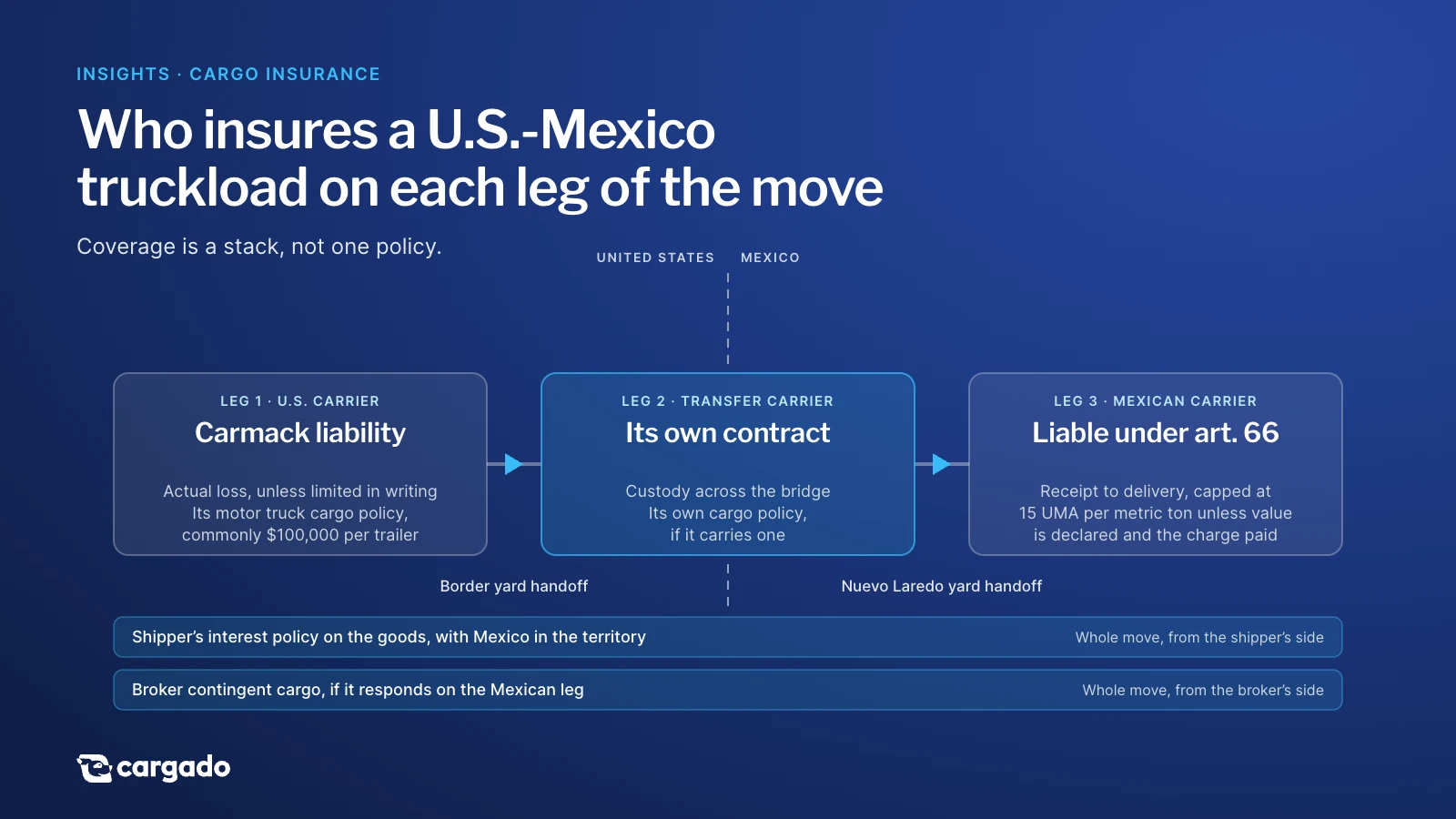
Cargo insurance on a U.S.-Mexico truckload is a stack, not one policy. The U.S. carrier's cargo policy covers the U.S. leg, the Mexican carrier answers for the goods under Mexican law up to a per-ton limit unless value is declared and paid for, and the shipper's own cargo policy or a broker's contingent coverage fills the gaps between them. Setting the stack up takes one conversation per party before the first load.
What does cargo insurance cover on a cross-border truckload?
Carrier liability is what a carrier owes by law or contract when freight is lost or damaged in its custody. Cargo insurance is a policy that pays a loss. A carrier buys a motor truck cargo policy to fund its liability; a cargo owner buys a policy on the goods so it is paid whether or not a carrier is liable.
In the United States, the Carmack Amendment (49 U.S.C. 14706) makes the carrier liable for the actual loss, and carriers carry cargo policies because brokers and shippers require them in contracts; FMCSA dropped its cargo-insurance minimum and filing rule for most for-hire property carriers on March 21, 2011 (Federal Register, June 22, 2010). A $100,000 limit per trailer is most common, with higher limits on request (ATS, July 2025).
In Mexico, the cargo owner is expected to insure the load (see seguro de carga). The carrier's liability is capped by weight unless the shipper declares value and pays a charge, and the insurance the law requires of the carrier covers damage to third parties, not the freight, except for hazardous materials (Ley de Caminos, Puentes y Autotransporte Federal, art. 68). ATS advises shippers to declare value and add coverage through their logistics provider or a cross-border policy.
Two policy types bridge the two systems. Shipper's interest (also sold as all-risk cargo insurance) is first-party coverage on the goods: it pays the cargo owner for an in-transit loss. Contingent cargo is held by brokers and responds only when the carrier's own coverage does not, for example after a cancellation, an exclusion or a refusal to pay (InTek Logistics). Ask first whether a contingent policy includes Mexico.
Who carries what on each leg?
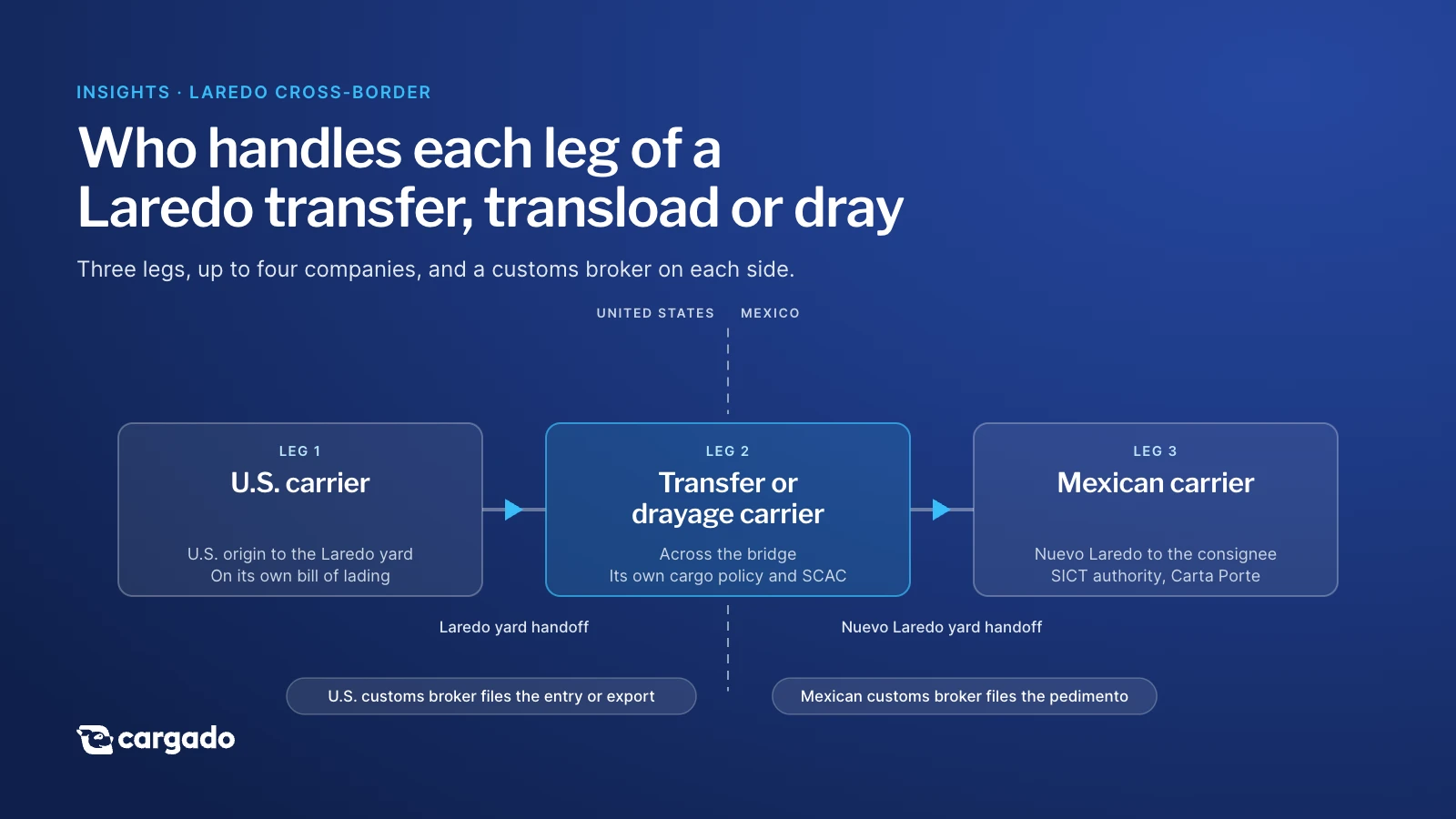
A Laredo move is three legs and a yard.
| Leg | Who is liable | What normally covers it | What to confirm before tender |
|---|---|---|---|
| U.S. origin to the border yard | The U.S. carrier, under Carmack, for actual loss unless liability was limited by written agreement at a reasonable value (49 U.S.C. 14706(c)(1)(A)) | The carrier's motor truck cargo policy, commonly $100,000 per trailer (ATS) | Limit, exclusions, any released-value term, and that custody ends at yard check-in |
| Across the bridge (transfer or drayage) | The transfer carrier that has custody, under its own contract | The transfer carrier's own cargo policy, if it carries one | Whether it carries cargo coverage, the limit, and that the rate confirmation names it |
| Nuevo Laredo yard to the Mexican consignee | The Mexican carrier, from receipt to delivery (Ley de Caminos, Puentes y Autotransporte Federal, art. 66), capped at 15 UMA per metric ton unless value is declared and the charge paid | Declared value with the additional charge, or the shipper's or broker's policy on the goods with Mexico in its territory | Whether value is declared, who pays the charge, and whose policy covers the leg if not |
| The whole move, from the shipper's side | No single carrier by default | A transit or shipper's interest policy on the goods | Mexico in the territory, yard time and transloading covered, and the deductible |
| The whole move, from the broker's side | Not a carrier; its FMCSA requirement is a $75,000 bond or trust fund (49 CFR 387.307), which backs the broker's own obligations to shippers and carriers | Contingent cargo, or a primary cargo policy bought per load or program | Contingent or primary, whether it responds on the Mexican leg, and the limit per load |
Source: the statutes and guides under Sources.
Why does Carmack stop at the border on most moves?
Carmack covers property "transported in the United States or from a place in the United States to a place in an adjacent foreign country when transported under a through bill of lading" (49 U.S.C. 14706(a)(1)). A through bill is one document under which one carrier takes responsibility for the whole trip. On a typical southbound move the U.S. carrier's bill of lading ends at the border yard and the Mexican carrier issues its own carta porte, so there is no through bill and Carmack ends where the U.S. carrier's custody ends. Whether the statute reaches the Mexican leg of a northbound move is unsettled (the Supreme Court left it open in Regal-Beloit, 2010), so for a northbound load treat Carmack as starting at the border yard.
If you want one carrier of record for the whole move, write it that way: a through bill of lading, a rate confirmation that makes the carrier responsible to the Mexican delivery point, and a cargo policy that names Mexico. Otherwise the Mexican leg runs under Mexican law and the carta porte.
How do you set declared value?
U.S. leg. The default is full actual loss. A carrier may limit its liability "to a value established by written or electronic declaration of the shipper or by written agreement" if that value is reasonable (49 U.S.C. 14706(c)(1)(A)). Read the carrier's tariff and rate confirmation for a released-value or per-pound limit, and declare a higher value or negotiate the limit when the freight is worth more than the carrier's policy.
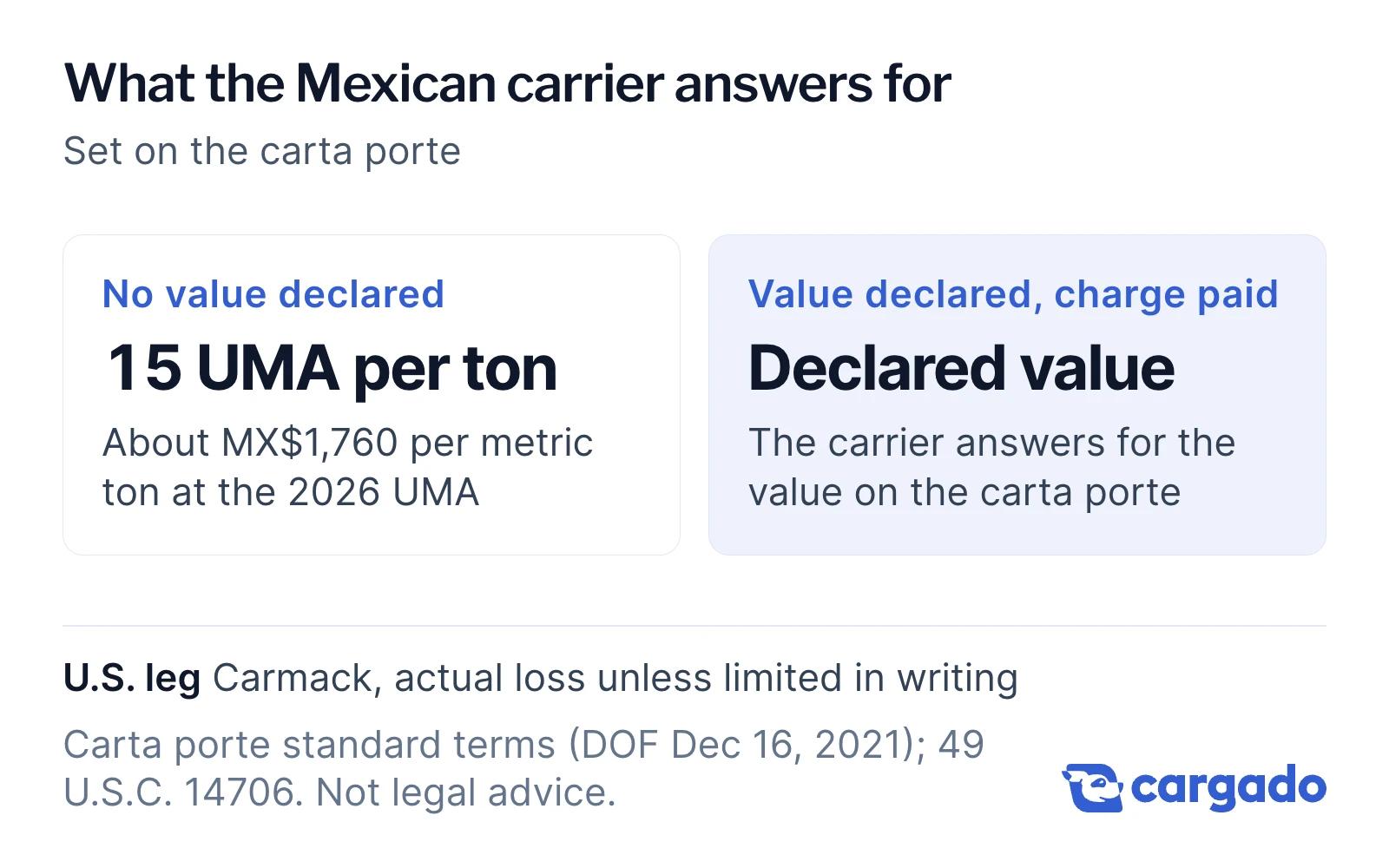
Mexican leg. The carta porte is where value is declared. Under the standard carta porte terms published in the Diario Oficial de la Federación on December 16, 2021, the shipper states the type of goods, weight and, where applicable, their value (clause Tercera). If the shipper wants the carrier to answer for the declared value, including loss from caso fortuito or fuerza mayor, the parties agree an additional charge equal to the insurance premium, shown on the CFDI with the Carta Porte complement (clause Novena). Without that charge, the carrier's liability is expressly limited to 15 Unidades de Medida y Actualización (UMA) per ton (clause Décima). Article 66 of the Ley de Caminos, Puentes y Autotransporte Federal states the same cap in minimum-wage days, which the January 27, 2016 de-indexation reform reads as UMA. The 2026 UMA is 117.31 pesos a day from February 1, 2026 (INEGI), so the cap is about MX$1,760 per metric ton.
The choice on the Mexican leg is to declare value and pay the charge, to cover the goods with a policy that names Mexico, or both. Where a carrier quotes the charge through its own insurer, ask who the insured is and who gets paid.
How do you document and file a claim?
The claim file starts at tender. Keep the commercial invoice and packing list, the U.S. bill of lading and the carta porte CFDI, the seal number on every handoff receipt, the yard check-in and interchange records, and photos at loading and delivery. Any exception goes on the delivery receipt in writing; a note on the receipt is evidence, not the claim.
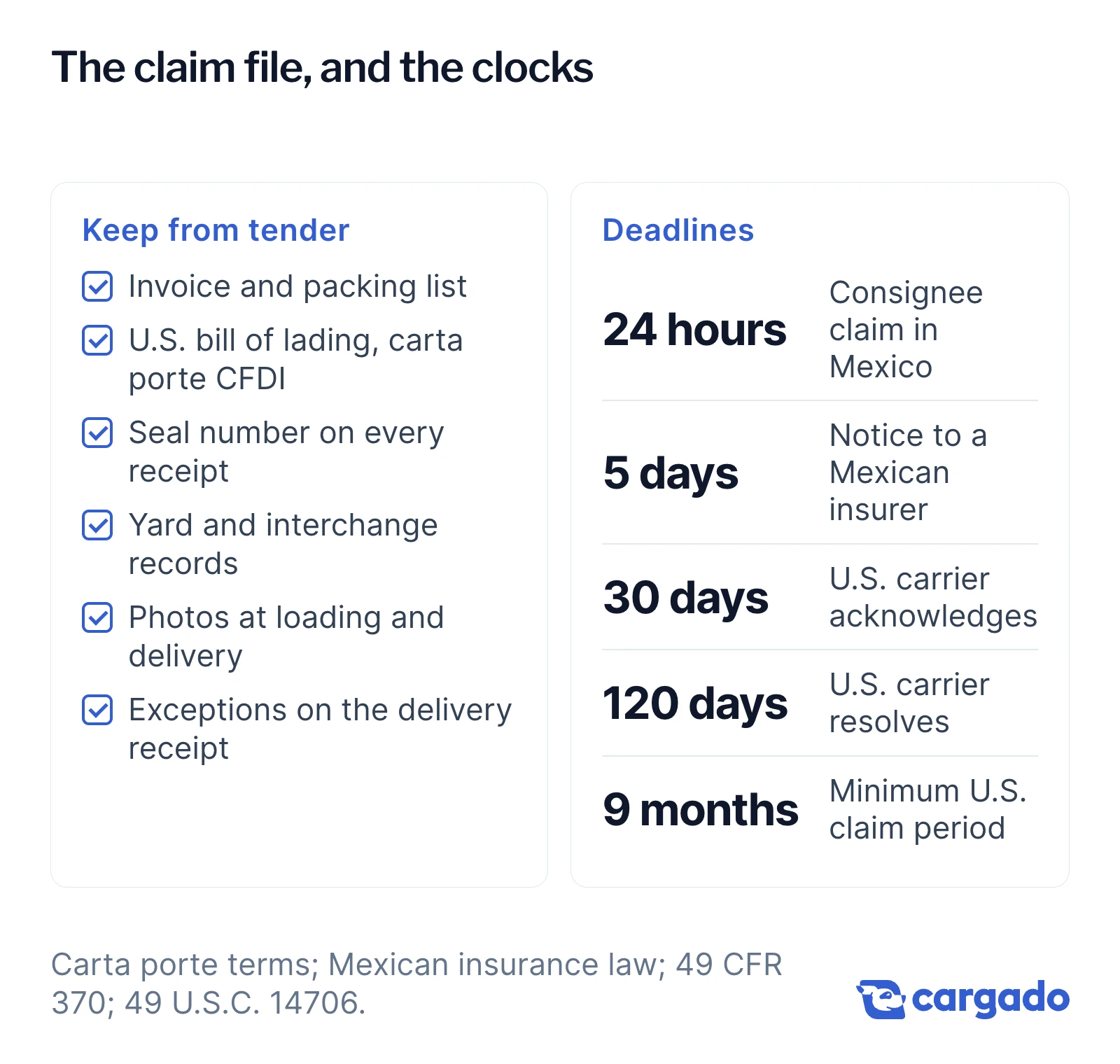
U.S. leg. A claim is a written communication that identifies the shipment, asserts the carrier's liability and claims a specified or determinable amount; notations on delivery receipts do not count on their own (49 CFR 370.3). The carrier must acknowledge it in writing within 30 days (370.5) and pay, decline or make a firm compromise offer within 120 days, with a status notice every 60 days while it stays open (370.9). A carrier cannot set a claim-filing period shorter than nine months or a suit period shorter than two years (49 U.S.C. 14706(e)(1)).
Mexican leg. Under the standard carta porte terms, the consignee files any shortage or damage claim in writing within 24 hours of delivery (clause Décima Segunda). On a two-contract move the Mexican carrier's delivery point is the consignee's dock southbound and the border yard northbound, so on a northbound load document condition at the yard. The amount recoverable is the declared value with the charge paid, or the 15-UMA-per-ton limit without it.
The insurer. Mexico's Ley sobre el Contrato de Seguro gives the insured at most five days after learning of a loss to notify the insurer, in writing unless the policy says otherwise (art. 66), and lets the insurer reduce the payout if notice is late (art. 67). U.S. policies carry their own notice terms; read both before the first load.
Who files. The party with the contract: the shipper or broker that booked each carrier files against it for its leg, and the cargo owner files on its own policy in parallel.
What should be in place before the first load?
- The carrier of record on each leg, named in the rate confirmation, with the bridge leg included.
- Each carrier's cargo certificate: limit, exclusions and territory, and whether the Mexican carrier has cargo coverage or only third-party liability.
- The declared-value decision per leg, and who pays the Mexican charge.
- The shipper's or broker's policy on the goods, with Mexico, yards and transloading inside the territory.
- One claims contact per party and one document list, agreed in writing.
- The deadlines on a calendar: 24 hours at delivery in Mexico, five days to a Mexican insurer, nine months at minimum under Carmack.
General information as of October 27, 2026, not legal advice. Produce freight has its own pages: produce cargo insurance and cargo claims on Mexico freight.
Posting Mexico freight? Brokers post loads and get Mexico rates, carriers find cross-border loads, and shippers see rates for their lanes at cargado.com.
Sources
- Ley de Caminos, Puentes y Autotransporte Federal, arts. 66, 67 and 68 (Cámara de Diputados, texto vigente, última reforma DOF 14-11-2025)
- DOF, Dec 16, 2021: Acuerdo por el que se actualiza la Carta de Porte en Autotransporte Federal, clauses Tercera, Novena, Décima and Décima Segunda
- INEGI, comunicado: valores de la Unidad de Medida y Actualización 2026 (117.31 pesos diarios desde el 1 de febrero de 2026)
- DOF, Jan 27, 2016: Decreto en materia de desindexación del salario mínimo (transitorio Tercero)
- Ley sobre el Contrato de Seguro, arts. 66 and 67 (Cámara de Diputados)
- 49 U.S.C. 14706, liability of carriers under receipts and bills of lading (LII)
- Kawasaki Kisen Kaisha Ltd. v. Regal-Beloit Corp., 561 U.S. 89 (2010): "Nor is it necessary to decide if Carmack applies to goods initially received in Canada or Mexico, for import into the United States" (LII)
- 49 CFR 370.3, 370.5 and 370.9, filing, acknowledgment and disposition of loss and damage claims (LII)
- 49 CFR 387.307, property broker surety bond or trust fund (LII)
- Federal Register, June 22, 2010: Cargo Insurance for Property Loss or Damage, final rule, docket FMCSA-2010-0189, effective March 21, 2011
- ATS: U.S. vs. Mexico Cargo Insurance, Key Coverage Differences Explained (Jul 24, 2025, updated Jul 28, 2025)
- InTek Logistics: Freight Cargo Insurance Policy Types Explained (Jul 8, 2019)