The story
Part of our guide to fresh produce freight between Mexico and the U.S.
A U.S. broker bidding its first Mexico produce program usually has a claims procedure that works, because Carmack and a U.S. carrier's cargo policy sit behind it. On the Mexican leg neither one is there. Find that out before the first reefer loads at a Mexican packhouse, not after the first warm arrival at a U.S. dock.
At a glance
- A Mexican carrier is liable from pickup to delivery, but with no declared value its liability is capped at fifteen days of the statutory unit of account per metric ton, about 1,760 pesos a ton at the 2026 UMA of 117.31 pesos, about 35,000 pesos on a 20-ton trailer.
- Declare the value on the CFDI with Carta Porte (the electronic invoice with its transport complement) and pay the surcharge, and the carrier answers for the declared value.
- Natural deterioration and bad packaging are statutory defenses. Your loading record is what beats them.
- On the Mexican leg, note any shortage or damage on the carta porte when the carrier delivers, then claim in writing within 24 hours. On a two-contract move that delivery is the border handoff yard. The 24 hours are a notice step, separate from the time to sue.
- One through bill of lading from a U.S. carrier of record means one claim, against that carrier, for the whole move. Booking the Mexican carrier to the border yourself means two claims under two sets of rules.
- Your own cargo coverage with Mexico territory is the only part of this you control completely.
Why a Mexico-leg claim is not a Carmack claim
In the U.S., Carmack (49 U.S.C. 14706) makes the carrier liable for the actual loss, lets it limit that liability only by a written declared value or written agreement, and bars any claim window shorter than nine months. Under 49 CFR Part 370 the carrier acknowledges a written claim within 30 days and pays, declines or makes a firm offer within 120.
Mexico's federal roads and transport law also holds the carrier liable, then limits that liability far more. Article 66 makes the carrier responsible for loss and damage from receipt until delivery to the consignee, then lists the exceptions: inherent vice or inadequate packaging, deterioration from the goods' own nature, false declarations by the shipper, and the one that decides most claims. When the shipper does not declare the value, liability is capped at fifteen days of the statutory unit of account per metric ton. The law's text still says minimum wage; since Mexico's 2016 de-indexation reform that unit is the UMA (Unidad de Medida y Actualización), 117.31 pesos a day in 2026, and SICT (Mexico's transport ministry) states the cap as 15 UMA in its standard Carta Porte terms. That is about 1,760 pesos a ton, about 35,000 pesos on a loaded 20-ton trailer, the figure our carrier vetting checklist works through.
Article 67 is the way out. Declare the value, pay the surcharge for the carrier's guarantee, and the carrier answers for the full declared value, fortuitous events included. And there is no nine-month floor on the Mexican side. On the Mexican leg, note any shortage or damage on the carta porte when the carrier delivers, then claim in writing within 24 hours. When the Mexican carrier's carta porte ends at the border, that delivery is the handoff yard, so check the seal, the trailer temperature and the load there. The 24 hours are a notice step, separate from the time to sue.
Who you claim against at the border handoff
It depends on what paper the load moved on, so settle it before dispatch.
If you booked a U.S. carrier that runs the Mexican leg through a partner, the common setup in which carrier runs your Mexico lane, and it issued one through bill of lading for the whole move, you claim against the carrier you booked, for the whole move, and it recovers from its partner. Carmack's text covers through-bill moves from the U.S. into an adjacent country, and a federal appeals court held a U.S. carrier that issued a through bill of lading liable for damage a Mexican drayage company caused on a southbound move, even though a customs broker had hired that company. Whether Carmack reaches the Mexican leg of a northbound move is unsettled; the Supreme Court left it open in 2010. So do not lean on the statute for a northbound produce load. Put it in the rate confirmation: the carrier of record accepts liability for the whole move, on one bill of lading, at a stated value.
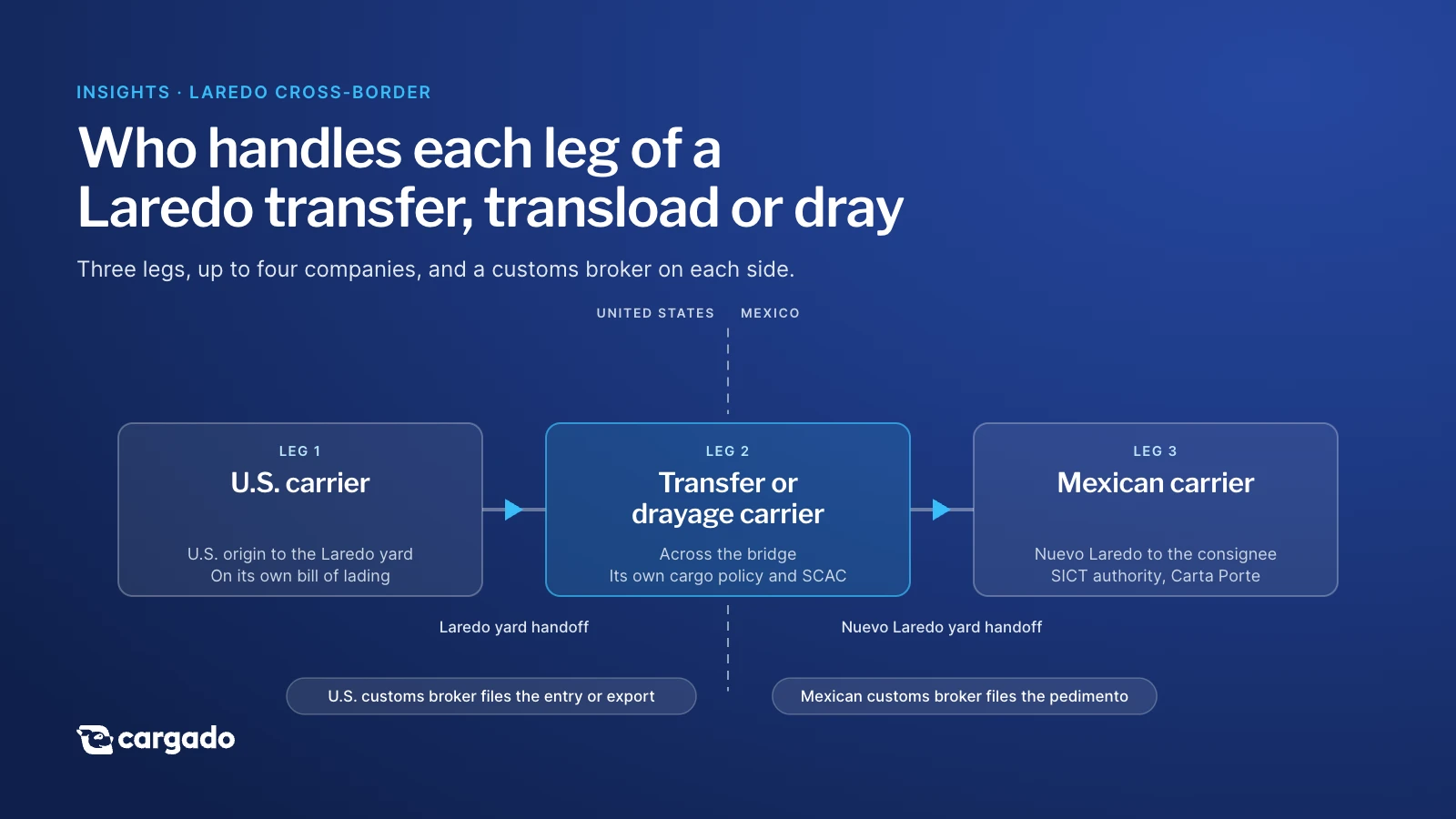
If you booked the Mexican carrier to the border yourself, on its own CFDI with Carta Porte, and a separate U.S. carrier from the bridge, you have two contracts. On a two-contract move, each carrier answers only for the segment it ran, on its own carta porte or bill of lading. The Mexican-leg claim goes to that carrier, under the cap unless value was declared, noted on the carta porte at the handoff yard and claimed in writing within 24 hours of that delivery; the U.S.-leg claim goes to the U.S. carrier under Carmack. A loss that cannot be placed on one side of the border is the gap, which is why the handoff needs its own record.
A broker is not a carrier under 49 U.S.C. 13102 and is not liable for the cargo under Carmack unless it held itself out as one. Your customer may still look to you under your contract, which is what your own cargo coverage is for.

The defense a produce carrier will reach for
Two of Article 66's exceptions, deterioration from the goods' own nature and inadequate packaging, could have been written for produce. A reefer carrier facing a warm-arrival claim will say the fruit was already turning. What you recorded at loading decides whether that holds.
Under PACA, a produce buyer has 8 hours after notice of arrival to reject a truck shipment, and unloading for any reason other than inspection counts as acceptance (7 CFR 46.2 and USDA AMS PACA guidance). Those rules sit between buyer and seller; PACA gives you no claim against a carrier. But the evidence that carries a carrier claim is the evidence PACA runs on: a USDA inspection at destination, requested before unloading where possible, with pulp temperatures on the certificate; the recorder download; and the temperature instruction the carrier was given. Where food needs temperature control for safety, the FSMA sanitary transportation rule (21 CFR 1.908) puts the written temperature spec, including pre-cool, on the party arranging the transportation, which can be a broker. Most whole produce is cooled for quality, not safety, so the rule may not reach every load; receivers ask for the same records either way. A carrier that agreed in writing to be responsible for temperature must be able to show it was held. If the recorder was never on the tender, there is nothing to show.
Set it up before the first load
- Rate confirmation terms. One through bill or two. Who is liable for the Mexican leg, at what value, and the claim window on each leg, starting from the 24-hour Carta Porte notice. Governing law. Set point, pre-cool, continuous run, and who keeps the recorder data.
- Declared value. Per lane: declare on the CFDI with Carta Porte and pay the surcharge, carry your own cargo coverage, or accept the cap. On a trailer of berries the cap is a rounding error.
- The carrier's cargo certificate and territory. Read the policy, not the certificate: territory (a U.S. policy may stop at the border; a Mexican one may cover Mexico only), reefer breakdown, perishable exclusions, the limit, and a named insured that matches the entity on the carta porte.
- Photos and seals at loading. Pulp temperatures, the pre-cool reading, the seal number on the shipping papers that travel with the carta porte and on the bill of lading, photos of the load and the seal. Repeat it at the handoff yard: who broke the seal, when, and the trailer temperature at the swap.
- Recorder data. A recorder on every load, downloaded at delivery, filed with the shipment. Name who owns the download.
- Notice. On the Mexican leg, note any shortage or damage on the carta porte when the carrier delivers, then claim in writing within 24 hours. When the Mexican carrier's carta porte ends at the border, that delivery is the handoff yard, so check the seal, the trailer temperature and the load there. The 24 hours are a notice step, separate from the time to sue. On the U.S. leg, claim within the rate-confirmation window, never shorter than nine months; a note on the U.S. delivery receipt is not a claim. Tell your own insurer too: Article 66 of Mexico's insurance contract law (Ley sobre el Contrato de Seguro) gives the insured at most five days to notify, in writing unless the policy says otherwise.
- Your own cargo coverage. Contingent cargo pays only where the carrier's policy does not. Shipper's-interest or all-risk coverage with Mexico territory is written to pay whether or not the carrier's policy responds, subject to its own terms and exclusions. Confirm with your underwriter which you have and whether Mexico, reefer breakdown and produce sit inside it.
If the carrier says no
A Mexican carrier that refuses to pay can be taken to SICT's federal trucking directorate by written complaint; the agency resolves within two months and runs conciliation hearings meant to settle in a day. Keep the carta porte, the CFDI, the inspection certificate and the recorder data in one file. Your complaint and any claim rest on those documents. On Cargado, a carrier you report is looked into and can be restricted or deactivated, and we can block it across your whole company.
Cargado is the modern marketplace for Mexico and Canada freight. Every carrier is reviewed before it can bid, and every bid shows the carrier's DOT, MC or SCT number, so you can check that the entity on your carta porte is the one you vetted. Tell us about your Mexico lanes.
General information as of 10/27/2026, not legal advice. Have your rate confirmation and cargo coverage reviewed by counsel and your underwriter.
Sources
- Ley de Caminos, Puentes y Autotransporte Federal, Articles 66 and 67 (Cámara de Diputados)
- Acuerdo por el que se actualiza la Carta de Porte en Autotransporte Federal, clauses 10 and 12 (DOF, December 16, 2021)
- INEGI, Unidad de Medida y Actualización, 2026 values
- Decree on the de-indexation of the minimum wage (DOF, January 27, 2016)
- Ley sobre el Contrato de Seguro, Article 66 (Cámara de Diputados)
- SICT, complaints for unpaid cargo indemnities
- 49 U.S.C. 14706, liability of carriers under receipts and bills of lading
- 49 CFR Part 370, processing of loss and damage claims
- 49 U.S.C. 13102, definitions of broker and motor carrier
- Tempel Steel Corp. v. Landstar Inway, Inc., 211 F.3d 1029 (7th Cir. 2000)
- Kawasaki Kisen Kaisha Ltd. v. Regal-Beloit Corp., 561 U.S. 89 (2010)
- 7 CFR 46.2, PACA definitions
- USDA AMS, PACA top 10 contracting issues
- 21 CFR 1.908, FSMA sanitary transportation of human and animal food