The story
Part of our guide to fresh produce freight between Mexico and the U.S.
A broker pricing a central Mexico produce program into South Texas, California, the Northeast and Florida asked us: what dwell time at the border should we relay to the customer as part of total transit? The short answer is one business day at the border, two when the load has a USDA inspection appointment, is transloaded, or reaches the bridge after cargo hours or on a weekend.
What border time is made of, northbound
Six stops sit between the Mexican yard and the U.S. tractor. The public wait time covers one.
- Mexican export customs. The agente aduanal files the export entry. At the export lot, Mexican customs checks documents and sends a random share of trucks to a hands-on inspection, the red light. No one publishes how long that takes.
- The bridge. The transfer driver, or on a door-to-door move a Mexican driver with a B-1 visa, who can take the trailer to its U.S. destination, pays the toll and joins the CBP line. That line is the number on our border status page, the only part of the crossing measured hourly.
- CBP primary and secondary. Primary takes 3 to 4 minutes when the officer releases the truck. A truck sent to secondary sits about an hour, by the agency figures TTI collected in 2017. Produce also draws CBP agriculture specialists; a pest or a mismatch sends a sample to USDA, and in a case CBP published from Pharr the answer came back the next day.
- FDA and USDA. FDA prior notice must be on file at least 2 hours before the truck arrives by road. Section 8e commodities, including tomatoes, onions, avocados and table grapes, need an AMS inspection, and AMS tells importers to arrange it at least one day before entry. A load without the appointment waits for the next slot.
- The state safety check. At the Texas bridges the tractor and trailer pass the DPS facility on the way out: under a minute unless pulled, about 30 minutes if it is.
- The U.S. yard. The transfer driver drops the trailer; the U.S. tractor pulls it when a driver with hours is available. On a direct move this handoff is usually the largest block of time, longer than the queue, and no agency measures it. The seal, the trailer temperature and the paperwork at that swap are also what a claim turns on; see cargo claims on Mexico freight and who insures the load on each leg.
Source: TTI, How Long Is Too Long to Cross the Border?, PRC 16-60 F, February 2017; 21 CFR 1.279; USDA AMS Section 8e import guidance; CBP Pharr local media release on an unmanifested produce shipment.
Direct crossing vs transloading
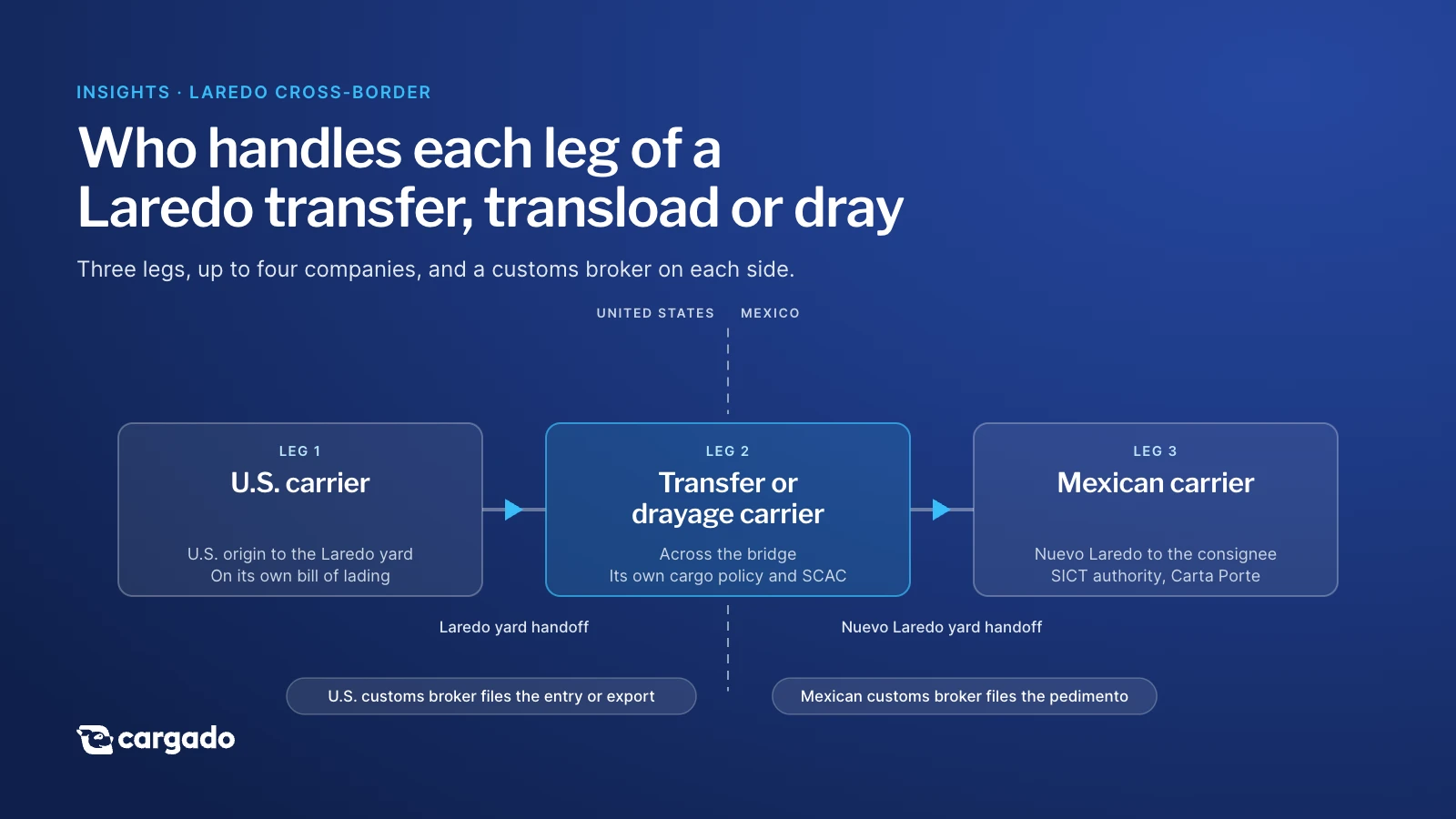
On a direct, or through-trailer, move the freight never leaves the trailer: Mexican yard, transfer driver, U.S. yard. When the trailer reaches the Mexican yard by mid-morning on a weekday and the U.S. tractor is scheduled, it is routinely a same-day crossing.
In a transload, the pallets come off at a border warehouse, are often inspected and sorted on the dock, and go into a U.S. reefer. Each touch takes time and adds claims exposure, and the warehouse's receiving hours decide whether the freight moves the same day. The model persists in Nogales because inspection and consolidation happen in one place. The full comparison is in transloading vs through-trailer.
Wait times at Pharr, Nogales and Laredo
Our hourly readings of CBP's commercial standard lanes, 10/9 to 10/27/2026, with cargo hours from CBP's port pages. The wait is the queue to primary only.
| Crossing | Median wait | Busy hours | Cargo hours (CBP) |
|---|---|---|---|
| Pharr (Pharr-Reynosa) | 15 min | 9 AM to 2 PM CT, medians 20 to 25, up to 55 | 7 AM to 10 PM CT weekdays, 8 to 4 weekends |
| Nogales (Mariposa) | 0 min | No queue in 78% of readings; 80 to 90 at midday on 10/19, 60 at 11 AM on 10/20 | 8 AM to 6 PM MST Monday to Friday, 8 to 4 Saturday, closed Sunday |
| Laredo (World Trade Bridge) | 30 min | 5 PM to 10 PM CT, medians 45, up to 60 | 7 AM to midnight CT weekdays, 8 to 4 weekends |

Pharr carried about 37% of Mexico's fruit and vegetable reefer volume in 2025 and runs cargo seven days a week. The line builds from 9 AM and clears after 3 PM. Busy days run well above the median: Pharr's daily median reached 45 minutes on 10/10 and 30 on 10/14 and 10/16. On 10/26, day one of the CANACAR driver strike, Pharr's daily median was 32.5 minutes, about double its 15-minute median for the period. Our strike page logged 50 minutes at 9 AM CT that morning, up from 20 at 7 AM, and 35 minutes on Tuesday morning, more than double the usual wait for that hour. CBP does not give a cause.
Nogales Mariposa had no queue most hours this month. Nogales is seasonal: in USDA's 2025 reefer data its produce volume built from November, ran heaviest from January to June and peaked in May, then fell about 90% by August and September, so treat these October figures as a floor. The cargo facility closes Sunday, so a Saturday afternoon arrival waits until Monday.
Laredo takes the smallest produce share of the three, about 12% in 2025, and World Trade Bridge is the busiest truck bridge on the border; its line builds all afternoon to 45-minute medians from 5 PM to 10 PM. It is the usual crossing for freight from Veracruz, and for loads whose customs broker or carrier yard is in Laredo.
Source: Cargado hourly log of CBP Border Wait Times (bwt.cbp.gov), commercial standard lanes, 10/9 to 10/27/2026; CBP port pages for Laredo and Hidalgo/Pharr (modified 11/13/2025) and Nogales (modified 8/31/2026); USDA AMS Refrigerated Truck Volumes, Mexico fruit and vegetables by port of entry, 2025.
Time of day and season
Pharr peaks late morning, World Trade Bridge in the evening. Weekends cut cargo hours to 8 AM to 4 PM at the Texas bridges, Saturday and Sunday, and to Saturday only at Mariposa. A truck that reaches Mariposa Friday evening and misses Saturday crosses Monday; at Pharr and World Trade Bridge a weekend crossing depends on whether the customs broker and a U.S. tractor are working that day. The heavy produce months run late fall into spring, and into June at Nogales; that is when the Arizona queue appears and the Texas bridges add reefer volume on top of year-round freight. Have the trailer at the border yard the evening before and cross early in the cargo day: before 9 AM at Pharr, before 5 PM at World Trade Bridge, by mid-afternoon Monday through Saturday at Mariposa. What to record when the trailer leaves the packhouse is in loading produce when the driver stays off the dock.
How to quote door-to-door transit
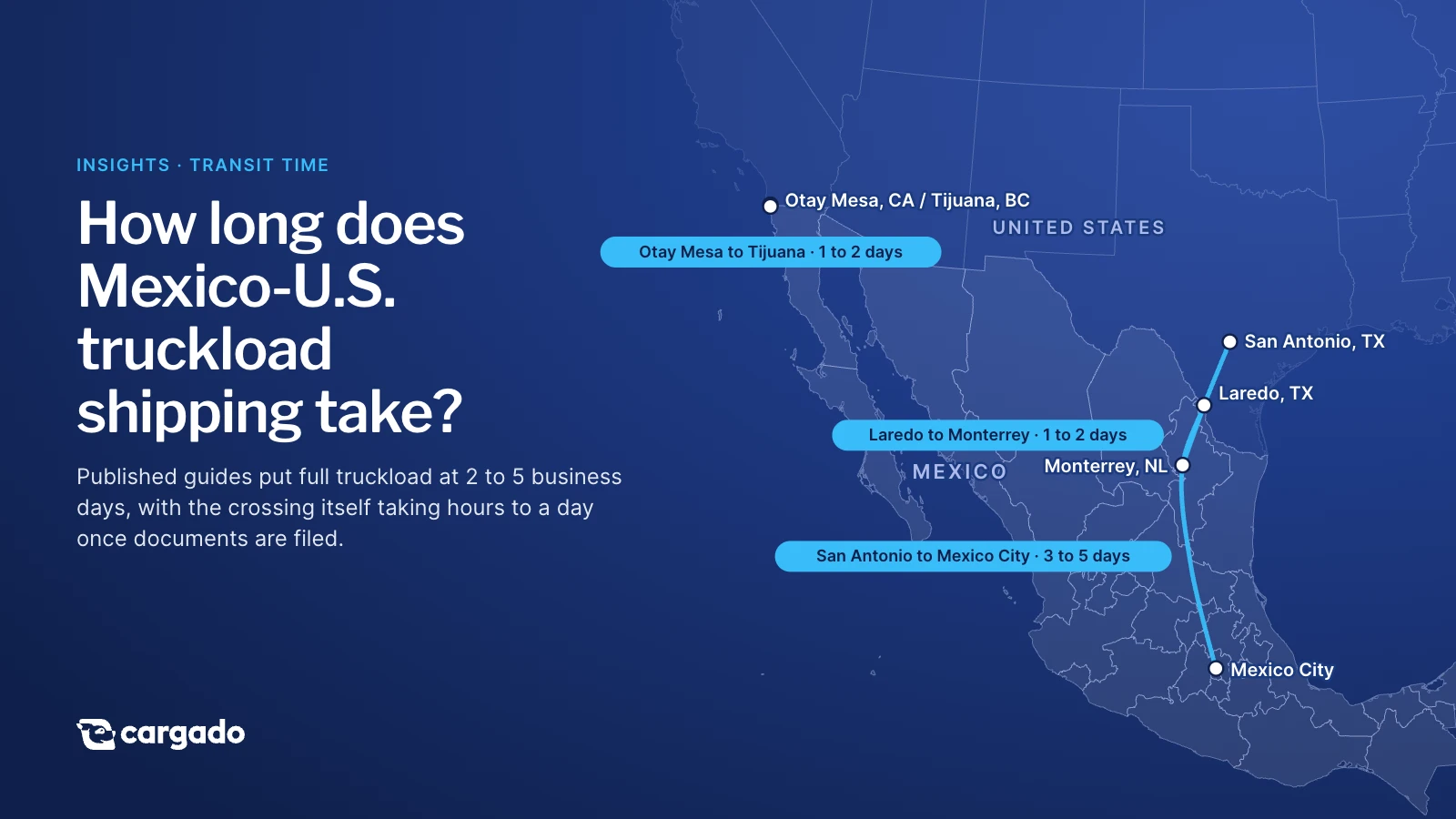
- Mexico leg. Use the Mexican carrier's own transit to the border yard, not a U.S. miles-per-day estimate; highway speeds, security stops and driver hours differ.
- Border. One business day, from the trailer's arrival at the Mexican yard to its pickup by the U.S. tractor. Two when any of these apply: an 8e commodity that needs an AMS appointment, a transload, arrival after cargo hours or on a weekend, or a shipper's first crossing with a new customs broker.
- U.S. leg. Your normal transit from the border city. South Texas is a local delivery from Pharr. Central Florida is roughly 1,350 road miles and southern New Jersey roughly 1,900, so two to three days and three to four days at solo-driver pace. Southern California from Nogales is roughly 550 miles, a one-day run.
So a direct load into South Texas is the carrier's Mexico transit, one border day, and a local delivery; central Florida adds two to three days. The sentence to relay: "Plan one business day at the border on top of the driving time, two if the load needs a USDA inspection appointment, is transloaded, or reaches the bridge after cargo hours or on a weekend, and you will hear the day the trailer clears." That matches the one to two days in transloading vs through-trailer, with the second day as the buffer. Going direct saves the warehouse time; the queue is the same either way.
General information as of 10/27/2026, not legal, tax or customs advice. Confirm filings and inspection requirements with a licensed customs broker.
See where the line is before you dispatch
Our border status page shows the current CBP wait and lanes open at every commercial crossing.
Related links
- Shipping fresh produce from Mexico to the U.S. by reefer
- Transloading vs through-trailer
- Mexico freight: which carrier should you book?
- Loading produce in Mexico when the driver stays off the dock
- Cargo claims on Mexico freight
- Cargo insurance on Mexico produce freight
- Pharr-Reynosa International Bridge
- Nogales Mariposa
- Laredo World Trade Bridge