The story
Part of our guide to fresh produce freight between Mexico and the U.S.
Most Mexican produce crosses into Texas by reefer. In Cargado it heads mostly to the McAllen and Laredo areas; Nogales is the seasonal gateway. Crop-specific preclearance, AMS inspection of listed commodities, FDA prior notice and a written temperature spec add time to the run. Northbound reefer bids are up 23% on a year ago, flat on the month.
Where Mexico's produce comes out and where it crosses
Fresh produce in Cargado comes out of west-central Mexico. Morelia sits in Michoacán, Guadalajara in Jalisco and Tepic in Nayarit, the belt that grows most of the avocados and berries bound for the U.S. Reefer carries 80% of it.
In Cargado, northbound produce heads mostly to the McAllen area, about a quarter of destinations, then the Laredo area with about a fifth, then Nogales and Southern California.
The public picture, by state of entry, agrees. In 2025, 57% of Mexico's fruit and vegetable reefer-truck volume entered through Texas, 25% through Arizona, 16% through California and 2% through New Mexico.
The crop map explains the origins. Michoacán and Jalisco are the only two states authorized to export avocados to the U.S. and grow 85% of the crop, and the same two states lead Mexico's strawberry, raspberry and blueberry production. Tomatoes come from farther north, led by Sinaloa.
Southbound produce in Cargado comes out of the Pacific Northwest and California's Central Valley. Frozen food, dairy and meat, the other reefer freight heading south, has its own article, linked below.

Source: Cargado postings, fresh produce family, 10/10/2025 to 10/9/2026 (destination shares and equipment split). USDA AMS Quarterly Refrigerated Truck Volumes by Origin, 2025, Mexico fruit and vegetables, share by U.S. state of entry calculated from the dataset. USDA FAS GAIN reports MX2026-0019 (avocado), MX2026-0015 (berries), MX2026-0028 (tomatoes). Retrieved 10/10/2026.
The season sets the market
Produce is the one freight family where the calendar matters more than the lane. In 2025, the first and second quarters each carried 29% of Mexico's reefer produce volume, the third quarter 19% and the fourth 22%.
The heavy months run from late fall into late spring, roughly November through April for the winter vegetables, with berries heaviest from November through June.
Over 2023 to 2025, strawberries moved 53% of their annual volume in the first quarter. Avocados are the exception that keeps Michoacán lanes busy all year: 30%, 24%, 19% and 28% by quarter.
The crossings feel it differently. On an index where 100 is each port's average month in 2025, Nogales truck crossings peaked at 133 in May and fell to 68 in August. Laredo stayed between 89 and 108 all year and Hidalgo between 84 and 113.
Nogales is a seasonal gateway; the Texas bridges carry mixed freight year round, so produce season shows up there as a change in reefer pricing rather than in truck counts.
Source: USDA AMS Quarterly Refrigerated Truck Volumes by Origin, Mexico, 2023 to 2025, quarterly shares calculated from the dataset. BTS Border Crossing Entry Data, trucks (all freight, not reefers only), monthly 2025, index calculated from the dataset. USDA FAS GAIN MX2026-0015 (berry windows). Retrieved 10/10/2026.
What adds cost and time between the field and the dock
Most of these are compliance steps rather than line items on a carrier's invoice. They still set how early a truck has to be booked, how long it waits at the bridge and who holds the record when a shipment arrives warm.
Authorization is crop by crop. A fruit or vegetable enters only if APHIS has found its pest risk can be mitigated and it is on the authorized list; mitigations run from treatments to registered fields and packinghouses. A new item on a pack list is a compliance project before it is a shipment.
Avocados are precleared in Mexico. Under the Hass avocado systems approach, SENASICA certifies the orchards and APHIS inspectors check the fruit at packinghouses in Michoacán and Jalisco before it ships; the fruit cutting that used to happen at the border was dropped in 2016.
The cost is a single point of failure. When U.S. inspectors pause work in Michoacán, exports pause with trucks already loaded, as happened in August 2026 (dated details in the box below). Settle with each carrier beforehand what a loaded trailer does during a pause.
AMS inspection before release. Commodities covered by Section 8e import regulations, which include tomatoes, onions, avocados and table grapes, must be inspected by AMS before CBP gives final release. The importer of record, not CBP, arranges it; AMS has a field office at Nogales and a cooperative inspection office at Pharr.
FDA prior notice. Prior notice has to be confirmed no less than two hours before the truck arrives by road. Inadequate notice can mean refusal and a hold at the port. The deadline belongs to whoever files the entry paperwork.
A written temperature spec, including pre-cool. For food that needs temperature control for safety, the FSMA sanitary transportation rule has the party that arranges the transportation (the rule calls this role the "shipper," and it can be the company that made the food or a freight broker) give the carrier the operating temperature in writing, including any pre-cool phase, unless written procedures cover it.
The loader must confirm the trailer is pre-cooled, if necessary, before loading.
When a written agreement makes the carrier responsible, it must be able to show the temperature was held if asked.
As of October 2026, 21 CFR 1.908 sets no standalone temperature-log mandate. If a shipment may have had a material temperature failure, it cannot be sold until a qualified person decides it is not unsafe. Spell out set point, pre-cool and continuous-run in the reefer agreement for that reason.
The reefer unit burns fuel while the truck waits. A conventional diesel trailer refrigeration unit uses about 0.8 gallons an hour. At the diesel prices in the box below, every hour in a queue or on an inspection hold is priced into the next bid.
Source, in order of the items above: 7 CFR 319.56-4; 7 CFR 319.56-30 (Hass avocados from Mexico); USDA FAS GAIN MX2026-0019 (avocado annual); Federal Register 2016-12586 (Mexican Hass avocado import program); U.S. Embassy Mexico security alerts 8/5, 8/7 and 8/13/2026; USDA AMS field inspection offices page; 7 CFR parts 944 and 980; CBP Customs Directive 3250-007B (2001); 21 CFR 1.279 and 1.283; 21 CFR part 1, subpart O; CARB TRU Technical Assessment Report (2020). Retrieved 10/10/2026.
As of October 2026
Everything in this box decays. Refresh it monthly, along with the dated lines elsewhere on the page.
- FSMA 204 traceability is not enforceable yet. FDA proposed (8/7/2025) moving the compliance date from 1/20/2026 to 7/20/2028, and Congress directed FDA not to enforce before then. No final rule setting the new date had been published as of 10/10/2026. On 10/9/2026 FDA proposed enforcement relief for mid-size retailers and restaurants (not growers, packers or carriers) and set a public meeting on lot-level traceability for 11/6/2026. Neither changes the compliance date.
- Produce on the Food Traceability List. Fresh melons (watermelon included), tomatoes, peppers, cucumbers, herbs, leafy greens, sprouts, tropical tree fruits such as mangoes and papayas, and fresh-cut fruits and vegetables. Avocados and limes are not on the list.
- Antidumping on tomatoes and strawberries. Tomatoes carry a cash deposit of 17.09% for most exporters (the all-others rate under order A-201-820; a few named exporters have their own rates) since the suspension agreement ended on 7/14/2025. The USITC voted on 6/30/2026 that no changed circumstances justify revoking the order, and Commerce opened the first administrative review on 9/4/2026. Fresh winter strawberries are under a pending investigation (A-201-869): Commerce's preliminary all-others rate of 4.83% (8/21/2026) is collected as a cash deposit while the case runs, its final determination is due about 1/3/2027 on the statutory schedule, and the USITC hearing is set for 1/6/2027. USDA forecasts Mexico's 2026 tomato production and exports both down 9%.
- Michoacán. The U.S. government suspended its activities in the state on 8/5/2026 after a threat against American interests; the Associated Press reported avocado inspections halted with it. Activities resumed in part on 8/8/2026 and in full on 8/13/2026. The Level 4 travel advisory is unchanged. Approved avocado states remain Michoacán and Jalisco under the APHIS operational workplan.
- Mexico's export law. A reform in force since 5/1/2026 lets Mexico restrict exports to prevent deforestation of forest land without authorization and on labor and social security grounds (Ley de Comercio Exterior Art. 15 IV and VI). It sets no restriction by itself; any measure would come through a separate instrument.
- Crossing volumes. January to August 2026 against the same months of 2025, all trucks: Laredo +1.1%, Hidalgo -1.0%, Nogales -2.2%.
- Second-quarter 2026 produce reefer rates (USDA AMS, 501 to 1,500 mile hauls): Arizona crossings up 38% year on year, Texas crossings up 55%. Diesel at Arizona crossings up 52%, at Texas crossings up 55%. Truck availability: slight shortage on average through South Texas, Calexico and San Luis, adequate by June; Nogales adequate, with a slight shortage in May. Mexico's fruit and vegetable reefer shipments were 3.21 million metric tons, down 1% year on year; tomatoes, the largest item, were down 12%.
- Section 301. Since 7/24/2026 goods of Mexico pay an extra 10% unless entered duty-free under USMCA. Tomatoes, avocados, mangoes, limes, papayas and some berries are on the U.S. note 52(b) exempt list; cucumbers, peppers, asparagus, onions and grapes are not, and no melon line was found on it. The 10% is under challenge at the U.S. Court of International Trade, which heard arguments on 9/30/2026 and had not ruled as of 10/11/2026. It is still collected.
- USMCA. The U.S. did not agree to renew at the 7/1/2026 joint review; the agreement remains in force and moves to annual reviews, with comments for the 2027 review due 1/12/2027.
Source: FDA Food Traceability Rule page and Food Traceability List page; Federal Register 2022-24417 (87 FR 70910, rule effective 1/20/2023), 2025-14967 (8/7/2025), 2026-20720 and 2026-20721 (10/9/2026); Federal Register 2025-13453, 2026-14884 and 2026-18185 (9/4/2026); USITC news release 6/30/2026; Commerce preliminary determination, fresh winter strawberries from Mexico, A-201-869, 91 FR 54297 (8/21/2026), and USITC schedule, 91 FR 57652; Ley de Comercio Exterior Art. 15 IV and VI (reform DOF 5/1/2026); Federal Register 91 FR 47318; HTSUS Rev. 21 chapter 99, U.S. note 52(b), text searched 10/11/2026; In re Section 301 Forced Labor Cases, Consol. Ct. No. 26-03555 (CIT; docket checked 10/11/2026); 91 FR 63379; USDA FAS GAIN MX2026-0028 and MX2026-0019; U.S. Embassy Mexico security alerts 8/5, 8/7 and 8/13/2026; AP 8/6/2026; BTS Border Crossing Entry Data through 8/2026; USDA AMS Mexico Transport Cost Indicator Report, second quarter 2026; USTR statement 7/1/2026. Retrieved 10/10/2026 and 10/11/2026.
General information as of 10/11/2026, not legal, tax or customs advice. Confirm classification and duty with a licensed customs broker.
How reefer bids moved through the produce year
Northbound reefer bids out of Mexico were up 23% in September 2026 against September 2025, and flat against August. Southbound reefer from all U.S. origins into Mexico rose 27% over the same year and 6.7% on the month.
These are market-level figures: the median of carrier bids on all reefer freight leaving Mexico for the U.S., not only produce. We pool across every origin market because reefer bidding out of any single market is too thin in a month to publish a defensible figure; we show that gap rather than fill it with a modeled number.
Source: Median carrier bid per mile, reefer, trips over 500 miles, U.S. dollars, September 2026 against August 2026 and September 2025. Northbound: all Mexico origins to the U.S. Southbound: all U.S. origins into Mexico. Cargado carrier bid data.
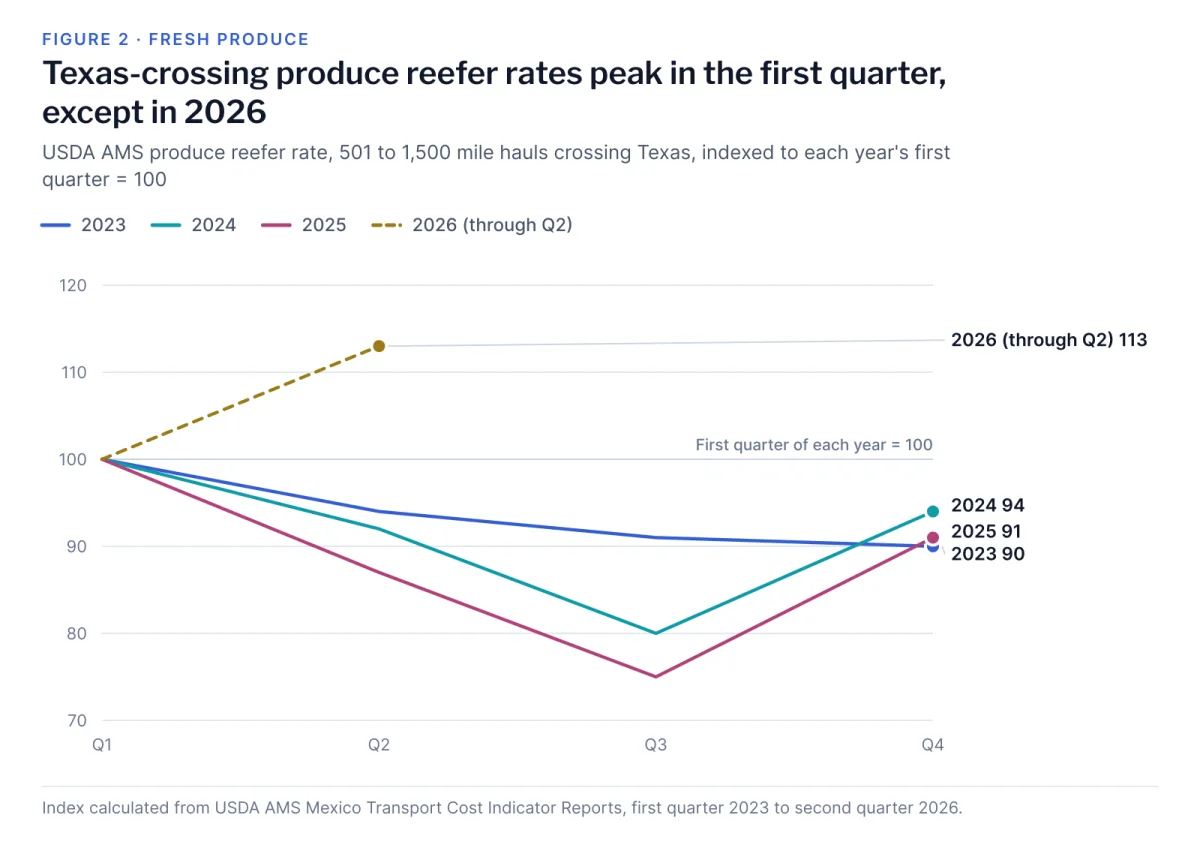
The public series points the same way. USDA's second-quarter 2026 report put produce reefer rates on 501 to 1,500 mile hauls up 38% year on year at Arizona crossings and 55% at Texas crossings, with diesel up 52% and 55%. Part of this year's rise is fuel; the reefer unit burns it too.
The season shows up in the price. In USDA's quarterly series for Texas crossings, the first quarter was the most expensive quarter of the year in 2023, 2024 and 2025, and the third quarter was the cheapest in 2024 and 2025.
In 2026 the pattern broke the other way: the second quarter came in above the first at both borders, the same rising market Cargado's +23% reflects.
Direction and haul length. Northbound and southbound are separate markets, and a short Michoacán to Rio Grande Valley run is not comparable per mile with a long haul to Southern California; compare a lane with lanes of similar length or with its own history. The automotive article works through both (/insights/automotive-parts-mexico-us, draft).
What to check on your own produce lanes
- Price the season, not the year. Texas-crossing lanes have had a first-quarter peak and a third-quarter trough in most recent years; one annual rate overpays in summer and underpays in winter.
- Price each direction on its own. A reefer returning south is buying its own market.
- Compare lanes of similar length and crossing. A Morelia to McAllen lane and a Guadalajara to Los Angeles lane are not comparable per mile.
- Put the temperature spec in writing on every tender: set point, pre-cool, continuous run or cycle, and who keeps the record.
- Name who files prior notice and who arranges AMS inspection, and by what hour, for every covered commodity through Pharr or Nogales.
- List your items on the Food Traceability List and where a lot code would be assigned at initial packing; compliance is proposed for 7/20/2028, and the shipping and receiving events sit on your shipments.
- Check that your fuel basis covers the reefer unit and both sides of the border. Cargado rates are all-in carrier bids, fuel included; see How to read a Mexico fuel surcharge.
Monthly lane watch
Median carrier bids, September 2026. We update this block each month.
| Market | Direction and equipment | vs September 2025 | vs August 2026 |
|---|---|---|---|
| Pooled northbound reefer (all Mexico origins) | Northbound reefer | +23% | -0.2% |
| Pooled southbound reefer (all U.S. origins into Mexico) | Southbound reefer | +27% | +6.7% |
| Morelia | Northbound reefer | Too few bids to report | |
| Guadalajara | Northbound reefer | Too few bids to report | |
| Tepic | Northbound reefer | Too few bids to report |
Source: Cargado carrier bid data.
See the market on your produce lanes through the season
Send us the Mexico produce lanes you are pricing, with the months they run, and we will show you where carrier bids sit through the season and say plainly where our data is thin or absent.
Talk to us → /contact?ref=industry-fresh-produce-mexico-us-reefer