The story
Structure a freight RFP with Mexico and Canada lanes as one lane file in which every cross-border lane is priced by leg (the Mexico or Canada leg, the crossing, and the U.S. leg) as well as all-in, with a cross-border section that settles, before anyone quotes, who hires and pays the customs broker on each side, which crossing or port of entry the lane uses, the Incoterms rule, fuel and accessorial terms by leg, and the documents each party provides. The rest works like a domestic bid; the cross-border section is what most RFPs leave out.
This page covers the bid file. Our Mexico 101 chapter Mexico freight usually sits outside the RFP is written for brokers and covers why cross-border is left out of the annual bid; read that one for the sales conversation.
Rules checked as of October 28, 2026.
What sections does the RFP need?
The same sections as any truckload RFP, plus one:
- Scope and timeline: what is bid, the contract term, the bid calendar, award and rate start dates.
- Lane file: one row per lane, with the cross-border columns below.
- Pricing instructions: currency per leg, fuel included or not, pricing by leg, all-in, or both.
- Cross-border terms: the section the rest of this guide spells out.
- Carrier and bidder requirements: authority, insurance, security programs, who covers each leg.
- Award rules: how bids are compared, carriers per lane, tender order, unbid lanes.
How should each cross-border lane be listed?
The price depends on how the load crosses, so each lane needs:
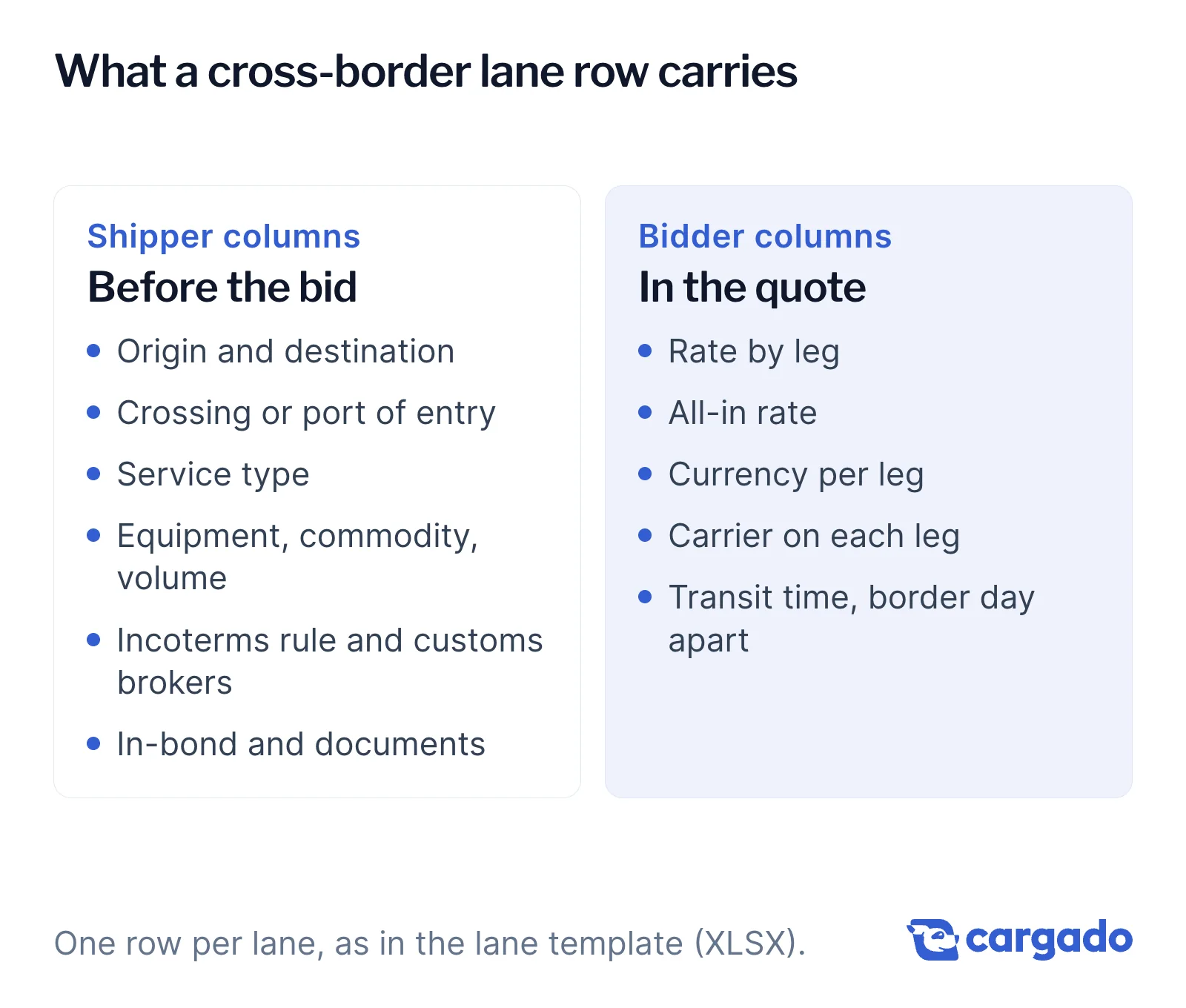
- Origin and destination with postal codes, and the direction.
- The crossing or port of entry you expect, or a note that the bidder may propose one.
- The service type: through-trailer (the same trailer crosses with a transfer carrier), transload at the border, door to door with one provider, or dray or transfer only.
- Equipment, temperature range for reefer, hazmat, commodity, average weight, annual loads, loads per week and seasonality.
- The Incoterms rule, who hires and pays each customs broker, whether the move is in-bond, and the documents the shipper will provide.
The cross-border RFP lane template (XLSX) lays these out as columns, shipper columns apart from bidder columns.
Who prices each leg?
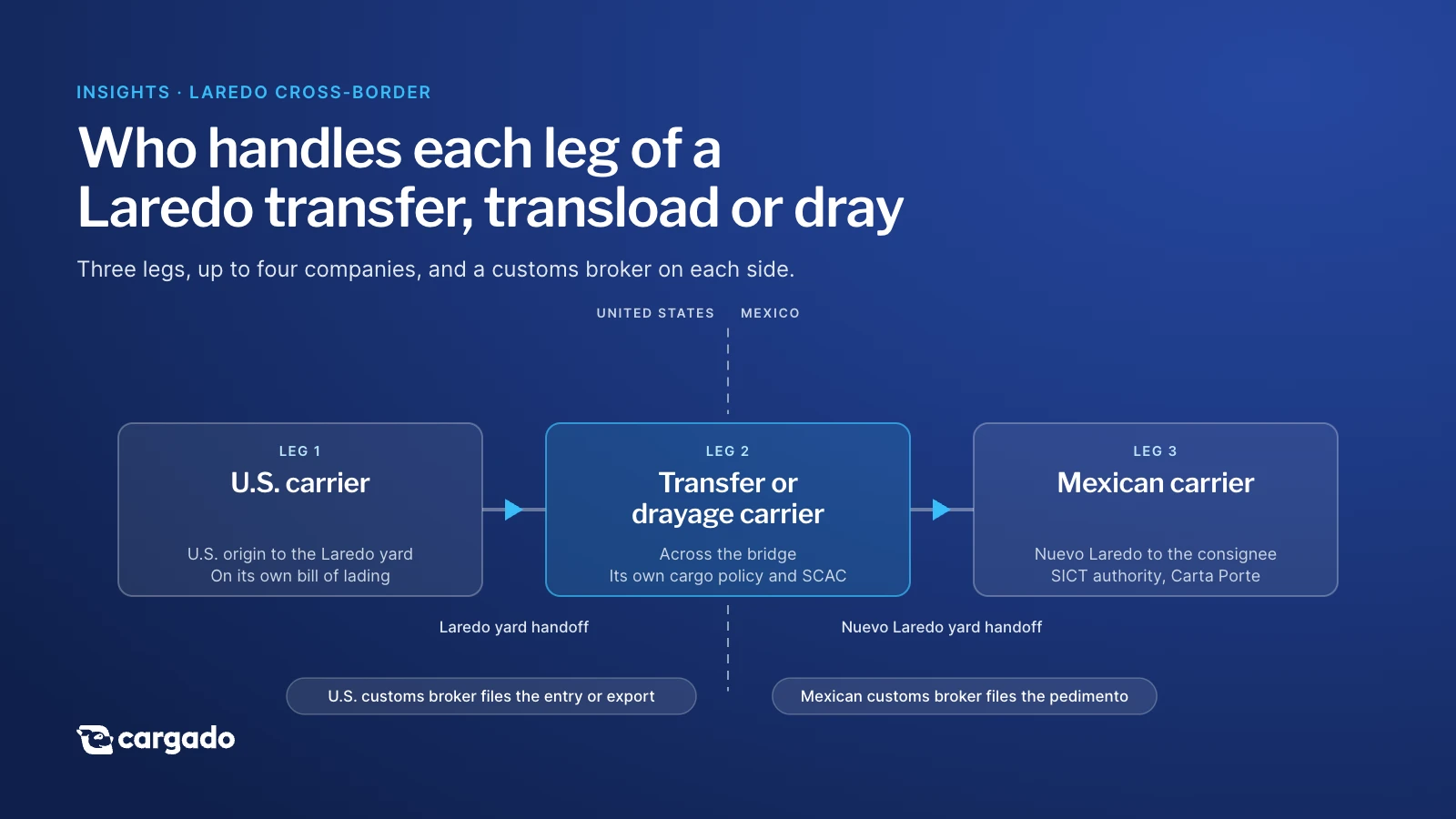
A U.S.-Mexico truckload is usually three legs: the Mexico leg, the crossing, and the U.S. leg. Ask bidders to price each leg and the all-in rate, and to name the carrier on each.
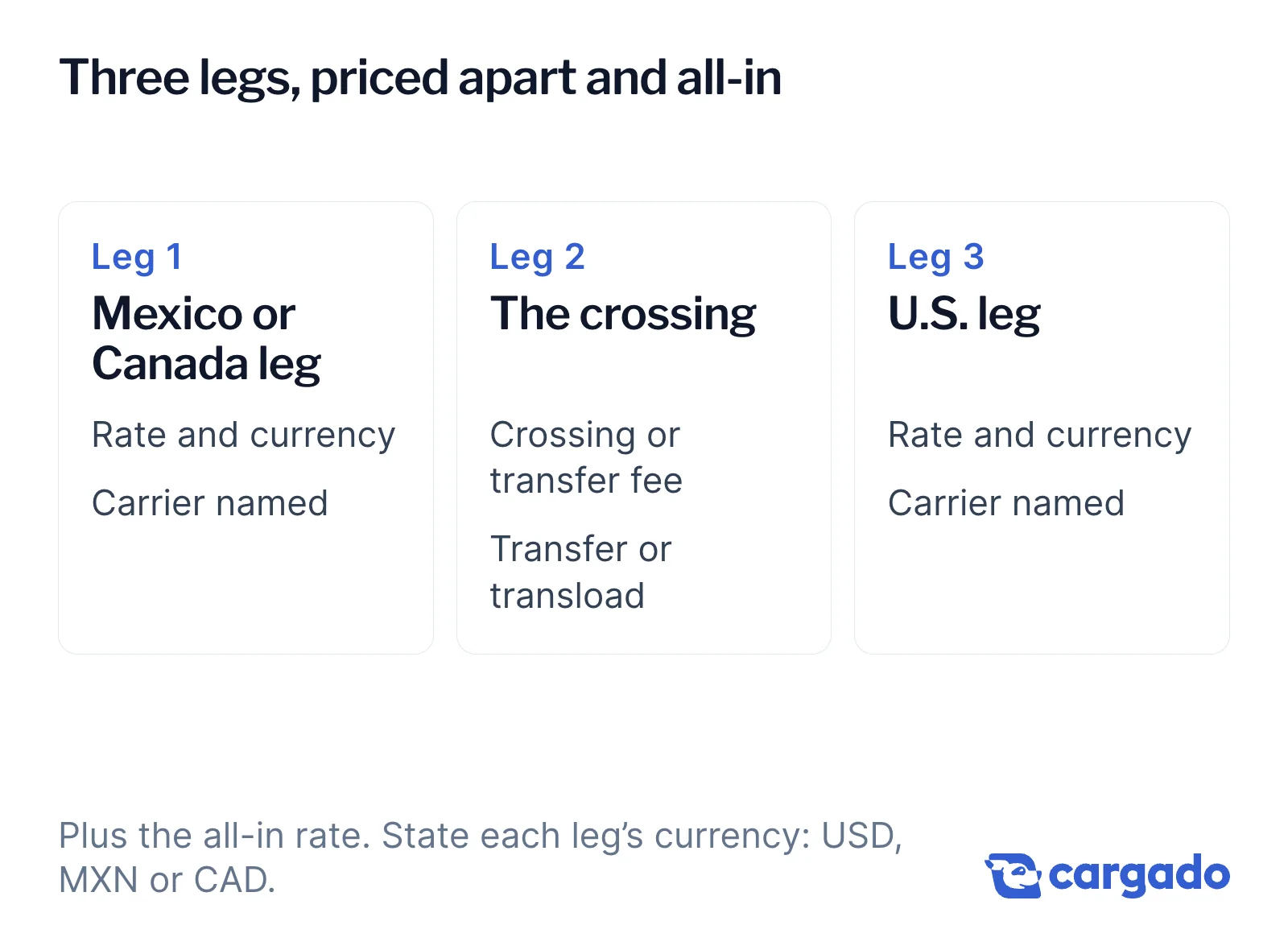
On U.S.-Mexico lanes the split is regulatory. A Mexico-domiciled carrier needs an FMCSA Certificate of Registration for the U.S. border municipalities and their commercial zones (49 CFR 368.1), separate long-haul authority to go beyond them (49 CFR 365.501), and may not haul anything but international cargo point to point inside the U.S. (49 CFR 365.501(b)). Drivers admitted as transportation operators under 8 CFR 214.2 bring international loads in and take international loads out, with no domestic unloading between. In practice lanes run as a through-trailer move (the trailer is loaded once; tractor and driver change at the border through a transfer carrier) or as a transload to a second trailer. Our guide to who handles each leg of a Laredo transfer, transload or dray walks through the handoffs.
On U.S.-Canada lanes one carrier often runs door to door, but the three-leg structure still helps when a bidder uses a partner for the Canadian leg. State each leg's currency (USD, MXN or CAD).
Which crossing or port of entry?
Name the crossing you expect, or let bidders propose one and say why. On Mexico lanes the border crossing decides where the transfer happens and which customs brokers are involved, so a Laredo quote and an Eagle Pass quote are not the same lane. On Canada lanes the port of entry matters more for the bidder's network and hours.
Who is responsible for the customs brokers?
State it per lane and per side, before you ask for rates. The customs broker is normally hired by the importer or exporter of record, not the carrier, and the Incoterms rule sets the default.
Mexico. Anyone bringing goods into or out of Mexico under a customs regime must transmit a pedimento, the electronic customs declaration (Ley Aduanera, art. 36), through an agente aduanal or agencia aduanal or the company's own accredited legal representative (art. 40). Say whose agente aduanal clears the Mexican side and who pays. On the Mexican road leg the party moving the goods, normally the carrier, issues the CFDI with the Carta Porte complement, required by the SAT on foreign trade moves since January 1, 2024 (version 3.1 since July 17, 2024).
Canada. The CBSA's import guide says every commercial importer needs a CARM Client Portal account and a 15-character business number (BN15), and that release before duties and taxes are paid requires enrollment in Release Prior to Payment with financial security posted (see CARM). An importer can delegate authority to a licensed customs broker in the portal, but the CBSA says the importer stays responsible for the accounting and liable for duties until paid. Name the Canadian importer of record, say whether its CARM registration and security are in place, and name the broker.
United States. Name the U.S. customs broker that will file the entry and who pays it. If the bidder arranges brokerage, ask for the fee as a separate line, never folded into the linehaul.
Incoterms. Incoterms 2020 has 11 rules, each allocating cost, risk and obligations between seller and buyer, including export and import clearance (article A7 of each rule, per the ICC). Put the rule on every lane row. If the rule and your customs broker column disagree, bidders will quote around the gap.
How should fuel and accessorials be written?
Set fuel terms per country leg, not per lane: the index, the base price and the update day. The U.S. Energy Information Administration publishes on-highway diesel prices every week, and Natural Resources Canada publishes daily average retail diesel prices by city. For the Mexico leg, ask the bidder to quote all-in or to name its reference and update day; our glossary entry on the fuel surcharge in Mexico covers why Mexico legs are often quoted all-in.
Accessorials need a unit, the included time before the charge starts, a rate, a currency, and the leg they apply on. The ones that cause cross-border disputes are detention at pickup, delivery and the border, inspection holds, transload handling, the transfer or dray move, layovers, truck ordered not used, and weekend or holiday crossings. Price each one in the Accessorials tab so every bidder answers the same list.
Which documents does the RFP need to assign?
List every document, who provides it and who files it. A late document stops the truck no matter whose fault it is, so the RFP has to settle who does what.
| Document | Which move | Who usually provides or files it |
|---|---|---|
| Commercial invoice and packing list | All cross-border moves | Shipper or exporter |
| Bill of lading | All moves | Carrier, from the shipper's data |
| Pedimento | Mexico imports and exports | Importer or exporter, through its agente aduanal or agencia aduanal, or its own accredited legal representative |
| CFDI with Carta Porte complement | Mexican road legs | The Mexican carrier on each Mexican leg, including the one that presents the load at Mexican customs |
| USMCA certification of origin | Moves claiming USMCA preference | The certifying party, agreed in the RFP |
| ACE truck manifest | Trucks entering the U.S. | Incoming carrier, no later than 30 minutes or 1 hour before arrival, by system (19 CFR 123.92) |
| ACI eManifest | Trucks entering Canada | Carrier, received and validated by the CBSA no later than one hour before arrival (D3-4-2) |
| U.S. customs entry | Imports into the U.S. | Importer of record, itself or through a licensed U.S. customs broker (19 U.S.C. 1484(a)) |
| Canadian release and accounting | Imports into Canada | Importer, itself or through its licensed customs broker |
| In-bond entry (IT, T&E or IE) | Freight moving through the U.S. under bond, such as Mexico to Canada | The carrier or its agent, or another party with an interest in the goods; the move needs a custodial bond (19 CFR 18.1(c) and (e)) |
The CBSA's guide adds that importers must give the carrier detailed cargo information or face delays. Write that handoff in: documents go to the carrier and the customs brokers at tender, not at pickup.
What about Mexico to Canada lanes?
A Mexico to Canada load crosses two borders and transits the U.S. The U.S. leg can move in-bond as a transportation and exportation (T&E) entry, under bond and without paying U.S. duty (19 CFR 18.1). Cargo in transit through the U.S. still needs the advance ACE filing (19 CFR 123.92(a)(1)), and the truck still needs its ACI eManifest at the Canadian port of entry. Mark the lane in-bond, name the entry and exit points, and ask whether the bidder will use a bonded carrier for the U.S. leg.
What should the carrier requirements section ask for?
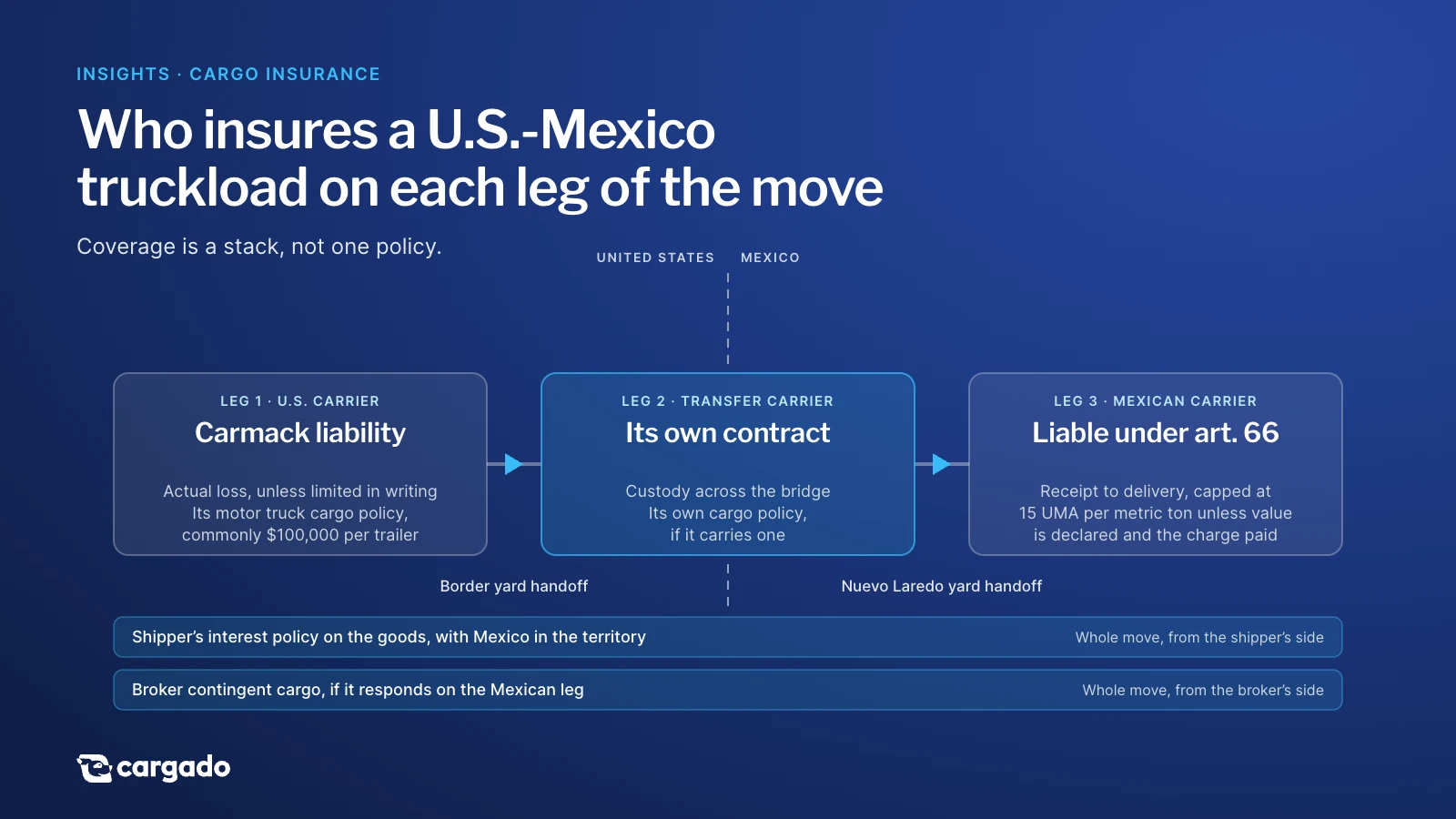
For each leg: the carrier that will run it, its FMCSA authority (long-haul or commercial zone only, for Mexico-domiciled carriers), whether it is a CTPAT member (CBP describes CTPAT as voluntary, with no cost to join), and its cargo insurance on that leg. Ask for transit time by leg, with the border day stated separately.
Start with the template
Download the cross-border RFP lane template (XLSX): a Read me tab, a Lanes tab with the shipper and bidder columns above (one row per lane, plus an example row showing the format only), an Accessorials tab with 14 named accessorials, and a Documents tab with 11 documents, who usually provides each and who files it. It holds no rates and no Cargado data.
How do you price the bid file quickly and line up consistent capacity?
Price the file with the Cargado add-in for Excel. Cargado Market Rates come from the bids vetted Mexico and Canada carriers place on Cargado over the trailing 12 weeks, refreshed weekly. With a Cargado subscription, the Cargado add-in for Excel puts those rates in the bid file: paste your lanes into the Cargado Rates sheet and each lane with enough recent bids returns a low, mid and high rate in U.S. dollars, a confidence label and, on U.S.-Mexico lanes, the recommended border crossing. Shippers use it to set a target rate for every lane before bids come back and to see which bids sit above the market range. Brokers and forwarders use it to price the whole file at once instead of asking carriers one lane at a time. Each rate is a total per load with fuel included, so compare it with a bidder's all-in line, not the linehaul.
Have your brokers post the lanes to source consistent capacity. An awarded rate holds only if trucks show up at it every week. On Cargado, brokers and forwarders post contracted freight as a lane rather than one load at a time, with the date range, loads per day, days of the week, commodity, equipment and requirements in one posting. Carriers that run the lane bid a rate per load and say how many loads they can take. Where your RFP allows lane details to be shared before award, a broker can also post an RFP lane as a Potential Lane while the bid is still open, price its response on what carriers will actually haul it for, and offer the loads to the carriers it matched with once it wins. Ask each broker or forwarder bidding your Mexico and Canada lanes how it will source capacity on every cross-border lane before award; quoting Mexico lanes and pricing RFPs from real bids shows how they do it in Cargado.
To see how your current lanes compare before the RFP goes out, get a benchmark of your Mexico and Canada lanes. The Cargado Market Update carries monthly notes on Mexico freight rates and capacity.
Sources
- 19 CFR 123.92, Electronic information for truck cargo required in advance of arrival (govinfo, 2025 edition)
- 19 CFR 18.1, In-bond application and entry; general rules (govinfo, 2025 edition)
- 49 CFR 368.1, Certificate of registration for Mexico-domiciled carriers in border commercial zones (govinfo, 2025 edition)
- 49 CFR 365.501, Special rules for certain Mexico-domiciled carriers, scope (govinfo, 2025 edition)
- 8 CFR 214.2(b)(4)(i)(E), Transportation operators under USMCA (govinfo, 2025 edition)
- U.S. Customs and Border Protection: Customs Trade Partnership Against Terrorism (CTPAT)
- CBSA Memorandum D3-4-2: Highway pre-arrival and reporting requirements (Nov 12, 2025)
- CBSA, Guide to importing commercial goods into Canada, step 4: Set up your business to import
- CBSA, Guide to importing commercial goods into Canada, step 5: Ship and report goods
- CBSA, Guide to importing commercial goods into Canada, step 6: Release, account and pay duties and taxes
- CBSA: Licensed customs brokers
- Ley Aduanera (Cámara de Diputados, consolidated text), arts. 2, 36, 36-A and 40
- SAT: Complemento Carta Porte (version 3.1 dates)
- ICC: Incoterms 2020
- U.S. Energy Information Administration: Gasoline and Diesel Fuel Update (weekly)
- Natural Resources Canada: Daily average retail prices by city (diesel)
- SAT: Preguntas frecuentes, complemento Carta Porte 3.1 (questions 1, 12 and 14)
- 19 U.S.C. 1484, Entry of merchandise (govinfo, 2023 edition)