The story
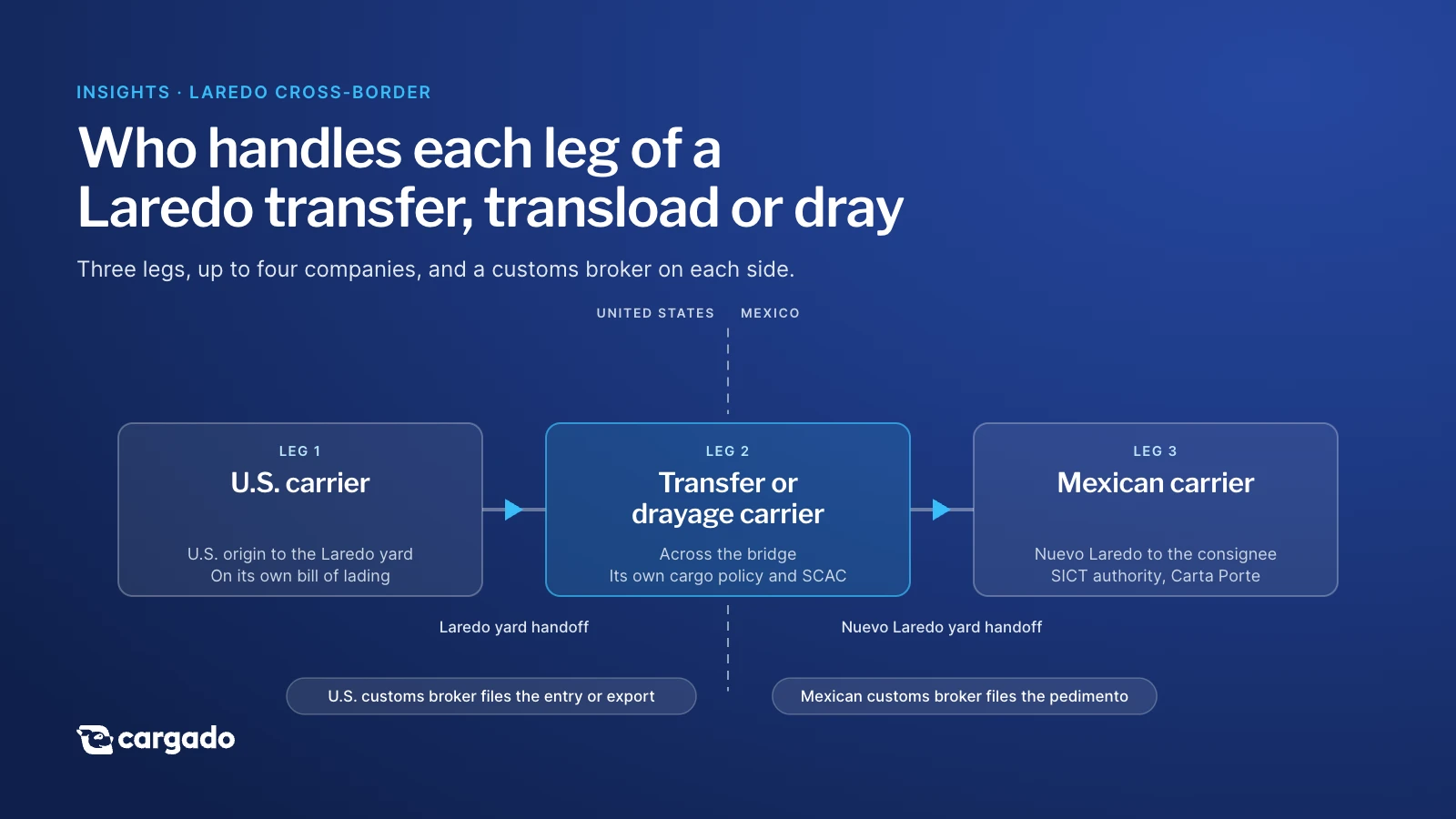
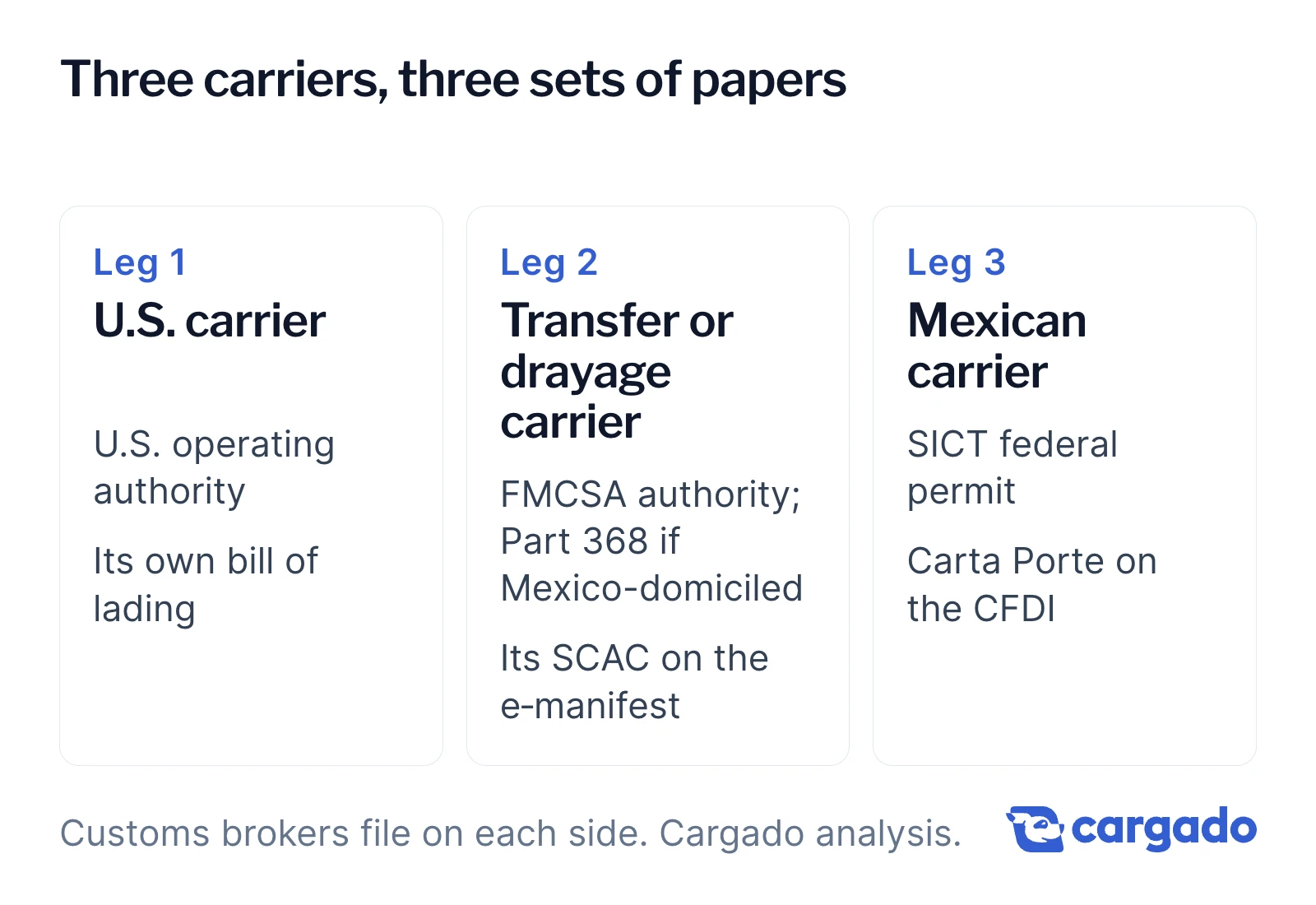
A truckload through Laredo is three legs with up to four companies on it: a U.S. carrier to the border yard, a transfer or drayage carrier across the bridge, and a Mexican carrier to the consignee, with a customs broker on each side clearing the paperwork in between. Each leg has its own carrier of record, its own authority and its own liability, and each handoff needs a named party so the move stays on schedule and on budget. This article lists who handles each leg and what to confirm before you tender.
Why is Laredo a three-leg move?
Because the law splits it. U.S. immigration rules let a Mexican driver bring international cargo into the United States and take export cargo out, but "purely domestic service or solicitation, in competition with the United States operators, is not permitted" (8 CFR 214.2(b)(4)(i)(E)(1)). On the FMCSA side, a Mexico-domiciled carrier needs a certificate of registration under 49 CFR Part 368 to operate inside the border municipalities and their commercial zones, and separate long-haul authority under 49 CFR Part 365 Subpart E to go beyond them; even then it "may not provide point-to-point transportation services, including express delivery services, within the United States for goods other than international cargo" (49 CFR 365.501(b)). Mexico mirrors the restriction for U.S. carriers. The practical result is that almost every load changes hands at the border, and the company that drives the bridge is usually not the company that drove to it. The short version is on the cabotage glossary page; the two modes for crossing (through-trailer versus transload) are compared in transloading vs through-trailer. This article is about who is responsible on each leg, not which mode to pick.
Who moves leg 1, from the U.S. origin to the Laredo yard?
Who moves it: a U.S.-authorized carrier, booked by the broker or shipper, from the origin to a yard, cross-dock or the Mexican carrier's own U.S. lot in Laredo. Who is responsible: that carrier, on its own bill of lading, until the trailer is checked in at the yard. What has to be true at drop: the yard knows the load is coming, the Mexican customs broker has the commercial invoice and packing list, and the trailer seal number is recorded on the delivery receipt. A dropped trailer that no one at the yard expects is a common reason a southbound load sits an extra day.
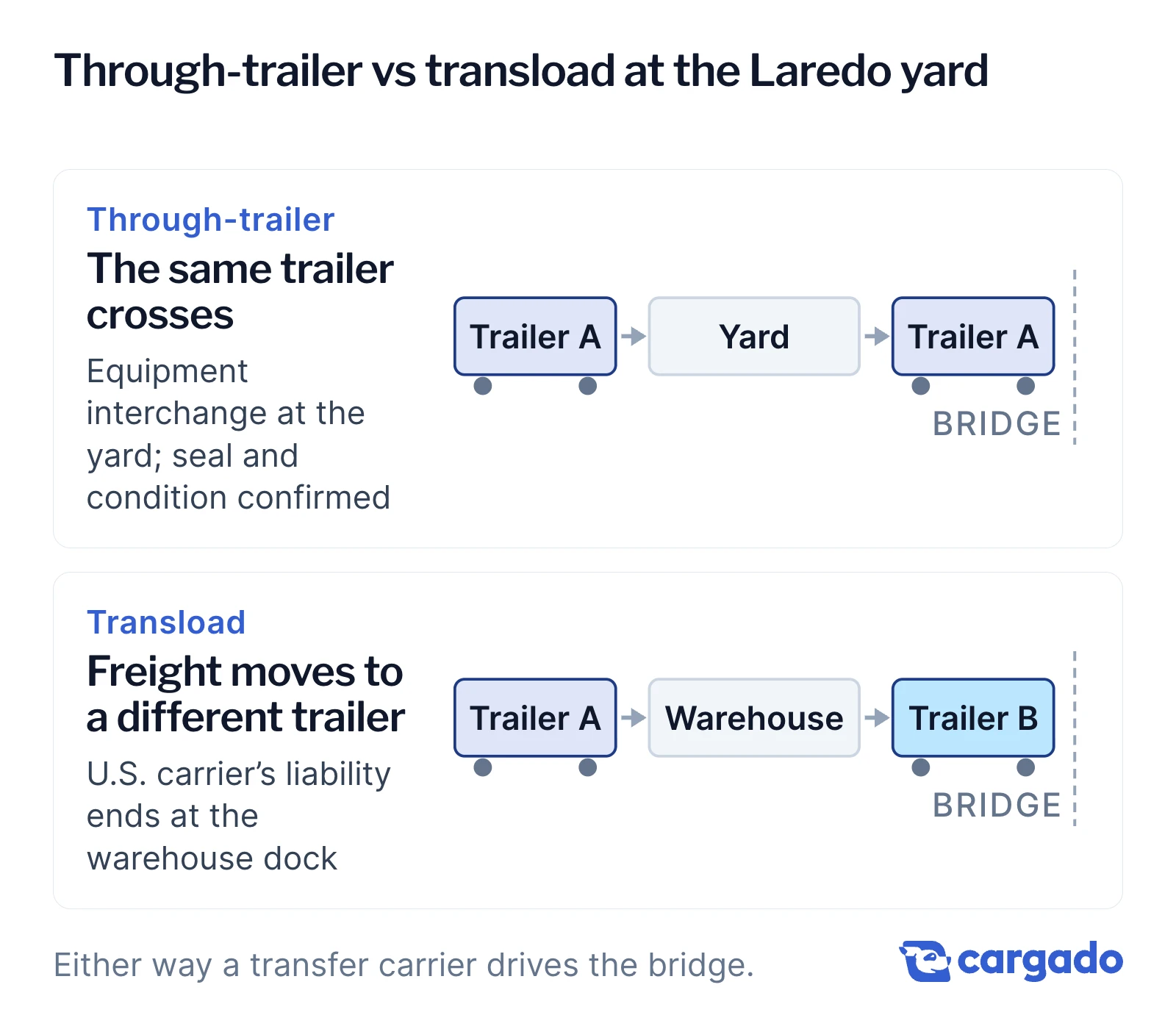
If the move is a transload, this leg ends at the warehouse and a different trailer continues; the U.S. carrier's liability ends at the dock, and the warehouse holds the freight until it is reloaded. If it is a through-trailer move, the trailer itself continues and the U.S. carrier's tractor goes home; the equipment interchange is where trailer condition and seal are confirmed.
Who moves leg 2, across the bridge?
Who moves it: a transfer carrier (the driver is the transfista) or a drayage carrier, typically Mexico-domiciled, holding Part 368 commercial-zone registration on the U.S. side and the matching Mexican permit on the other, or the Mexican line-haul carrier's own crossing unit. RXO's cross-border guide notes the crossing driver is "almost always" a different driver from the line-haul driver (RXO). Who is responsible: the transfer carrier, for the hours the trailer is in its custody, under its own cargo policy. The glossary entry on transfer explains the SCAC that appears on the e-manifest and the per-crossing cruce charge.
Who clears it: on a southbound load, the Mexican customs broker (agente aduanal) files the import pedimento, and the U.S. side files the export declaration. Only a licensed agente aduanal can file the pedimento; as ExFreight's 2026 guide puts it, "You cannot self-clear a commercial import" into Mexico (ExFreight, June 16, 2026). Northbound, the U.S. customs broker files the entry and the carrier files the ACE e-manifest before arrival. The customs broker, not the carrier, usually decides which bridge the load uses, and the transfer carrier should be booked for that bridge.
Who moves leg 3, from Nuevo Laredo to the consignee?
Who moves it: a Mexican carrier with federal SICT authority and the equipment to run the lane, booked by the Mexican broker, the shipper's Mexican forwarder, or directly by a U.S. broker that works with Mexican carriers. Who is responsible: that carrier, under Mexican law, from the Nuevo Laredo yard to delivery. Mexican carriers must carry the Carta Porte complement on the CFDI for the move; the Carta Porte page covers what it is and who issues it. Cargo coverage on this leg follows Mexican law and the carrier's own policy, not the U.S. carrier's. Confirm the Mexican carrier's cargo coverage and its limit in writing, and ask whether the shipper's own policy covers the Mexican leg.
Who coordinates all three?
Someone has to, and it is usually the broker that quoted the door-to-door rate. RXO's guide describes the Mexican customs broker coordinating with a U.S. counterpart, and that pairing, plus the yard, is the minimum set of parties that need the same load number, seal number and crossing date. A broker that books only leg 1 and assumes "the customs broker handles the rest" has no carrier of record for the bridge or for Mexico, so name all three before tender and confirm each one's coverage.
Confirm before you tender
- Customs broker named for this crossing. Company, contact, and which bridge. If you cannot name the agente aduanal, the load is not ready to move.
- Yard or cross-dock named and notified. Address, hours, who receives, and whether the trailer drops or live-unloads.
- Transfer carrier named and matched to the bridge. Its SCAC on the e-manifest, its FMCSA authority (Part 368 registration if it is Mexico-domiciled), and its Mexican permit.
- Mexican carrier named, with authority and insurance confirmed. SICT permit, Carta Porte issuer, cargo coverage and the limit.
- Documents staged before the trailer arrives. Commercial invoice, packing list, USMCA certification of origin where claimed, and any permits for regulated goods; the customs broker should have them before leg 1 delivers.
- Seal and equipment interchange. Seal number written on every handoff receipt; for through-trailer, the interchange inspection and who owns trailer damage.
- Who pays which charge. Line haul, cruce, yard storage, transload labor, customs fees and any Mexican-side detention, each assigned to a party in writing.
- One load number across all parties. The shipper's reference on every document, so the yard, the transfer carrier and the Mexican carrier can find the same trailer.
Where handoffs slip, and the fix
- The trailer arrives before the paperwork. The customs broker cannot file, the trailer sits, and storage starts. Fix: documents to the broker at tender, not at delivery.
- Two carriers each think the other has coverage for the bridge. Fix: the transfer carrier's cargo policy named in the rate confirmation.
- The wrong bridge. The transfer carrier is set up at Colombia and the customs broker filed at World Trade Bridge. Fix: confirm the bridge with the customs broker before booking the transfer.
- A U.S. driver asked to run into Mexico, or a Mexican driver asked to run a domestic U.S. leg. Both are cabotage problems, not scheduling problems.
Where a marketplace helps
The hard part of a three-leg move is finding a carrier for the legs you do not control, especially the Mexican line haul, and confirming its authority and coverage. Cargado is a marketplace for Mexico and Canada freight where brokers post cross-border loads and verified carriers, including Mexican carriers, bid on them. Learn more at cargado.com.
Sources
- 8 CFR 214.2(b)(4)(i)(E)(1), transportation operators (LII)
- 49 CFR 365.501, scope of rules for Mexico-domiciled carriers beyond the commercial zones (LII)
- 49 CFR Part 368, certificate of registration to operate in border municipalities and commercial zones (LII)
- ExFreight: Cross-border shipping between the U.S. and Mexico, a 2026 guide (Jun 16, 2026)
- RXO: Cross-border shipping guide, U.S.-Mexico