The story
Part of our guide to fresh produce freight between Mexico and the U.S.
A broker pricing a central Mexico produce program hears it from carrier after carrier: we insure the truck, not the cargo. That is usually accurate. Mexico's federal trucking law requires carriers to insure the damage they cause to other people and property, not the freight, and it caps what they owe for a lost load at a figure set by weight. So on a reefer of berries from central Mexico into South Texas, California, the Northeast or Florida, someone else's policy has to protect the load.
At a glance
- A Mexican carrier's required policy is civil liability (responsabilidad civil): it pays third parties after an accident. Cargo coverage is optional and most carriers carry little or none.
- With no declared value, the carrier's liability for the load is capped at fifteen days of the statutory unit of account per metric ton, 1,759.65 pesos a ton at the 2026 UMA of 117.31 pesos. On a 20-ton trailer that is about 35,000 pesos, roughly $1,900 at the October 27, 2026 exchange rate.
- Produce is worse off than the cap suggests: the same article of law excludes goods that deteriorate by their own nature, so a warm arrival can be argued as no carrier fault at all.
- A U.S. carrier's cargo policy usually stops at the border. Ask for the territory clause, not the certificate.
- The load gets covered by the cargo owner's transit policy, a shipper's interest policy written for Mexico, or cargo coverage the broker buys. A contingent cargo policy sits behind the carrier's and may not reach Mexico.
- Reefer breakdown is its own endorsement with its own conditions. Pre-cool, pulp temperatures and the set point on the bill of lading are the claim file.
What a Mexican carrier's insurance usually is
Article 68 of Mexico's federal roads and transport law (Ley de Caminos, Puentes y Autotransporte Federal) requires cargo carriers to guarantee the damage their vehicle or load causes to third parties, roads and other property in an accident, and Article 63 Bis requires every vehicle on federal roads to carry insurance for damage it causes to third parties and their property. That is the policy a carrier means when it says the truck is insured, and it is what you get when you ask for a certificate. It covers the goods only if the policy also has a cargo section, a separate purchase.
In the U.S., carriers carry cargo insurance because brokers and shippers require it in their contracts; the federal filing requirement for most for-hire carriers of property ended in 2011. The bigger difference is the liability underneath: a U.S. interstate carrier owes the actual loss unless the shipper agrees to a lower value in writing; a Mexican carrier's liability is capped by statute unless value is declared.
What the cap is worth on a reefer of produce
Article 66 makes the carrier responsible for loss and damage from pickup to delivery, then limits it. When the shipper does not declare the value, liability is capped at fifteen days of the statutory unit of account per metric ton. The law's text still says minimum wage; Mexico's 2016 constitutional de-indexation reform (DOF, January 27, 2016) makes that reference read as the UMA (Unidad de Medida y Actualización), 117.31 pesos a day in 2026, and SICT (Mexico's transport ministry) states the cap as 15 UMA in its standard Carta Porte terms. That puts the cap at 1,759.65 pesos per metric ton: 35,193 pesos on a 20-ton trailer, about 31,900 pesos on 40,000 pounds. At the Banco de México FIX rate of 18.65 pesos on October 27, 2026, that is about $94 per ton, about $1,900 for the trailer and about $1,700 for 40,000 pounds. Against a trailer of blueberries or avocados, it is a rounding error on the invoice.
Declaring value changes the math. Under Article 67 and the Carta Porte's ninth clause, the shipper declares the value and pays an additional charge equal to the premium the carrier buys, and the carrier then answers for the full price, including acts of God and force majeure. The value field on the Carta Porte complement is optional and does not shift liability by itself; the agreement and the charge do, and the charge is a real cost on a tight produce rate.
Why produce is the hard case
The exceptions in Article 66 are where most produce claims fail. The carrier is not liable for inherent defects or inadequate packaging, nor when the cargo by its own nature suffers total or partial deterioration. Berries that arrive soft after a slow reefer or a long bridge queue can be argued as natural deterioration, and the broker is then negotiating from zero rather than from the cap. The Carta Porte terms add a deadline. On the Mexican leg, note any shortage or damage on the carta porte when the carrier delivers, then claim in writing within 24 hours. When the Mexican carrier's carta porte ends at the border, that delivery is the handoff yard, so check the seal, the trailer temperature and the load there. The 24 hours are a notice step, separate from the time to sue. On a two-contract move, a warm arrival first noticed at the U.S. dock is already late for the Mexican leg; on one through bill, the claim goes to the carrier of record under the rate confirmation's terms. The full sequence is in cargo claims on Mexico freight.
Two documents decide whether anything is recoverable: the written temperature spec, including pre-cool, and the reefer unit's download with pulp temperatures taken at loading (what to collect at the packhouse). Where food needs temperature control for safety, the FSMA sanitary transportation rule (21 CFR 1.908) puts the written temperature spec, including pre-cool, on the party arranging the transportation, which can be a broker. Most whole produce is cooled for quality, not safety, so the rule may not reach every load; receivers ask for the same records either way. Without them no insurer can tell a breakdown from a bad load.
Does the U.S. carrier's cargo policy cover the Mexico leg?
Usually not. Most motor truck cargo policies define a coverage territory, and in practice Mexico is excluded or added by endorsement with conditions: sealed trailers, GPS on every unit, no unattended stops, toll roads where they exist. A certificate shows none of that. Ask for the territory clause and any Mexico endorsement, because a condition the carrier cannot meet is the same as no coverage.
Reefer breakdown deserves the same question by name. Standard cargo forms commonly exclude spoilage from failure of the refrigeration unit unless a reefer breakdown endorsement is added, with its own conditions: unit age limits, maintenance records, the set point on the bill of lading, pre-cool and pulp checks at pickup. Fuel exhaustion and driver error are usually excluded.
How brokers and shippers actually cover the load
The goods on a Mexico produce move are insured by one of three parties, and the broker's job is to confirm which one before dispatch.
- The cargo owner's own transit policy. Many shippers carry a marine or transit policy that follows their goods, and some have added Mexico to it. Ask whether this program is insured on their end, in which territory, and whether it covers handling and storage at a border yard.
- A shipper's interest policy written for Mexico. First-dollar coverage on the goods, bought per shipment, per program or annually, that pays the cargo owner and pursues the carrier afterward. The usual answer when the shipper's policy stops at the border. Price it into the program rate.
- The broker's contingent or primary cargo policy. Contingent cargo responds only after the carrier's policy fails, and many forms limit Mexico or require cargo coverage the Mexican carrier does not hold. Ask your agent about the Mexico leg by name.
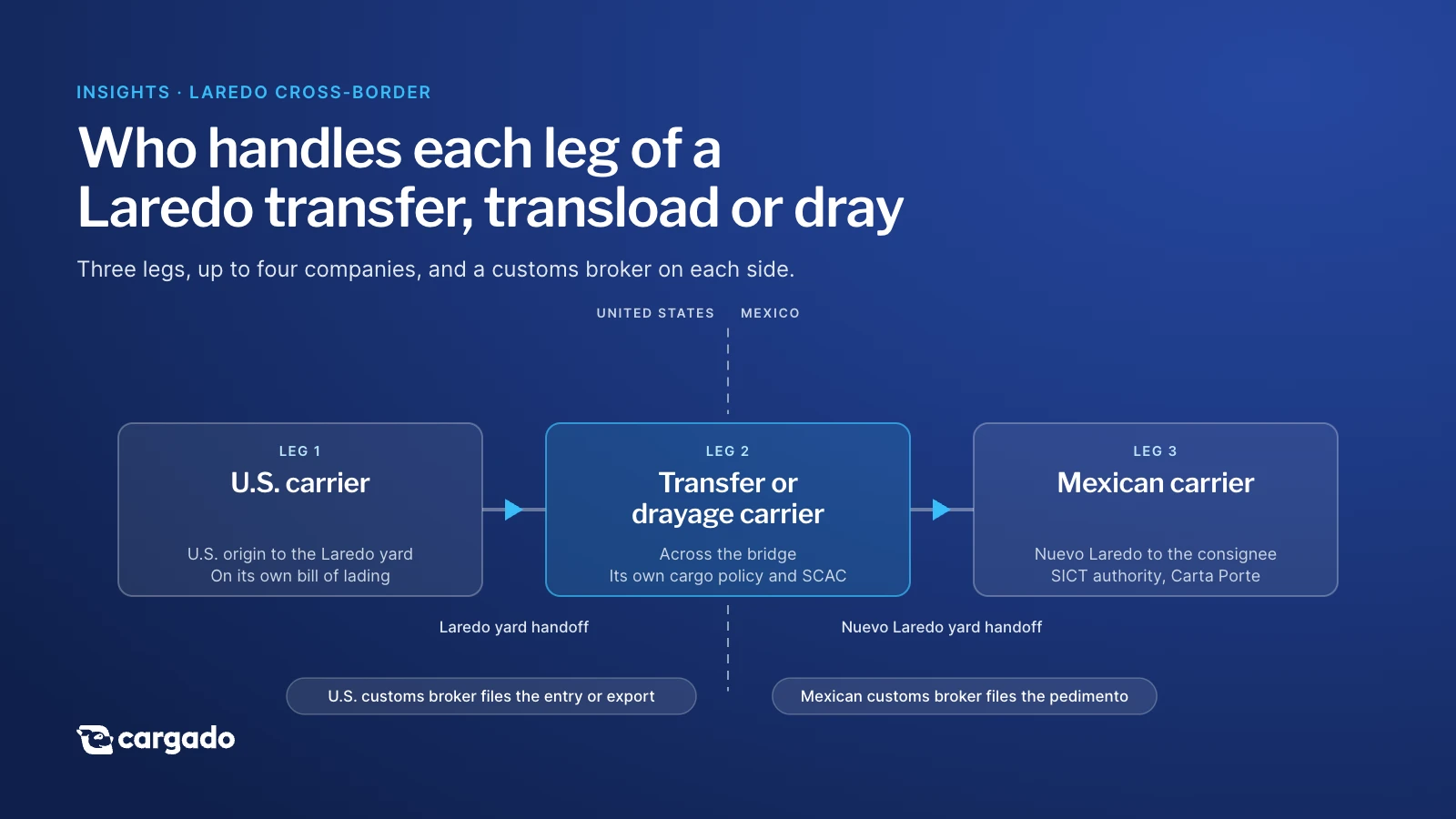
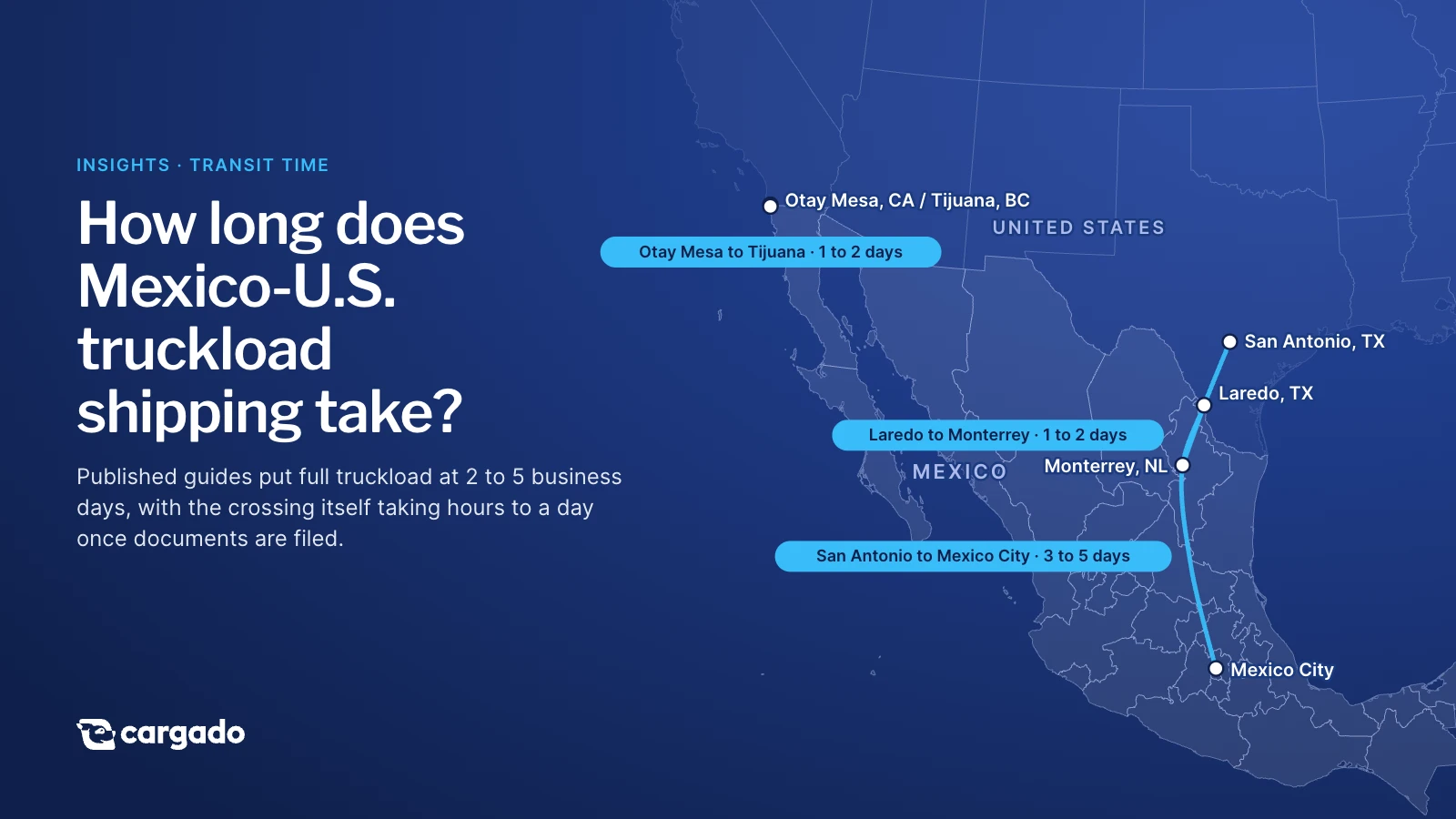
Whichever applies, get a certificate that names the territory, the commodity (fresh produce is sometimes restricted) and handling at any transfer yard. On a two-contract move, whether through-trailer or transload, the yard and the bridge are where the Mexican leg's coverage ends and the U.S. leg's has not started, so name who covers the wait; one carrier of record on a through bill closes that gap only if its cargo policy names Mexico. Plan one business day for the crossing, two with a USDA inspection appointment, a transload or an after-hours arrival; where that time goes is in how long Mexico produce sits at the border.

Whoever holds the policy has to hear about a loss fast. Under a Mexican policy, Article 66 of the Ley sobre el Contrato de Seguro, Mexico's insurance contract law, gives the insured at most five days to notify the insurer, in writing unless the policy says otherwise, and Article 67 lets the insurer cut the payment to what it would have owed on timely notice. A policy written in the U.S. sets its deadline in its own notice clause. Agree up front who tells which insurer, and see cargo claims on Mexico freight for the rest of the claim file.
Theft is a reefer problem too
Food and drinks were the most targeted product category in Mexican cargo theft in 2025, and 82% of thefts involved violence, according to Overhaul's annual report; the insurers' association AMIS counted 9,242 insured heavy vehicles stolen in the year to September 2025. Produce is easy to sell and hard to trace, which is why Mexico cargo policies attach the security conditions above. Match the carrier's operating plan to them before pickup, and run the checklist for vetting Mexican carriers so a shell company never gets the load.
What to ask a carrier before you tender
- Does your policy cover cargo, or only civil liability? Send the policy summary, not just the certificate.
- If it covers cargo, what is the limit, in which currency, and what is the deductible?
- What territory does it cover? The bridge and the U.S. side, or only up to the yard?
- Does it cover reefer breakdown, and what does the endorsement require of the driver and the unit?
- What theft conditions apply: GPS, toll roads, approved stops, escort above a value?
- Will you accept a declared value on this program, and what is the charge?
- Who holds custody at the transfer yard, and who covers the trailer while it waits?
Get the answers in writing, then ask the shipper the first three about their own policy, and put the claim terms in the rate confirmation; cargo claims on Mexico freight lists what belongs there. The outcome to avoid is learning who was supposed to insure the load after it arrived warm.
Cargado is the modern marketplace for Mexico and Canada freight, where carriers are reviewed before they can bid; it does not insure, haul or broker freight. A minimum cargo insurance you set on a Cargado posting is a carrier requirement on the load. Because many Mexican carriers hold little cargo coverage, a minimum set by habit can leave a load with no bids, so set it at what your customer and your own policy actually require, and still ask for the policy before dispatch. The coverage conversation for a specific load is yours to run.
Sources
- Ley de Caminos, Puentes y Autotransporte Federal, Articles 63 Bis, 66, 67 and 68 (Cámara de Diputados, last reform DOF November 14, 2025)
- Ley sobre el Contrato de Seguro, Articles 66 and 67 (Cámara de Diputados, last reform DOF April 4, 2013)
- Acuerdo por el que se actualiza la Carta de Porte en Autotransporte Federal, Anexo Único, clauses 9, 10 and 12 (DOF, December 16, 2021)
- INEGI, Unidad de Medida y Actualización, 2026 values (DOF, January 9, 2026)
- Decree on the de-indexation of the minimum wage, third transitory article (DOF, January 27, 2016)
- 21 CFR 1.908, FSMA sanitary transportation of human and animal food
- Banco de México, FIX exchange rate, October 27, 2026
- SAT, Estándar del Complemento Carta Porte 3.1, ValorMercancia attribute
- FMCSA, Cargo Insurance for Property Loss or Damage, final rule, 75 FR 35318 (June 22, 2010, effective March 21, 2011)
- 49 U.S.C. 14706, liability of carriers under receipts and bills of lading
- Overhaul, Mexico Annual Cargo Theft Report 2025
- AMIS heavy-vehicle theft figures, reported by El Economista (November 29, 2025)
Updated October 27, 2026. General information, not legal or insurance advice. Confirm coverage for a specific shipment with your insurance agent and counsel.