The story
- 2024Laredo office opens
- July 2024Joins Cargado
- 2025First full year on Cargado
- Early 2026Intra-Mexico flatbed
- TodayA Mexico division
At a glance
- Mexico revenue up 3,300%
In their first full year on Cargado, with 2026 on track to surpass 2025 by more than 25% - From 2 people to 9
Teams of 6 in Laredo and 3 in Monterrey, with Cargado standard operating procedure for every new hire from day one - Into intra-Mexico freight
Daily flatbed loads with trusted carriers found through Cargado - Days of sourcing became minutes
Using Market Rates to benchmark, win spot freight, and price RFPs with confidence
Challenge
A limited network built on referrals, WhatsApp, and a lot of manual work
Steam Logistics has been in business for 14 years, has opened 11 offices during that time, and generates more than $700 million in annual gross revenue. The company serves more than 5,000 customers across its air, ocean, drayage, and domestic transportation divisions. Cross-border Mexico was the one missing piece. That is, until the great freight recession in 2024, when Steam’s executive team started brainstorming new ways to grow revenue and become stickier with customers. Their answer was the one service customers constantly asked for: Mexico.
“We have all of these customers already in the building that also do Mexico, and they’re asking for it,” said Steam’s COO, Joe Saggio. “We didn’t have to sell it that hard.”
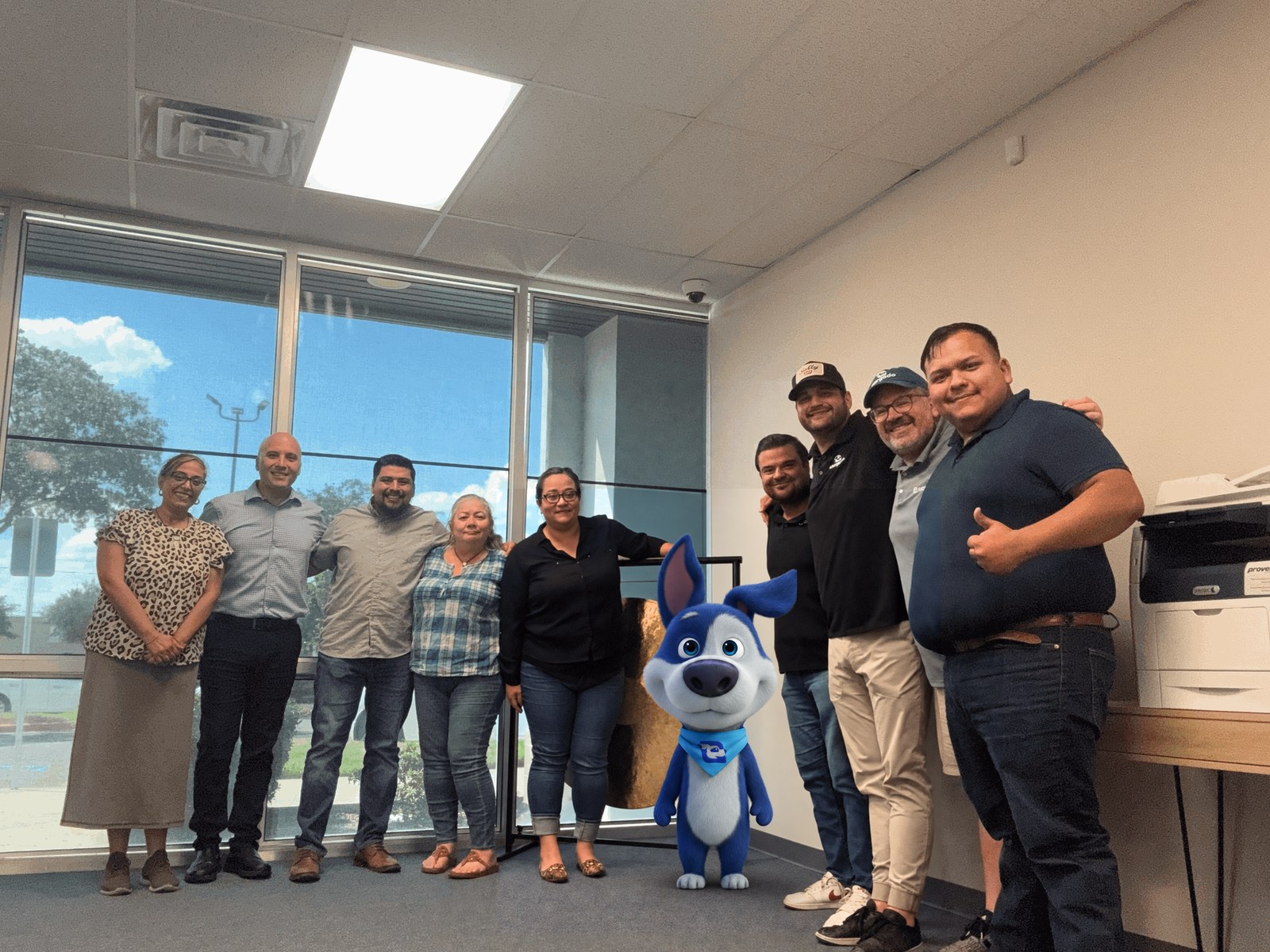
With this handful of already-trusting customers from years of domestic and international service, Steam had a strong foundation to build on. Since Mexico freight, too, is all about relationships, the Chattanooga-based 3PL invested in a physical office in Laredo and hired bilingual team members with Mexico experience. They also leaned on Monterrey-based attorneys who could make introductions within the carrier community. Joe, who speaks Spanish himself, flew to Monterrey to start building carrier relationships.
At the time, Steam's Mexico team sourced carriers the way most brokers do: through existing relationships, referrals, tribal knowledge passed between reps, and direct outreach. But even with these tactics, the team, and Steam’s deep investment, they had a challenge they couldn't build their way through, and that was finding and vetting Mexico carriers at scale.
“There was a lot of self-finding of carriers, which can be challenging,” Joe said.
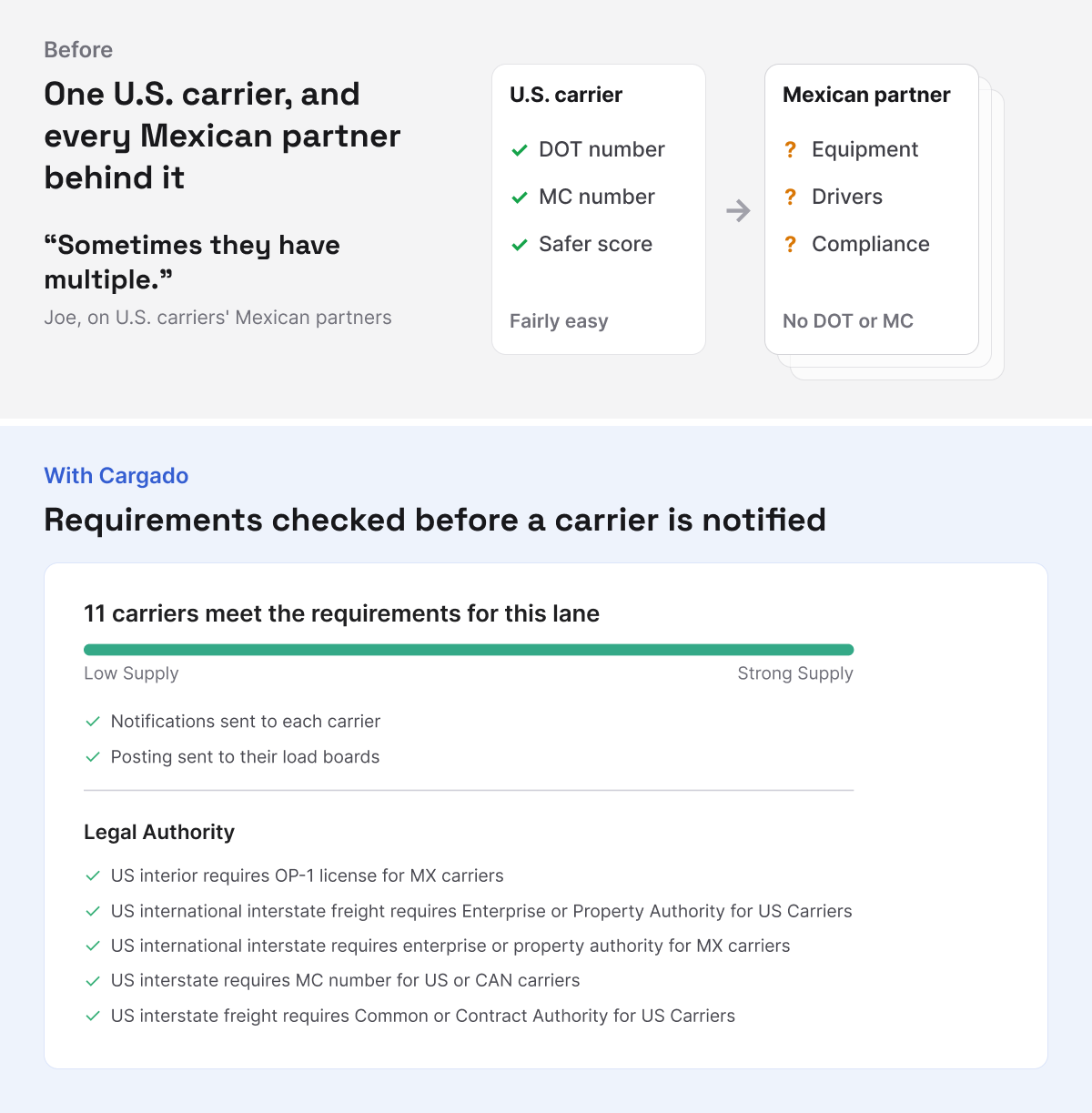
What made the vetting piece particularly difficult was how different Mexican carriers are to qualify compared to their U.S. counterparts. The domestic U.S. carrier world has DOT numbers, MC numbers, Safer scores, and digital compliance tools built for it. Mexico doesn't. Steam's attorneys in Monterrey helped fill the gap, running manual document checks and site visits on Mexican carriers, but it was slow, intensive work.
The other challenge: U.S.-based carriers that claimed to do Mexico often weren't actually crossing the border themselves, instead working with a Mexican carrier partner whose equipment, drivers, and compliance credentials were an entirely separate vetting project.
“You have to not only vet your U.S. carrier, which is fairly easy, but who is their partner or partners? Sometimes they have multiple," Joe said. Each one a different network of carriers, different relationships, and different documentation requirements.
For a team building a division from scratch, this capped Steam’s potential to grow. Their carrier base was limited, their pricing intelligence minimal, and every new lane meant starting the search process over.
Solution
The right tool at the right time, from a partner they already trusted
The legacy load boards were never part of Steam’s operation, simply because, as Joe says, these tools were built for domestic U.S. freight, not for Mexico freight. Still, Joe says of Cargado, “It’s not like your traditional load board.”
For Mexico, there was simply no equivalent. No platform that offered lane-level rate intelligence broken down by ZIP code, equipment type, and border crossing. No vetted carrier network that a broker could post to and quickly get a response, and even a bid.
"That didn't exist in the cross-border market," Joe said. "And so for us, Cargado was a no-brainer.”
It was perfect timing. They needed Cargado to meet the demand from customers as they were getting off the ground. In July 2024, Steam became one of Cargado's earliest broker partners, giving their pricing, procurement, and account teams immediate access.
Results
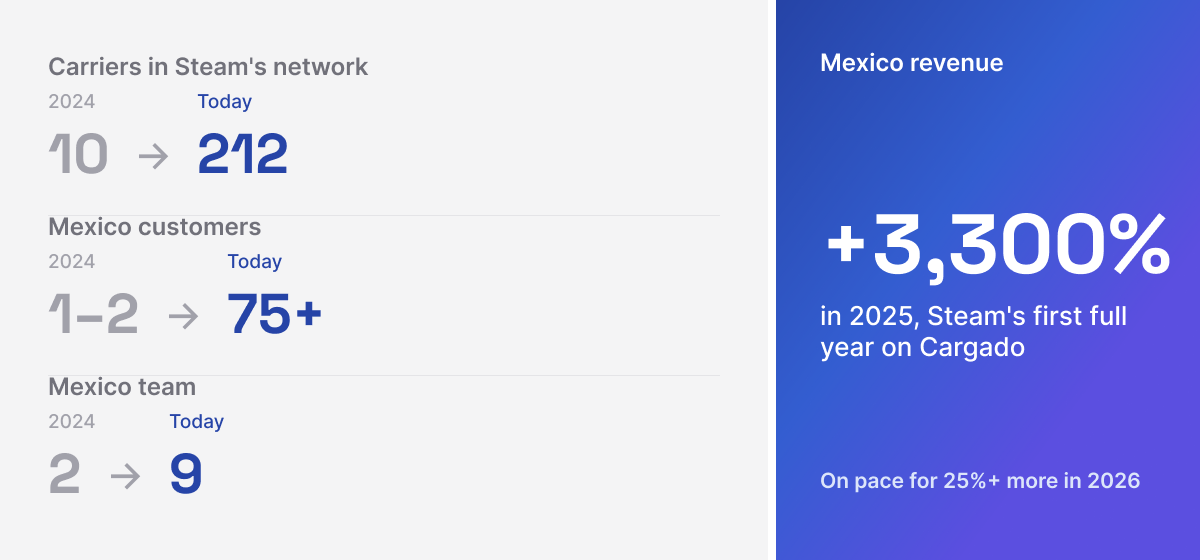
From 10 carriers and 53 shipments in 2024 to 212 carriers and a multimillion-dollar business
When Steam started moving Mexico freight in 2024, they had about 10 carriers they could call on. Today, 212 unique carriers have engaged with Steam's freight through Cargado, and several have become trusted, repeat partners that continue to come back to Steam for more freight.
“Cargado has given us access to carriers we otherwise never would have known existed,” Joe said.
The numbers show Steam’s story of growth. Starting from just a handful of shipments in their first few months of 2024, Steam's Mexico revenue grew more than 3,300% in 2025, their first full year with Cargado. In 2026, the team is on pace to grow revenue by more than 25% year over year.
The Laredo team that started with two people in 2024 now has six, and they’ve since opened a Monterrey office with three more. Their initial customer count of a few trusted shippers wanting Mexico service has grown to more than 75 customers regularly shipping Mexico freight with Steam.
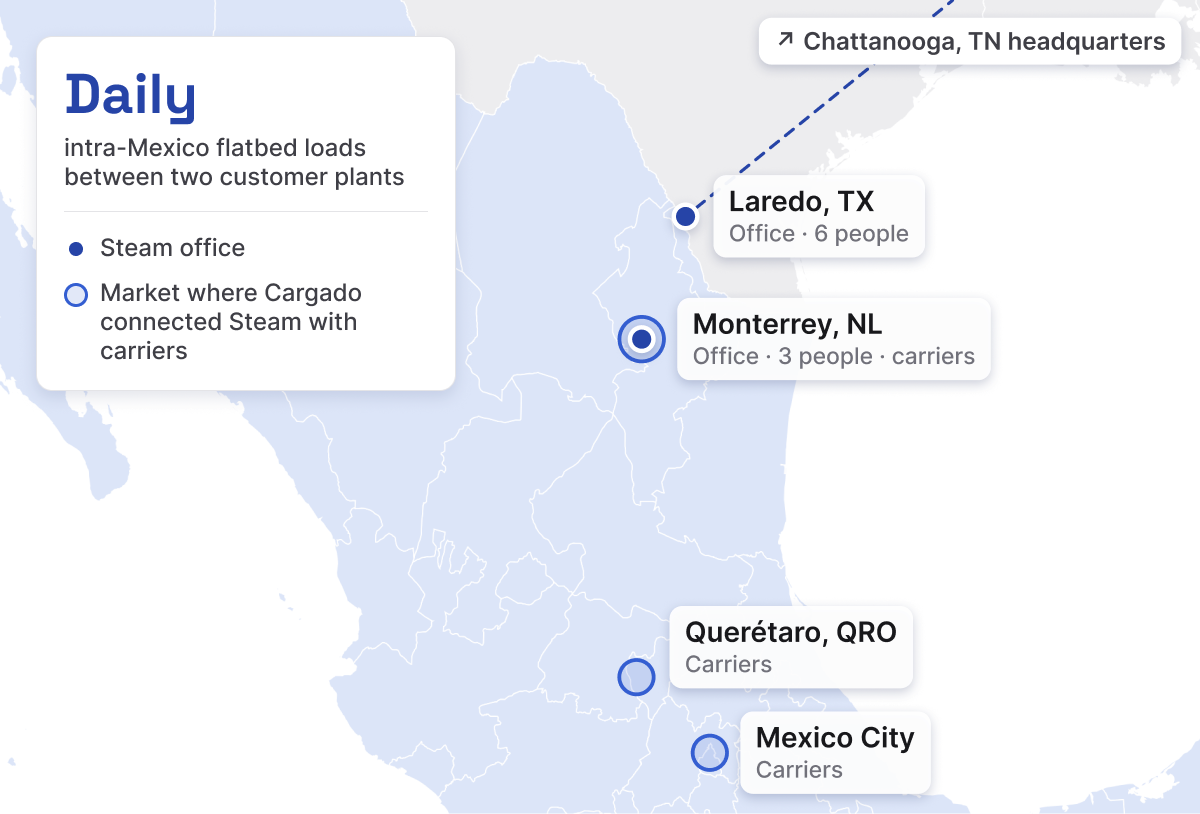
In early 2026, when a domestic customer approached Steam about moving daily flatbed loads between two plants in Mexico, Steam found the carriers through Cargado, and thus began Steam’s expansion moving intra-Mexico freight, a segment many brokers don't attempt since most aren’t set up with a Mexican entity or Mexico footprint.
“Cargado allowed us to immediately identify carriers who can support our domestic Mexico services by connecting us with carriers in key locations like Monterrey, Querétaro, and CDMX,” Joe said. Those two carriers, sourced and onboarded through Cargado, have become foundational partners for this new line of business and the relationship has only grown, with them running two to three loads a day.
Another long-standing customer that already shipped air and ocean freight with Steam has seen their Mexico volume grow significantly since Steam launched the division. Another was a prospect Steam had been chasing for years: a shipper with high-volume, southbound flatbed freight going to a single location in Mexico.
“It's higher-paying freight, not overly complicated,” Joe said, adding, “It fit perfectly in our network.”
Steam landed them three to four months ago, now moving weekly loads covered by carriers sourced through Cargado.
“We really went after them hard and got them on board,” Joe said. “Things are going well, and there are opportunities for continued growth.”
From days to minutes: Faster carrier sourcing helps Steam win more freight
Before Cargado, finding and confirming a carrier on a Mexico lane meant drafting emails, cycling through WhatsApp contacts, and waiting on callbacks. Joe recalled it could take two to three days just to compile enough options for both carrier and rate. Today, Steam's team posts a lane and bids start coming in within minutes.

“Cargado cut down on tons of emails and back and forth,” Joe said. “It is more proactive. The freight is out there, and now carriers can come to you. It cut down on a lot of administrative burden.”
In freight, the broker that gets back to a shipper first often wins the freight. The speed of Cargado gives Steam a strategic advantage, delivering rates and solutions to customers quicker than they ever could before.
“Oftentimes it's the speed of execution that wins the business,” Joe said.
This advantage only compounds as the network grows. As more brokers like Steam post freight and more carriers engage, Cargado’s marketplace grows more fluid, response times only get faster, the data only richer. Steam has felt that flywheel accelerate since they joined.
“It's helped us tremendously with onboarding new carriers, both U.S. and Mexico-based,” Joe said. “We're constantly adding new carriers because it seems like more and more are always getting added. It just gives us a lot of engagement from our team with the carriers and the Cargado network.”
Cargado’s market intelligence helps Steam win more freight faster
The advantage of speed doesn’t come with just the marketplace. Among the greatest value Cargado brings to Steam’s operation is fast access to rate data.
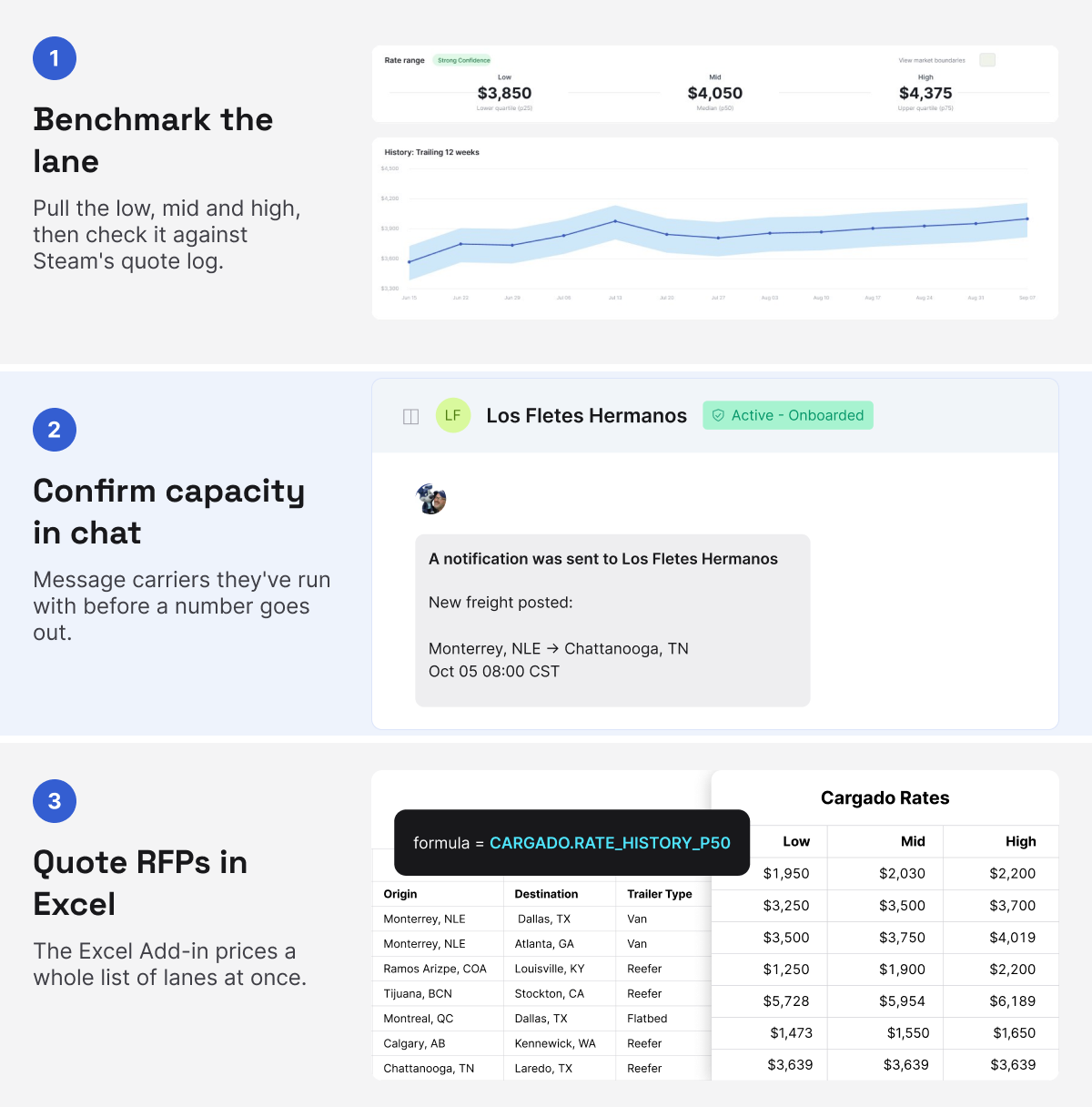
Steam's pricing and procurement team uses Cargado Market Rates daily in three ways: benchmarking to keep costs at market, pricing spot freight fast enough to win it, and running RFPs using the Excel Add-in to turn around competitive bids fast and at scale.
For benchmarking, the team uses Market Rates to pull the low, mid, and high rate range, and then they cross-reference it against an internal quote log, where they keep a running record of every rate they've given a customer, broken out by carrier. From there, they'll use Cargado's chat feature to reach out directly to a group of curated carriers they’ve run with before for more detail, to confirm capacity before a final number goes to the customer.
With a current picture of where the market sits, the team can test and adjust with precision rather than guessing.
Joe said of the spread, "It's super helpful, especially right now when the market's gotten so tight, capacity's coming out, and there are a lot of challenges with B-1 drivers. The spread gives us the ability to test a lot.”
This pricing intelligence also tightens up the learning curve for new reps. For Steam, Cargado is the infrastructure.
“Our expectation is that in the first week they’re sending customers rates and solutions because of the data they have access to,” Joe said. “It's a daily tool used by anybody in our cross-border division. When you're hired as a new hire, Cargado is happening week one. It's that important now for us.”
‘You make our lives easier’: What customers say about Steam’s Mexico offering
Steam landed its earliest Mexico freight with customers it had already built trust with in other divisions: shippers that knew what Steam's domestic service looked like and were willing to hand over their Mexico freight on that basis, especially when many of Steam's early Mexico customers had already had bad experiences, with freight getting stuck at the border for days.
Mexico freight is so complex that when a shipper finds a broker they can trust with it, they tend to stay. They buy reliability as much as they buy rates. Once a shipper trusts your cross-border process, they're unlikely to look elsewhere. That was Steam’s goal from the beginning: to become sticky with customers.
“A lot of people can tell you they can do things, but the reality is different,” Joe said. “And so we've heard that a lot: 'You make our lives easier. Whether we need you for a domestic shipment or a Mexico shipment, we don't have to go find eight different brokers or eight different asset carriers to figure out how we're going to do this.' They can just give it to Steam and trust that we're going to get it done. And it's been nice to get that kind of feedback.”
‘Real potential’ in Mexico: Steam’s investment in 2026 and beyond
Mexico has delivered the ROI that Steam's leadership team had hoped for back in 2024. In a recent interview, Steam CEO Jason Provonsha reflected on launching cross-border "right in the middle" of the freight recession, saying that now, in 2026, the business is "doing very well" and "growing really quickly."
Steam is still actively hiring in both Laredo and Monterrey, and Joe says that will continue as they go deeper into the market.
They’re also continuing to invest in intra-Mexico freight, pushing to bring on Mexican shippers: companies where the bill-to party is actually in Mexico, not just a U.S. company moving freight across the border. And they expect to build this business out through the same Cargado carrier relationships that helped launch their domestic Mexico flatbed lanes.
Through all of it, Cargado is expected to play the same role it has from the start: surfacing carriers, providing rate intelligence, and giving Steam's team the data and speed to go after opportunities that would have been out of reach before.


%2520FINAL%2520v3.jpeg)