
The Mexico freight opportunity is bigger than most brokers think
Why the Mexico lane keeps growing, and why thinner broker competition makes it worth learning now.
All chapters
TL;DR
Mexico freight is the clearest "do the hard thing once, win for years" opportunity in brokerage right now. The market keeps growing, fewer brokers compete for it than on most domestic lanes, and once you have a repeatable process the work becomes routine.
Mexico is the U.S.'s largest trading partner
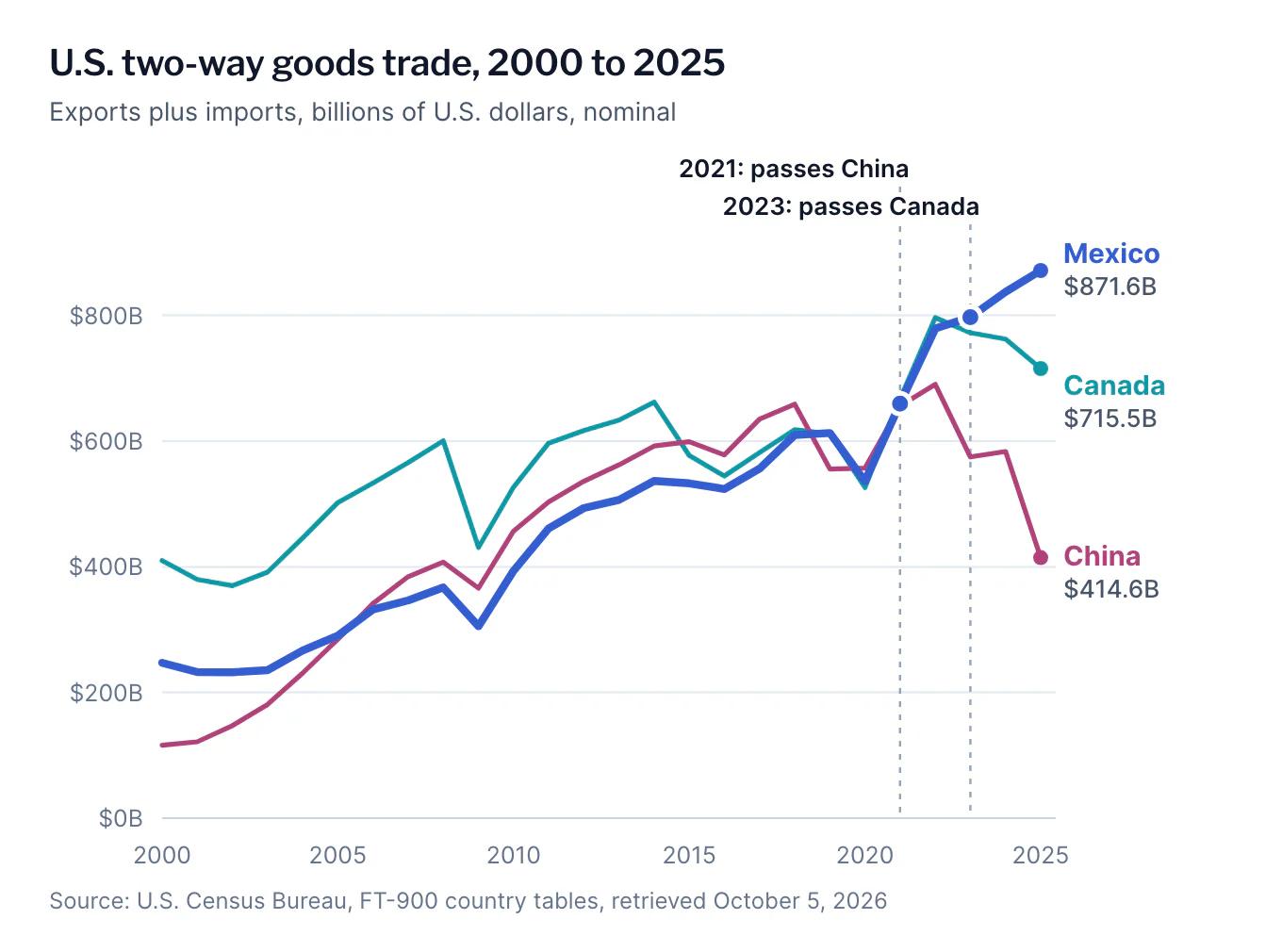
Mexico passed China in two-way goods trade with the U.S. in 2021 and passed Canada in 2023. It has been the largest U.S. trading partner every year since. Three forces drove it:
- Tariffs and trade policy uncertainty are pushing manufacturers away from long, fragile supply chains.
- Nearshoring is moving production from Asia to Mexico. Plants announced in 2023 and 2024 are opening in waves, and the freight is the last thing to show up. A plant that opened last year is quoting freight this year.
- Speed to market. A shipment from central Mexico can reach a U.S. customer in days. From China it is weeks.
USMCA is why the freight moved
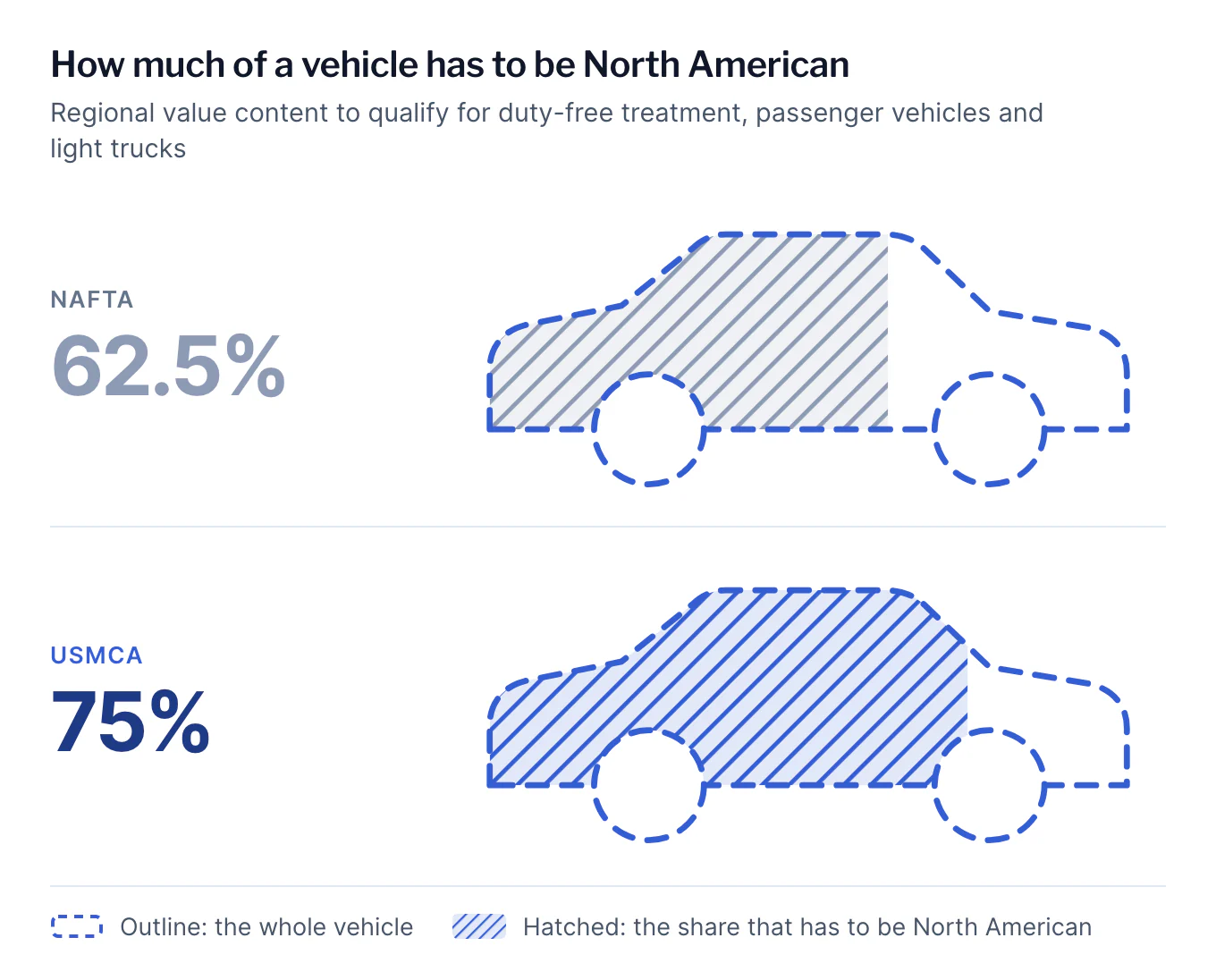
USMCA did more than keep duties low. It raised how much of a vehicle has to be North American to qualify for duty-free treatment, which pushed more parts production onto this continent. A lot of it went to Mexico.
- NAFTA required 62.5% regional value content for passenger vehicles and light trucks. USMCA raised it to 75%.
- A separate labor rule requires 40% of a car's value (45% for light trucks) to come from high-wage work, starting at $16 an hour, with some credits for technology and assembly spending.
- 70% of an automaker's steel and aluminum purchases have to be North American.
For goods that meet the rules and claim preference, USMCA takes the duty to zero. It does not switch off every tariff. Section 232 tariffs on autos, auto parts, steel and aluminum can still apply to goods that qualify for USMCA, so never tell a customer their freight "crosses duty-free." The importer and its customs broker confirm eligibility and every duty that applies, and the importer stays responsible for its claim.
Why the opportunity is real
Shippers buy reliability on Mexico freight. The rate matters, and execution decides who keeps the lane.
Mexico freight opens accounts
Mexico freight can start conversations domestic freight can't:
- It gets you meetings outside RFP cycles. When someone says "call me next contract season," ask about Mexico. Those lanes are often messy, expensive, or both.
- It expands wallet share inside your current book. Many customers already have Mexico lanes. They just assume you don't handle them.
- It differentiates you. "We run cross-border Mexico with clean execution and visibility" stands out against generic capacity claims.
Know the major truck crossings
Laredo is the busiest crossing for trucks coming from Mexico by a wide margin, at about four in ten inbound trucks in 2025 (BTS Border Crossing/Entry Data). The other crossings to know:
Manufacturing clusters in the Bajío (Querétaro, Guanajuato, Aguascalientes, San Luis Potosí) and around Monterrey create steady northbound volume.
Five myths that keep brokers out
Each of these is a reason somebody didn't quote a Mexico load this week. Each one has a practical answer.
| Myth | Reality |
|---|---|
| "Mexico freight is too risky to touch." | Cargo theft is real on both sides of the border, and it is a managed risk. What changes the outcome is vetted carriers, no load-board strangers, GPS and geofencing, secured yards, and avoiding the known hot segments. Cross-border carriers are often CTPAT-certified because the shippers they haul for require it. Treat a Mexico load like any other high-value lane. As our founder Matt Silver puts it: "Double brokering has cost me more than Mexico." |
| "The border is chaos." | It looks that way from the outside. Up close, it is the same documents, the same parties and the same sequence on every load. |
| "You need someone in Mexico." | Start with nobody and scale later. You don't need a Mexican entity, an office or staff. The carrier and the customs broker already have all of that. |
| "It's all about price." | The cheapest carrier gets one load. The carrier who crosses on time keeps the lane. |
| "I need to find a Mexican shipper." | Most Mexico freight is bought by U.S. companies importing it. They are already in your CRM. You just haven't asked them where their freight starts. |
Where to start
Most of the "difficulty" is knowing what to ask early:
- Who's your customs broker?
- Where are you crossing?
- Do you control both ends of the shipment?
- What's the commodity and its value?
- Who is covering this load if something happens to it?
Brokers like Blackbox Logistics started with zero Mexico experience. Blackbox launched its Mexico operation within 36 hours of signing up for Cargado and was profitable on day two, with its first covered load.
If you're already touching border-city freight, you're closer than you think. Start with Chapter 2: how to find the Mexico freight already hiding in your book.
Ready to see Mexico market rates and vetted carriers?
The guide covers the playbook. A demo shows it running.