
How Mexico freight actually moves
The parties, the handoffs and the crossing timeline on a typical cross-border load, start to finish.
All chapters
Cross-border moves involve more parties, but the motion is repeatable. Most of the time you are coordinating one primary carrier that manages a Mexico partner, the border crossing and the U.S. delivery. Your job is to pick the right crossing method, confirm capacity constraints early, and treat customs readiness as a hard gate before pickup.
The parties on a cross-border shipment
Most Mexico moves involve:
That sounds like a lot. In practice you're usually working with one carrier who coordinates all of it, through its Mexican partner and its border operation. Your job is to give that carrier the freight and make sure the paperwork is in order.
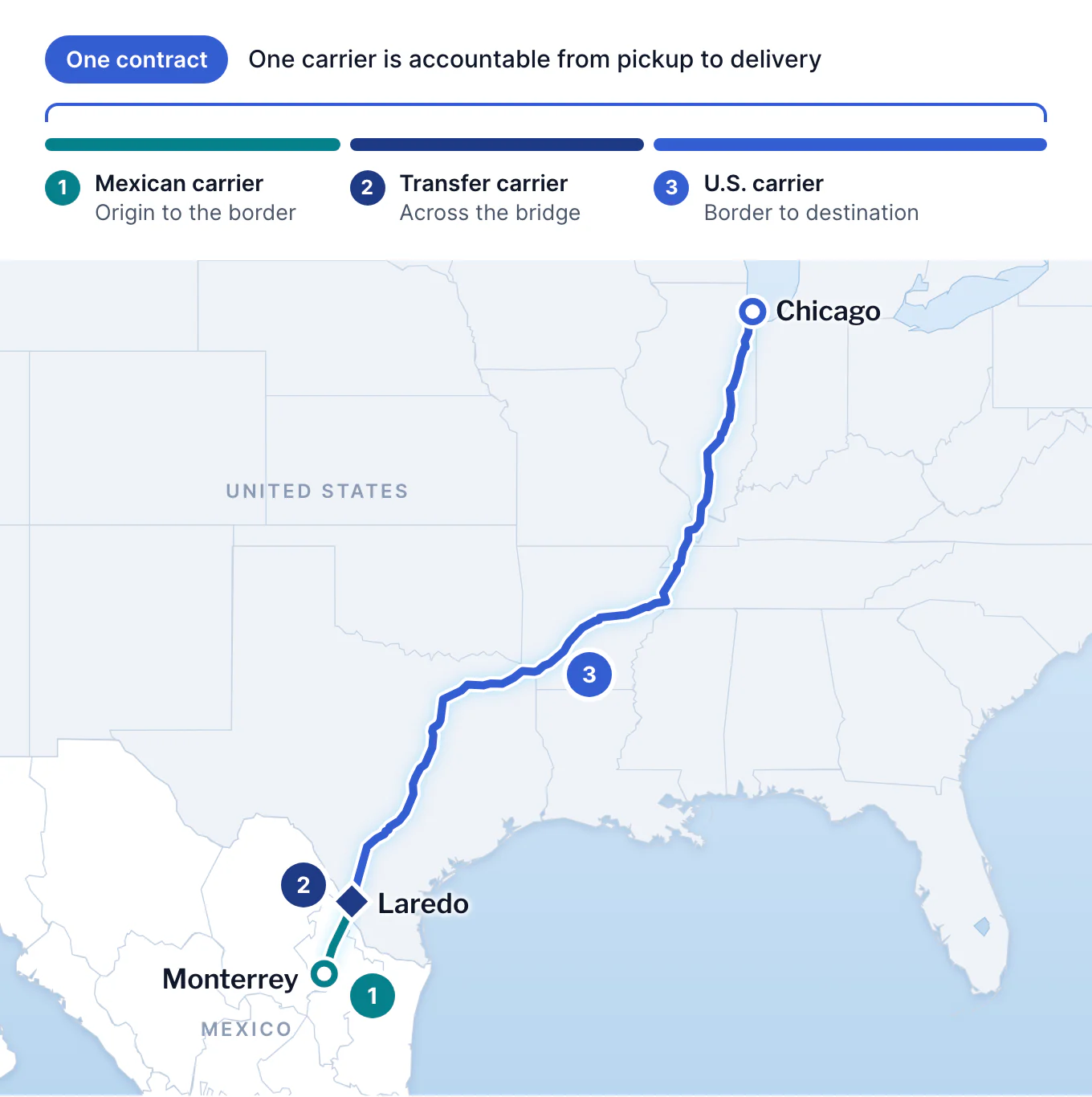
A partner carrier is not double brokering
This is the objection that stops a lot of brokers before their first Mexico load, so here is the difference.
When you hire a carrier for a move from Guadalajara to Chicago, you're hiring a company that runs international shipments. It accepts responsibility for the whole move, subcontracts the Mexico portion to a partner it works with on that lane, and the freight usually rides in its own trailer the whole way.
Double brokering is different. You hire a carrier for Chicago to Dallas, and it re-tenders the load to another company without your knowledge or consent, often while it has no authority to broker. On a cross-border move, the partners are part of how the carrier you booked runs the lane, and you know who they are before the truck moves.
Before you book, ask the carrier:
- Who runs the Mexico leg?
- Who runs the crossing?
- Whose trailer is it, end to end?
- Can you name the partner on each leg, so we know who had the freight if there's a claim?
Confirm your contract with the carrier allows the subcontracted legs, check the operating authority of each carrier that will run a leg in the U.S., and keep the partner names and their legs in writing.
How the trailer crosses
Door-to-door describes the contract: one carrier is accountable from pickup to delivery. Physically, the freight gets across the border in one of two ways, and either one can sit inside a door-to-door move.
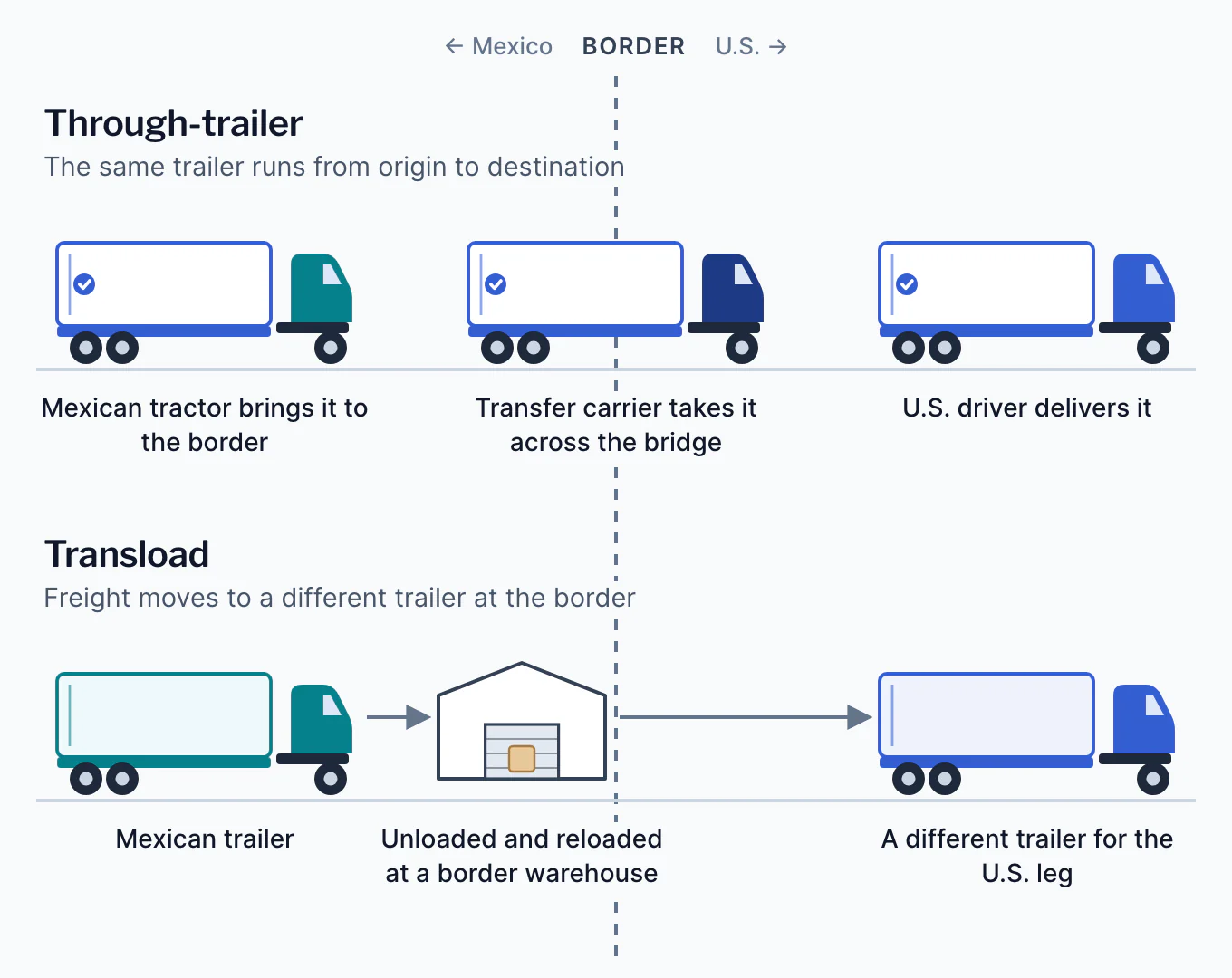
| Through-trailer | Transload |
|---|---|
| The same trailer runs from origin to destination. A Mexican tractor brings it to the border, and usually a transfer carrier takes it across the bridge before a U.S. driver delivers it. Some moves skip the transfer when one authorized driver runs straight through. | The freight is unloaded at a warehouse at or near the border and reloaded onto a different trailer. |
|
|
Either is normal. Ask which one the carrier is quoting, because it changes the rate, the transit time and how many hands touch the freight. You can specify either one in the posting details on Cargado.
B-1 drivers: the backbone of cross-border capacity
A B-1 driver is a Mexican national admitted to the U.S. on a business-visitor visa to move international freight. B-1 drivers work for Mexico-based carriers, and many of those carriers are the partners or affiliates of the U.S. carriers you book. A B-1 driver can carry a load that is crossing the border in either direction, including the U.S. leg of a northbound move. It's often the same driver crossing your freight week after week, because they know the route and the bridge.
Ask early: "Are B-1 drivers acceptable for the crossing, or do you require U.S. CDL drivers only?" If the answer is unclear, treat it as a quoting and capacity question, not a detail to sort out later.
Vet the carrier first. Operating authority and insurance sit with the carrier, and individual drivers don't appear on either. Then have the carrier confirm that the assigned driver holds a valid commercial license and is eligible for the planned move.
The one line you can't cross: cabotage
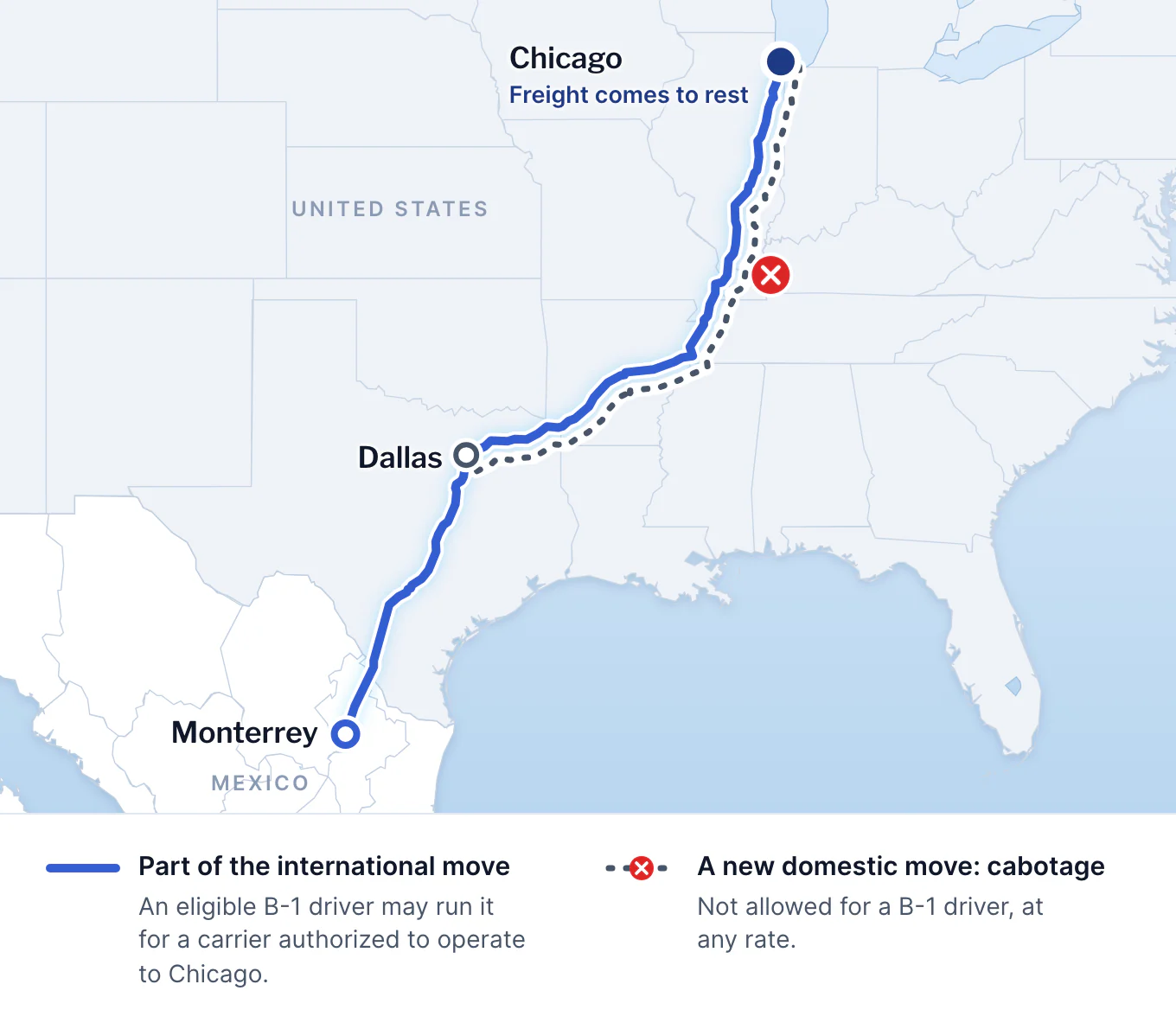
A B-1 driver may not haul a domestic U.S. move. Once the freight has come to rest in the U.S., the next leg is a new domestic move, and no rate makes it legal for a B-1 driver. Coming to rest is broader than final delivery: storing the freight at a U.S. warehouse, parking it at a drop lot and some tractor changes can end the international move. Screen the move, not the visa: is this leg still part of one continuous international journey? If there's a U.S. handoff before the leg a B-1 driver would run, have the carrier confirm the whole movement against current CBP guidance for that port.
How cross-border carriers are set up
Go to a border crossing and you'll see trailers from U.S. companies like Schneider, Werner and J.B. Hunt being pulled by Mexican tractors. These carriers have built relationships with Mexican trucking companies over years. They trust each other because they need each other.
Some Mexican carriers hold U.S. operating authority of their own, including long-haul authority. Many others have a sister company in the U.S. with a DOT and MC number. If you book one, confirm which company runs each leg, because the U.S. company's DOT and MC don't cover the Mexico side.
When a shipper asks "is this secure?", explain that many cross-border carriers are CTPAT-certified, often because the shippers they haul for require it. CTPAT (Customs Trade Partnership Against Terrorism) is a U.S. Customs and Border Protection security program with supply-chain security standards that go beyond what most domestic carriers follow.
Which carrier fits which lane
"Mexico freight" covers three kinds of lanes, and the carrier you book depends on which one you have.
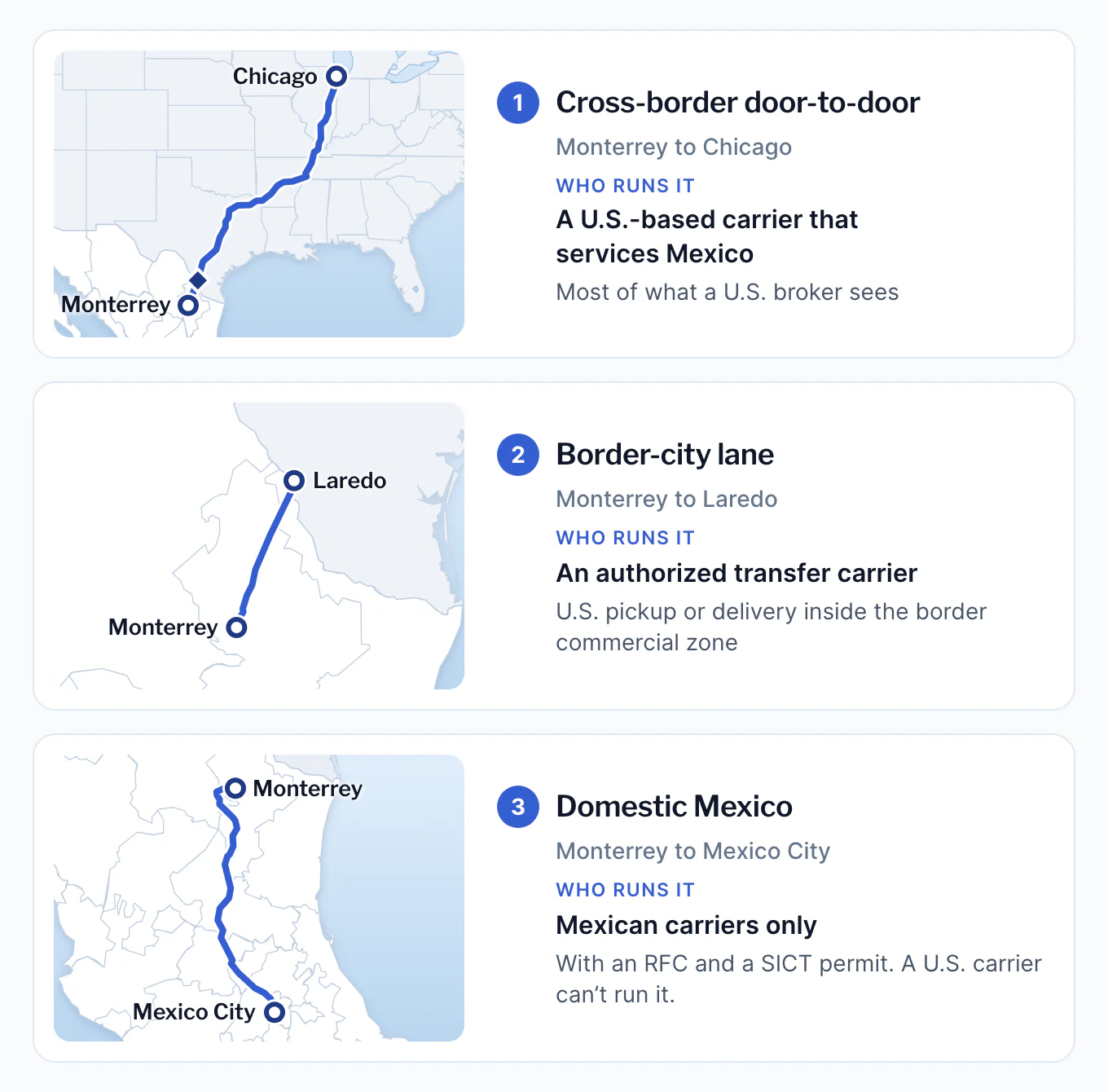
- Cross-border door-to-door, like Monterrey to Chicago or Tijuana to Stockton. This is most of what a U.S. broker sees. Book a U.S.-based carrier that services Mexico. You can onboard them in the carrier onboarding system you already use.
- Border-city lanes, where the U.S. end is the border city itself, like Monterrey to Laredo or El Paso to Chihuahua. An authorized transfer carrier can handle the crossing and the U.S. pickup or delivery as long as the address is inside the border commercial zone.
- Domestic Mexico, like Monterrey to Mexico City. Mexican carriers only, with an RFC (their Mexican federal taxpayer ID) and a SICT permit to haul on federal highways. A U.S. carrier can't run it.
Beyond dry van
Dry van is where most brokers start. The questions that come back most often are about everything else you can put on a trailer, and the niches are where far fewer brokers compete.
| Freight | What to know |
|---|---|
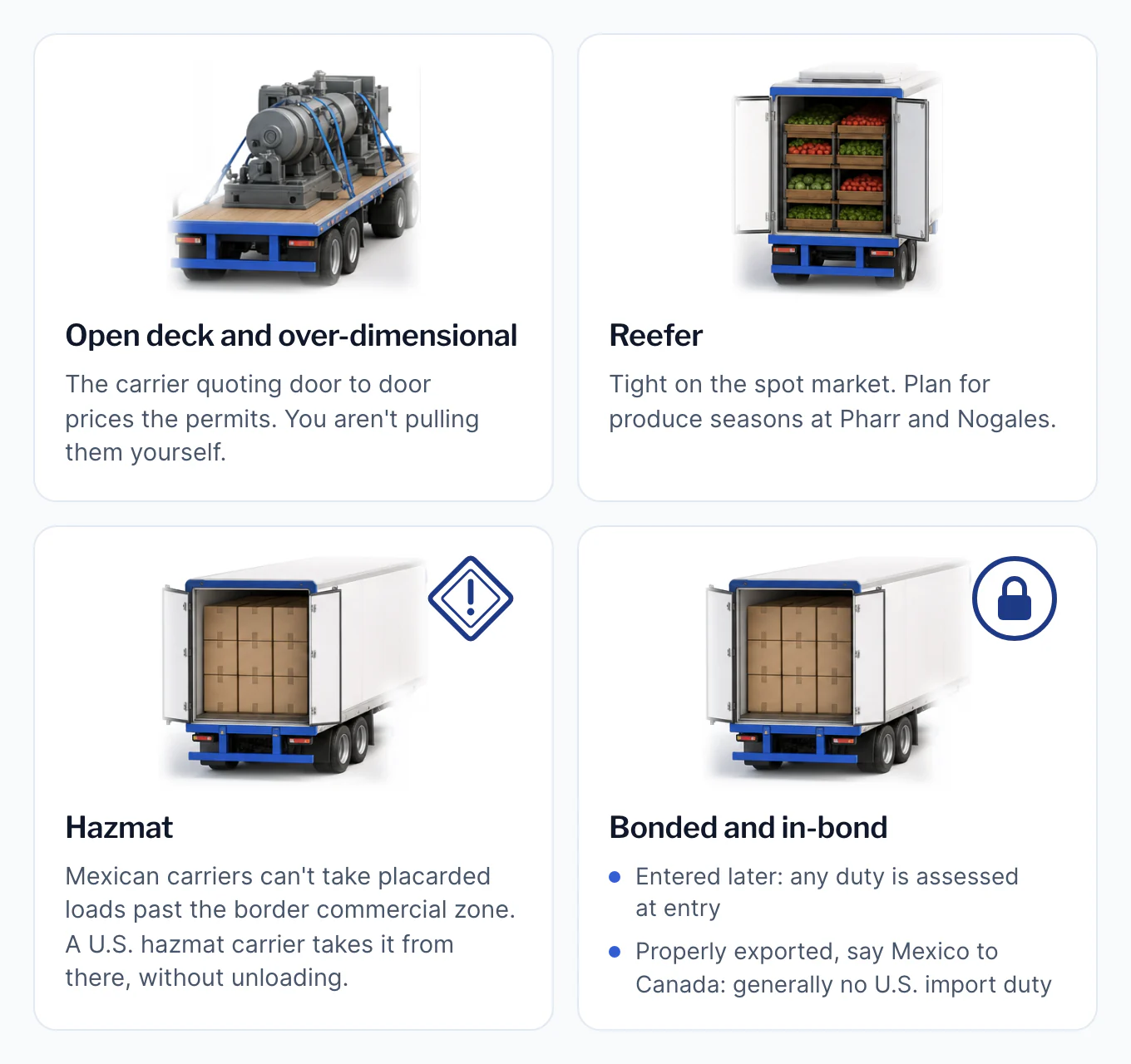
| Open deck and over-dimensional | Open-deck freight moves across the border all the time. Post the details: dimensions, tarps, chains, bulkhead, edge protection, ramps. Over-dimensional loads need permits, and the carrier quoting the door-to-door move prices the permits and its Mexico-side partner into the bid. You aren't pulling permits yourself. |
| Reefer | Reefer capacity is tight on the spot market because the big reefer fleets run direct for large shippers. Expect to pay a premium, and plan for produce seasons at Pharr and Nogales. |
| Hazmat | Be precise here. Mexico-domiciled carriers with U.S. long-haul authority can't haul placarded hazmat beyond the border commercial zone, so a U.S. hazmat carrier takes the load from there. The freight doesn't have to be unloaded. |
| Bonded and in-bond | In-bond freight moves under customs control before it is formally entered, like a connecting flight for cargo. CBP has to authorize the in-bond movement before it starts, and it moves under a carrier's bond. In-bond defers the entry. It doesn't erase the duty: any duty that applies is assessed when the goods are entered later. Freight that passes through the U.S. and is properly exported under the in-bond procedure, say from Mexico to Canada, generally owes no U.S. import duty. When you post an in-bond load, say which country the bond is for. |
The customs broker rule that prevents stuck trailers
If you pick up freight without a confirmed customs broker at the border, you'll end up with a trailer stuck in Mexico. Your carrier will be angry. Your customer will be angry. Everyone will be angry.
Don't dispatch pickup until you've confirmed:
- The crossing city
- The customs broker contact
- That the commercial documents have reached the customs broker in time
And make sure each customs broker can actually work your freight at that crossing, with an office there or a working arrangement for inspections and document problems. Get an operational contact for that port. A broker in Houston or Los Angeles with no presence at the crossing is a red flag.
How long does it actually take?
Take one load from Monterrey to Houston. Pickup happens the same day. The Mexico linehaul to Laredo is under a day. The U.S. linehaul to Houston is about a day. The border is the only block that surprises people.
The typical time at the border is 1 to 3 days, sometimes faster. These are typical ranges, not guarantees. If it's taking four days or more, something is usually stuck and you should find out what.
These are typical ranges, not guarantees.
- PickupSame dayMonterrey
- Mexico linehaulUnder a dayLaredo
- At the border1 to 3 days
- U.S. linehaulAbout a dayHouston
The trailer waits, the driver doesn't
This is the part people get wrong. On the usual drop arrangement, the trailer sits at a customs broker's facility at the border while the entry clears and any inspection happens. Nobody is parked in a cab for three days. On a straight-through move the driver does wait, so confirm the arrangement and any waiting charges with the carrier. If your team has only run Canada, where trucks usually clear with the driver at the booth, this is the whole adjustment.
What changes the time at the border
- Paperwork. The most common avoidable hold, and usually it's the commercial invoice.
- Inspections. Random inspections happen. CTPAT-certified supply chains generally see fewer.
- FAST. FAST lanes speed up eligible shipments, but the carrier, the importer, the manufacturer and the driver all have to qualify.
- Volume. Holiday weekends and month-end bring longer lines. The bridge queue alone can swing from under an hour to several hours depending on the day.
- The crossing itself. Laredo is the busiest. Smaller crossings can be faster or slower depending on the day.
Quote their history, not the best case
Ask your customer what their crossing time has averaged historically, and quote that. If they say their freight "usually takes a week to cross," dig in:
- Which crossing they use
- Where the process breaks down
- Which documents are often late
Don't promise a next-day crossing until you've confirmed the corridor can support it.
Ready to see Mexico market rates and vetted carriers?
The guide covers the playbook. A demo shows it running.