
How to quote Mexico freight with confidence
The seven inputs you need before quoting, why northbound can cost more, and the B-1 driver question to ask early.
All chapters
To quote Mexico freight, you need a complete lane definition and a clear crossing plan. The fastest way to sound credible is to run a checklist, confirm who controls the crossing, price the move leg by leg, and account for direction and carrier constraints.
You pay one carrier, and it pays the rest
On a typical door-to-door move you hire one carrier, usually a U.S. carrier that services Mexico, and get one rate and one invoice. That carrier pays its Mexican partner for the Mexico leg and pays for the transfer at the bridge if there is one. You don't see those invoices, but you should be able to name who runs each leg.
Most all-in rates are built from these lines:
And two lines that get forgotten:
- Cargo cover, if the shipper wants it arranged. When no value is declared, Mexican federal transport law limits carrier liability by weight, so cover above that limit is a separate cost (Chapter 12).
- Permits on anything over-dimensional. The carrier quoting the door-to-door move prices them in.
Both belong on the quote as line items, not as surprises at the bridge.
Knowing the stack matters when a lane looks expensive. Is it the Mexico side, the transfer or the U.S. side that's driving the cost? Quote the stack and you can defend every line of it.
The seven inputs checklist
To give a rate, you need these inputs:
- Origin: city, state
- Destination: city, state
- Border crossing: Laredo, El Paso, Pharr, Nogales, Otay Mesa and so on
- Commodity: be specific. Never post Freight All Kinds (FAK). Customs filings and the Carta Porte both need a real description of the goods, and carriers can't price or move what they can't describe.
- Trailer type
- Weight
- Cargo value
When a customer asks, "What's the rate for Mexico?", the right answer is: "I need seven pieces of information to give you a real rate." Then walk them through the list. Those seven define the lane. Before you give a firm number, also confirm pickup and delivery dates, appointment requirements, and whether this is a one-off load or a recurring lane.
The non-negotiable clarifier
If that's unclear, stop and clarify. You can't price a multi-party move if you don't know who owns which piece.
Direction matters
Northbound and southbound on the same lane are different markets with different carrier supply, and the rates can be far apart. Quote each direction on its own, and specify:
- Northbound or southbound
- One way or round trip
If your customer ships both ways, the difference between the two rates is an opportunity to talk about.
The B-1 driver question (don't skip it)
If the customer won't allow B-1 drivers on the crossing, your capacity options shrink. Ask early: "Are B-1 drivers acceptable for the crossing, or do you require U.S. CDL drivers only?"
B-1 drivers are the backbone of capacity at the southern border (Chapter 8 explains who they are). Don't let your customer restrict this capacity without a reason.
Key corridors and crossings to know for quoting
| Crossing | Freight |
|---|---|
| Laredo | for Monterrey, the Bajío, Mexico City and many Midwest lanes |
| El Paso | for Juárez and Chihuahua manufacturing |
| Otay Mesa | for Tijuana and West Coast inbound and outbound |
| Calexico East | for Mexicali |
| Nogales | for produce from Sonora and Sinaloa |
| Pharr / McAllen | for produce and Reynosa manufacturing |
| Brownsville | for Matamoros and Gulf corridors |
Choose the crossing that fits the geography. The crossing changes carrier options, transit time and lane rhythm.
Get the real band before you quote
A national average stretched across the border is not a Mexico rate. Before you quote, look at what carriers are actually bidding on the lane.
Cargado is a modern marketplace for Mexico and Canada freight, and Cargado Market Rates are built from the carrier bids that come through it. Each lane shows a band of what carriers are bidding.
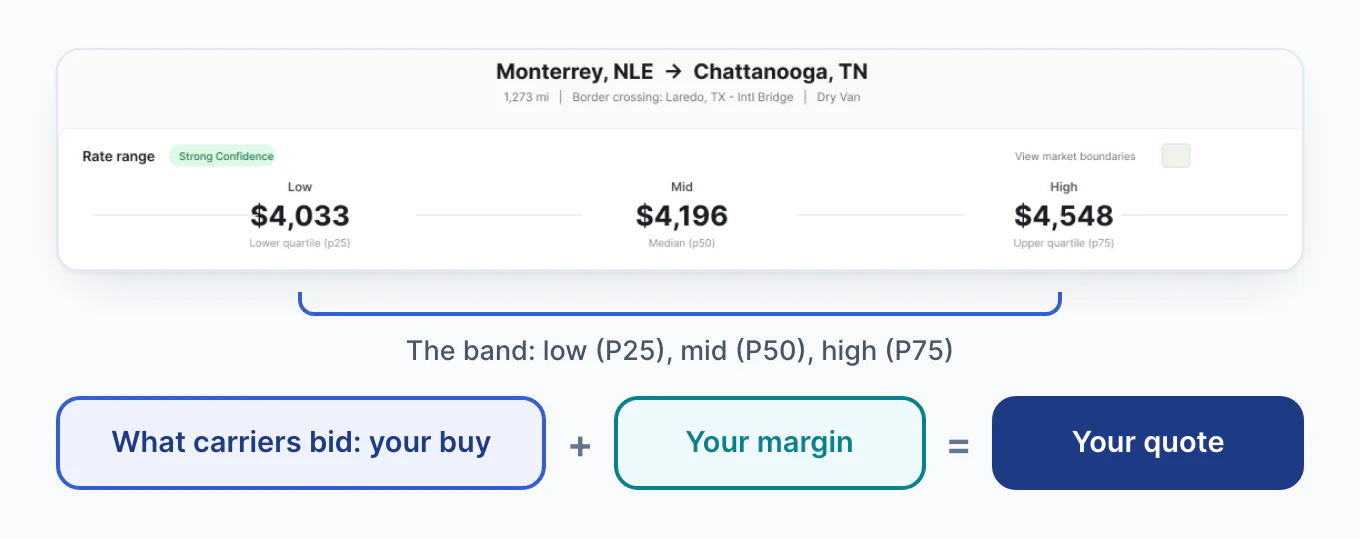
Use the band to pressure-test your crossing choice and direction assumptions, too. If the band on one crossing sits well above another, ask why before you quote it.
How to defend the "why" behind the quote
Keep it simple and operational. You're pricing a move with more coordination points:
- Multiple parties
- Border timing dependencies
- Document and compliance requirements
- Tighter handoff management
When a customer pushes on price, bring it back to the job they're hiring you to do: "This rate includes door-to-door visibility and one team accountable end to end. It's designed to remove the border handoff surprises we talked about."
Ready to see Mexico market rates and vetted carriers?
The guide covers the playbook. A demo shows it running.