
Questions to ask in the discovery call
The questions that reveal who controls the crossing, where visibility breaks, and what is driving the decision.
All chapters
Your goal is to find out what's driving the decision and where the process breaks: price pressure, service failures or border complexity. Ask a few high-leverage questions that reveal control, handoffs, visibility gaps and who carries the risk.
Start with decision drivers
You're trying to learn what drives their decision-making:
Ask: "When you think about Mexico freight, what matters most right now: lowering cost, improving reliability, or simplifying the process?"
Then run the control and handoff check
This tells you whether you can take the move door-to-door.
- "Do you control the cross-border move, or does a supplier or forwarder handle it?"
- "At what point do you first get reliable updates?"
- "Where does it usually break: on the Mexico side, at the crossing, or after clearance?"
Map the lane in 60 seconds
You don't need a full SOP on the call. You need enough to know what you're solving.
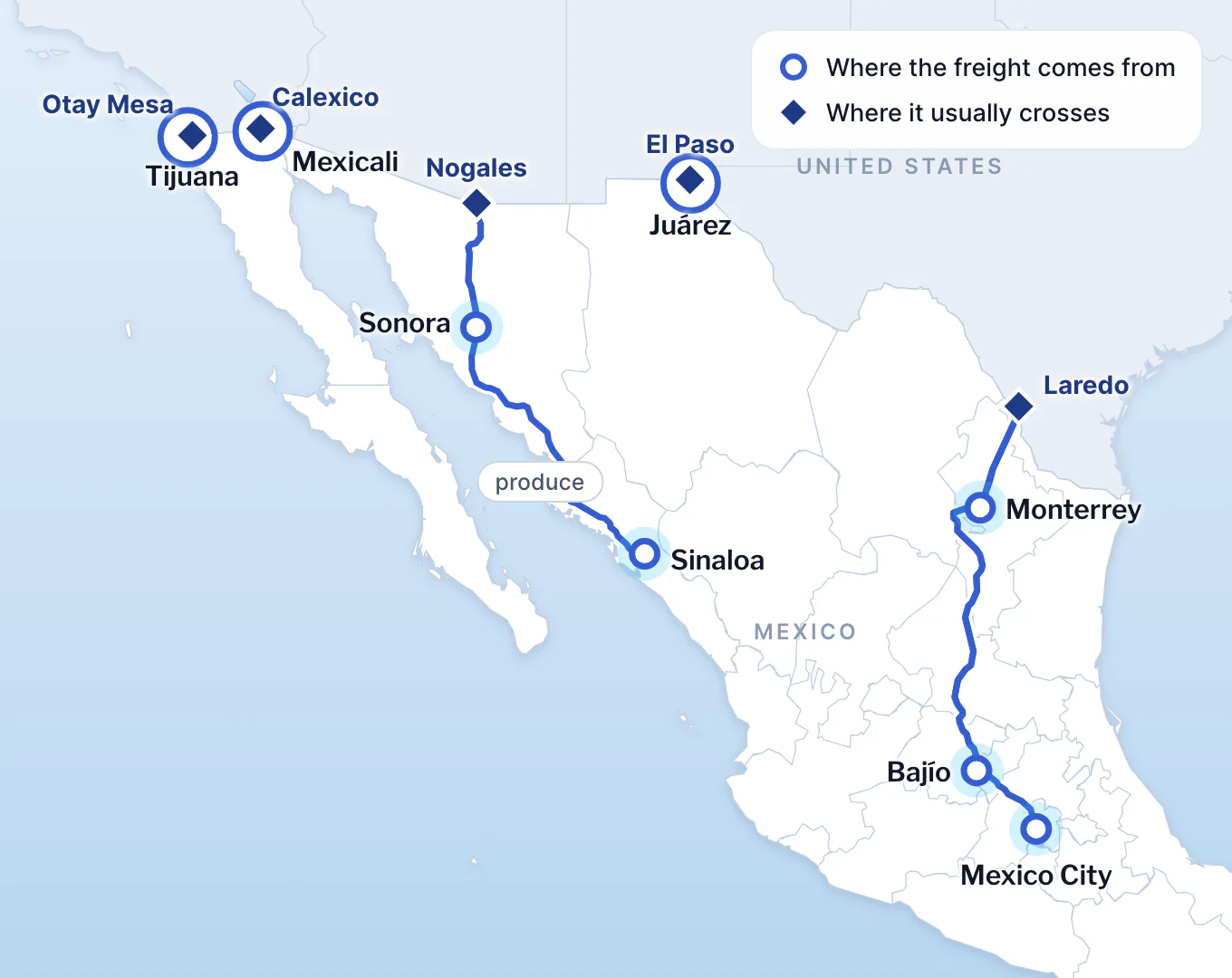
Start with one question: "Which part of Mexico does this freight come from?" The manufacturing region answers several things at once. Freight out of Monterrey, the Bajío or Mexico City usually crosses at Laredo. Tijuana and Mexicali freight crosses in California, Juárez freight at El Paso, and produce from Sonora and Sinaloa at Nogales. The region tells you the likely crossing, the transit time and the carrier base.
Then ask:
- "What's the origin city and the final destination?"
- "Where do you typically cross?"
- "What equipment are we talking about?"
- "Is this steady weekly volume or more sporadic?"
- "How long does it take to cross today, on average?" Their own history is the number to quote against later.
Ask who carries the risk
Cargo coverage is the question brokers new to Mexico ask most, so settle it in discovery, not at booking. When no value is declared, Mexican federal transport law limits carrier liability by weight, whatever is on the trailer (Chapter 12 explains). Ask:
- "Who is covering this load if something happens to it?"
- "Do you insure it yourselves, or do you need us to arrange cover?"
Ask about drivers and security
- "Are B-1 drivers acceptable for the crossing?" Ruling them out shrinks your carrier options sharply (Chapter 8).
- "Do you have security requirements, such as CTPAT carriers, specific seals, GPS or escorts?"
Spot the hidden pain
These are the most common Mexico pain patterns:
Close discovery with a simple recap
Don't jump straight to pricing. Anchor on what you learned.
"What I'm hearing is you lose visibility before the crossing, and the handoff in Laredo creates surprises. If we can run this door-to-door with one team accountable and clean updates, I can come back with a real plan and a real rate."
Ready to see Mexico market rates and vetted carriers?
The guide covers the playbook. A demo shows it running.