
Vancouver, BC freight lanes
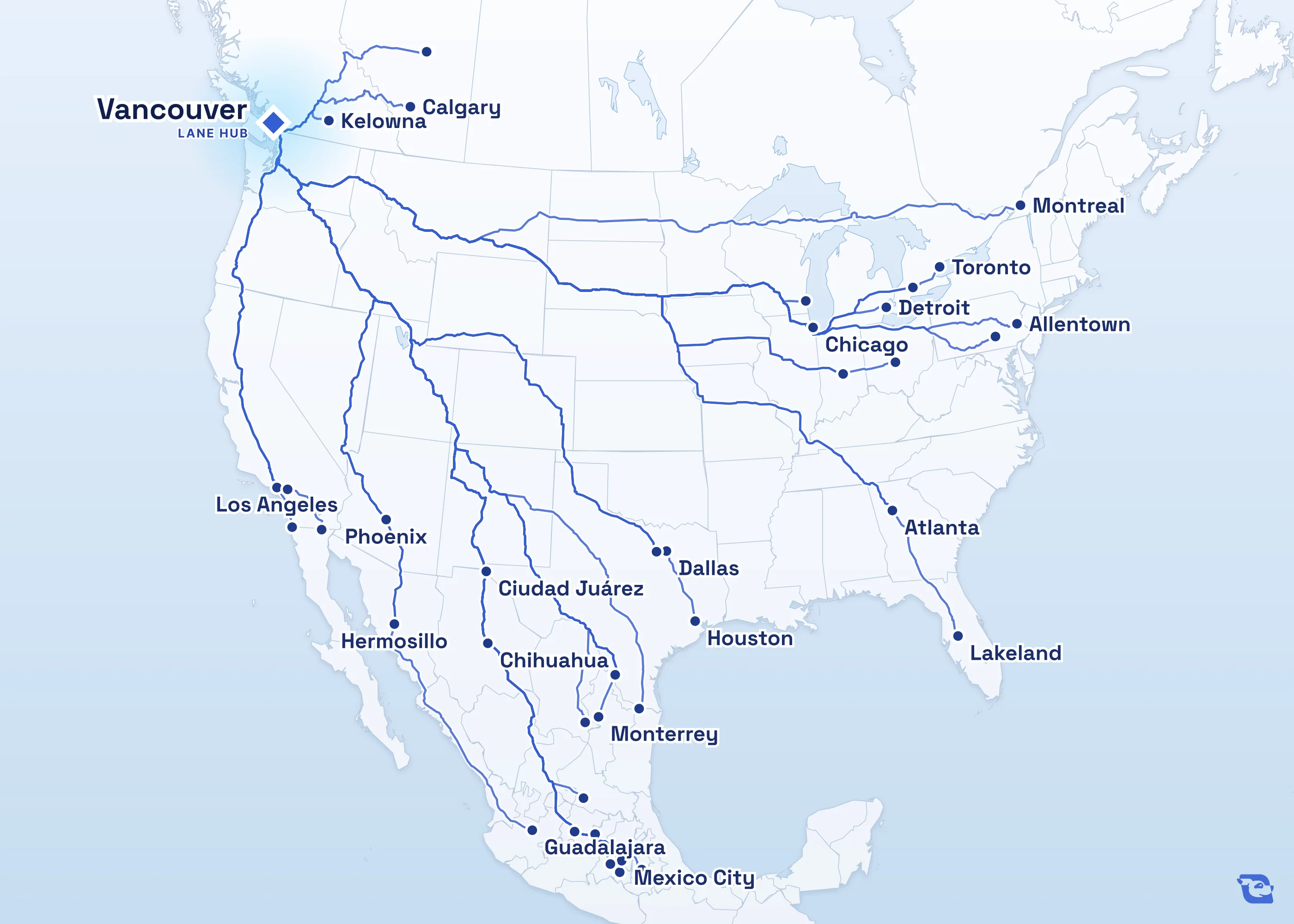
Vancouver is Canada's largest port and the Pacific gateway for the whole country, a market that ships food, lumber, metals and imports in every direction. Pick an origin or destination in the directory to open its lane guide, and read how customs, carrier authority and Mexico moves work on Vancouver freight. Cargado is a marketplace where brokers post Mexico and Canada truck freight and vetted carriers bid on it.
Port of Vancouver
158 million tonnes
58
Dry van
Corridors out of Vancouver
Southbound into the U.S.
- Vancouver to Dallas, TX
- Vancouver to Detroit, MI
- Vancouver to Fort Worth, TX
- Vancouver to Harrisburg, PA
- Vancouver to Houston, TX
- Vancouver to Indianapolis, IN
- Vancouver to Laredo, TX
- Vancouver to Los Angeles, CA
- Vancouver to Ontario, CA
Within Canada
- Vancouver to Calgary, AB
- Vancouver to Edmonton, AB
- Vancouver to Kelowna, BC
- Vancouver to London, ON
- Vancouver to Montreal, QC
- Vancouver to Toronto, ON
To Mexico
- Vancouver to Chihuahua
- Vancouver to Ciudad Juárez, Chihuahua
- Vancouver to Cuautitlán Izcalli, Estado de México
- Vancouver to Guadalajara, Jalisco
- Vancouver to Hermosillo, Sonora
- Vancouver to Mexicali, Baja California
- Vancouver to Mexico City
- Vancouver to Monterrey, Nuevo León
- Vancouver to Puebla
- Vancouver to Saltillo, Coahuila
- Vancouver to San Luis Potosí
- Vancouver to Tijuana, Baja California
- Vancouver to Toluca, Estado de México
Corridors into Vancouver
Northbound from the U.S.
- Allentown, PA to Vancouver
- Atlanta, GA to Vancouver
- Chicago, IL to Vancouver
- Columbus, OH to Vancouver
- Dallas, TX to Vancouver
- Harrisburg, PA to Vancouver
- Indianapolis, IN to Vancouver
- Lakeland, FL to Vancouver
- Milwaukee, WI to Vancouver
- Phoenix, AZ to Vancouver
Within Canada
- Calgary, AB to Vancouver
- Edmonton, AB to Vancouver
- Kelowna, BC to Vancouver
- London, ON to Vancouver
- Toronto, ON to Vancouver
From Mexico
- Ciudad Juárez, Chihuahua to Vancouver
- Cuautitlán Izcalli, Estado de México to Vancouver
- Cuernavaca, Morelos to Vancouver
- Hermosillo, Sonora to Vancouver
- Irapuato, Guanajuato to Vancouver
- Mexicali, Baja California to Vancouver
- Mexico City to Vancouver
- Nuevo Laredo, Tamaulipas to Vancouver
- Puebla to Vancouver
- Reynosa, Tamaulipas to Vancouver
- Saltillo, Coahuila to Vancouver
- San Luis Potosí to Vancouver
- Santiago de Querétaro, Querétaro to Vancouver
- Tijuana, Baja California to Vancouver
- Toluca, Estado de México to Vancouver
What moves through the Vancouver market
The Port of Vancouver moved a record 158 million tonnes of cargo in 2024, up 5 percent, with growth in autos, bulk and containers, and Canadian grain exports through the port reached a near-record 29 million tonnes (Vancouver Fraser Port Authority statistics, Maritime Magazine). Lower Mainland warehouses distribute imported goods to Western Canada, and regional producers ship food and beverage, seafood, lumber, metals and building materials out. Southbound, expect food and produce, lumber and building materials, metals and packaged goods for the Pacific Northwest, California and Texas; northbound, produce from California and Mexico, consumer goods and machinery. Vancouver also anchors the long Mexico corridors on the West Coast.
What ships from the Vancouver area
Plants, mills, packing houses and distribution centers within about 100 miles of Vancouver are among the area's main freight sources. The commodities below are ranked by employment in public business-establishment data, and each is tied to a named facility, cluster or growing region.
- Lumber and wood products. Lynnterm and DP World Fraser Surrey consolidate lumber, panels, pulp and paper for truck, rail and ship.
- Fresh produce. Fraser Valley and Delta farms grow blueberries, raspberries and greenhouse vegetables.
- Sugar and packaged food. Lantic's Rogers refinery in Vancouver makes sugar and syrup.
- Poultry and eggs. The Fraser Valley is British Columbia's poultry and egg center.
- Imported vehicles. The Annacis Auto Terminal in Delta receives vehicles from Asia for distribution across Canada.
On the road, reefer carries fresh produce and poultry and eggs; flatbed or open deck carries lumber and wood products; dry van carries sugar and packaged food; car haulers carry imported vehicles. Post the commodity, weight and trailer type with each load so carriers can price it.
The corridor groups Vancouver anchors
Mexico guides are a large part of this hub, from Vancouver to Tijuana, Mexicali, Hermosillo, Chihuahua, Ciudad Juárez, Monterrey, Saltillo, San Luis Potosí, Guadalajara, Mexico City, Cuautitlán Izcalli, Toluca and Puebla, and back from those markets except Chihuahua, Monterrey and Guadalajara, plus Nuevo Laredo, Reynosa, Querétaro, Irapuato and Cuernavaca. U.S. guides run to Los Angeles, Ontario, California, Dallas, Fort Worth, Houston, Laredo, Detroit, Indianapolis and Harrisburg, and into Vancouver from Phoenix, Dallas, Chicago, Columbus, Indianapolis, Milwaukee, Atlanta, Lakeland, Allentown and Harrisburg. Canada guides run each way with Calgary, Edmonton, Kelowna, London and Toronto, and to Montreal. Confirm whether you need a domestic leg, the U.S. move or a two-border move into Mexico.
Covering Vancouver freight: what a broker needs to know
Prepare customs before dispatch
For a U.S. lane, the carrier needs an ACE eManifest southbound or an ACI eManifest northbound, filed before arrival, and the importer or its customs broker arranges release, with a PARS or PAPS reference when one is used. Provide the invoice information the importing country requires and any USMCA certification of origin needed to claim preferential treatment, and put the broker and release arrangement on the posting so the carrier can file. Missing paperwork holds the truck at the border, so agree on free time and detention up front.
Mexico lanes clear two borders
A lane between this market and Mexico clears two borders in either direction: export reporting and entry or in-transit arrangements at the northern border, and Mexican import or export at the southern crossing the lane guide names, often Laredo, where a transfer carrier usually moves the trailer and a carrier with Mexican operating authority runs the Mexico leg. Confirm the crossing, whether the cargo stays in its trailer or transloads, who issues the CFDI, Mexico's electronic tax document, with Carta Porte details when required, and who covers the transfer, before you post.
Port pickups and the mountain passes
Confirm whether pickup is a container move from a marine terminal or trailer freight from a transload warehouse; for terminal pickups, verify the carrier's port access, reservation, release status, chassis arrangement and empty-return instructions. Eastbound loads for Kelowna, Alberta and beyond cross mountain routes where winter closures add transit days; confirm the route with the carrier, state the shipper's temperature requirements for reefer loads and build a weather margin into delivery windows.
Common questions about Vancouver freight
How does a Vancouver to Mexico lane work?
It clears two borders. Canadian export reporting and U.S. entry or in-transit arrangements are handled at the northern border, and Mexican import clears at the southern crossing the lane guide names, often Laredo, where a transfer carrier usually moves the trailer to a carrier with Mexican operating authority. Confirm the crossing, any transload and the customs broker for each border before dispatch, and post which legs you are covering.
Do I need a Canadian carrier for a Vancouver lane?
A lane between Canada and the U.S. can run on a Canadian or a U.S. carrier with cross-border authority, and the carrier files the ACE or ACI manifest before arrival. A lane that stays inside Canada, such as Vancouver to another Canadian city, is domestic work: cross-border authority does not by itself allow it, so confirm the carrier's domestic operating authority, driver eligibility and cabotage compliance before booking. State the leg you need covered when you post on Cargado.
How do I find carriers for a Vancouver lane on Cargado?
Post the pickup and delivery, the date, the equipment and the leg you need covered. For a port pickup, include the terminal and release details; for a border move, the customs broker on each side. Vetted carriers that run the corridor bid, and you compare what each bid covers before you book. Where a corridor has enough bid history, Cargado Market Rates gives you a reference built from carrier bids before you quote.
What equipment runs Vancouver corridors?
Dry van leads, carrying imports, consumer goods and packaged food. Reefer carries produce, seafood and food and beverage, and open deck carries lumber, metals and building materials. Post the trailer type with the weight, dimensions and loading requirements so carriers can price the load.
What freight ships out of Vancouver?
Facilities within about 100 miles of Vancouver mainly ship lumber and wood products, fresh produce, sugar and packaged food, poultry and eggs and imported vehicles. On the road, reefer carries fresh produce and poultry and eggs; flatbed or open deck carries lumber and wood products; dry van carries sugar and packaged food; car haulers carry imported vehicles.
Moving freight through this market?
Post it to 2,400+ vetted Mexico and Canada carriers, or check market rates built from real carrier bids before you quote.