The story
Yes, most specialized freight moves on Cargado the same way a dry van load does. Flatbed, step deck, double drop, RGN and Conestoga are trailer types you pick on the standard posting form, and the Oversize and Overweight flags set themselves from the dimensions and weight you enter. Tanker is the one exception: Cargado does not support tanker moves. What changes on a cross-border project load is everything around the posting: two permit regimes, escort rules, travel curfews and a smaller carrier pool. Here is what to confirm before you quote.
Which specialized equipment can I post?
Under Trailer Requirements, open Trailer Type and pick from the open-deck options: Flatbed, Step Deck, Double Drop, RGN and three Conestoga variants. You can select more than one on a single posting, which widens the carrier pool when the freight can ride on either a flatbed or a step deck. The same section lets you ask for specific equipment, such as Minimum Axles or Metal Edge Protectors.
You do not check a box for oversize or overweight. Cargado flags the commodity Oversize once its dimensions cross a threshold and flags the load Overweight once the total weight crosses one. Overall dimensions are only captured when you pick an open-deck trailer type and post a full truckload; on a partial, enter per-piece dimensions instead. Post flatbed, oversize, power-only and other special moves walks through each field.
Is the load legal on both sides of the border?
A cross-border load has to be legal for every mile of the route, and the two countries draw the line in different places.
In Texas, where most U.S.-Mexico truck freight crosses, the legal limits without a permit are 8 feet 6 inches wide, 14 feet high and a gross weight of about 36 metric tons. Above any of those, the carrier needs an oversize or overweight permit from the Texas Department of Motor Vehicles (TxDMV). Arizona, New Mexico and California issue their own permits under their own limits, covered below.
In Mexico, the federal weight and dimension limits come from NOM-012-SCT-2-2017 and depend on the road class. On ET and A highways, the top road classes, a standard five-axle tractor-trailer (T3-S2) may run at more than 46 metric tons gross, well above the Texas legal limit. A load that is legal on the Mexican leg can therefore be overweight the moment it crosses into Texas. Check the weight against both countries before you quote, and put the axle configuration in the posting.
Who pulls the permits, and what do they require?
The carrier applies for the permits, but you price them, and the answer is different in each country.
Mexico. A load that cannot be broken down and whose weight or dimensions exceed the NOM-012 limits is an "objeto indivisible de gran peso y/o volumen" and needs a special permit from SICT to travel on federal highways. There are two permit types: one for payloads up to 90 metric tons and one for heavier loads, which also need a route ruling from SICT. The route on the permit can only change in an emergency, with authorization from the local SICT center. Loads within the NOM-012 limits need no special permit and carry no travel-hour restriction under NOM-040.
Check the carrier's SICT operating permit too. It defines the class of service the carrier may perform, and general-freight authority is not the same as specialized-cargo authority. See SCT / SICT permit.
Texas. TxDMV issues a single-trip permit for a nondivisible load, one that cannot be broken into legal-size pieces without destroying its use or value. If the load can be split, the expectation is that it moves legal. Holiday travel is capped at 14 feet wide, 16 feet high and 110 feet long, and the largest loads need a route inspection on file.
Arizona, New Mexico and California. Each state issues its own permit, and each expects the load to be nondivisible. ADOT's Central Commercial Vehicle Permit Office issues Arizona permits for state routes, online or at a port of entry. Arizona's legal height is 13 feet 6 inches on most roads and 14 feet only on designated routes; New Mexico and California allow 14 feet, as Texas does. New Mexico permits are online only, through the NMDOT permit system, and must be bought before the truck enters the state. A permitted load there moves only from 30 minutes before sunrise to 30 minutes after sunset unless the permit allows continuous travel, and not in bad weather or on holidays. Within 12 miles of a port of entry on the Mexican border, and in the Santa Teresa zone set by state law, a truck up to 96,000 pounds gross (about 43.5 metric tons) can be permitted even when the load could be split. In California, the Caltrans Office of Commercial Vehicle Operations issues permits for the State Highway System only. In Arizona and California, ask whether the city or county roads at each end need a local permit.
Do not rely on a verbal "we can do it." Ask the carrier for the permit answer in writing, and for anything close to a superload, have a licensed permit service review the dimensions, weight and route on both sides before you commit a rate.
When does the load need an escort?
Texas sets escorts by dimension. Widths over 14 feet up to 16 feet need one escort, in front on a two-lane highway or behind on a multi-lane one; over 16 feet, one in front and one behind on all roads. Heights over 17 feet need a front escort with a height pole, and over 18 feet a front and rear escort. Lengths over 110 feet up to 125 feet need one escort, and over 125 feet two. A load that trips two dimensions needs front and rear escorts. TxDOT can vary any of these after a route and traffic study, so the permit itself has the final word.
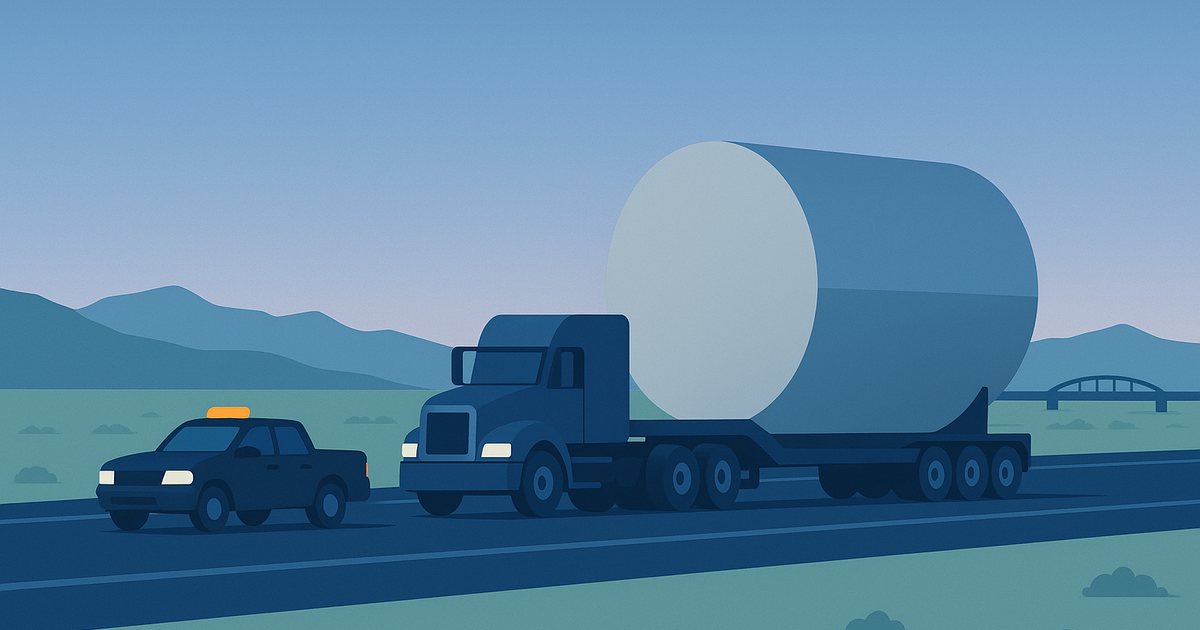
Mexico uses pilot vehicles (unidades piloto), and NOM-040-SCT-2-2012 sets how many by the size class of the combination. The pilot must be a yellow pickup marked UNIDAD PILOTO with an amber beacon and a warning sign. The same rule sets travel hours for loads that exceed NOM-012: on four-lane ET, A and B highways, Monday to Friday at any hour and Saturdays from 6:00 to 14:00; on two-lane highways and C and D roads, daylight from 6:00 to 18:30 plus 00:00 to 6:00, with the evening hours allowed only with two pilot vehicles. No travel on Sundays or mandatory rest days on any road. Build those windows into the transit time you promise.
Which crossing can take the load?
Not every bridge can. In Laredo, the City of Laredo designates the Colombia-Solidarity Bridge as the route for hazmat and oversize loads, and oversize project freight favors it for its geometry and lighter congestion. Your customer's customs broker effectively decides which bridge a load uses, so confirm the crossing before you quote and name it on the posting, because the crossing is part of how Cargado matches carriers. Colombia – Solidarity Bridge.
What does a carrier need to price it?
A specialized carrier checks more before bidding, because a wrong assumption costs them a permit, an escort or a failed pickup. Put all of this in the posting fields, not the notes:
- Exact length, width and height, and whether any piece can come off and ship separately.
- Total weight and weight per piece, plus the axle configuration you expect.
- Securement and tarping requirements.
- How the load gets on and off at each end: crane, forklift or ramp.
- A pickup window with enough lead time for permits.
- The commodity and its UN number if it is hazmat. See Hazmat cross-border.
Cargado matches the posting against each carrier's profile, so a carrier is notified only if its trailer type, service area, crossing and requirements line up. Then message the suggested carriers in the Coverage panel. The pool that runs cross-border oversize is small, and the ones who fit are often booked days out.
How do I price specialized freight?
Market Rates does not price it for you. The posting page skips the market-rate card for oversize, overweight, hazmat and escorted loads, and the rates form has no weight input, so a lookup on the same lane returns the standard band for that trailer type. Use that band for the linehaul portion only, and treat a Lower Confidence result as a starting point, not a quote. Add on top: permits in both countries, escorts or pilot vehicles, the transit days the Mexican travel windows add, and the crane or rigging time at each end.
When the shipper wants a number before you have a carrier, post the load as a Potential. Carriers bid real numbers, and you learn where the market sits before you commit. Why is there no market rate for my lane?
Who insures the freight on the Mexican leg?
Mexican federal law makes the carrier liable for loss or damage to the freight, but unless the shipper declares the value and pays for that guarantee, the liability is capped at a small per-ton amount. The insurance the federal carrier permit requires is third-party liability, not cargo insurance. Those are different policies, and an open deck load is visible for every Mexican mile. Confirm in writing who carries cargo insurance for the Mexican leg and for what value, ask the carrier for GPS tracking and secure overnight yards, and choose the crossing that keeps the Mexican miles short. Cargado collects a Mexican carrier's RFC and SICT permit before it can bid; your own onboarding still decides who you dispatch. How Cargado vets carriers.
Before you quote: the checklist
- Dimensions, weight and piece count confirmed in writing by the shipper.
- Weight checked against both countries' limits.
- Permit answer in writing from the carrier, or a permit service review for anything near a superload.
- Escort or pilot-vehicle needs and Mexican travel windows built into transit time.
- Crossing confirmed with the customs broker and named on the posting.
- Exact trailer type or types selected, full dimensions entered so the flags set themselves.
- Cargo insurance for the Mexican leg confirmed.
- Permit, escort and travel-window costs added on top of the market band.
- Posted early, with a target rate, and the suggested carriers messaged.
Specialized freight rewards the broker who answers the carrier's questions before the carrier asks them.