The story
Part of our guide to machinery and industrial equipment freight between Mexico and the U.S.
In Cargado, machinery moves half in dry vans and most of the rest on open deck, in both directions at equal weight. Cost turns on legal weight at the bridge, the Section 232 category and the customs regime for machines entering Mexico. Northbound dry van bids out of these markets rose 21% to 29% in a year.
Where machinery ships from, in both directions
U.S. machinery exports to Mexico grew about 26% in 2025; U.S. machinery imports from Mexico, computers set aside, grew about 6%. In Cargado the two directions run at equal weight, so a team moving a line into a Querétaro plant and the finished product back north is buying two markets on one corridor.
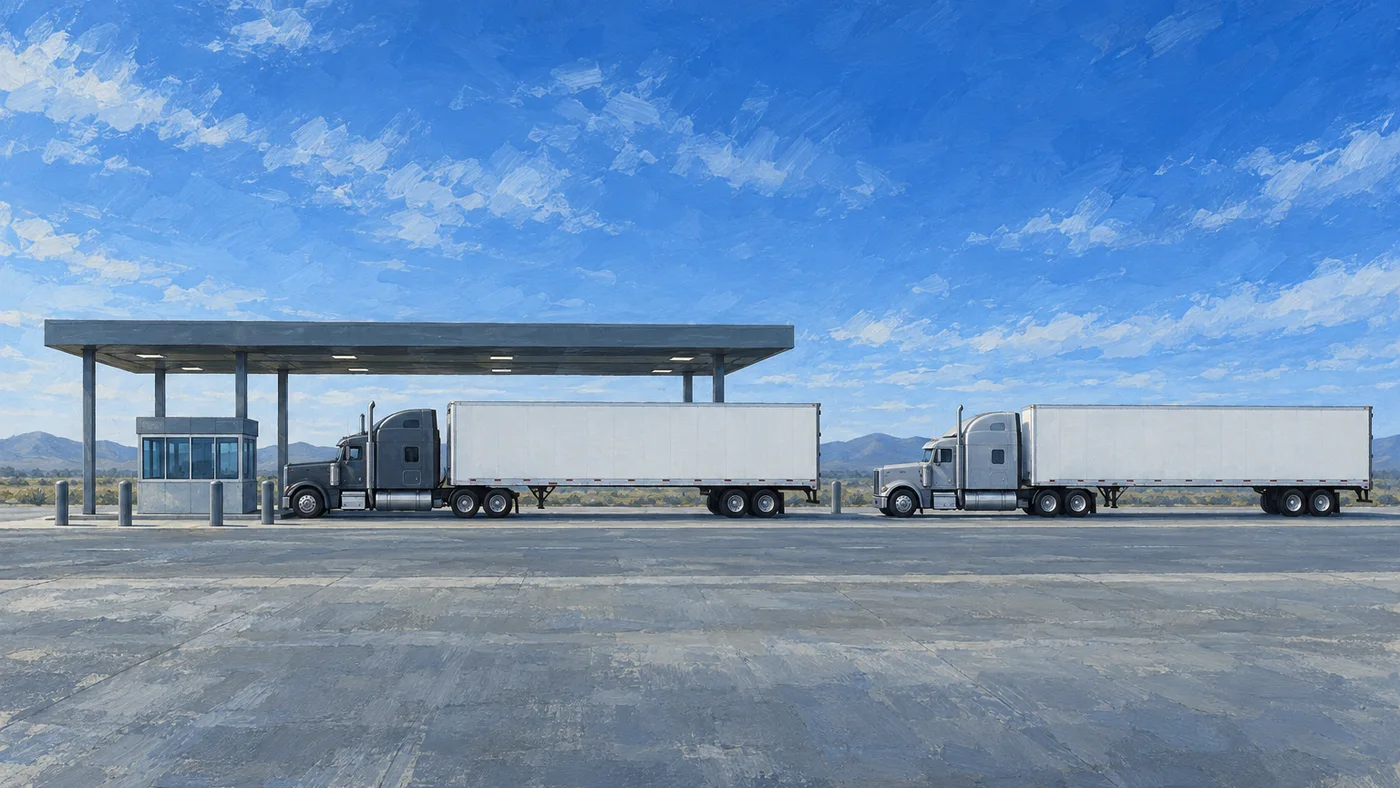
Machinery freight leaves Mexico from Monterrey first, with Guadalajara, Querétaro, the Mexico City area (Cuautitlán Izcalli) and Ciudad Juárez making up most of the rest. Dry van carries about half: pumps, compressors, HVAC units and crated components that fit through a trailer door.
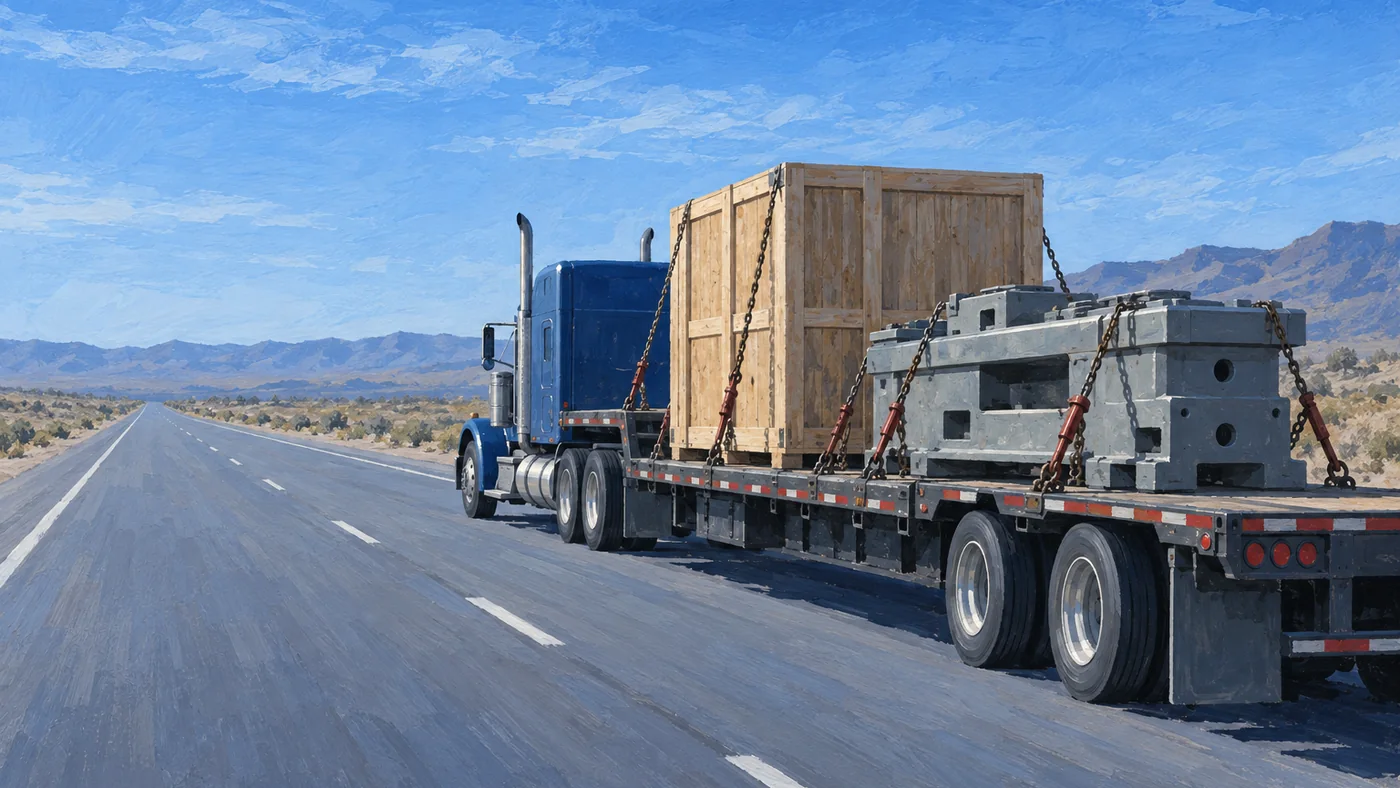
Open deck carries most of the rest, flatbed and step deck for machines too tall or heavy for a van, removable goosenecks for the largest pieces. That open-deck share is far larger than in automotive parts or packaged goods.
Laredo handled 38.8% of northbound truck crossings in 2025, and Hidalgo, the Pharr-Reynosa bridge at McAllen, was the third-busiest northbound truck port on the border.
North of the bridge, most of this freight stays in Texas (Dallas, Houston) and Arizona (Phoenix) rather than running on to the Southeast or Midwest the way auto parts do.
Southbound, machines and production equipment going into Mexican plants leave the Texas border yards, Southern California, the Gulf Coast, the Southeast ports and the Midwest for Monterrey, the Bajío and the Mexico City area.

Source: Equipment split, origin order, destinations and direction balance: Cargado postings, industrial machinery family, trailing 12 months to 10/9/2026, shares only. Crossing shares: BTS Border Crossing Entry Data, trucks, 2025. Trade growth: UN Comtrade, U.S.-reported customs value, HS 84, 2025 against 2024; the northbound figure excludes HS 8471 (own arithmetic). Retrieved 10/10/2026.
What the border adds to a machine's landed cost
Legal in Mexico, overweight in Texas. Mexico's NOM-012 allows 46.5 metric tons gross, about 102,500 pounds, for a tractor and two-axle semitrailer on its best roads. Texas allows 80,000 pounds without a permit.
Width matches at 8 feet 6 inches, and Mexico's 4.25 meter height limit sits less than an inch under the Texas 14 feet, so weight is the gap.
A trailer loaded to its Mexican legal limit reaches the bridge about 22,500 pounds over the Texas limit and needs a permit, a lighter load or a split. Taller pieces need a special route permit in Mexico as well, issued up to 4.50 meters.
Texas permits and escorts. A single-trip permit costs $60 plus a highway maintenance fee of $150 to $375 by weight, before escorts. Escorts start above 14 feet wide, 17 feet high or 110 feet long. Above 254,300 pounds the move is superheavy: a separate permit, route approval and three to four weeks of lead time.
Hidalgo County runs a local overweight corridor serving the Pharr-Reynosa, Anzalduas and Progreso bridges: up to 125,000 pounds on 15 designated routes, $206 per permit, valid 24 hours, with both ends of the trip inside the corridor. It serves a transload yard, not a through move.
Wood blocking is wood packaging. Mexico's NOM-144 counts blocking and bracing for heavy machinery as dunnage, so the lumber under a flatbed load is regulated in both directions. Northbound it must be heat-treated or fumigated and carry the IPPC mark, or the port inspector can order it re-exported and the shipment waits.
Southbound, noncompliant blocking must be treated or shipped back, at the importer's choice.
The tariff line sets landed cost. As of October 2026, fixed industrial machinery and power equipment on the Section 232 lists pay 15% in total, the normal duty plus Section 232, through 2027, whether or not the machine qualifies under USMCA.
As of October 2026, a machine whose steel or aluminum is at least 85% U.S.-made totals 10%, and one whose normal duty is 15% or more pays only that.
As of October 2026, mobile equipment such as forklifts, excavators and non-farm tractors pays 25%. For a USMCA-qualifying Mexican machine, the 25% falls only on the non-U.S. content, with a 15% floor. USMCA is a discount here, not an exemption.
As of October 2026, a non-qualifying Mexican machine outside the Section 232 lists pays its normal duty plus the 10% Section 301 tariff.
Machines going into Mexico. Under IMMEX, machinery, equipment, tools, molds and spare parts can stay in temporary import for the life of the program, against 18 months for materials. A machine not returned is treated as illegally in the country, and after a program cancellation notice there are 60 calendar days to return it or change its regime.
Mexico's sector-specific importer registry covers only a listed set of machines, Sector 8 (machines and devices related to weapons and others), not machinery in general. A new importer of a listed machine has to be registered before the shipment clears.
Liability when value is not declared. Under Mexico's federal road transport law the carrier is liable from pickup to delivery, but if the value was not declared, the SICT Carta de Porte terms cap liability at 15 UMA per metric ton, about 1,760 pesos in 2026.
The UMA is the indexed unit Mexican law uses in place of the minimum wage. For a machine worth a few hundred thousand dollars, that cap covers a small fraction of the value.
Declare the value in writing on the transport document and agree the guarantee charge up front; it is a priced line item.
Source, in order of the items above: NOM-012-SCT-2-2017 (DOF 12/26/2017), sections 6.2.1 and 6.4.4 and the weight tables; TxDMV Texas Size and Weight Limits, General Single Trip Permit, Superheavy Single Trip Permit and Escort and Equipment Requirements pages; 43 TAC chapter 219 (TxDMV oversize and overweight permits); Hidalgo County Regional Mobility Authority, Overweight Truck Corridor; NOM-144-SEMARNAT-2017 section 3.21; 7 CFR 319.40-3(b); Proclamations 11021 and 11032; HTSUS heading 9903.82.10; 91 FR 47318 (Section 301); USMCA Chapter 4 and Annex 4-B; Ley Aduanera Arts. 106 and 108; SAT, Anexo 10 de las RGCE para 2026; Ley de Caminos, Puentes y Autotransporte Federal (DOF 12/22/1993) Arts. 66-67; SICT Carta de Porte acuerdo (DOF 12/16/2021), clause DÉCIMA; DOF 1/27/2016, transitorio Tercero (UMA desindexation); INEGI UMA 2026. Retrieved 10/10/2026 and 10/11/2026.
As of October 2026
Everything in this box decays. Refresh it monthly, along with the dated lines elsewhere on the page.
- Section 232, fixed machinery. Proclamation 11021 (4/2/2026, entries on or after 4/6/2026) put fixed industrial machinery and power equipment on its Annex III list at a combined 15% (normal duty plus Section 232) through 12/31/2027, under HTSUS heading 9903.82.10, which reads 15% in both the general and special columns. Exceptions: 10% in total with at least 85% U.S. melted and poured steel or smelted and cast aluminum (heading 9903.82.07), and the normal duty alone where it is 15% or more (9903.82.11). From 1/1/2028 they return to the standard derivative rate (25%).
- Section 232, mobile equipment and the USMCA rule. Proclamation 11032 (6/1/2026, effective 6/8/2026) kept mobile industrial equipment such as forklifts, excavators and non-farm tractors at 25% through 12/31/2027 and moved agricultural equipment and residential HVAC to the 15% category. For USMCA-qualifying Canadian and Mexican goods, the 25% applies only to non-U.S. content, with a total effective duty of at least 15%. The rule is now in the tariff schedule (HTSUS chapter 99, U.S. note 16(j)). Commerce defines U.S. content for this rule in a notice scheduled to publish 10/14/2026 (FR Doc. 2026-20938): parts wholly obtained, entirely produced or substantially transformed in the U.S., plus, where not already counted in those parts, steel melted and poured and aluminum or copper smelted and cast in the U.S. It applies to entries from publication. Confirm each part number's category with your customs broker.
- Section 301. 10% on goods of Mexico since 7/24/2026. Exempt: goods entered at zero duty under USMCA, steel, aluminum and copper articles and derivatives under the Section 232 headings, and a list of other products. A non-qualifying machine outside those headings pays MFN plus 10%. The 10% is under challenge at the U.S. Court of International Trade, which heard arguments on 9/30/2026 and had not ruled as of 10/11/2026. It is still collected.
- Pending, not in force. Commerce proposed on 8/6/2026 adding cranes, parts of hydraulic motors (8412.90.9005), welding machine parts and heat exchanger parts to the metals derivative lists; no final list had been published as of 10/11/2026. Its Section 232 investigation of robotics and industrial machinery, opened 9/2/2025, had produced no proclamation as of the same date.
- Open trade cases. Commerce opened antidumping cases on linear hydraulic cylinders from Mexico and four other countries, and a countervailing case covering Mexico, in September 2026 (A-201-870, C-201-871); on the statutory schedule the countervailing preliminary is due about 11/12/2026, extendable. On van-type trailers from Mexico, Commerce made preliminary affirmative findings in both the countervailing (June 2026) and antidumping (August 2026) cases; finals are due about 12/17/2026 on the statutory schedule. Cash deposits at entry can be required while a case runs.
- Mexican customs. Annex 10 of the 2026 general foreign trade rules (DOF 1/14/2026) carries the current Sector 8 list (machines and devices related to weapons and others); where a line also appears in the SEDENA agreement, a SEDENA permit is needed at customs. The 60-day rule after an IMMEX cancellation was added to the Ley Aduanera by the reform of 11/19/2025.
- U.S. customs enforcement. Executive Order 14411 (6/3/2026) directs DHS to raise importer-of-record bonding and asset requirements and to require more import documentation, including the documents the exporter filed with its own customs administration. CBP has begun implementing it: importer-of-record data checks published 8/19/2026 (91 FR 53627), with inaccurate numbers voidable from 9/18/2026, and a 9/2/2026 advance notice on collecting exporters' foreign customs filings, comments due 12/1/2026. Bonding rules had not appeared as of 10/11/2026.
- Crossings and the September disruption. Laredo carried 38.8% of 2025 northbound truck crossings; all ports ran 0.5% above a year earlier in January through August 2026. Mexican customs barred empty trucks from entering Mexico at Eagle Pass from 9/9 to 9/14 and closed the empty-truck lanes at a Brownsville bridge from 9/9. Eagle Pass commercial traffic fell from about 1,000 trucks a day to 300-400 and about 700 tractors were stranded, according to trade press reports.
- Diesel in Mexico. The voluntary agreement holding diesel below MXN 27 per liter was renewed 8/31/2026 for six more months. The target is voluntary.
Source: Federal Register 91 FR 18201 (Proclamation 11021), 91 FR 34085 (Proclamation 11032), HTSUS chapter 99, U.S. note 16 and heading 9903.82.10; BIS U.S. content notice, FR Doc. 2026-20938 (publishes 10/14/2026); 91 FR 47318 (Section 301); In re Section 301 Forced Labor Cases, Consol. Ct. No. 26-03555 (CIT; docket checked 10/11/2026); BIS proposed derivative inclusions, 91 FR 50756 (8/6/2026); BIS robotics and industrial machinery investigation, 90 FR 46382; 91 FR 49442, 91 FR 49416, FR Docs. 2026-18706, 2026-18707 and 2026-11348 (trade cases); 91 FR 35125 (EO 14411), 91 FR 53627 and 91 FR 56408 (CBP implementation); SAT Anexo 10 RGCE 2026; Ley Aduanera Art. 108; BTS Border Crossing Entry Data through 8/2026; FreightWaves (9/17/2026), Periódico La Voz (9/15/2026) and El Diario de Chihuahua (9/9/2026) on the September empty-truck restrictions; SENER and Profeco diesel agreement notices. Retrieved 10/10/2026 and 10/11/2026.
General information as of 10/11/2026, not legal, tax or customs advice. Confirm classification and duty with a licensed customs broker.
How open deck and dry van rates moved out of the machinery markets
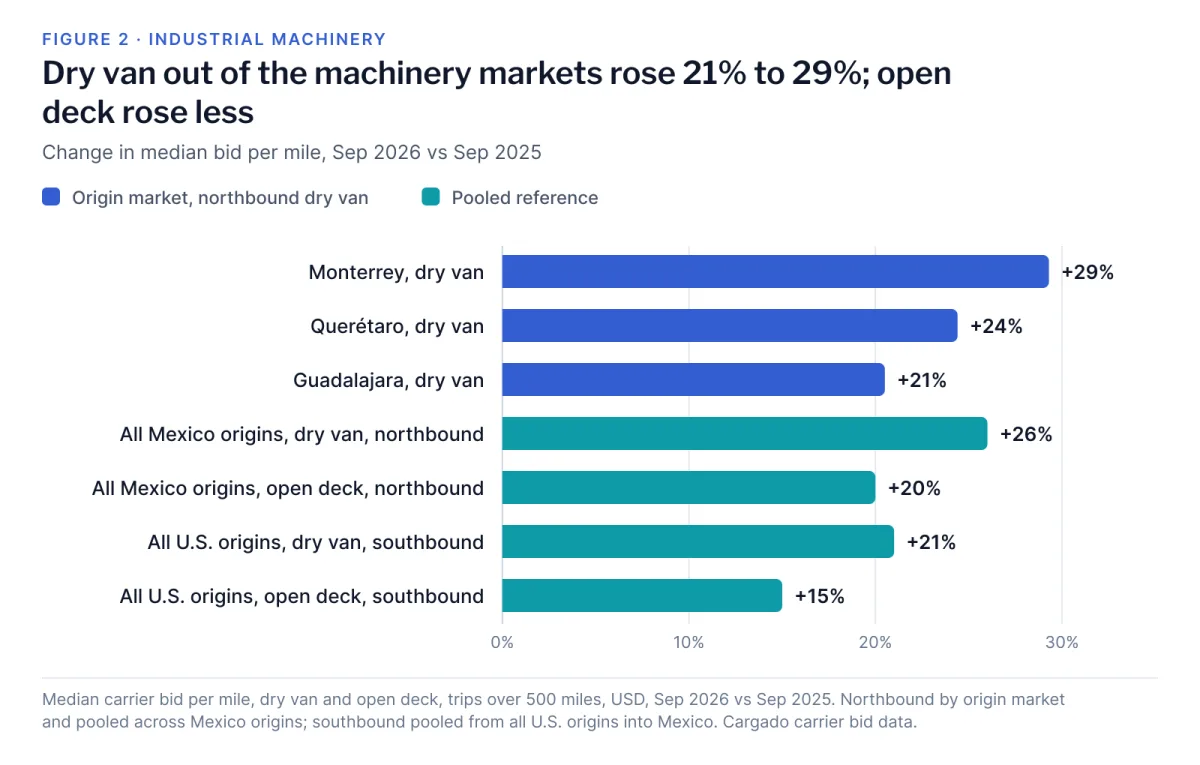
Northbound dry van bids out of the three machinery markets rose between 21% and 29% from September 2025 to September 2026. Open deck rose less.
| Market and equipment | Change in median northbound bid per mile, Sep 2026 vs Sep 2025 |
|---|---|
| Monterrey, dry van | +29% |
| Querétaro, dry van | +24% |
| Guadalajara, dry van | +21% |
| All Mexico origins, dry van, northbound | +26% |
| All Mexico origins, open deck, northbound | +20% |
| All U.S. origins, dry van, southbound into Mexico | +21% |
| All U.S. origins, open deck, southbound into Mexico | +15% |
These are market-level figures, the median of carrier bids on all freight out of each origin market, not only machinery: the cost of a trailer leaving that market. We publish the change rather than the level because per-mile levels mislead across markets with different haul lengths; Monterrey's short runs to the border inflate its unfiltered number.
Source: Median carrier bid per mile, dry van and open deck, trips over 500 miles, U.S. dollars, September 2026 against September 2025. Northbound by origin market and pooled across Mexico origins; southbound pooled from all U.S. origins into Mexico. Cargado carrier bid data.
Open deck needs a longer window. Monterrey and Querétaro are the only machinery markets where open-deck bidding runs deep enough to publish on their own, and even there one month is too few bids. Read open-deck moves on quarters, not months.
On a rolling three-month window, the median northbound open-deck bid out of Monterrey rose about 16% in July through September 2026 against April through June, and Querétaro about 7%. Pooled northbound open deck eased 1.6% from August to September after rising since March.
Source: Median carrier bid per mile, open deck, northbound, trips over 500 miles, U.S. dollars, July to September 2026 against April to June 2026 by origin market; pooled Mexico origins, September 2026 against August 2026. Cargado carrier bid data.
Each direction is its own market. On nine city pairs priced both ways on October 10, 2026, northbound dry van through Laredo ran 15% to 53% above southbound: a line going into a Mexican plant buys the cheaper direction, finished machines coming north the expensive one. Full comparison: /insights/automotive-parts-mexico-us.
Source: Median carrier bid from Cargado Market Rates, dry van, via Laredo, both directions, October 10, 2026, nine city pairs from Puebla, Silao and Monterrey-area origins with a confidence score of 60 or higher in both directions.
Some lanes have no defensible rate. On the networks we have benchmarked, open deck ran thinnest; in one network most open-deck lanes returned no rate at all. We marked those lanes as gaps rather than filling them with a modeled number, because an oversize move is engineered, permitted and quoted.
Each Cargado rate carries a confidence label based on how much recent bidding stands behind it.
What we see benchmarking machinery freight
We run rate benchmarks with companies that ship across the border. These are patterns from that work, shared without names or rates.
- Two U.S. regions can have two different years. In one machinery network, rates into one U.S. region climbed while rates into another dipped and then rebounded. A blended rate hides that split, and an annual contract needs it.
- Open deck data is thinner than dry van. In the same network, far fewer open deck lanes had a market rate than dry van lanes. We name that gap instead of filling it with an estimate.
Source: Cargado rate benchmarking engagements, anonymized. Market movements cited are Cargado carrier bid data.
Six checks before you price a machinery lane
- Check every piece against the Texas limits, not the Mexican ones. Over 80,000 pounds gross or 14 feet high needs a permit; price the permit, the escorts and the days, and start a superheavy move three to four weeks out.
- Price each direction on its own; a southbound bid says little about the northbound one.
- Ask which open-deck lanes have a defensible rate. Read those on a rolling three-month window and collect quotes on the rest.
- Confirm each machine's Section 232 category and USMCA status by tariff line with your customs broker, and check whether any machine on the order sits in Sector 8.
- Declare the value in writing on the transport document for every expensive piece, agree the guarantee charge up front, and ask each carrier what cargo insurance it carries.
- Require heat-treated, IPPC-marked blocking from the crating shop, and keep an inventory of machines in Mexico under IMMEX with their return deadlines.
Monthly lane watch
Median carrier bids, September 2026. We update this block each month.
| Market | Direction and equipment | vs September 2025 | vs August 2026 |
|---|---|---|---|
| Monterrey open deck | Northbound open deck | +16% vs the prior 3 months | |
| Querétaro open deck | Northbound open deck | +7% vs the prior 3 months | |
| Pooled northbound open deck (all Mexico origins) | Northbound open deck | +20% | -1.6% |
| Pooled southbound open deck (all U.S. origins into Mexico) | Southbound open deck | +15% | +3.0% |
| Monterrey | Northbound dry van | +29% | +3.1% |
| Guadalajara | Northbound dry van | +21% | +0.8% |
| Querétaro | Northbound dry van | +24% | +2.1% |
| Pooled southbound dry van (all U.S. origins into Mexico) | Southbound dry van | +21% | +3.4% |
Source: Cargado carrier bid data.
Where carrier bids sit on your machinery lanes
Send us the machinery lanes you are pricing, both directions and both trailer types, and we will show you where carrier bids sit and which open-deck lanes have thin or no data.
Talk to us → /contact?ref=industry-industrial-machinery-mexico-us
Related links
- Industrial machinery freight (hub)
- Market Rates for your Mexico and Canada freight
- How rate confidence scores work
- How to read a Mexico fuel surcharge
- What a Mexican carrier is liable for when freight is lost or damaged