
The story
In 2026, the best Mexico pricing teams don’t “know the rate.” They run a repeatable system:
- Benchmark lanes to stay grounded in reality
- Quote spot fast (without getting reckless)
- Price large bid files / RFPs at scale without spending days in spreadsheets
This post explains how top logistics providers use Cargado Market Rates across the business, and why treating rate data as a workflow (not a lookup) is the difference between winning and scrambling.
Why Mexico pricing is different (and why “one number” fails)
Mexico freight looks simple until you’re accountable for margin.
Two loads can share the same origin and destination and still price very differently because of:
- crossing and operating model differences
- lead time and appointment windows
- equipment availability and constraints
- service expectations (door-to-door vs. handoffs)
- accessorial exposure
- the reality of which carriers can run the move (legally and operationally)
That’s why the right mental model isn’t “What’s the rate?”
It’s: “What’s normal for this move, what’s the spread, and how confident should we be?”
Where Cargado Market Rates come from
Cargado Market Rates are powered by real carrier bids placed in the Cargado marketplace across a mix of spot and contracted/repeat freight.
Because those bids come from real broker↔carrier interactions, the output reflects what’s actually happening in the market, not an abstract average.
To make rates usable for day-to-day decisions, we present low / mid / high pricing bands (quartiles) rather than a single number, and we include confidence signals so teams can understand where the rate is stable and where it needs judgment.

The three workflows market-rate data should support
The best pricing teams don’t use market rates for one thing. They use it across three workflows.
1) Benchmarking: pricing discipline and fast sanity checks
Benchmarking answers one question: Are we in the ballpark?
It prevents the two costly failures:
- Quote too high and lose the load (often without feedback).
- Quote too low, win, and then spend the next 48 hours trying to make it real.
A good benchmark doesn’t need to be perfect.
It needs to be credible, and it needs to be shared so the whole team starts from the same baseline.
What this unlocks:
- consistent pricing across reps and branches
- coaching that’s based on reality (not opinion)
- faster internal alignment on when to win vs. protect margin
2) Spot pricing: speed with guardrails
Spot quotes have a clock.
If you respond slowly, you lose.
If you respond quickly with a bad number, you win and then scramble.
The best teams follow a two-step motion:
- Anchor the first response quickly using market rates (range-based, defensible).
- Tighten the quote with live carrier feedback before committing.
Market-rate data supports the first step, and it helps teams recognize exceptions early, so they can price risk intentionally instead of treating every move as standard.
3) Bid files & RFPs: scaling pricing without creating a 12‑month margin leak
RFPs and bid files are where mistakes compound, because you repeat the decision over and over.
The spreadsheet is the trap:
- it makes the work feel deterministic
- it hides service constraints
- it turns “Mexico leg” assumptions into a black box
- it encourages precision where you need guardrails
The highest-leverage use of market rates in a large RFP is not “the exact penny.”
It’s building guardrails:
- where to play vs. where not to
- buffers and floors
- seasonality adjustments
- post-award monitoring so the contract doesn’t become a silent loss
And in 2026, scale matters.
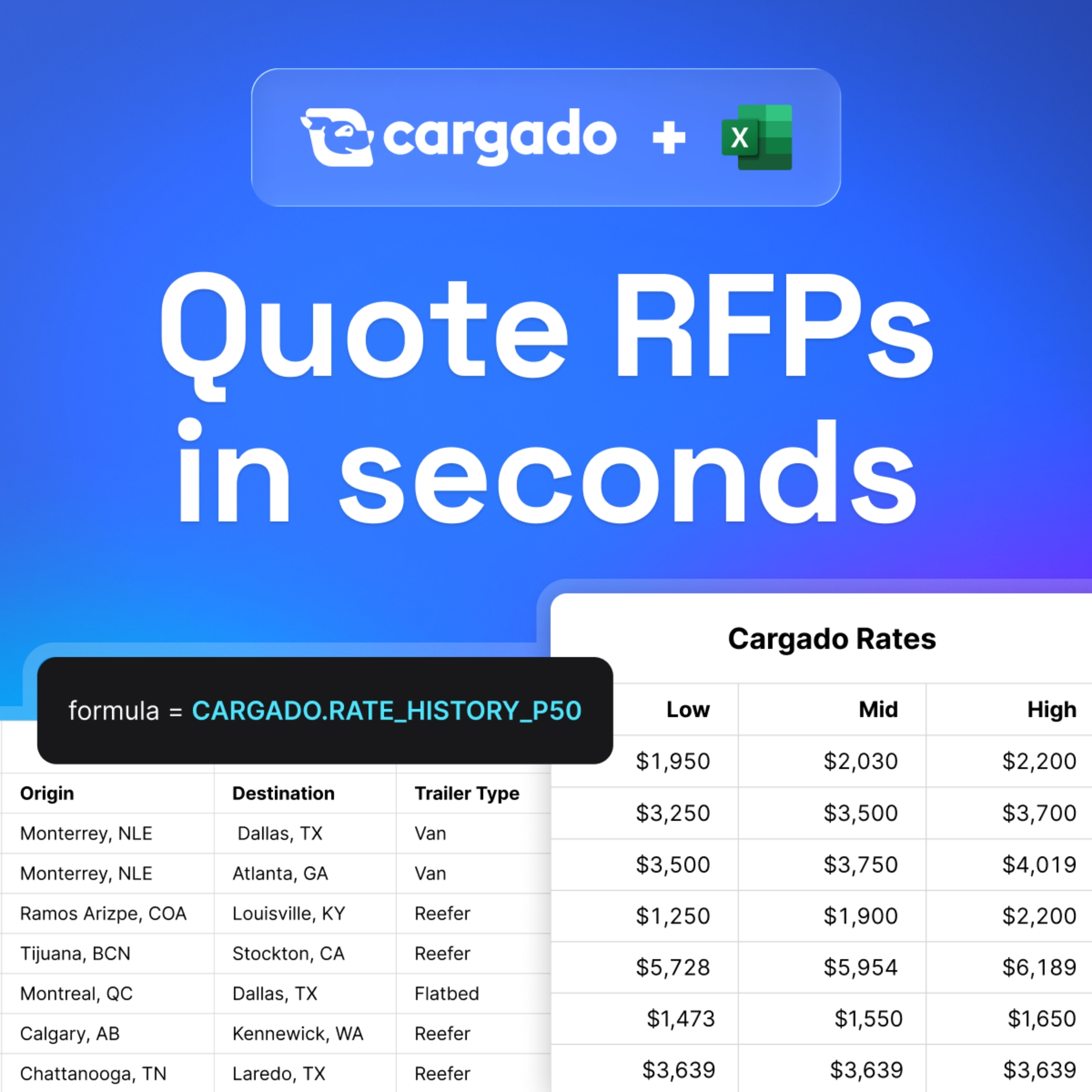
If you’re looking at 100 lanes, you need a way to price lane sets efficiently (Excel / API) so your team spends time thinking and validating, not copying and pasting.
A practical operating system for Mexico pricing teams
If you want to price Mexico freight like the best logistics providers do in 2026, start here:
- Make benchmarks mandatory before any quote goes out.
- Set an internal SLA for spot: initial response time + tightened response time.
- Set max-pay (and enforce it): use market rates to define your ceiling, then hold your team, and your carrier network, accountable to it.
- Treat bid files as a workflow, not a hero project dependent on one person.
- Measure outcomes: where you win but can’t cover, where you lose fast, where lanes drift from assumptions.
A critical pricing truth: “max-pay” only works if carriers still want your freight
Mexico freight is a relationship business.
Market rates and max-pay guardrails are meant to prevent self-inflicted margin mistakes, not to turn every carrier conversation into a squeeze.
When capacity tightens, carriers have choices. Brokers that develop a reputation for pushing unrealistic numbers, creating churn, or being hard to work with will often see the same outcome: slower responses, fewer bids, and less access to the best trucks.
The teams that use rate data best tend to pair discipline with fairness:
- Use market rates to set expectations and educate internal teams (and shippers) when the market moves.
- Pay fair, lane-appropriate rates so carriers stay engaged.
- Protect long-term carrier relationships instead of winning one load and losing the lane.
The point
Market-rate data shouldn’t be a number you occasionally reference.
It should be the backbone of your pricing system: across benchmarking, spot quoting, and RFPs.
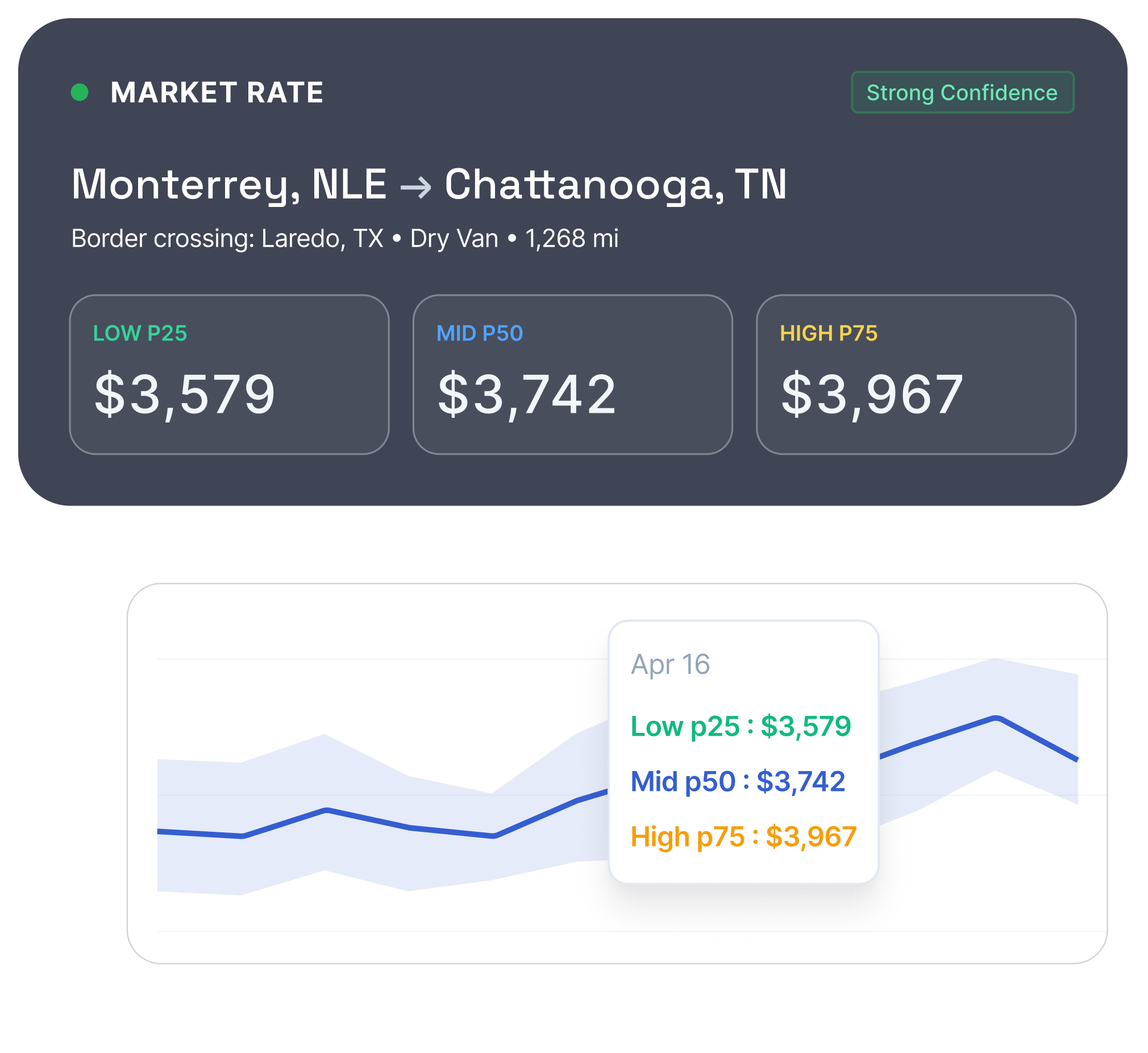
Want to see Cargado Market Rates in action?
Book a demo to see how brokers use live marketplace bids to:
- Benchmark Mexico freight spend against the market
- Quote spot faster with credible ranges
- Price large lane sets efficiently via Excel and API