
DAT vs Loadlink vs Cargado for Canada freight (2026)
A straight comparison of Canada freight options, including who owns which one. If you run two, this is how to decide which two.
- Loadlink calls itself Canada's largest load board and lists carrier and broker subscription plans without published prices. (Sources: Loadlink's Canadian load board page, loadlink.ca/canadian-load-board; Loadlink's carrier plans page, loadlink.ca/carrier-plans; Loadlink's broker plans page, loadlink.ca/broker-plans. Verified September 2026.)
- 123Loadboard publishes its carrier pricing on its own site and offers load searching, truck posting and lane rate insights. (Source: 123Loadboard's pricing page, 123loadboard.com/pricing, verified September 2026.)
- DAT offers a load board and shares an owner with Loadlink. (Sources: DAT's load board page, dat.com/load-boards; DAT's company page, dat.com/company; Loadlink's company page, loadlink.ca/our-company. Verified September 2026.)
- Cargado is built to span Mexico and Canada freight; carriers join at no cost.
- If you run two, pick the two that cover your map.
The Canada shortlist at a glance
| Loadlink | 123Loadboard | DAT | Cargado | |
|---|---|---|---|---|
Network focus | Canada | North America | North America | Mexico and Canada, cross-border and domestic |
Who gets in | Paid subscribers | Paid subscribers | Paid subscribers | Vetted: every carrier checked, every broker met before onboarding |
Carrier cost | Plans without published prices | Three published carrier tiers | Paid carrier plans | No cost |
Rate data | Rate Index tool | Rate Check, top tier | Rate benchmarks | Based on real carrier bid data |
Ownership | Roper Technologies | Not published | Roper Technologies | Independent |
What carriers and brokers have done on Cargado
Two published customer stories, in their own numbers.
This broker grew Mexico revenue 1,400% in just 4 months.
This carrier grew from 1 to 6 trucks and 50 customers using only Cargado.
Five questions worth asking first
Before comparing logos, get clear on what your freight actually demands. These five questions separate the boards faster than any feature grid.
Loadlink
Loadlink has been matching Canada freight since 1990 and calls itself Canada's leader in load and freight-matching services. It also calls itself Canada's largest load board, which matters if your freight moves Toronto to Montreal, Calgary to Vancouver, or across the country. Loadlink has French-language pages, which matters for Quebec freight, and it offers a Rate Index truckload rating tool. (Sources: Loadlink's company page, loadlink.ca/our-company; Loadlink's French load board page, loadlink.ca/fr/carrier-loadboard; Loadlink's Canadian load board page, loadlink.ca/canadian-load-board. Verified September 2026.)
123Loadboard
123Loadboard publishes three carrier tiers on its own pricing page, and its lane rate insights come only with the top tier. (Source: 123Loadboard's pricing page, 123loadboard.com/pricing, verified September 2026.)
The product covers trucking across North America, with mileage and routing, credit checks and a mobile app. (Sources: 123Loadboard's about page, 123loadboard.com/about; 123Loadboard's pricing page, 123loadboard.com/pricing. Verified September 2026.)
DAT
DAT offers a load board, and it lists loads moving into and out of Canada. Whether it fits a Canada operation depends on the depth of Canada-specific capacity and tooling you need, so check its current product pages against your lanes. (Source: DAT's load board page, dat.com/load-boards, verified September 2026.)
DAT publishes separate carrier and broker plans on its own pricing page. Check there for current terms before you plan your Canada freight around it. Some DAT load board plans also include market rate data. (Sources: DAT's pricing page, dat.com/pricing; DAT's load board page, dat.com/load-boards. Verified September 2026.)
Cargado
Cargado is the modern marketplace for Mexico and Canada freight, and it is built to span both. It covers freight crossing between the United States, Mexico and Canada, freight moving domestically within Mexico and within Canada, and the U.S. domestic legs that feed the border, loads to and from cities like Laredo or Detroit.
It is a vetted marketplace. Carriers are verified through FMCSA (the U.S. Federal Motor Carrier Safety Administration) and SICT (Mexico's federal transport authority) before they can bid, with FAST (Free and Secure Trade), PIP (Partners in Protection, the CBSA program) and CTPAT status tracked on the profile. Cargado meets with every broker before onboarding them.
Brokers post loads for spot coverage and post lanes as procurement events carrying date range, loads per day, days of the week, commodity, equipment and requirements, to source dedicated capacity for a schedule.
Carriers pay nothing, including market rate visibility. Broker subscriptions include unlimited users, so there is no per-seat math. Chat is bilingual with message translation, and Canadian and U.S. dollars are both handled natively.
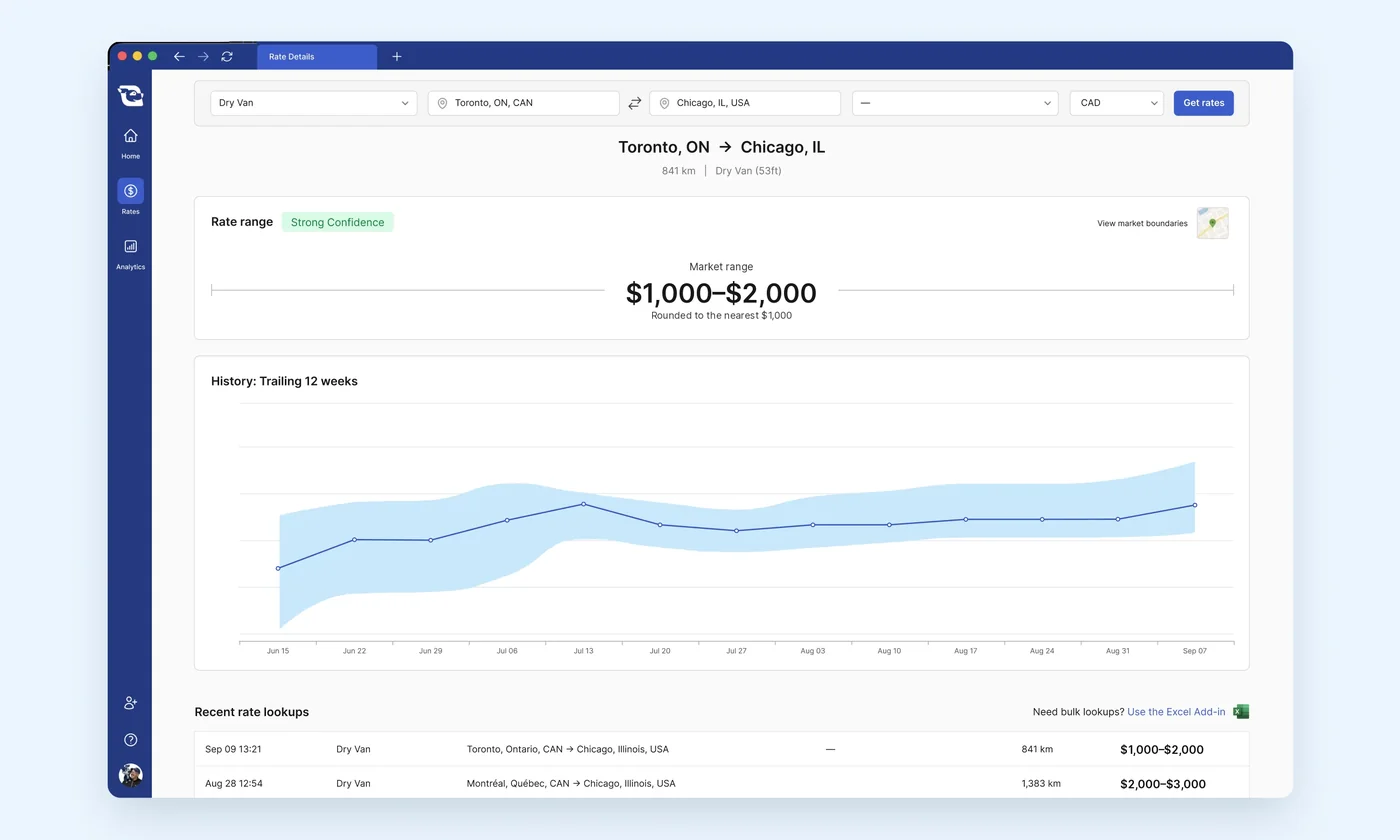
Where that shows up: Toronto to Chicago, Montreal into the Northeast, Winnipeg to Chicago reefer, Brampton to Calgary domestic, southern Ontario into western New York, British Columbia south into Washington.
Who actually owns the Canada load boards
This part surprises people, and it is worth knowing before you build a shortlist.
Loadlink states on its own company page that Loadlink Technologies is a wholly-owned subsidiary of Roper Technologies, the S&P 500 company that trades as ROP. DAT's company page lists its parent company as Roper Technologies as well. (Sources: Loadlink's company page, loadlink.ca/our-company; DAT's company page, dat.com/company. Verified September 2026.)
The history is straightforward. Loadlink's own timeline shows it was acquired by TransCore in 2001, and TransCore was acquired by Roper in 2004, which brought both freight-matching businesses under the same roof. In October 2021 Roper announced the sale of TransCore for $2.68 billion and kept DAT and Loadlink. (Sources: Loadlink's company page, loadlink.ca/our-company; Roper's October 2021 TransCore announcement on GlobeNewswire. Verified September 2026.)
Nothing about that is a knock on either product. Both are well-run and both earned their positions. It is simply useful context: two of the biggest names on a Canada shortlist are corporate siblings, so a comparison between them is a narrower comparison than it looks.
What to run
No single board wins every lane, and the honest recommendation is to run more than one where your freight justifies it.
One setup: keep an established domestic board for the freight it is deepest on, whether that is domestic Canada or the U.S. interior, and route Mexico and Canada freight through a network built for it.
Skip the question of which board is best in the abstract. Answer a better one: which two cover your map without leaving a corner of it dark.
Add Mexico and Canada coverage
Brokers see live lane rates and vetted carriers on their own lanes in a demo. Carrier access is at no cost.
Common questions
What is the best load board for Canada freight?
It depends on where the freight lives. Loadlink calls itself Canada's largest load board, DAT describes itself as North America's largest on-demand freight marketplace, and Cargado is built to span Mexico and Canada freight in one place. You can also run two rather than choosing one. (Sources: Loadlink's Canadian load board page, loadlink.ca/canadian-load-board; DAT's about page, dat.com/about. Verified September 2026.)
Is there a free option for Canada carriers?
Yes. Cargado, the marketplace on this list, charges carriers nothing, including market rate visibility. DAT and 123Loadboard publish paid carrier plans; check Loadlink's own site for its carrier plans. (Sources: DAT's pricing page, dat.com/pricing; 123Loadboard's pricing page, 123loadboard.com/pricing. Verified September 2026.)
What covers both Mexico and Canada freight?
Cargado is built to span Mexico and Canada freight in one place, covering cross-border moves between the United States, Mexico and Canada as well as domestic freight inside both countries.
Do Loadlink and DAT have the same owner?
Yes. Loadlink's company page states it is a wholly-owned subsidiary of Roper Technologies, and DAT's company page lists Roper Technologies as its parent. Roper acquired both through its 2004 purchase of TransCore and kept them when it agreed to sell TransCore in October 2021. (Sources: Loadlink's company page, loadlink.ca/our-company; DAT's company page, dat.com/company; Roper's October 2021 TransCore announcement on GlobeNewswire. Verified September 2026.)
How is Cargado priced for Canada freight?
Cargado broker plans are value-based and include unlimited users. Contact Cargado for a quote. Vetted carriers join and bid at no cost. For the others, read each vendor's own pricing page.
What should a load board let me specify on a Canada posting?
At minimum the equipment, including reefer and heated where protect-from-freezing applies, drop versus live, the temperature range, and any PIP-certified facility, minimum cargo insurance or CTPAT requirement. Postings that cannot carry that detail generate phone calls instead of bids.