
DAT c. Loadlink c. Cargado pour le fret au Canada (2026)
Une comparaison directe des options pour le fret au Canada, y compris qui possède laquelle. Si vous en utilisez deux, voici comment choisir lesquelles.
- Loadlink se présente comme le plus grand tableau de chargement au Canada et affiche des forfaits d'abonnement pour transporteurs et pour courtiers sans prix publiés. (Sources : page du tableau de chargement canadien de Loadlink, loadlink.ca/canadian-load-board ; page des forfaits transporteurs de Loadlink, loadlink.ca/carrier-plans ; page des forfaits courtiers de Loadlink, loadlink.ca/broker-plans. Vérifiées en septembre 2026.)
- 123Loadboard publie ses prix pour les transporteurs sur son propre site et offre la recherche de chargements, la publication de camions et des indications sur les tarifs par voie. (Source : page de tarification de 123Loadboard, 123loadboard.com/pricing, vérifiée en septembre 2026.)
- DAT offre un tableau de chargement et partage un propriétaire avec Loadlink. (Sources : page du tableau de chargement de DAT, dat.com/load-boards ; page d'entreprise de DAT, dat.com/company ; page d'entreprise de Loadlink, loadlink.ca/our-company. Vérifiées en septembre 2026.)
- Cargado est conçu pour couvrir le fret du Mexique et du Canada; l'adhésion des transporteurs est gratuite.
- Si vous en utilisez deux, choisissez les deux qui couvrent votre carte.
La courte liste canadienne en un coup d'œil
| Loadlink | 123Loadboard | DAT | Cargado | |
|---|---|---|---|---|
Orientation du réseau | Canada | Amérique du Nord | Amérique du Nord | Mexique et Canada, transfrontalier et intérieur |
Qui y a accès | Abonnés payants | Abonnés payants | Abonnés payants | Vérifiés : chaque transporteur contrôlé, chaque courtier en transport rencontré avant son inscription |
Coût pour les transporteurs | Forfaits sans prix publiés | Trois paliers publiés pour les transporteurs | Forfaits transporteurs payants | Sans frais |
Données tarifaires | Outil Rate Index | Rate Check, palier supérieur | Références tarifaires | Basé sur des données réelles d'offres de transporteurs |
Propriété | Roper Technologies | Non publiée | Roper Technologies | Indépendant |
Ce que des transporteurs et des courtiers ont accompli sur Cargado
Deux histoires de clients publiées, avec leurs propres chiffres.
Ce courtier a augmenté ses revenus au Mexique de 1 400 % en seulement 4 mois.
Ce transporteur est passé de 1 à 6 camions et 50 clients en n'utilisant que Cargado.
Cinq questions à poser d'abord
Avant de comparer des logos, précisez ce que votre fret exige réellement. Ces cinq questions distinguent les tableaux de chargement plus vite que n'importe quel tableau de fonctions.
Loadlink
Loadlink jumelle du fret au Canada depuis 1990 et se présente comme le chef de file canadien des services de jumelage de chargements et de fret. Il se présente aussi comme le plus grand tableau de chargement au Canada, ce qui compte si votre fret circule de Toronto à Montréal, de Calgary à Vancouver ou à travers le pays. Loadlink a des pages en français, ce qui compte pour le fret au Québec, et il offre Rate Index, un outil de tarification pour le chargement complet. (Sources : page d'entreprise de Loadlink, loadlink.ca/our-company ; page du tableau de chargement en français de Loadlink, loadlink.ca/fr/carrier-loadboard ; page du tableau de chargement canadien de Loadlink, loadlink.ca/canadian-load-board. Vérifiées en septembre 2026.)
123Loadboard
123Loadboard publie trois paliers pour les transporteurs sur sa propre page de tarification, et ses indications sur les tarifs par voie ne sont offertes qu'avec le palier supérieur. (Source : page de tarification de 123Loadboard, 123loadboard.com/pricing, vérifiée en septembre 2026.)
Le produit couvre le camionnage partout en Amérique du Nord : kilométrage et itinéraires, vérifications de crédit et application mobile. (Sources : page de présentation de 123Loadboard, 123loadboard.com/about ; page de tarification de 123Loadboard, 123loadboard.com/pricing. Vérifiées en septembre 2026.)
DAT
DAT offre un tableau de chargement, et il affiche des chargements qui entrent au Canada et qui en sortent. Savoir s'il convient à une opération canadienne dépend de la profondeur de capacité et des outils propres au Canada dont vous avez besoin : vérifiez ses pages produit actuelles au regard de vos voies. (Source : page du tableau de chargement de DAT, dat.com/load-boards, vérifiée en septembre 2026.)
DAT publie des forfaits distincts pour les transporteurs et pour les courtiers sur sa propre page de tarification. Consultez-la pour connaître les conditions en vigueur avant de choisir un forfait pour votre équipe au Canada. Certains forfaits du tableau de chargement de DAT comprennent aussi des données sur les tarifs du marché. (Sources : page de tarification de DAT, dat.com/pricing ; page du tableau de chargement de DAT, dat.com/load-boards. Vérifiées en septembre 2026.)
Cargado
Cargado est la bourse de fret moderne pour le fret du Mexique et du Canada, et il est conçu pour couvrir les deux. Il couvre le fret qui traverse entre les États-Unis, le Mexique et le Canada, le fret qui circule à l'intérieur du Mexique et à l'intérieur du Canada, et les segments américains qui alimentent la frontière, soit les chargements vers et depuis des villes comme Laredo ou Detroit.
C'est une bourse de fret vérifiée. Avant de pouvoir faire une offre, chaque transporteur fait l'objet d'une vérification des registres de permis d'exploitation applicables à ses activités, auprès de la FMCSA (l'organisme fédéral américain de sécurité du camionnage) ou de la SICT (l'autorité fédérale mexicaine des transports), et les statuts EXPRES (FAST), PEP (Partenaires en protection, le programme de l'ASFC) et CTPAT sont inscrits au profil. Cargado rencontre chaque courtier avant son inscription.
Les courtiers publient des chargements pour trouver un transporteur sur un envoi ponctuel, et des voies pour lancer un appel d'offres : période, nombre de chargements par jour, jours de la semaine, marchandise, équipement et exigences, afin d'obtenir de la capacité dédiée pour un horaire.
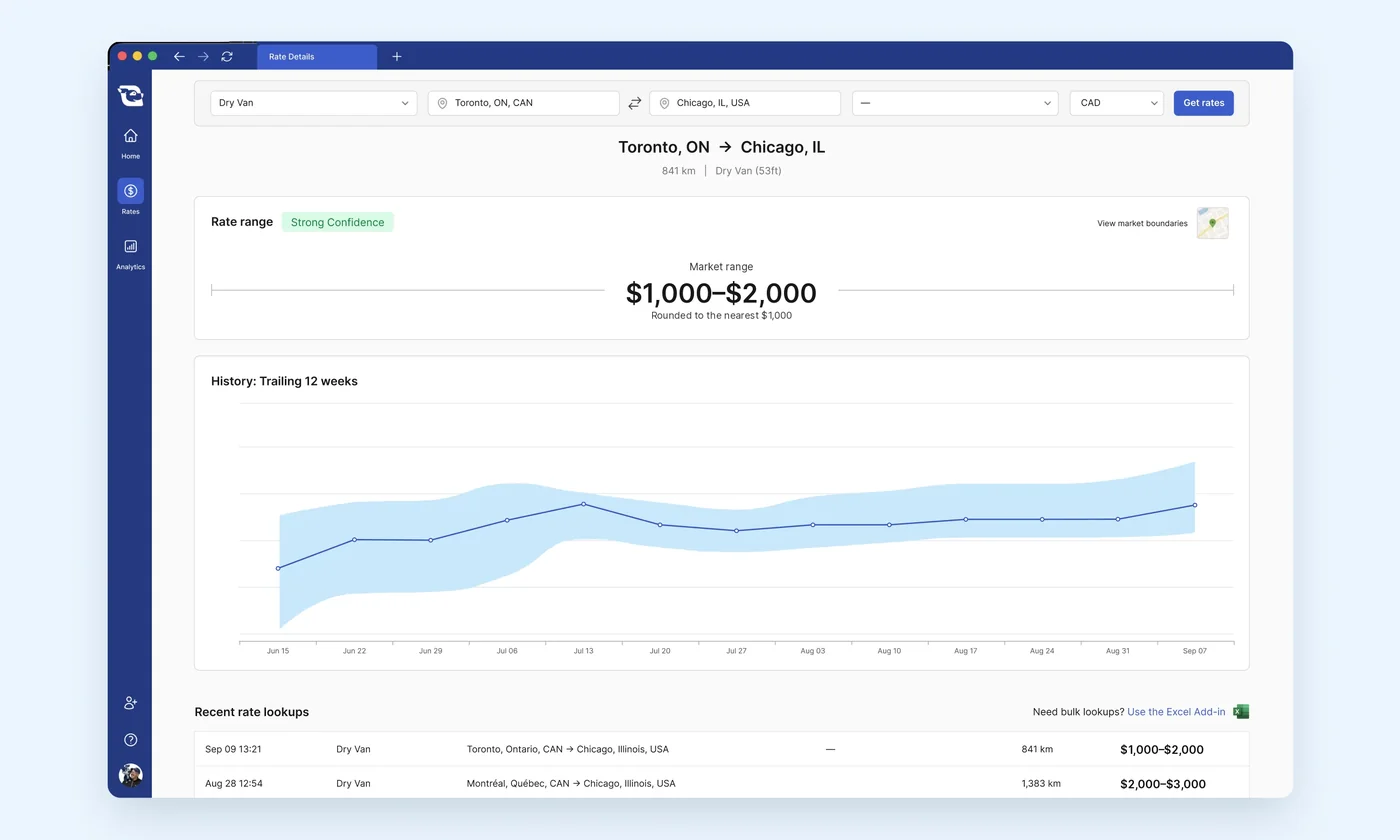
Les transporteurs ne paient rien, visibilité des tarifs du marché comprise. Les abonnements courtiers comprennent un nombre illimité d'utilisateurs : aucun calcul par poste. Le Chat est multilingue et traduit les messages, et le dollar canadien comme le dollar américain sont traités nativement.
Où cela se voit : Toronto à Chicago, Montréal vers le Nord-Est américain, Winnipeg à Chicago en réfrigéré, Brampton à Calgary, le sud de l'Ontario vers l'ouest de l'État de New York, la Colombie-Britannique vers le sud jusqu'à l'État de Washington.
À qui appartiennent vraiment les tableaux de chargement canadiens
Cette partie surprend les gens, et il vaut la peine de la connaître avant de dresser une courte liste.
Loadlink indique sur sa propre page d'entreprise que Loadlink Technologies est une filiale en propriété exclusive de Roper Technologies, la société du S&P 500 qui se négocie sous le symbole ROP. La page d'entreprise de DAT indique elle aussi Roper Technologies comme société mère. (Sources : page d'entreprise de Loadlink, loadlink.ca/our-company ; page d'entreprise de DAT, dat.com/company. Vérifiées en septembre 2026.)
L'historique est simple. La chronologie de Loadlink montre qu'elle a été acquise par TransCore en 2001, et TransCore a été acquise par Roper en 2004, ce qui a réuni les deux entreprises de jumelage de fret sous le même toit. En octobre 2021, Roper a annoncé la vente de TransCore pour 2,68 milliards de dollars et a conservé DAT et Loadlink. (Sources : page d'entreprise de Loadlink, loadlink.ca/our-company ; annonce de Roper sur la vente de TransCore, octobre 2021, sur GlobeNewswire. Vérifiées en septembre 2026.)
Rien là-dedans n'est un reproche à l'un ou à l'autre produit. Les deux sont bien tenus et ont gagné leur position. C'est simplement un contexte utile : deux des plus grands noms d'une courte liste canadienne sont des sociétés sœurs, de sorte qu'une comparaison entre elles est plus étroite qu'elle n'en a l'air.
Ce qu'il faut utiliser
Aucun tableau de chargement ne gagne sur toutes les voies, et la recommandation honnête est d'en utiliser plus d'un là où votre fret le justifie.
Une configuration : garder un tableau de chargement établi pour le fret où il est le plus profond, que ce soit à l'intérieur du Canada ou à l'intérieur des États-Unis, et faire passer le fret du Mexique et du Canada par un réseau conçu pour cela.
Laissez tomber la question de savoir quel tableau de chargement est le meilleur dans l'absolu. Répondez plutôt à celle-ci : lesquels des deux couvrent votre carte sans en laisser un coin dans le noir.
Ajoutez la couverture du Mexique et du Canada
En démonstration, les courtiers voient les tarifs en direct et les transporteurs vérifiés sur leurs propres voies. L'accès est gratuit pour les transporteurs.
Questions fréquentes
Quel est le meilleur tableau de chargement pour le fret au Canada ?
Cela dépend de l'endroit où vit le fret. Loadlink se présente comme le plus grand tableau de chargement au Canada, DAT se décrit comme la plus grande bourse de fret sur demande en Amérique du Nord, et Cargado est conçu pour réunir le fret du Mexique et du Canada au même endroit. Vous pouvez aussi en utiliser deux plutôt que d'en choisir un seul. (Sources : page du tableau de chargement canadien de Loadlink, loadlink.ca/canadian-load-board ; page de présentation de DAT, dat.com/about. Vérifiées en septembre 2026.)
Y a-t-il une option gratuite pour les transporteurs au Canada ?
Oui. Cargado, la bourse de fret de cette liste, ne facture rien aux transporteurs, visibilité des tarifs du marché comprise. DAT et 123Loadboard publient des forfaits transporteurs payants ; consultez le site de Loadlink pour ses propres forfaits. (Sources : page de tarification de DAT, dat.com/pricing ; page de tarification de 123Loadboard, 123loadboard.com/pricing. Vérifiées en septembre 2026.)
Qu'est-ce qui couvre à la fois le fret du Mexique et du Canada ?
Cargado est conçu pour réunir le fret du Mexique et du Canada au même endroit : les mouvements transfrontaliers entre les États-Unis, le Mexique et le Canada, ainsi que le fret qui circule à l'intérieur des deux pays.
Loadlink et DAT ont-ils le même propriétaire ?
Oui. La page d'entreprise de Loadlink indique qu'elle est une filiale en propriété exclusive de Roper Technologies, et celle de DAT indique Roper Technologies comme société mère. Roper a acquis les deux lors de son achat de TransCore en 2004 et les a conservées quand elle a accepté de vendre TransCore en octobre 2021. (Sources : page d'entreprise de Loadlink, loadlink.ca/our-company ; page d'entreprise de DAT, dat.com/company ; annonce de Roper sur la vente de TransCore, octobre 2021, sur GlobeNewswire. Vérifiées en septembre 2026.)
Comment Cargado est-il tarifé pour le fret au Canada ?
Les forfaits courtiers de Cargado sont basés sur la valeur et comprennent un nombre illimité d'utilisateurs. Communiquez avec Cargado pour obtenir un prix. Les transporteurs vérifiés adhèrent et font des offres gratuitement. Pour les autres, consultez la page de tarification de chaque fournisseur.
Que devrait permettre de préciser un tableau de chargement sur une publication canadienne ?
Au minimum l'équipement, y compris le réfrigéré et le chauffé là où la protection contre le gel s'applique, la livraison « Drop » ou « En direct », la plage de température et toute exigence d'installation certifiée PEP, d'assurance cargo minimale ou CTPAT. Les publications qui ne peuvent pas porter ce détail génèrent des appels téléphoniques plutôt que des offres.