
El marketplace moderno para la industria del transporte de carga
La mayoría de las empresas de logística empieza una ruta de Canadá en un tablero de embarques. Aquí te explicamos cómo se mueven realmente los embarques, qué le pide la aduana a un transportista antes de que el camión cargue y qué cambia cuando cada transportista de la red está verificado.
- Hacia el norte y hacia el sur son trabajos distintos: PARS en un sentido, PAPS en el otro, así que cotízalos y publícalos como rutas separadas.
- El invierno es una especificación de equipo. El servicio con calefacción y protección contra congelamiento es un requisito, no un comentario.
- En Cargado, publicas la ruta una vez y ofertan por ella transportistas verificados que encajan con la ruta y tienen FAST y PIP registrados.
- Los transportistas se unen sin costo.
Lo que transportistas y empresas de logística han logrado en Cargado
Dos casos de clientes publicados, con sus propias cifras.
Esta empresa de logística aumentó sus ingresos en México 1,400% en solo 4 meses.
Este transportista pasó de 1 a 6 camiones usando solo Cargado.
Lo que la aduana le pide a un embarque antes de moverse
Para el papeleo, un embarque entre EE. UU. y Canadá cuenta como dos, y el despacho aduanal ante la CBSA o la CBP tiene que quedar listo antes de que llegue el camión. El proceso tiene un nombre distinto según el sentido del viaje.
Hacia el norte, la entrada a Canadá funciona con PARS (Pre-Arrival Review System, el sistema de revisión previa a la llegada). El agente aduanal presenta la declaración de entrada con un código de barras PARS que le da el transportista, la CBSA (la Agencia de Servicios Fronterizos de Canadá) la revisa antes de que llegue el camión, y el camión queda liberado en la caseta de inspección primaria si todo está autorizado. Hacia el sur, la entrada a Estados Unidos funciona con PAPS (Pre-Arrival Processing System), que se presenta de la misma manera ante la Oficina de Aduanas y Protección Fronteriza de EE. UU. (CBP). En ambos sentidos, el transportista también tiene que transmitir un manifiesto electrónico antes de llegar: ACI hacia el norte y ACE hacia el sur.
El T-MEC (en Canadá se llama CUSMA), el tratado entre México, Estados Unidos y Canadá vigente desde 2020, define si la mercancía califica para un arancel preferencial. También define qué documentación viaja con el embarque, y un error en la certificación de origen convierte un trámite de dos horas en uno de dos días.
El Certificado de Comercio Libre y Seguro (FAST) es el programa para comerciantes confiables. Un transportista inscrito en FAST, con operadores que tienen tarjeta FAST y que trabaja para un importador aprobado, puede usar un acceso exclusivo en puertos de entrada designados. En una mañana con mucho tráfico, eso marca la diferencia entre una entrega el mismo día y una cita perdida.
Hacia el norte y hacia el sur son dos trabajos distintos
Las empresas de logística que mueven embarques de Canadá con regularidad aprenden a cotizar cada sentido por separado.
Los embarques hacia el norte que salen del Midwest y del noreste de EE. UU. suelen ser los más fáciles de cubrir, porque una gran parte de los transportistas tiene su base en Ontario y Quebec y quiere un embarque que lo lleve de regreso a casa. Hacia el sur es donde la capacidad se aprieta, porque esos mismos transportistas necesitan un embarque pagado para salir y esperan la ruta que los deje bien posicionados.
Una tarifa que funciona hacia el norte rara vez funciona hacia el sur. Cotizar una ruta de Canadá como una sola cifra de viaje redondo es uno de los hábitos más caros en estos embarques.
Las rutas que mueven los embarques
La cobertura sigue una lista corta de rutas.
Toronto a Chicago es la ruta de manufactura y bienes de consumo con más volumen en la red.
Montreal al noreste de EE. UU. entra por Nueva York y Vermont y abastece a Boston, Nueva Jersey y los centros de distribución del noreste. Los transportistas de Quebec dominan esta ruta, y buena parte de la comunicación diaria de despacho se hace en francés.
Winnipeg a Chicago es ante todo una ruta de refrigerado, que lleva proteína y alimentos procesados hacia el sur.
Brampton a Calgary es una ruta nacional dentro de Canadá, y aun así pertenece a esta lista. Así es como un transportista transfronterizo se reposiciona hacia el oeste, y las empresas de logística que pueden ofrecerla junto con una ruta transfronteriza reciben mejores respuestas en ambas.
El acarreo en Vancouver y la ruta de Columbia Británica a Washington mueven la distribución de importaciones que sale del puerto, además de productos frescos que van hacia el sur, a Washington y California.
El invierno es una especificación de equipo, no un comentario
De noviembre a marzo, una parte importante de la carga que en julio viaja en caja seca necesita un remolque con control de temperatura que caliente en lugar de enfriar.
La protección contra congelamiento para pintura, adhesivos, bebidas, productos farmacéuticos y enlatados es un requisito obligatorio, y las publicaciones que la esconden en el campo de comentarios reciben los camiones equivocados. Un transportista que llega con una caja sin calefacción a 25 grados bajo cero ya le costó el embarque al cliente. Las plataformas tienen su propio estándar de sujeción para invierno, y en las rutas de las praderas entran los vehículos de combinación larga (LCV), incluidos los trenes Super-B donde los permisos provinciales los autorizan.
Las publicaciones que ponen el requisito desde el inicio reciben ofertas de transportistas que ya tienen el equipo para la temporada.
Qué significa trabajar con transportistas verificados en la frontera
Cargado es el marketplace moderno para embarques de México y Canadá, y no es un tablero abierto. Verificamos a cada transportista antes de que pueda ofertar y nos reunimos con cada empresa de logística, 3PL y agente de carga antes de darlos de alta. La red conecta a cientos de empresas de logística de un lado y a más de 2,350 transportistas verificados del otro.
Para los embarques transfronterizos, la verificación cubre lo que un perfil de transportista nacional deja fuera:
- La inscripción en FAST, PIP (Partners in Protection, el programa de seguridad de la cadena de suministro de la CBSA) y CTPAT (Customs Trade Partnership Against Terrorism, el programa de EE. UU.), registrada en el expediente del transportista
- Seguro verificado, incluido si la cobertura se extiende a Canadá
- Transportistas bonded y con experiencia aduanal identificados, para que los trámites ante la CBSA y la CBP los hagan operadores que ya los conocen
- Las regiones que cada transportista realmente opera, porque un transportista fuerte en Ontario no es automáticamente la respuesta correcta en Manitoba
Para empresas de logística: publica la ruta una vez
Publica la ruta una vez, con el sentido del viaje y el equipo incluidos. Llega a transportistas que ya tienen las certificaciones para esa frontera y que ya operan esa ruta, así que las ofertas vienen de transportistas a los que puedes asignar el embarque, no de nombres que todavía tienes que evaluar.
Las suscripciones para empresas de logística se basan en valor e incluyen usuarios ilimitados, así que quien vendió el embarque, quien coordina con el agente aduanal y el turno de despacho nocturno trabajan en el mismo registro.
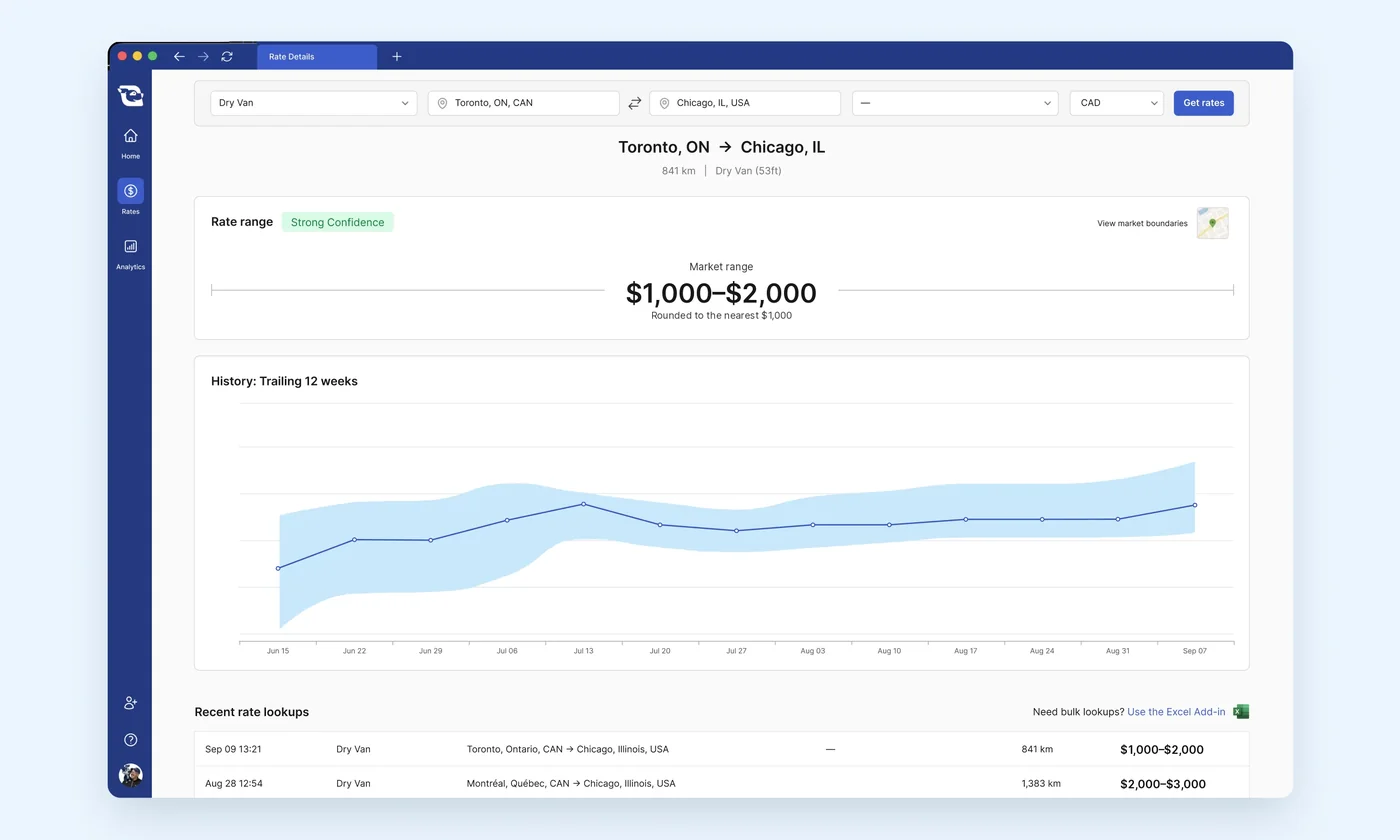
Toronto a Chicago en Tarifas de Mercado de Cargado: el rango de tarifas, su nivel de confianza y 12 semanas de historialVer en tamaño completo
Para transportistas: embarques transfronterizos constantes sin costo
Los transportistas usan Cargado sin costo. Si tienes FAST, PIP o CTPAT y operas rutas transfronterizas con regularidad, ese estatus juega a tu favor, porque es justo lo que buscan las empresas de logística. Configura las rutas que operas y el equipo que tienes, y los embarques que encajan te llegan en ambos sentidos, no solo en el tramo que te reposiciona.
Cada empresa se revisa, lo que mantiene reales los embarques del tablero y responsables a las empresas de logística del otro lado.
Agrega cobertura en México y Canadá
En una demo, las empresas de logística ven tarifas en vivo y transportistas verificados en sus propias rutas. El acceso para transportistas no tiene costo.
Preguntas frecuentes
¿Cuál es la diferencia entre PARS y PAPS?
El sentido del viaje. PARS (Pre-Arrival Review System) se usa para embarques que van hacia el norte, a Canadá, y la CBSA lo revisa antes de que llegue el camión. PAPS (Pre-Arrival Processing System) es el equivalente para embarques que van hacia el sur, a Estados Unidos, y se presenta ante la CBP. En ambos casos, el agente aduanal presenta la declaración con un código de barras que le da el transportista, y el transportista transmite por separado un manifiesto electrónico: ACI hacia el norte y ACE hacia el sur.
¿Necesito un transportista aprobado en FAST para cada embarque transfronterizo?
No. FAST es un programa para comerciantes confiables que les da a los transportistas inscritos, con operadores que tienen tarjeta FAST, un acceso exclusivo en la aduana, y también exige que el importador y el exportador estén aprobados. Muchos embarques transfronterizos se mueven bien sin él. Vale la pena en rutas urgentes y cuando las esperas en la aduana se alargan, y por eso conviene ver qué transportistas lo tienen antes de asignar el embarque.
¿Por qué es más difícil encontrar capacidad hacia el sur que hacia el norte?
Una gran parte de los transportistas transfronterizos tiene su base en Ontario y Quebec. Los embarques hacia el norte los acercan a casa, así que compiten bien. Los que van hacia el sur les piden salir, así que esperan rutas que les preparen el siguiente movimiento. Cotizar los dos sentidos como una sola cifra de viaje redondo suele dejar corto el precio del tramo más difícil.
¿El marketplace cubre embarques que se quedan dentro de Canadá?
Sí. Las rutas dentro de Canadá, como Toronto a Calgary, Montreal a Halifax y Vancouver a Edmonton, conviven con los embarques transfronterizos, con transportistas que tienen equipo con calefacción y protección contra congelamiento, plataformas, carga pesada y vehículos de combinación larga (LCV), incluidos los trenes Super-B donde están permitidos.
¿Qué significa aquí que un transportista esté verificado?
Revisamos a cada transportista antes de darle acceso. La revisión cubre su autoridad para operar, el seguro verificado, incluida la cobertura en Canadá, su estatus en programas como FAST, PIP y CTPAT, y las rutas y el equipo que realmente opera. Nos reunimos con cada empresa de logística antes de darla de alta. Tu propio proceso de alta sigue decidiendo a quién le asignas el embarque.
¿Cómo obtienen acceso los transportistas y cuánto cuesta?
Los transportistas solicitan acceso directamente y se verifican antes de poder ofertar. El acceso al marketplace no tiene costo para los transportistas. Las empresas de logística, 3PL y agentes de carga pagan una suscripción basada en valor que incluye usuarios ilimitados.