
The modern marketplace for the freight industry
Most 3PLs in Ontario and Quebec first post a cross-border lane on a load board. Here is how the freight actually moves north and south, what CBSA and U.S. Customs need before the truck loads, and what changes when every carrier in the network has been vetted.
- Northbound into Canada runs on PARS and ACI eManifest; southbound into the U.S. runs on PAPS and ACE. Quote and post them as separate lanes.
- From November to March, heated and protect-from-freezing service belongs in the posting's requirements, not the comments field.
- On Cargado, post the lane once and vetted carriers who run that corridor bid on it, with FAST and PIP status on their profiles and rates you can check in CAD.
- Carriers, owner-operators included, join at no cost.
What carriers and 3PLs have done on Cargado
Two published customer stories, in their own numbers.
This broker grew Mexico revenue 1,400% in just 4 months.
This carrier grew from 1 to 6 trucks using only Cargado.
What customs needs before the load moves
To customs, a Canada–U.S. load is two filings, and release has to be arranged before the truck arrives. CBSA and U.S. Customs and Border Protection each run their own process, named for the direction of travel.
Going north, your customs broker needs the PARS barcode from the carrier before the truck leaves the shipper. They file the entry against it, CBSA (the Canada Border Services Agency) reviews it before arrival, and if it clears, the driver is released at the primary inspection line and keeps rolling. The carrier also transmits the ACI eManifest to CBSA ahead of arrival. Going south, the same pattern runs through PAPS, the Pre-Arrival Processing System, and an ACE manifest filed with U.S. Customs and Border Protection. Confirm the barcode and the manifest when you book the carrier, not when the truck is loaded.
CUSMA, in force since 2020, decides whether the goods qualify for preferential tariff treatment, and it shapes the documents that travel with the load. An error on the certification of origin can hold freight at customs for days instead of hours, so settle it with the customs broker before pickup.
FAST (Free and Secure Trade) is the trusted-trader program CBSA and CBP run together. When the carrier, the driver and the importer are all approved, the load gets expedited customs processing, which on a busy morning separates a same-day delivery from a missed appointment.
Southbound is the harder leg
3PLs who run Canada–U.S. freight every week quote the two directions separately.
Southbound out of Ontario and Quebec is the side that gets tight. Much of the cross-border carrier base is domiciled here, so a truck heading south needs a paying load back, and those carriers hold for the lane that sets up the return. Northbound out of the U.S. Midwest and Northeast is usually easier to cover, because the same carriers want a load headed home.
A rate that works northbound rarely works southbound. Check both directions in Market Rates before you quote; pricing a Canada lane as one round-trip number is one of the more expensive habits on this freight.
Where Canada freight runs
Coverage follows a short list of corridors, most of them starting in Ontario, Quebec, the Prairies or B.C.
Toronto to Chicago is the network's highest-volume manufacturing and consumer-goods corridor: auto parts, food and consumer goods out of the GTA, bound for the U.S. Midwest.
Montreal into the Northeast runs into New York and Vermont, feeding Boston, New Jersey and the Northeast distribution centres. Quebec-based carriers dominate this corridor and much of the dispatch conversation happens in French, so Cargado serves these carriers in French as well as English. Chat translates messages between English, French and Spanish. Carrier chat is in beta.
Winnipeg to Chicago is a reefer corridor first, carrying protein and processed food south year-round.
Brampton to Calgary never leaves Canada, and it belongs on this list anyway. It is how a cross-border carrier repositions west, and 3PLs who can offer it alongside a Canada–U.S. lane get better answers on both.
Vancouver drayage and Lower Mainland freight into Washington carry import distribution off the Port of Vancouver plus produce moving south into Washington and California.
Winter belongs in the posting
From November through March, a meaningful share of freight that moves dry van in July needs a reefer running heat instead of cold.
Paint, adhesives, beverages, pharmaceuticals and canned goods need protect-from-freezing service, and a posting that buries it in the comments field gets the wrong trucks. One unheated van at minus 25°C costs the customer the load. Flatbed and step deck freight carries its own winter securement standard, and on Prairie lanes, long combination vehicles such as Super-B trains run where provincial permits allow.
Postings that carry the requirement up front get bids from carriers already equipped for winter.
What vetting covers on Canada–U.S. freight
Cargado is the modern marketplace for Mexico and Canada freight, and it is not an open board. We vet every carrier before it can bid and meet with every 3PL, broker and forwarder before onboarding. The network connects hundreds of 3PLs and brokers on one side and 2,350+ vetted carriers running 220,000+ trucks on the other.
For Canada–U.S. freight, vetting covers what a carrier profile built for U.S. trucking leaves out:
- FAST enrollment, PIP (Partners in Protection, the CBSA supply chain security program), and CTPAT (Customs Trade Partnership Against Terrorism, the U.S. program) tracked on the carrier record
- An NSC, CVOR or NIR number on file for carriers based in Canada, and insurance verified, including whether coverage extends into Canada
- Bonded carriers with customs experience identified, so the CBSA and CBP steps are handled by drivers who have done them before
- The markets and lanes each carrier actually runs, because a carrier who is strong in Ontario is not automatically the right answer in Manitoba
For 3PLs, post the lane once
Post the lane once, with the direction, the equipment and any PIP-certified facility or minimum cargo insurance attached. It reaches carriers already running that corridor, so bids come back from carriers you can tender to rather than names you still have to qualify.
3PL subscriptions are value based and include unlimited users, so the rep who sold the load, the coordinator working with your customs broker and night dispatch all work in the same record, with Toronto support behind them.
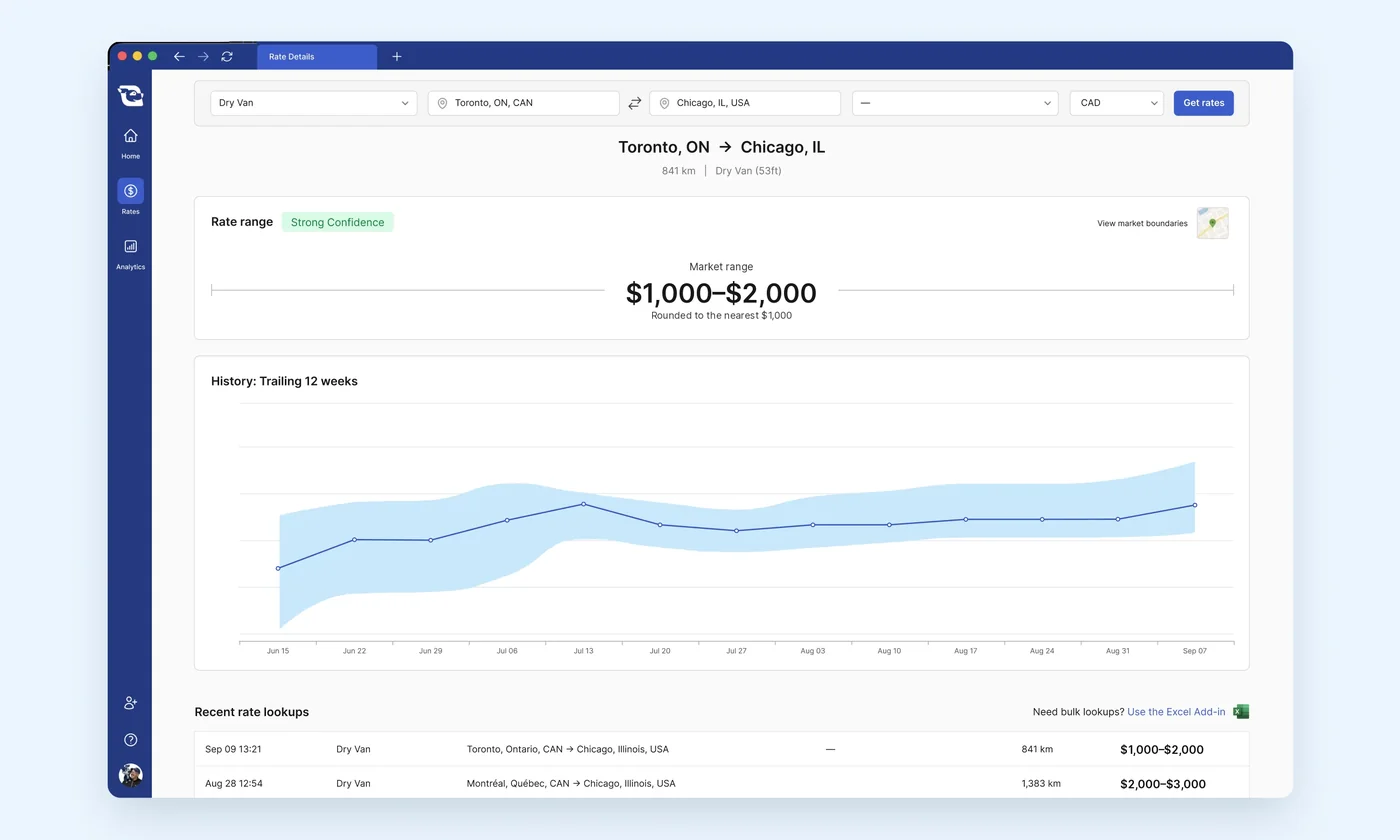
Toronto to Chicago in Cargado Market Rates: the rate range, its confidence score and 12 weeks of historyView full size
For carriers, freight both ways at no cost
Carriers use Cargado at no cost. If you hold FAST, PIP or CTPAT and run Canada–U.S. freight every week, that status works in your favour here, because it is exactly what 3PLs look for. Set the lanes you run and the equipment you operate, and the freight that fits comes to you southbound as well as on the run home.
Every company is vetted, which keeps the freight real and the 3PLs on the other side accountable.
Cover Canada–U.S. lanes, and Mexico when you need it
3PLs see live lane rates in CAD and the vetted carriers on their own lanes in a demo. Carrier access is at no cost.
Common questions
What is the difference between PARS and PAPS?
Direction. PARS is for northbound freight into Canada: the customs broker files against the carrier's PARS barcode and CBSA reviews the entry before the truck arrives. PAPS is the southbound version, filed with U.S. Customs and Border Protection. Either way, the carrier also sends an electronic manifest ahead of arrival, ACI eManifest going north and ACE going south.
Do I need a FAST-approved carrier for every cross-border load?
No. FAST is a trusted-trader program that gives approved carriers with carded drivers expedited customs processing, and it requires the importer and the exporter to be approved as well. Plenty of Canada–U.S. freight moves fine without it. It earns its keep on time-sensitive lanes and when customs queues run long, which is why it is worth seeing which carriers hold it before you tender.
Why is southbound capacity harder to find than northbound?
Much of the cross-border carrier base is domiciled in Ontario and Quebec. A southbound load takes those carriers away from home, so they hold for lanes that set up the return. A northbound load brings them home, so it covers easily. Quoting both directions as one round-trip number tends to underprice the southbound leg.
Does the marketplace cover freight within Canada, and to Mexico?
Yes. Lanes within Canada, such as Toronto to Calgary, Montreal to Halifax and Vancouver to Edmonton, run alongside Canada–U.S. freight across Ontario, Quebec, Alberta, British Columbia and Manitoba, on a carrier base that includes heated and protect-from-freezing equipment, open deck, heavy haul and Super-B trains where they are permitted. Freight between Canada and Mexico runs on the same login, with the Mexico crossing chosen on the posting.
What does "vetted" actually mean here?
Every carrier is reviewed before being granted access. The review covers operating authority (an NSC, CVOR or NIR number for carriers based in Canada, FMCSA authority in the U.S.), insurance including Canada coverage, three commercial references, customs program status such as FAST, PIP and CTPAT, and the lanes and equipment the carrier actually runs. We meet with every 3PL before onboarding them. Your own onboarding still decides who gets the tender.
How do carriers get access, and what does it cost?
Carriers request access directly and are verified before they can bid. There is no cost to carriers for marketplace access. 3PLs, brokers and forwarders pay a value-based subscription that includes unlimited users.