The story
To ship freight to Mexico from the U.S., a U.S. carrier hauls the load to the border, a transfer carrier takes it across the bridge and a Mexican carrier delivers it. A Mexican customs broker clears it for your customer, who must be a registered importer. You file U.S. export data (EEI) when the value or the goods require it.
Shipping the other way? Read how to ship freight from Mexico to the U.S.. For how both directions fit together, read how U.S.-Mexico cross-border freight works.
Who has to be the importer in Mexico?
Every southbound load needs an importer in Mexico. Mexico's customs law says that, with narrow exceptions, anyone who brings goods into the country must be registered in the Padrón de Importadores, a list run by the tax authority, SAT (Ley Aduanera, Article 59, section IV). Some goods also need the separate Padrón de Importadores de Sectores Específicos.
Usually the importer is your Mexican customer. Ask early whether they are registered.
If your customer is not registered, the fix is on their side. SAT's registration is free and needs no intermediary. The company must be active in Mexico's taxpayer registry (RFC), be current on its taxes, hold a valid e.firma (SAT's electronic signature), have a verified tax address and name the customs broker it will use. Settle who the importer is before you quote.
Your U.S. company cannot fill the gap on its own. A licensed customs broker will not clear goods for an unregistered importer, because SAT can cancel the broker's license for it (Ley Aduanera, Article 165, section X).
If your goods qualify under USMCA, the importer claims the lower duty. You, as exporter or producer, can supply the certification of origin that supports the claim.
When do you file EEI for an export to Mexico?
On the U.S. side, the export filing is Electronic Export Information (EEI), filed in the Automated Export System (AES). The U.S. principal party in interest (usually the seller) files it, or an authorized agent such as a freight forwarder files it for them. If your Mexican buyer controls the export through its own U.S. forwarder (a routed export), that forwarder usually files, and you still owe it accurate data.
The rules are in the Foreign Trade Regulations (15 CFR Part 30):
- Value test. EEI is required when any one Schedule B number, shipped from one seller to one consignee on one truck, is worth more than $2,500. A $10,000 load can be exempt if no single Schedule B number on it totals more than $2,500.
- License and always-file test. If the goods need an export license (for example, from the Commerce Department's BIS or the State Department), EEI is required at any value. The same applies to a short list of other goods, including used self-propelled vehicles (15 CFR 30.2(a)(1)(iv)).
- No Mexico exemption. Shipments to Canada are generally exempt from EEI. Shipments to Mexico are not.
- Truck timing. File EEI and give the filing number (ITN) to the carrier taking the load across at least one hour before the truck reaches the U.S. border. If no EEI is required, give that carrier the exemption legend instead. For defense articles on the U.S. Munitions List, file at least eight hours before departure.
What does the Mexican customs broker do?
The agente aduanal classifies the goods, files the import pedimento (Mexico's customs entry) and pays duties and taxes for the importer. Some goods also need an import permit or must meet Mexican official standards (NOMs). Before it files, the broker must confirm the importer has the documents that show compliance. On an ordinary import, the trailer does not cross until the pedimento is paid and validated. IMMEX plants are the main exception (see below).
Once the pedimento is paid, the broker generates a QR-coded crossing document that the driver presents at Mexican customs. For years that was the DODA. On November 20, 2026, Mexico's customs agency, ANAM, began replacing it with the Aviso de Cruce (AVC) at all 50 customs offices (checked November 26, 2026). During the changeover, ask the broker which document it will issue. Customs then runs its automated selection (Ley Aduanera, Article 43). A green light releases the load. A red light sends it to physical inspection.
The pedimento is filed under one broker's license. That license covers one assigned customs office, plus up to three more if SAT authorizes them (Ley Aduanera, Article 161). The broker cannot hand the job to another broker without the importer's written authorization (Article 162, section IV). One truck can carry freight under several pedimentos, so confirm the broker behind each one is ready at that crossing.
So the customs broker often decides the bridge. Before pickup, confirm:
- the crossing city
- the customs broker's contact at that crossing
- that the commercial invoice and packing list reached the broker in time
Our guide to Mexico freight paperwork walks through the documents you will see most often on a crossing.
How does a southbound truckload cross the border?
Who does what, step by step:
| Step | What happens | Who does it | Paperwork |
|---|---|---|---|
| 1. Confirm the importer | Customer confirms padrón registration and names its customs broker | Mexican importer | Padrón registration |
| 2. Export filing | EEI filed in AES when required | Shipper, its forwarder or the buyer's forwarder | EEI and ITN, commercial invoice, packing list |
| 3. U.S. leg | U.S. carrier hauls to the customs broker's yard in the border city | U.S. carrier | Bill of lading |
| 4. Import clearance | Broker reviews the freight, files and pays the pedimento | Mexican customs broker | Pedimento, Aviso de Cruce (replacing the DODA) |
| 5. The crossing | Transfer carrier pulls the trailer across the bridge to a yard in Mexico | Transfer carrier | Aviso de Cruce (replacing the DODA), Carta Porte from a Mexican transfer carrier |
| 6. Mexican leg | Mexican carrier hauls to the consignee | Mexican carrier | Carta Porte |
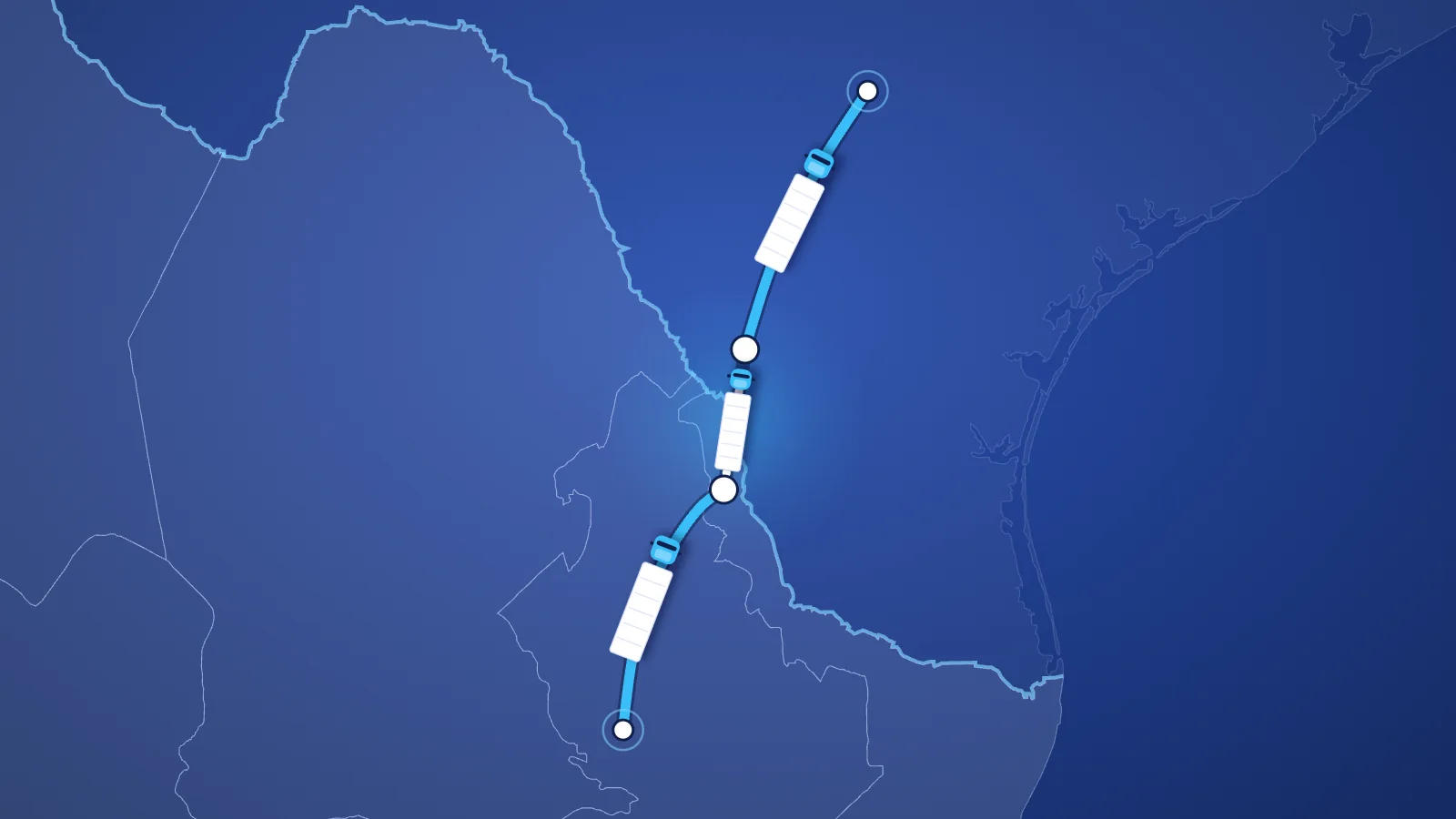
The freight crosses one of two ways: in the same trailer (through-trailer) or moved to a second trailer at a border warehouse (transload). Ask which one you are quoted. Transloading vs. through-trailer compares them.
Pick the crossing that keeps the Mexican miles short and where your customer's customs broker works. Laredo / Nuevo Laredo is the busiest. Which border crossings trucks use compares the main ones.
What rules apply on the Mexican side of the road?
Carta Porte. Mexico requires a digital waybill, the Complemento Carta Porte, for freight moving on its federal roads. It attaches to the carrier's CFDI electronic invoice. SAT has accepted only version 3.1 since July 17, 2024 (checked November 26, 2026). On a normal contracted move, each Mexican carrier issues its own: the transfer carrier for the crossing and the long-haul carrier for the Mexican leg. Your part is to get the carrier accurate data, including the pedimento number, and to tell them right away if the truck, trailer or driver changes.
Cabotage. Mexico's foreign investment law reserves domestic freight trucking inside Mexico for Mexican nationals and Mexican companies that exclude foreign shareholders (Ley de Inversión Extranjera, Article 6, section I). A U.S. carrier cannot pick up and deliver a load between two points in Mexico.
The mirror rule applies if a Mexican carrier picks up your export in the U.S. It needs FMCSA registration to operate in the U.S. at all, long-haul authority to go beyond the border commercial zones, and may not haul domestic U.S. loads (49 CFR 365.501). Our guide to how Mexico freight moves covers B-1 drivers.
What changes if your customer is an IMMEX plant?
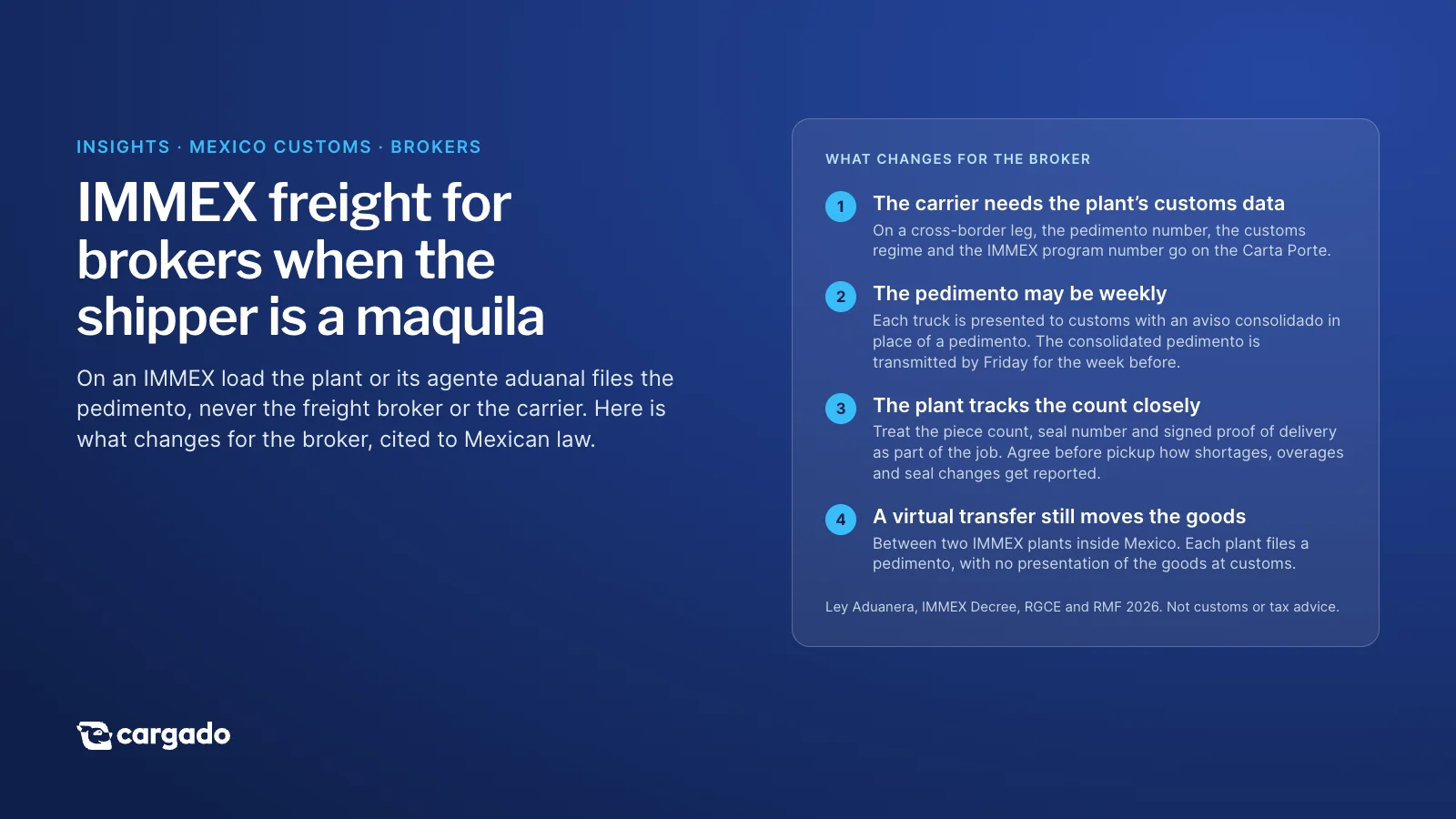
Many Mexican manufacturers hold an IMMEX program from Mexico's Secretaría de Economía. IMMEX lets the plant import inputs temporarily, as long as they leave Mexico again after processing or change customs regime within the legal term.
The plant, through its own customs broker, files the pedimento. It is often one consolidated pedimento a week, with each truck declared on a consolidated notice (aviso consolidado) instead of its own pedimento. And on the cross-border leg, the Mexican carrier's Carta Porte carries the plant's IMMEX program number along with the customs document data.
Check with the plant's customs broker before you ship. Our IMMEX guide goes deeper.
How long does shipping freight to Mexico take?
The U.S. leg runs like a domestic load. The crossing time varies with the bridge, the paperwork and the transfer handoffs. Southbound, it waits on the pedimento and on any red-light inspection. Our transit time guide lists published ranges for several lanes.
What drives the cost?
A southbound rate is several prices, bought all-in or by leg:
- The legs. U.S. linehaul to the border, the transfer across the bridge and the Mexican linehaul. The transfer is often its own line.
- Transload. Warehouse handling is an extra line.
- Customs brokers. Fees on each side, plus any storage at the broker's yard.
- Duties and taxes. The importer pays these on the pedimento. They include any import duty, Mexico's 16% IVA (value-added tax) and a customs processing fee (DTA), which goods imported under the USMCA preference do not pay.
- Border delays. Detention runs while the trailer waits.
- Cargo insurance and security. Mexican carrier liability is limited unless the value is declared. Ask your insurer whether your cargo policy covers Mexico, and confirm who insures the Mexican leg.
- Fuel. Mexico publishes diesel prices, but no index is the standard for freight contracts. See our Mexico fuel surcharge guide.
Check this week's low, mid and high rates for supported lanes in Market Rates.
Next step: price the lane
If you ship freight to Mexico, get a benchmark. Send us your lanes and we price them against Cargado Market Rates: a low, mid and high total per load, built from real carrier bids and refreshed weekly. If you are a broker, 3PL or forwarder, post the load on Cargado and get bids from vetted carriers. Questions about a lane? Talk to our team.
This guide explains how the process generally works. It is not legal or customs advice; confirm requirements for your shipment with a licensed customs broker.
Sources
- SAT, Padrón de Importadores, registration requirements (checked 11/26/2026)
- SAT, ficha de trámite 5/LA, Padrón de Importadores (checked 11/26/2026)
- SAT, Padrón de Importadores, recommendations (registration is free and needs no intermediary; checked 11/26/2026)
- Ley Aduanera, text as published, last reform DOF 10/23/2026 (Articles 36-A, 37, 37-A, 40, 43, 52, 54, 59, 108, 161, 162, 165)
- SAT, Reglas Generales de Comercio Exterior para 2026, compiled text after the second modification (rules 3.1.32, 3.1.33, 5.1.4)
- DOF, Tercera Resolución de Modificaciones a las RGCE para 2026, rule 3.1.43 (November 23, 2026)
- ANAM, Boletín Informativo No. 3, Aviso de Cruce en las 50 Aduanas del país (November 20, 2026)
- ANAM, Aviso de Cruce (AVC) guidelines, version 1.0 (November 20, 2026)
- Ley de Inversión Extranjera, text in force, last reform DOF 11/19/2026 (Article 6)
- Ley del Impuesto al Valor Agregado, Article 1 (16% rate on imports)
- Ley Federal de Derechos, Article 49 (DTA), last reform DOF 11/7/2025
- SAT, Complemento Carta Porte (version 3.1 since July 17, 2024; checked 11/26/2026)
- SAT, Resolución Miscelánea Fiscal para 2026, compiled text after the third modification (rules 2.7.7.1.1 and 2.7.7.1.5)
- Ley de Comercio Exterior, Article 17 (non-tariff measures include prior permits and certifications), last reform DOF 5/1/2026
- 15 CFR 30.2, 30.3 (including 30.3(e), routed export transactions), 30.4, 30.36 and 30.37, Foreign Trade Regulations (eCFR, up to date as of 11/24/2026)
- 15 CFR 758.1, when EEI must be filed regardless of value (eCFR)
- 49 CFR 365.501, Mexico-domiciled carriers (eCFR)
- FMCSA, Cross-border operating requirements for Mexico-domiciled carriers
- USMCA, Chapter 5, Origin Procedures (Article 5.2)
- Bureau of Transportation Statistics, Border Crossing Data annual release 2025
- International Trade Administration, Mexico temporary entry (IMMEX overview)
- SAT, Instructivo de llenado del CFDI con complemento Carta Porte, Autotransporte, versión 3.1, Apéndice 16 IMMEX (checked 11/26/2026)
- ANAM, DODA guidelines (v1.5)
- Ley de Caminos, Puentes y Autotransporte Federal, articles 8, 59, 61 and 66 (Cámara de Diputados)
- 22 CFR 123.22, filing deadlines for U.S. Munitions List exports (eCFR)
- 19 CFR 192.1 and 192.2, export of used self-propelled vehicles (eCFR)