The story
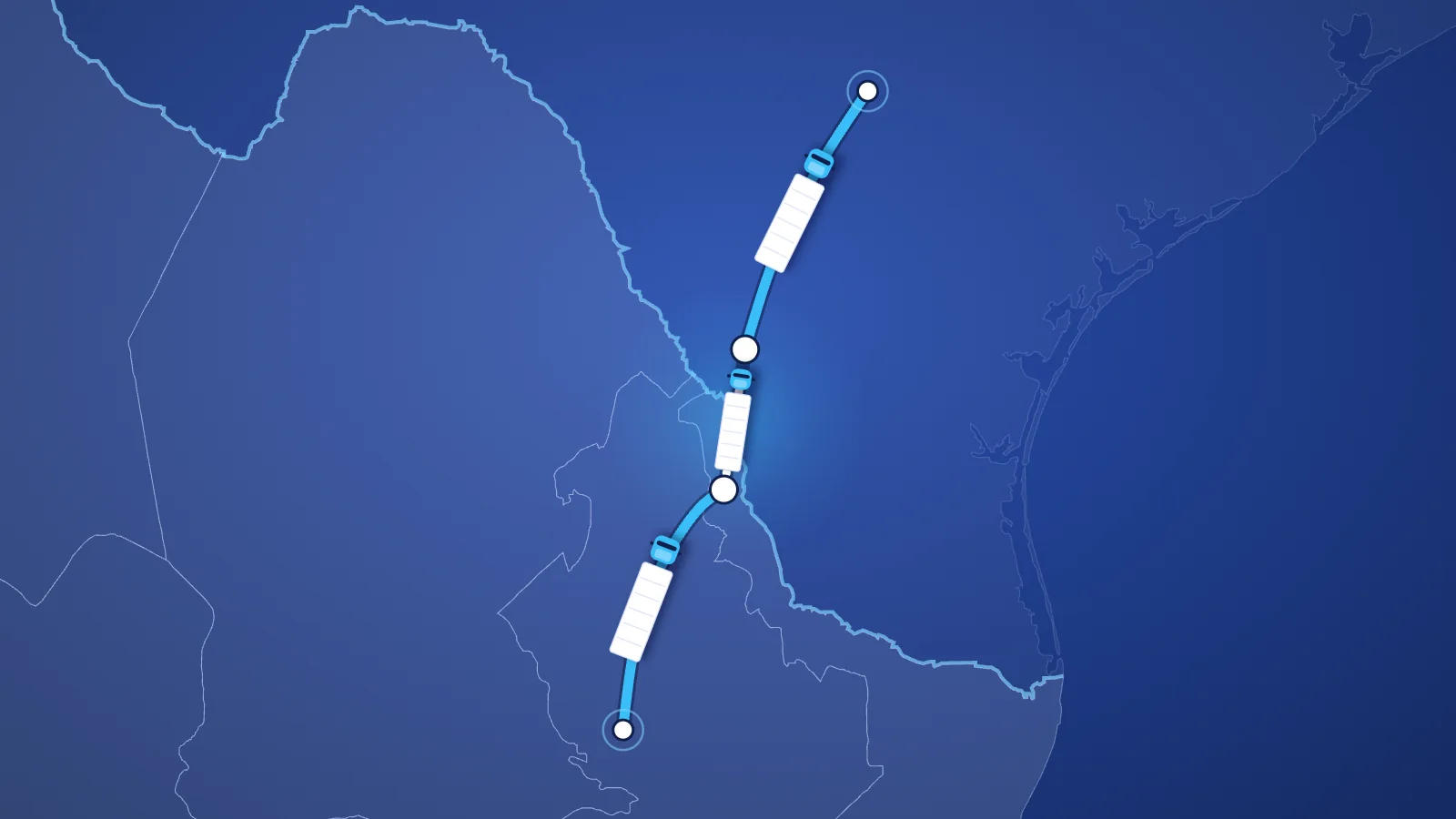
Cross-border freight is cargo that moves between two countries. Between the U.S. and Mexico, a truckload usually moves in three legs: a Mexican carrier hauls the trailer to the border, a transfer carrier takes it across the bridge, and a U.S. carrier delivers it. Customs brokers on both sides usually clear the goods, and many delays start at the crossing.
For step-by-step guides by direction, read how to ship freight from Mexico to the U.S. and how to ship freight to Mexico.
How does a truckload cross the U.S.-Mexico border?
A cross-border truckload usually has three operators. U.S. rules limit where Mexican trucks and drivers can run, and most U.S. carriers do not run inside Mexico.
- The Mexican leg. A Mexican carrier picks up at the plant or warehouse and runs to a yard in the border city, such as Nuevo Laredo or Ciudad Juárez.
- The crossing. A transfer carrier (a short-haul operator that only shuttles trailers over the bridge) takes the trailer across. Customs on both sides clear it at the port.
- The U.S. leg. A U.S. carrier picks up the trailer on the U.S. side and delivers it.
Southbound runs the same three legs in reverse. On many moves, one carrier sells you the whole trip door to door and works with partners on the legs it does not run itself.
The freight crosses one of two ways: in the same trailer (through-trailer) or moved to a second trailer at a border warehouse (transload). Ask which one you are quoted. Transloading vs. through-trailer compares them.
Time at the border depends on the crossing, the paperwork and the transfer handoffs. A trailer whose documents reached both customs brokers before it arrived moves through much faster than one that arrives first and waits in the yard. How long Mexico-U.S. truckload shipping takes lists published ranges for several lanes.
The paperwork runs alongside the three legs. Before pickup, the shipper sends the commercial invoice and packing list to both customs brokers. On Mexican roads, the freight travels with a Carta Porte, and version 3.1 has been required since July 17, 2024, per Mexico's tax authority, SAT (checked November 26, 2026). A pedimento clears the goods through Mexican customs. Northbound, the carrier files an ACE e-Manifest before arrival and the importer, or a licensed customs broker acting for it, files the U.S. entry. Mexico freight paperwork explained goes deeper on the documents.
Which cross-border freight and logistics companies are involved?
Cross-border freight companies come in several types, including Mexican trucking companies, U.S. carriers and cross-border logistics companies. Each owns a different piece of the move.
| Company type | What it does | What to ask |
|---|---|---|
| Mexican carrier | Runs the Mexican leg on federal highways. Some also cross or hold U.S. authority. | Its RFC and SICT permit, and whether it crosses or hands off |
| Transfer (drayage) carrier | Shuttles the trailer across the bridge and around the border yards | Its U.S. registration for the border zone, and how the transfer is booked |
| U.S. carrier | Runs the U.S. leg from the border to the delivery | Its USDOT number and operating authority, and its insurance |
| Mexican customs broker (agente aduanal) | Files the pedimento that clears goods into or out of Mexico | Which crossings it works, and when the pedimento will be ready |
| U.S. customs broker | Files the U.S. entry for the importer | Its contact at the crossing, and when the entry will be filed |
| Freight broker or 3PL | Finds and contracts the carriers for each leg and manages the load | How it vets Mexican carriers, and who insures the Mexican leg |
| Freight forwarder | Takes responsibility for the whole international shipment, often including customs coordination | Which parts it runs itself and which it hands to partners |
A shipper new to Mexico usually gets more from a broker, 3PL or forwarder that already works the lane than from contracting each leg itself. How to choose a Mexico freight partner lists the questions to ask each one.
How do you choose and vet Mexico cross-border carriers?
Vet each carrier for the leg it will run. A Mexican carrier that never crosses has no MC or DOT number, and that is normal.
Authority for the leg. On the U.S. side, a carrier may not operate without the operating authority the move requires, or beyond its scope. A Mexico-domiciled carrier with an FMCSA certificate of registration may run only in U.S. border municipalities and their commercial zones. To go farther into the U.S., it needs separate long-haul authority from FMCSA. In Mexico, hauling freight on federal highways requires a permit from SICT, the transport ministry. Ask for that permit and the carrier's RFC, its federal taxpayer ID.
Insurance, leg by leg. U.S. for-hire carriers of general freight must carry at least $750,000 in public liability coverage. That covers damage to others, not your cargo. In Mexico, when the shipper does not declare the value of the goods, the law limits the carrier's liability to a small fixed amount per ton. Get a written answer on who insures the cargo on each leg before dispatch.
CTPAT and OEA. CTPAT is a voluntary U.S. Customs and Border Protection (CBP) supply-chain security program. CBP treats members as low risk, so they are less likely to be examined. Mexico's counterpart is SAT's Authorized Economic Operator program (OEA in Spanish), and the two have recognized each other since October 2014. Require certification only where your own supply chain needs it, because it narrows the carriers who can bid.
B-1 drivers and cabotage. Many cross-border carriers use Mexican drivers on B-1 visas. They may haul only international freight, so tell the carrier the true origin and destination. How Mexico freight moves covers the rule.
How to find and vet Mexican carriers has the full checklist, including the Mexican documents. How to find carriers for Mexico freight covers where to look.
Which border crossings do trucks use?
Each crossing has its own bridges, customs brokers and yards. The right one depends on where the freight starts and ends.
- Laredo / Nuevo Laredo. The busiest truck crossing. It took nearly four in ten trucks entering from Mexico in 2025, per the Bureau of Transportation Statistics. Freight uses the World Trade Bridge and the Colombia Solidarity Bridge, upriver from Laredo, crossing into Nuevo León.
- Pharr / Reynosa. South Texas to Tamaulipas. Reefer capacity gets tight here in produce season.
- El Paso / Ciudad Juárez. West Texas to Chihuahua.
- Otay Mesa / Tijuana. California to Baja California.
- Nogales. Arizona to Sonora, also busy with produce in season.
Other crossings include Eagle Pass / Piedras Negras, Brownsville / Matamoros, Calexico East / Mexicali and Del Rio / Ciudad Acuña. The Mexican customs broker often decides the crossing, because it works at specific ports. Settle the crossing with both customs brokers before you book trucks. Ask them about FAST, CBP's clearance program for known low-risk shipments. CBP says its dedicated lanes require the manufacturer, carrier, driver and importer all to be certified. Border crossings for Mexico freight has a page for each one.
What goes wrong on cross-border loads, and how do shippers avoid it?
These problems often hold trailers at the border.
- The commercial invoice is late or wrong. No invoice, no clearance. Send the commercial invoice and packing list to both customs brokers at tender, not when the truck leaves.
- No customs broker at the crossing. Confirm the crossing city and both broker contacts before you book the pickup.
- Wrong Carta Porte data. Send final truck, trailer and driver details to whoever issues the Carta Porte before pickup, and flag any change at once.
- A cabotage break. CBP treats goods as having "come to rest" once they are parked at a drop lot, holding lot or warehouse for later pickup, or once tractors are switched in the U.S., with narrow exceptions such as goods awaiting clearance by CBP, USDA or FDA. After that, the next move is domestic, and a B-1 driver cannot haul it. Name the true origin and destination on the order.
- Food entering the U.S. without prior notice. FDA must confirm prior notice at least 2 hours before the truck reaches the U.S. port of arrival.
- Quotes that are not comparable. Ask every bidder for a total per load and whether it includes the transfer and fuel.
Where does USMCA fit?
USMCA is the trade agreement between the U.S., Mexico and Canada. It decides whether goods qualify for preferential duty treatment. The truck moves the same way whether or not the goods qualify.
The importer normally makes the claim at entry, based on a certification of origin completed by the importer, exporter or producer. Whether a product qualifies depends on its rules of origin, so the importer and its customs broker decide, not the carrier or the freight broker.
USMCA preference does not switch off every tariff. As of November 26, 2026, CBP says Section 232 duties, such as those on steel and aluminum, are not waived by a free trade agreement unless a specific exemption applies. Mexican goods that do not enter duty-free under USMCA also owe an added 10% Section 301 duty, apart from listed exemptions. Tariff actions on Mexican goods changed several times in 2025 and 2026. As of November 2026, USMCA remains in force. At the first joint review on July 1, 2026, the U.S. did not agree to extend it for a new 16-year term, so the three countries now review it every year, and it ends on July 1, 2036 unless all three extend it (U.S. Trade Representative notice, October 5, 2026). Ask your customs broker which duties apply on the date the goods enter, and do not plan a landed cost around the phrase "duty-free."
Check your lane before you book
If you ship freight to or from Mexico, get a benchmark. Send us your lanes and we price them against Cargado Market Rates: a low, mid and high total per load, built from real carrier bids and refreshed weekly. If you are a broker, 3PL or forwarder, post the load on Cargado and get bids from vetted carriers. Questions about a lane? Talk to our team.
This guide explains how the process generally works. It is not legal or customs advice; confirm requirements for your shipment with a licensed customs broker.
Sources
- CBP, CTPAT alert on cabotage rules violations (May 20, 2025)
- U.S. Customs and Border Protection (eCFR), 19 CFR 123.92, electronic information for truck cargo in advance of arrival
- U.S. Customs and Border Protection (eCFR), 19 CFR 123.14, foreign-based trucks in international traffic
- 8 CFR 214.2, paragraph (b)(4)(i)(E), B-1 transportation operators (eCFR)
- CBP San Diego Field Office, cabotage bulletin (June 24, 2026)
- CBP, How do I enter the United States as a commercial truck driver?
- FMCSA (eCFR), 49 CFR 368.1, certificate of registration for Mexico-domiciled carriers in the border zone
- FMCSA (eCFR), 49 CFR 365.501, Mexico-domiciled carriers beyond the border zone
- FMCSA (eCFR), 49 CFR 392.9a, operating authority
- FMCSA (eCFR), 49 CFR 387.9, minimum levels of financial responsibility
- FDA (eCFR), 21 CFR 1.279, prior notice timing
- CBP, CTPAT
- CBP, CTPAT mutual recognition
- CBP, FAST
- CBP, FAST overview (dedicated lanes require CTPAT across the supply chain; last modified November 5, 2026)
- CBP, Customs brokers
- CBP, Section 232 tariffs on aluminum and steel FAQs (last modified November 17, 2026)
- CBP (eCFR), 19 CFR 182.11, USMCA preference claims
- CBP (eCFR), 19 CFR 182.31, USMCA claims after importation
- 19 U.S.C. 1484(a)(1), entry by the importer of record or its authorized agent
- USTR, Ambassador Greer statement on the USMCA joint review (July 1, 2026)
- USTR, request for comments ahead of the 2027 USMCA joint review, 91 FR 63379 (October 5, 2026)
- USMCA, Annex I and Annex II, Schedule of the United States (cross-border trucking reservations)
- CBP, IEEPA frequently asked questions (historical; kept by CBP for reference only, last modified April 14, 2026)
- USTR, Notice of Actions in Section 301 Investigations, 91 FR 47318 (July 28, 2026; 10% on products of Mexico from July 24, 2026, goods entered duty-free under USMCA exempt)
- CBP, CSMS # 69326983, Section 301 guidance (July 23, 2026)
- SAT, Complemento Carta Porte
- Ley Aduanera, articles 36 and 40 (Cámara de Diputados)
- Ley de Caminos, Puentes y Autotransporte Federal, articles 8 and 66 (Cámara de Diputados)
- Bureau of Transportation Statistics, Border Crossing Data Annual Release: 2025
- Bureau of Transportation Statistics, Border Crossing Entry Data (dataset)
- Presidential permit for the Laredo-Colombia Solidarity International Bridge, 90 FR 26189 (June 20, 2025)
- USDA Agricultural Marketing Service, Specialty Crops National Truck Rate Report (produce seasons at Pharr and Nogales)