The story
Part of our guide to paper and packaging freight between Mexico and the U.S.
The pallet rules, the tariff question and how dry van rates out of Mexico's paper markets moved this year.
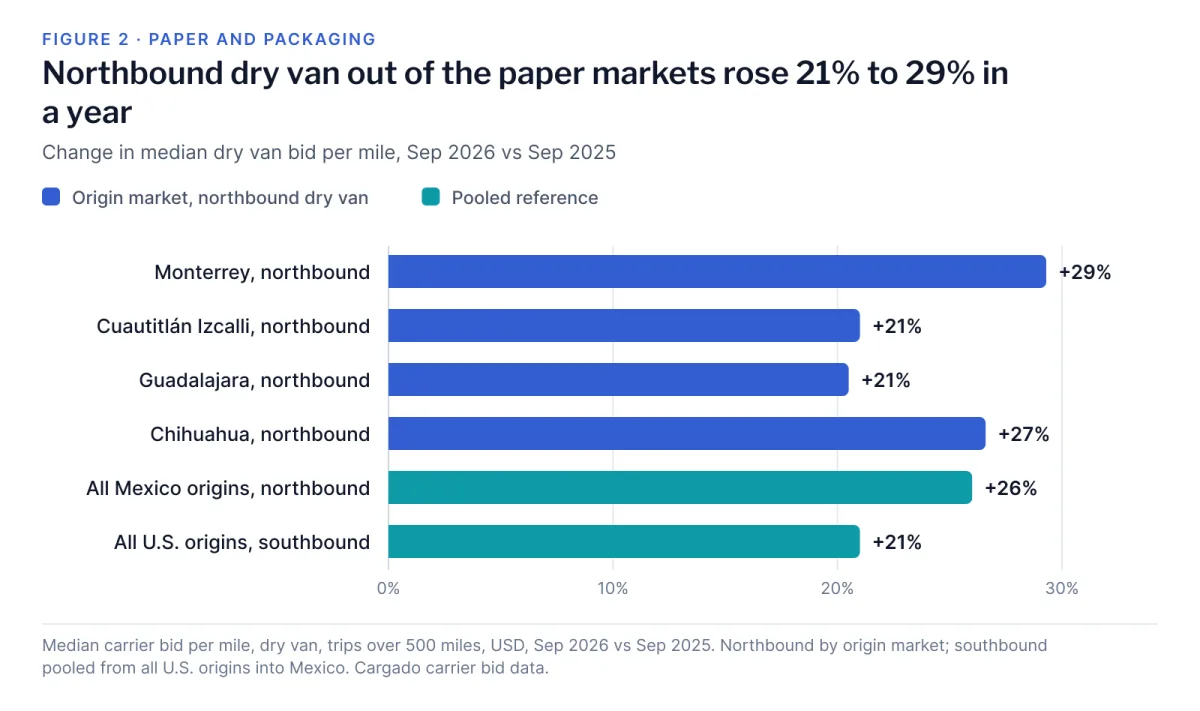
Paper and packaging cross the border in dry vans, mostly southbound by trade value: U.S. kraft, pulp and cartons feeding Mexican plants, with boxes and tissue coming north from Monterrey, Guadalajara, the Mexico City area and Chihuahua. Every solid-wood pallet falls under ISPM-15 in both directions. Northbound dry van bids from these markets rose 21% to 29% in a year.
Where Mexico's paper and packaging freight ships from
Packaging moves with every other industry. Cartons, kraft paper and pallets feed the plants that ship automotive parts, food and appliances, so paper lanes trace the same corridors as the industries they pack for, and a paper lane that runs on time keeps those plants supplied.
In Cargado, dry van carries 91% of it. Equipment and posting advice live on the hub page; this page covers cost.
Northbound, the freight comes out of four Mexican markets: Monterrey in the northeast, Guadalajara in the west, Cuautitlán Izcalli in the Mexico City industrial belt, and Chihuahua. Laredo handled 38.8% of northbound truck crossings from Mexico in 2025, more than any other port.
North of the border it lands in Texas, mainly the Dallas-Fort Worth and Houston metros, at the Laredo border for transload, and in Central California. That matches where Mexico makes paper: in the 2019 Economic Census, Estado de México and Nuevo León led the country in paper production.
Southbound is the larger flow. U.S. exports of paper and paperboard to Mexico were about $4.0 billion in 2025 against about $1.7 billion of imports, roughly 2.3 to 1, with another $1.0 billion of pulp and recovered paper going south and almost none coming back.
Kraft paper and cartons lead the exports; cartons, coated paper and tissue lead the imports, so Mexico sends back converted product rather than rolls. Southbound shipments in Cargado leave the Texas border, the Southwest and the West Coast for Monterrey, Ciudad Juárez, the Mexico City area and the Bajío.

Source: Equipment split: Cargado postings, paper and packaging family, trailing 12 months to 10/9/2026. Crossing share: BTS Border Crossing Entry Data, trucks, 2025. Trade values: UN Comtrade, U.S.-reported trade, imports at CIF value, HS 47 and 48, 2025. Production geography: DataMéxico, paper manufacturing, 2019 Economic Census. Retrieved 10/10/2026.
What adds cost and time to paper freight
Paper's cost story is mostly wood packaging and paperwork. Little of it appears as a line on the carrier's invoice; most of it appears as a held trailer.
ISPM-15 pallets, both directions. Pallets, crates and dunnage must be heat-treated or fumigated and carry the IPPC mark. At a U.S. port the inspector can order unmarked material re-exported on the spot, and CBP can assess liquidated damages of three times the entered value, up to the bond, when an importer ignores an emergency action notice.
Southbound, PROFEPA checks the mark and can require treatment or return of the packaging abroad at the importer's cost. Paper shipments are palletized almost by definition, so this touches nearly every trailer. The fix sits upstream, with the pallet supplier and its treatment records, not at the bridge.
Lacey Act declarations. Some wood and paper products need a plant declaration at U.S. entry: species, value, quantity, country of harvest and recycled content. Wood used only as packaging for other goods is exempt. When the paper product is itself the shipment, confirm with your broker whether its HS heading is on the schedule. A missing declaration holds the entry.
Carta Porte on the Mexican leg. Every Mexican leg needs a CFDI with the Carta Porte complement, issued before the goods reach Mexican customs, its folio in the DODA and the pedimento numbers listed. Without the folio the DODA is incomplete; a roadside check without it opens a proceeding that can end in a fine or a contraband case.
Route security. Freight out of the Mexico City area runs the Mexico-Querétaro highway, one of the corridors the federal "Cero Robos al Transporte" program watches. Carriers answer with no-stop rules, daylight scheduling and tracking, priced inside the bid; ask for the protocol when you compare quotes.
Direction. The direction paper mostly travels is the cheaper one: on nine city pairs priced both ways on October 10, 2026, northbound dry van ran 15% to 53% above southbound, so a converter buying board southbound and shipping boxes north sits on both sides of that gap. The direction gap is laid out in the automotive parts article, /insights/automotive-parts-mexico-us.
Source, in order: 7 CFR 319.40-3(b); APHIS wood packaging import page (updated 7/27/2026); CBP liquidated damages guidelines for noncompliant wood packaging (2017); NOM-144-SEMARNAT-2017; Federal Register 74 FR 45415 (9/2/2009) and 89 FR 47122 (5/31/2024); SAT Carta Porte standard and FAQ; Guardia Nacional briefing as reported 8/11/2026; direction gap from Cargado Market Rates, dry van via Laredo, 10/10/2026. Retrieved 10/10/2026.
As of October 2026
Everything in this box decays. Refresh it monthly, along with the dated lines elsewhere on the page.
- Section 301. 10% on goods of Mexico since 7/24/2026. Paper entered free of duty under USMCA is exempt (U.S. note 52(h)), so qualification decides the duty; no chapter 48 line is on the note 52(b) exempt list, while chemical pulp (4703) is. Chapter 48 rules of origin are tariff shifts, for example a change to heading 48.01 "from any other chapter" (USMCA Annex 4-B); a converter using board from outside North America should check its headings with a broker. The 10% is under challenge at the U.S. Court of International Trade, which heard arguments on 9/30/2026 and had not ruled as of 10/11/2026. It is still collected.
- Border volume. Northbound truck crossings at all ports, January to August 2026, ran 0.5% ahead of the same months of 2025. Laredo carried 38.8% of the 2025 total.
- Empties restriction. A third-party logistics provider's published market report (October 2026) says Mexican customs barred empty trucks southbound at Eagle Pass and Brownsville from 9/9 to 9/14. Daily commercial crossings there fell from about 1,000 to between 300 and 400, about 700 tractors were stranded, equipment came home through Laredo and rates rose on affected lanes. It also cites CANACAR on a shrinking cross-border driver pool.
- Importer vetting. U.S. Executive Order 14411 (6/3/2026) gives DHS 180 days to tighten importer-of-record bonding and disclosure. CBP published importer-of-record data checks on 8/19/2026, with inaccurate numbers voidable from 9/18/2026, and in September asked for comment on collecting the foreign export documents that cleared the goods; the bonding changes were still at the proposal stage as of 10/10/2026.
- Theft trend. Truck cargo theft complaints in Mexico fell 19.4% in the first half of 2026 against a year earlier; the federal program reports drops of 86% on the Mexico-Querétaro highway and 90% on Mexico-Puebla. Government self-reported.
- Diesel. Mexico's voluntary diesel agreement holds the price at or below MXN 27 per liter, renewed 8/31/2026 for six months.
- Mexican paper exports were up 11% year on year in the first quarter of 2026.
- Mexico's tariffs on non-agreement paper. Mexico set chapter 48 paper lines at 22% to 35% from 1/1/2026 (DOF 12/29/2025) and further lines at 15%, 25% or 35% from 4/24/2026 (DOF 4/23/2026) for countries without a trade agreement. U.S. paper with valid USMCA origin keeps its preferential rate.
Source: Federal Register 91 FR 47318, 91 FR 35125, 91 FR 53627 (8/19/2026), 91 FR 56408 (9/2/2026) and 91 FR 64532 (10/8/2026); HTSUS Rev. 21 chapter 99, U.S. note 52(b) and 52(h); In re Section 301 Forced Labor Cases, Consol. Ct. No. 26-03555 (CIT; docket checked 10/11/2026); USMCA Annex 4-B, Chapter 48 product-specific rules; DOF 12/29/2025 (codigo 5777376) and DOF 4/23/2026 (codigo 5785818) tariff decrees; BTS Border Crossing Entry Data through 8/2026; third-party logistics provider's cross-border market report, 10/1/2026; Guardia Nacional briefing as reported 8/11/2026; El Imparcial (8/31/2026) and La Razón (9/1/2026) on the diesel agreement renewal; INEGI boletín 406/26. Retrieved 10/10/2026 and 10/11/2026.
General information as of 10/11/2026, not legal, tax or customs advice. Confirm classification and duty with a licensed customs broker.
How dry van rates moved out of the paper markets
Northbound dry van bids out of the four paper markets rose 21% to 29% from September 2025 to September 2026. These are market-level figures: the median of carrier bids on all freight out of each origin market, not only paper, so they read as the cost of a dry van leaving that market.
| Market and direction | Change in median dry van bid per mile, Sep 2026 vs Sep 2025 |
|---|---|
| Monterrey, northbound | +29% |
| Chihuahua, northbound | +27% (year over year only; too few bids each month for a monthly change) |
| Cuautitlán Izcalli, northbound | +21% |
| Guadalajara, northbound | +21% |
| All Mexico origins, northbound | +26% |
| All U.S. origins, southbound into Mexico | +21% |
Chihuahua is the thinnest of the four, so it carries a year-over-year figure and nothing finer. Southbound rose less on the year but was still climbing into the fall, up 3.4% in September alone.
Source: Median carrier bid per mile, dry van, trips over 500 miles, U.S. dollars, September 2026 against September 2025 and August 2026. Northbound by origin market; southbound pooled from all U.S. origins into Mexico. Cargado carrier bid data.
Seasonality. Northbound long-haul dry van bids ran flat from October through February, stepped up in March and April and peaked in July. Time contract conversations to that curve rather than the calendar year.
Compare all-in with all-in. Cargado rates are all-in carrier bids, fuel included, so a paper routing guide that files linehaul plus a U.S.-only fuel surcharge next to peso-priced domestic Mexico lanes is comparing three different things.
Source: Seasonality from Cargado carrier bid data, northbound dry van, 1,000 to 2,200 miles, October 2025 to September 2026.
What we see benchmarking packaging freight
We run rate benchmarks with companies that ship across the border. These are patterns from that work, shared without names or rates.
- Agree on the baseline file first. Settle whether the bid file or the routing guide is the baseline before comparing rates; on the largest lanes the two can disagree.
- Put every rate on one basis. Linehaul or all-in, fuel on both sides of the border, and pesos converted rather than added to dollars.
- Price the truck alternative on rail lanes every year. Rail won on most lanes, but one lane priced level with truck.
Source: Cargado rate benchmarking engagements, anonymized. Market movements cited are Cargado carrier bid data.
What to check on your own paper lanes
- Price inbound board and outbound boxes as two markets. The southbound rate tells you nothing about the northbound one.
- Ask every pallet supplier for the IPPC mark and treatment records, and check the dunnage, not only the pallets. One unmarked stringer holds the trailer.
- Confirm with your broker, heading by heading, whether your paper products carry a Lacey declaration, and whether they qualify under USMCA. Qualification decides whether the 10% applies.
- Know whether each lane weighs out or cubes out, and quote it that way.
- Ask each carrier how it keeps the Carta Porte, pedimento and DODA matched, and what its security protocol on the central Mexico corridors adds to transit time.
- Put fuel and currency on the same basis as the benchmark before deciding a lane is high.
- Read when a lane moved, not only where it sits; northbound dry van stepped up in March and April, and the full history is in the automotive parts article, /insights/automotive-parts-mexico-us.
Monthly lane watch
Median carrier bids, September 2026. We update this block each month.
| Market | Direction and equipment | vs September 2025 | vs August 2026 |
|---|---|---|---|
| Monterrey | Northbound dry van | +29% | +3.1% |
| Guadalajara | Northbound dry van | +21% | +0.8% |
| Cuautitlán Izcalli | Northbound dry van | +21% | -0.6% |
| Chihuahua | Northbound dry van | +27% (3-month basis) | |
| Pooled northbound dry van (all Mexico origins) | Northbound dry van | +26% | +1.7% |
| Pooled southbound dry van (all U.S. origins into Mexico) | Southbound dry van | +21% | +3.4% |
Source: Cargado carrier bid data.
See the market on your paper and packaging lanes
Send us the Mexico lanes you are pricing, board inbound and boxes outbound, and we will show you where carrier bids sit and where our data is thin or absent.
Talk to us → /contact?ref=industry-paper-packaging-mexico-us