The story
Part of our guide to plastics and packaging freight between Mexico and the U.S.
What USMCA origin, Mexico's PVC duty and the border weight gap add to plastics freight, and how dry van rates moved this year.
Mexico was the top buyer of U.S. polyethylene in 2025. Resin moves south from the Texas Gulf Coast to Monterrey, the Mexico City area and the Bajío; parts return north in dry vans, with the Laredo area the leading destination in Cargado postings.
Cost turns on USMCA origin, Mexico's PVC duty and the border weight gap. Northbound dry van bids rose 21% to 29% in a year.
Where resin and plastic parts ship from
Plastics freight runs both ways across the border more evenly than most. Mexico was the No. 1 export market for U.S. polyethylene in 2025, by weight and by value, ahead of China, and took about 48% of U.S. polypropylene exports by weight. The U.S. supplied 85% of Mexico's polyethylene imports, 78% of its polypropylene and 84% of its PVC by value.
Southbound trucks carry that resin to converters. Northbound trucks carry what the converters make: $1.79 billion of plastic packaging and $2.37 billion of other plastic articles entered the U.S. from Mexico in 2025. In Cargado, northbound and southbound plastics postings run about even, and dry van carries 89% of them.
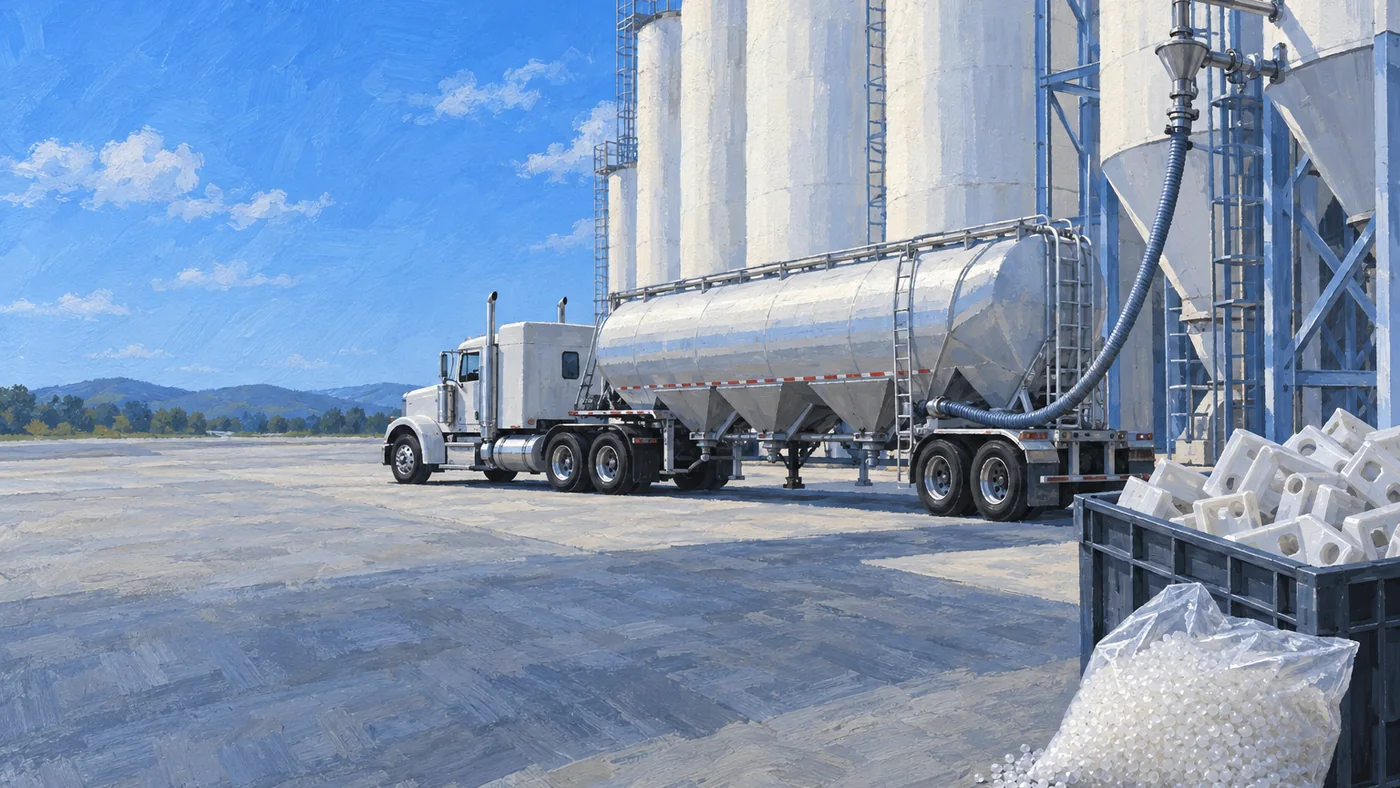
Bulk pneumatic trailers and hopper railcars carry resin that Cargado does not cover. This page is about truckload.
Northbound, the Cargado origin markets are Monterrey, Guadalajara and Cuautitlán Izcalli in the Mexico City area, with Querétaro behind them. That matches where Mexico's converters are: Estado de México, Nuevo León, Guanajuato, Jalisco, Mexico City and Querétaro hold the largest shares of plastics-industry employment.
In Cargado postings, the freight delivers to Texas (the Laredo, Houston and Dallas areas), the Chicago area and Southern California. Southbound, the Houston area is the largest single origin market, with the Laredo border yards and the Midwest making up most of the rest. The resin goes to Monterrey, the Mexico City area and the Bajío.

Source: Trade volumes and shares: UN Comtrade, U.S.-reported exports (HS 3901, 3902) and imports from Mexico (HS 3923, 3926), and Mexico-reported imports (HS 3901, 3902, 3904), 2025. Converter geography: INEGI DENUE via Data México, subsector 326, May 2026 release, employment estimated from establishment-size bands. Direction balance, equipment split, origin and destination markets: Cargado postings, plastics family, trailing 12 months to 10/9/2026. Retrieved 10/10/2026.
What adds cost and time to resin and parts shipments
Most of this is landed cost or compliance rather than the carrier's rate. It still decides which freight moves by truck, how much paperwork rides with it and how heavy it can be.
Bagged or bulk sets the equipment. Resin ships in standard 25 kg or 50 lb bags on pallets, or in bulk. Bagged resin rides a dry van door to door with no transload. Bulk rides hopper railcars and pneumatic trailers and often transloads near the border. If your plants take both, a truckload benchmark covers only the bagged side.
USMCA origin, in both directions. As of October 2026, U.S. resin keeps its preference in Mexico only with valid USMCA origin; without proof it pays Mexico's MFN rate, raised in 2026 for polystyrene, PET and urea resins (box). As of the same date, Mexican parts and packaging not entered at zero duty under USMCA pay an extra 10% under Section 301.
Either way, a missing certification at entry means paying the duty, then claiming a refund within a year (19 CFR 182.31). Rates and dates are in the box below.
Mexico's antidumping case on U.S. suspension PVC. Mexico's Economy Secretariat opened the case in April 2025 and set a provisional duty in March 2026. U.S. product was 98% of these imports in the period investigated, so any duty lands on this corridor. IMMEX temporary imports are not shielded: Mexico's Customs Law keeps compensatory duties on them. Rate and status are in the box.
The weight gap at the border. The U.S. Interstate gross limit is 80,000 lb. Mexico allows 46.5 metric tons, about 102,500 lb, on a five-axle T3-S2 on main highways, roughly 22,500 lb more. Resin is dense, so a trailer built to Mexican weight is overweight the moment it crosses north, and one built to U.S. weight leaves Mexican capacity unused.
Build cross-border shipments to the U.S. limit and expect the Mexico leg to price by the truck, not by the metric ton.
Most pellets are not hazmat. Polyethylene, polypropylene and PVC have no entry in the U.S. Hazardous Materials Table, so standard pellets usually need no hazmat endorsement, placards or surcharge. The common exception is expandable polystyrene beads, UN2211, Class 9. Check each grade's safety data sheet; the party offering the freight is responsible for the classification (49 CFR 173.22).
Hazmat dry van bids in Cargado ran about 18% above non-hazmat over the last 12 months overall, and the premium shrinks on the longest hauls. Budget it for EPS beads and any grade its safety data sheet lists as hazmat.
IMMEX paperwork. Under Article 108 of Mexico's Customs Law, an IMMEX company can hold resin and packaging under temporary import for 18 months. The customs law reform (published in the DOF 11/19/2025, in force since 1/1/2026) adds record-keeping for temporary-import regimes, including records of transformation processes and transfers. Expect more document requests on resin entries and longer customs broker prep.
Source, in order of the items above: a resin packager's guide (4/7/2026); DOF decrees of 12/29/2025 and 4/23/2026; USTR Section 301 notice, 91 FR 47318; DOF resolución de inicio of 4/28/2025, resolución preliminar of 3/24/2026 and Ley Aduanera Art. 108; 23 CFR 658.17 and NOM-012-SCT-2-2017; 49 CFR 172.101 Hazardous Materials Table, entries UN2211 and UN3314, and 172.102 (eCFR, current as of 10/1/2026); 49 CFR 173.22(a)(1) (offeror classifies); hazmat premium from Cargado carrier bid data, dry van, October 2025 to October 2026; Ley Aduanera Art. 108 and the Ley Aduanera reform decree (DOF 11/19/2025), with Galicia Abogados and EY summaries. Retrieved 10/10/2026.
As of October 2026
Everything in this box decays. Refresh it monthly, along with the dated lines elsewhere on the page.
- PVC antidumping duty. Provisional duty of $0.6315/kg on U.S. suspension PVC (fracción 3904.10.03), published in the DOF on 3/24/2026, effective 3/25/2026, for a four-month term. That term has run out, and the final resolution had not been located in the DOF as of 10/11/2026. Mexico's foreign trade law sets 210 business days from initiation for a final resolution (Ley de Comercio Exterior Art. 59); the deadline Economía applies depends on the days it declares non-working. Confirm the duty's current status with your customs broker before relying on it either way.
- Section 301. 10% on products of Mexico since 7/24/2026 (91 FR 47318). Goods entered at zero duty under USMCA are excluded (U.S. note 52(h), heading 9903.05.94). A non-qualifying Mexican plastic part pays MFN plus 10%, unless it pays a Section 232 metals duty instead. No chapter 39 resin line is on the U.S. note 52(b) exempt list. The 10% is under challenge at the U.S. Court of International Trade, which heard arguments on 9/30/2026 and had not ruled as of 10/11/2026. It is still collected. A separate Section 301 investigation of structural excess capacity, opened 3/11/2026, names Mexico; on the statute's 12-month clock, USTR's determination is due by 3/11/2027.
- Mexico's MFN increases. 35% on polystyrene (3903.11.01, 3903.19.99), PET (3907.61.01, 3907.69.99), other polyesters (3907.91.99) and urea and melamine resins (3909.10.01, 3909.20.99) since 4/24/2026 (DOF 4/23/2026), the decree's only chapter 39 lines. New MFN rates on 79 plastic-article lines in headings 3916 to 3926 (pipe, film, sheet, packaging, other articles) since 1/1/2026 (DOF 12/29/2025), from 5% to 35%, most at 25% or 7%; that decree has no line in primary resins 3901 to 3914. The April decree states that originating goods of Mexico's trade-agreement partners keep preferential treatment; tax advisers read the December decree the same way.
- Section 232. As written, the Section 232 metals duties do not reach primary plastic resins. Plastic articles on the Section 232 derivative lists pay the metals duty only when the metal named for their list (steel, aluminum or copper) is at least 15% of their weight, and an article that pays Section 232 does not also pay the Section 301 10%.
- USMCA review. The U.S. declined to extend the agreement at the July 2026 joint review. It remains in force with annual reviews; comments for the 2027 review opened 10/5/2026 and are due 1/12/2027. Rules of origin can change at any review; ask counsel whether contracts past a year need a tariff-change clause.
- What ended. The Supreme Court held on 2/20/2026 (Learning Resources v. Trump) that IEEPA does not authorize tariffs, and the 10% Section 122 surcharge that followed lapsed on 7/24/2026. Importers can file refund claims for IEEPA duties already paid through CBP's CAPE tool; confirm each entry's eligibility with your customs broker. Articles describing a 25% IEEPA tariff on Mexican goods are out of date.
- New supply. Argus expects about 2 million metric tons a year of new U.S. polyethylene capacity to start in the second half of 2026, mostly aimed at export. Mexico was already the largest buyer of U.S. polyethylene in 2025.
Source: DOF 4/28/2025 (resolución de inicio, PVC) and 3/24/2026 (resolución preliminar, PVC); Ley de Comercio Exterior Art. 59 (text current to DOF 5/1/2026); Federal Register 91 FR 47318 (7/28/2026); In re Section 301 Forced Labor Cases, Consol. Ct. No. 26-03555 (CIT; docket checked 10/11/2026); USTR excess-capacity investigation, 91 FR 12886, and 19 U.S.C. 2414(a)(2)(B); DOF 4/23/2026 (codigo 5785818, tariff table and considerandos) and 12/29/2025 (codigo 5777376, tariff table) TIGIE decrees, chapter 39 rows read in the decree text on sidof.segob.gob.mx 10/11/2026; EY tax flash on the December decree; Proclamation 11021 (Federal Register 4/9/2026); HTSUS Revision 21 (2026), chapter 99, U.S. notes 16(c) and 52(f); USTR joint review statement (7/1/2026) and Federal Register notice 2026-20341 (10/5/2026); Supreme Court slip opinion, Learning Resources, Inc. v. Trump (2/20/2026); Proclamation 11012 (Section 122); CBP trade remedies page (CAPE); Argus Media, "Viewpoint: New PE capacity favorable to buyers in 2026"; UN Comtrade, U.S.-reported polyethylene exports (HS 3901), 2025. Retrieved 10/10/2026 and 10/11/2026.
General information as of 10/11/2026, not legal, tax or customs advice. Confirm classification and duty with a licensed customs broker.
How dry van rates are moving out of the plastics markets
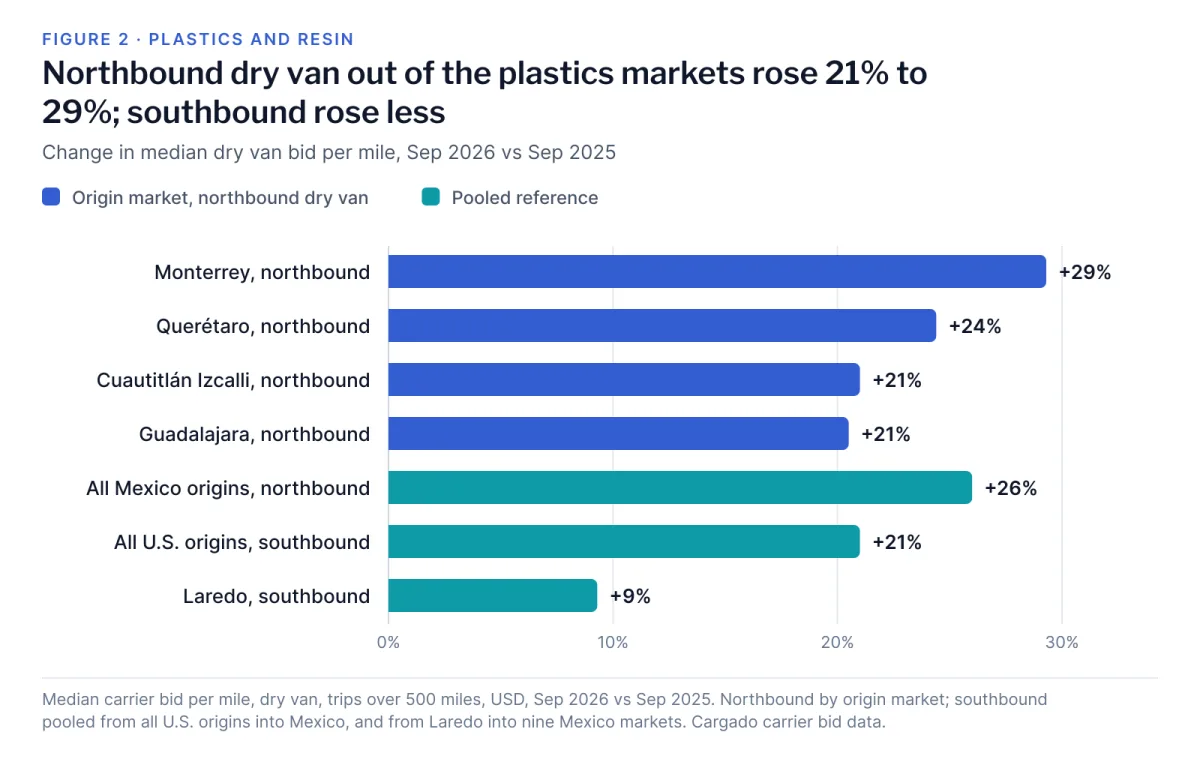
Northbound dry van bids out of the four plastics markets rose between 21% and 29% from September 2025 to September 2026. Southbound rose less.
| Market | Change in median dry van bid per mile, Sep 2026 vs Sep 2025 |
|---|---|
| Monterrey, northbound | +29% |
| Querétaro, northbound | +24% |
| Cuautitlán Izcalli, northbound | +21% |
| Guadalajara, northbound | +21% |
| All Mexico origins, northbound | +26% |
| All U.S. origins, southbound into Mexico | +21% |
| Laredo, southbound into Mexico | +9% |
These are market-level figures: the median of carrier bids on all freight out of each origin market, not only plastics, so they read as the cost of a dry van leaving that market. The southbound pooled figure covers all U.S. origins into Mexico.
A Laredo-origin southbound run is a shorter haul and moved less on the year. Southbound was still rising in September, up 3.4% on August.
Source: Median carrier bid per mile, dry van, trips over 500 miles, U.S. dollars, September 2026 against September 2025 and August 2026. Northbound by origin market; southbound pooled from all U.S. origins into Mexico; the Laredo row covers Laredo origins into Mexico's nine main destination markets. Cargado carrier bid data.
Each direction is its own market. On the city pairs priced both ways in October, northbound dry van through Laredo ran well above southbound (figures and method in the automotive parts article, /insights/automotive-parts-mexico-us, draft). Plastics teams feel it most because the same company often buys both legs, resin inbound and parts outbound, so benchmark them with two numbers, not one.
Compare all-in with all-in. Cargado rates are all-in carrier bids, fuel included, so put fuel and currency on the same basis before setting a routing guide beside them; peso lanes summed in a dollar column overstate spend.
What to check on your resin and parts lanes
- Price each direction on its own. Resin inbound buys the cheaper direction; parts and packaging outbound buy the expensive one.
- Separate bagged truckload from bulk before benchmarking. A truck rate says nothing about a railcar-and-pneumatic lane.
- Build cross-border shipments to the 80,000 lb U.S. limit, and ask Mexican carriers whether their domestic quotes assume the heavier Mexican gross weight.
- List the resin grades and part numbers with a valid USMCA certification, and the ones without. As of October 2026, a gap costs 10% at U.S. entry or the MFN rate at Mexican entry.
- If you buy suspension PVC into Mexico, read the current antidumping resolution with your customs broker before the next contract, and check whether your IMMEX entries have been paying the compensatory duty.
- Check each grade's safety data sheet: expandable polystyrene beads are UN2211, and standard pellets usually ship as general freight. Compare any hazmat rate with a non-hazmat rate of similar length.
- Put fuel and currency on the same basis as the benchmark, and read how a lane moved over the year, not only where it sits today.
Monthly lane watch
Median carrier bids, September 2026. We update this block each month.
| Market | Direction and equipment | vs September 2025 | vs August 2026 |
|---|---|---|---|
| Monterrey | Northbound dry van | +29% | +3.1% |
| Guadalajara | Northbound dry van | +21% | +0.8% |
| Cuautitlán Izcalli | Northbound dry van | +21% | -0.6% |
| Pooled northbound dry van (all Mexico origins) | Northbound dry van | +26% | +1.7% |
| Pooled southbound dry van (all U.S. origins into Mexico) | Southbound dry van | +21% | +3.4% |
Source: Cargado carrier bid data.
See the market on your plastics lanes
Send us the Mexico lanes you are pricing, resin inbound and parts outbound, and we will show you where carrier bids sit and where our data is thin or absent.
Talk to us → /contact?ref=industry-plastics-resin-mexico-us