The story
Part of our guide to metals and building materials freight between Mexico and the U.S.
Steel crosses the border about half in dry vans and half on open deck. As of October 2026, Mexican steel pays a 50% Section 232 duty, and the heavy flow is southbound: U.S. coil and plate into Monterrey, Saltillo and the Bajío. Northbound dry van bids out of Monterrey are up 29% in a year; open deck out of Mexico is up 20%.
Where steel and metals ship from
Steel moves both ways, and the heavier flow runs south. By weight, U.S. flat-rolled steel going into Mexico exceeded Mexican flat-rolled coming north by more than six to one in 2025 (figures in the October box). Cargado postings run roughly balanced, so this page prices both directions.
Northbound steel and metals in Cargado come out of Monterrey first, then San Luis Potosí and Guadalajara. Monterrey is the processing and service-center hub: Nuevo León holds about a third of the workforce at Mexico's steelmaking establishments and leads metal-materials wholesale.
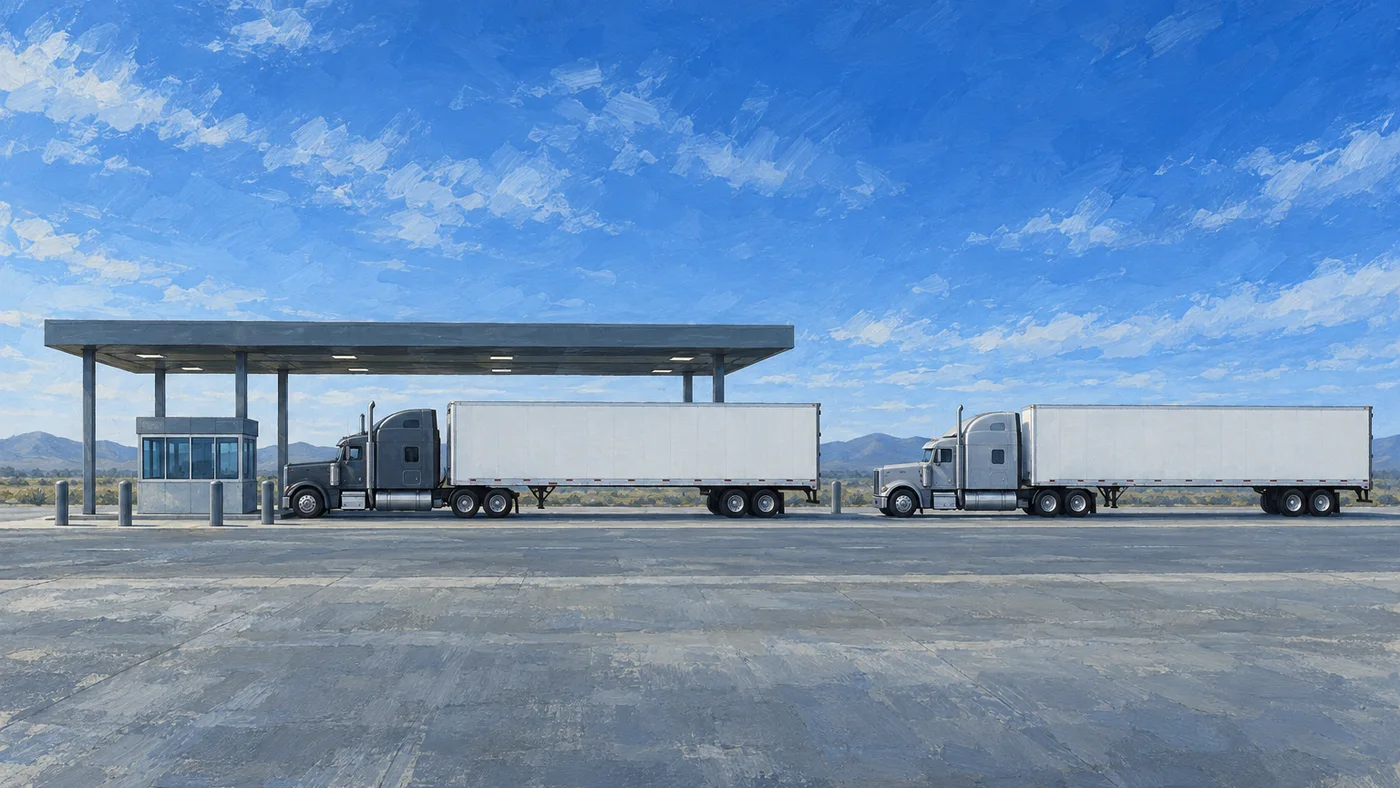
North of the border the freight lands in Texas (Houston, Dallas and the Laredo yards), Kentucky and Arizona. Dry van carries 54% and open deck 44%, and coils move in both.
Southbound freight comes from the Texas Gulf Coast, the Laredo border yards, the Great Lakes and Ohio steel belt, and the Gulf at Mobile. It lands in Monterrey, Saltillo and the Bajío.
Laredo appears in the steel postings as both a northbound destination and a southbound origin. That is the transload: shipments break at the border yards because the two countries disagree on how much a truck may weigh (next section).

Source: Cargado postings, steel and metals family, trailing 12 months to 10/9/2026 (markets and equipment split; shares only). Nuevo León workforce share: INEGI DENUE via Data México, May 2026 release, SCIAN 331111, 331112, 331210, 331220 and 434221. Direction by weight: UN Comtrade, U.S.-reported trade with Mexico, HS 7208 and 7210, 2025.
What adds cost and time to a steel shipment
Most of these costs fall on the importer or on the paperwork, not on the carrier's rate. They still decide which lanes run and how much time a shipment spends at the border.
Who pays the duty. The U.S. importer pays the Section 232 duty on Mexican steel, not the carrier. The rate, the value it is charged on and what qualifies for relief are in the October box.
Northbound coil and plate is already thin and price-sensitive, and the heavier tonnage is U.S. steel going south. Fewer northbound steel shipments also means a weaker backhaul for a southbound flatbed.
The weight gap. Mexico's NOM-012 allows a five-axle tractor-semitrailer 46.5 metric tons gross on its main highway classes, about 102,500 lb. The U.S. Interstate cap is 80,000 lb, a gap of roughly 22,500 lb, so a coil load built to Mexican limits cannot cross and keep rolling.
It gets split into two trucks, transloaded at a border yard, or run on a designated overweight corridor. The Hidalgo County corridor, serving three Hidalgo County bridges, permits up to 125,000 lb on a 24-hour permit with a certified scale ticket when both trip ends sit inside the corridor (fee in the box). Each option costs money or a day.
Northbound paperwork. Every formal import of basic steel mill products needs a Commerce SIMA license number on the entry summary. It is issued automatically online, requested up to 60 days ahead and valid for 75 days. CBP also requires the country where the steel was melted and poured on every entry, which the mill test certificate proves.
Neither usually stops the truck. A missing license leaves the entry incomplete and exposes the importer to penalties, and a missing or mismatched certificate delays the entry summary. Transportation and exportation (T&E) entries and bonded-warehouse admissions need no license; warehouse withdrawals for consumption and foreign-trade zone admissions do. Have the broker hold both before the truck reaches the bridge.
Mexico's import notice, southbound. Most steel entering Mexico needs an automatic import notice (the AAIPS) backed by a mill certificate for most mill products or a quality certificate for the rest, from a mill on the catalog in VUCEM, Mexico's foreign trade single window. A rejected notice holds the shipment at the Mexican broker.
Rejections rose sharply in 2025 and the rules changed in February 2026 (box); whether rejections have fallen since is not yet measured. Plan as if the requirement applies to your steel and confirm the scope with your Mexican customs broker.
Mexican antidumping duties. As of October 2026, some U.S. products pay antidumping duty on entry to Mexico, including straight-seam carbon steel pipe and aluminum hollow profiles (rates in the box). The importer owes it, and for the aluminum profiles it applies to temporary IMMEX imports too.
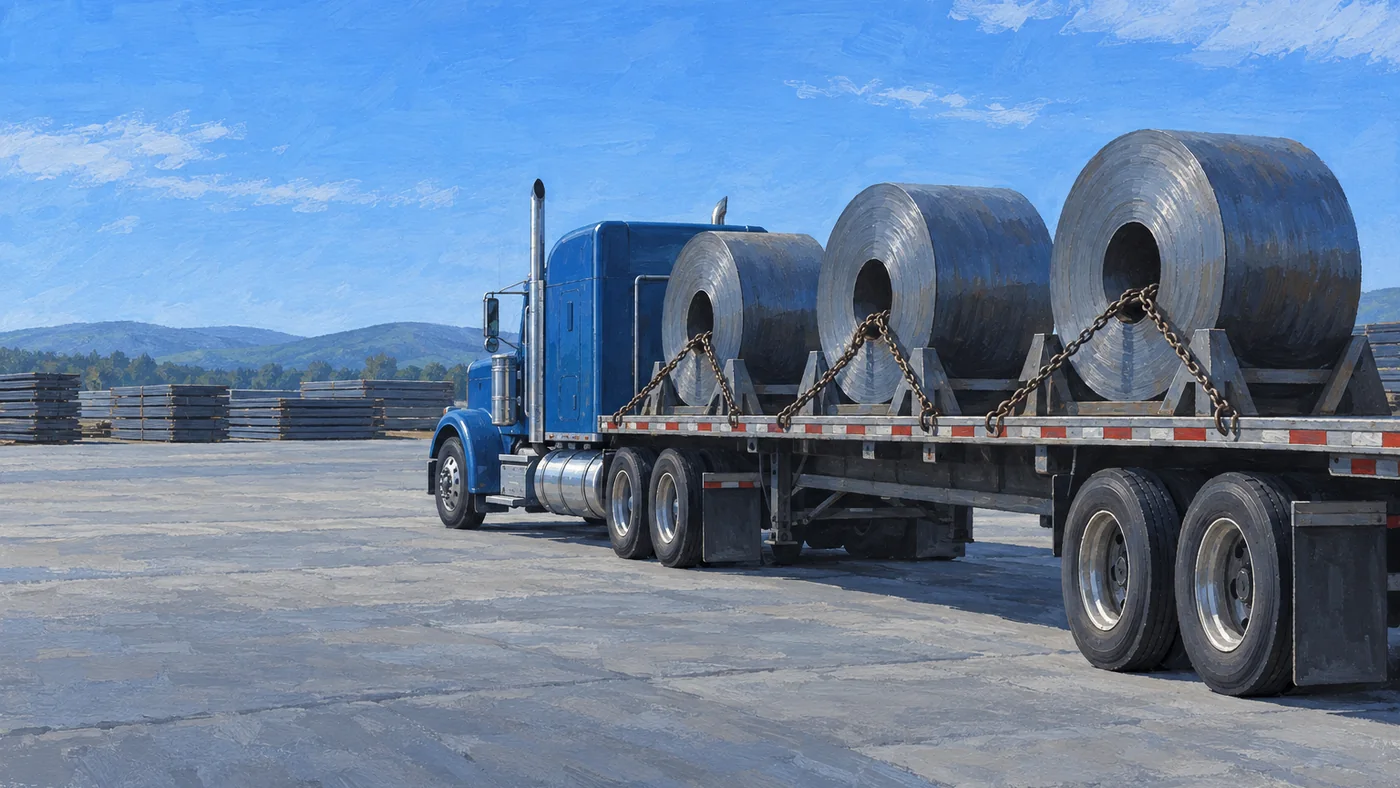
Open-deck securement. Metal coils of 5,000 lb or more fall under 49 CFR 393.120, and plate, pipe and structural shapes follow 393.110. The rules that change the bid:
- Coils with eyes crosswise or lengthwise need a means to keep them from rolling that supports the coil off the deck. Nailed blocking alone is prohibited, and crosswise coils may not use an X pattern of tiedowns through the eye.
- An article longer than 5 feet needs two tiedowns for its first 10 feet, plus one per additional 10 feet or fraction, when it is not blocked at the front.
- That means chains, coil racks or bunks, friction mats and often tarps, each a separate accessorial on the rate confirmation.
Coil-qualified carriers are a narrower pool than flatbed carriers, and it shows in lead time and in the bid.
Source, in order of the items above: Proclamation 11021 (91 FR 18201) and CSMS #68253075; NOM-012-SCT-2-2017 and 23 CFR 658.17; Hidalgo County RMA overweight permit page; 19 CFR Part 360 and CSMS #68253075; ITA Market Intelligence, Mexico steel and aluminum import requirements (5/30/2024); DOF resolutions of 6/25/2026 and 9/4/2026; 49 CFR 393.120 and 393.110(b). Retrieved 10/10/2026.
As of October 2026
Everything in this box decays. Refresh it monthly, along with the dated lines elsewhere on the page.
- Section 232 on Mexican steel, 50% of full customs value. Proclamation 10947 raised the steel rate to 50% from 6/4/2025, and Proclamation 11021 (4/2/2026) applied it to full customs value for entries on or after 4/6/2026. The June USMCA content rule in Proclamation 11032 covers only mobile industrial equipment such as forklifts and excavators (25% on non-U.S. content, 15% floor, through 12/31/2027). Steel mill products stay at 50%. Commerce proposed on 8/6/2026 adding 14 product groups, among them trailers, conductor cables and aluminum powder, to the metals derivative lists at a proposed 25%; no final list had been published as of 10/11/2026.
- No quota; the producer program is not a general path. There is no Mexico quota. A Commerce program, open to applications since 4/23/2026, can cut the rate to no less than 25% for limited quantities of USMCA-qualifying steel melted and poured in Mexico. It serves producers that supply U.S. auto or heavy-truck makers and commit to new U.S. primary steel capacity. CBP had not issued entry instructions for it as of 10/10/2026.
- Section 301 does not stack. The 10% action on products of Mexico in effect since 7/24/2026 excludes steel, aluminum and copper articles and the derivatives that pay the Section 232 duty (U.S. note 52(f)), and goods entered at zero duty under USMCA. Non-steel cargo on the same truck needs its USMCA qualification to avoid the 10%. The 10% is under challenge at the U.S. Court of International Trade, which heard arguments on 9/30/2026 and had not ruled as of 10/11/2026. It is still collected. A separate Section 301 investigation of structural excess capacity, opened 3/11/2026, names Mexico; on the statute's 12-month clock, USTR's determination is due by 3/11/2027.
- U.S. antidumping and countervailing duties. These apply on top of Section 232. Mexican corrosion-resistant steel has carried AD and CVD orders since 12/19/2025, with all-others cash deposits of 4.32% (AD, after offset) and 13.26% (CVD). Orders also cover Mexican rebar, oil country tubular goods, rectangular and standard pipe, wire rod, PC strand, welded wire mesh, brass rod and seamless copper pipe. Rates change with each review.
- Volume since the duty. U.S. imports of iron and steel (HS 72) from Mexico fell 27% in value from 2024 to 2025; coated flat steel (HS 7210) fell about 70% by weight. The U.S. shipped about 1.8 million metric tons of flat steel (HS 7208 and 7210) to Mexico in 2025, against about 0.28 million coming north.
- Mexico's import notice. Rejected AAIPS applications rose from 18,910 to 44,489 (January to April, 2024 against 2025) while approvals slipped from 88,709 to 87,353. The Secretaría de Economía revised the criteria in an Acuerdo of 2/12/2026 (effective 2/13/2026): clearer signature and seal rules, a stronger mill catalog, and exceptional volume increases for importers in the steel registry. Mexico's customs law reform was published in the DOF on 11/19/2025 and took effect 1/1/2026, with a few provisions on 2/1/2026 and 4/1/2026. It adds documentation duties for temporary-import regimes and raises customs-broker liability.
- Mexican antidumping on U.S. products. Straight-seam carbon steel pipe (7305.11.02, 7305.12.91): company-specific rates of 6.77% and 4.04%, and 25.43% for one named exporter and all other U.S. exporters, extended five years from 5/28/2025. Aluminum hollow profiles (7604.21.01): $1.72 per kilogram for U.S. origin, final resolution of 9/4/2026, covering definitive and temporary imports.
- Mexico's tariffs on third-country steel. Mexico raised MFN duties on about 1,460 tariff lines effective 1/1/2026, mostly to 25% to 35% and up to 50%, including roughly 275 lines in Chapters 72 and 73, and added 185 lines on 4/24/2026. Goods originating in Mexico's trade-agreement partners, U.S. steel under USMCA included, keep their preferential rate. For U.S. exporters, steel from countries without a Mexican trade agreement now faces the higher MFN rates.
- Overweight corridor fee. $206 per 24-hour permit for up to 125,000 lb on the Hidalgo County designated routes; the authority says the fee is subject to change.
- USMCA review. The U.S. declined to extend the agreement at the 7/1/2026 joint review; it stays in force and moves to annual reviews, with comments for the 2027 review due 1/12/2027. A 7/23/2026 joint statement lists steel, aluminum and derivative products among the topics under discussion; no deal had been announced as of 10/11/2026. Already scheduled: from 7/1/2027, steel counted in a vehicle maker's 70% steel purchase test must be made in USMCA countries from initial melting through coating; Chapter 72 origin rules do not change.
Source: Proclamation 10947 (90 FR 24199); Federal Register 91 FR 18201, 91 FR 34085, 90 FR 9817, 91 FR 21790, 91 FR 47318; BIS proposed derivative inclusions, 91 FR 50756 (8/6/2026); HTSUS chapter 99, U.S. note 52(f)(1); In re Section 301 Forced Labor Cases, Consol. Ct. No. 26-03555 (CIT; docket checked 10/11/2026); USTR excess-capacity investigation, 91 FR 12886, and 19 U.S.C. 2414(a)(2)(B); Commerce AD and CVD orders on corrosion-resistant steel from Mexico, A-201-863 and C-201-864, 90 FR 59494 and 90 FR 59488, and the orders listed in research/trade-authority-2026-10-11/us-actions.md section 5.1; USTR joint statement of 7/23/2026; USMCA Automotive Appendix Art. 6, fn. 74, and 19 CFR Part 182, Appendix A, sec. 17(5)(b); CSMS #68253075; UN Comtrade, U.S.-reported trade with Mexico, HS 72, 7208, 7210, 2024 to 2025; DOF 2/12/2026, 6/25/2026, 9/4/2026, 12/29/2025, 4/23/2026; Hidalgo County RMA; USTR press release 7/1/2026 and Federal Register notice of 10/5/2026; DOF decree of 11/19/2025 amending the Ley Aduanera (transitory article for the effective dates); HTSUS chapter 99, U.S. note 16(j). Retrieved 10/10/2026 and 10/11/2026.
General information as of 10/11/2026, not legal, tax or customs advice. Confirm classification and duty with a licensed customs broker.
How rates are moving in the steel markets
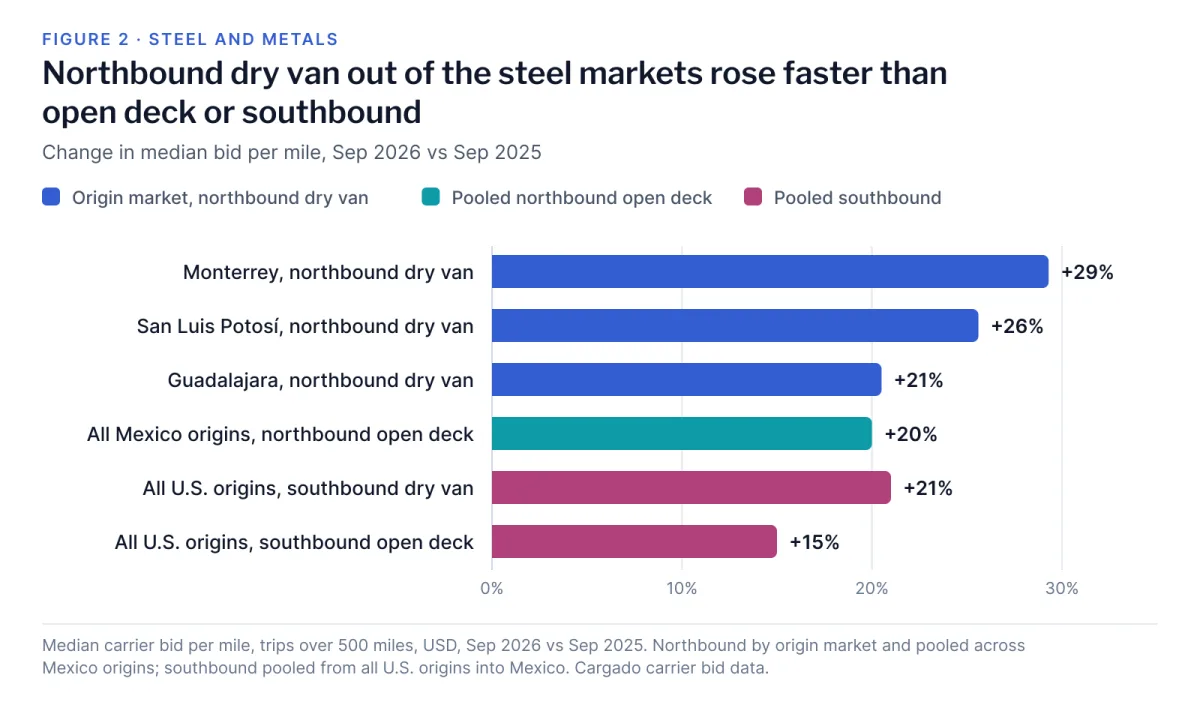
Northbound dry van bids out of the three steel markets rose 21% to 29% from September 2025 to September 2026. Open deck out of Mexico, pooled across all origins, rose 20%. Southbound open deck rose 15% and southbound dry van 21%.
| Market or pool | Equipment | Change in median bid per mile, Sep 2026 vs Sep 2025 |
|---|---|---|
| Monterrey, northbound | Dry van | +29% |
| San Luis Potosí, northbound | Dry van | +26% |
| Guadalajara, northbound | Dry van | +21% |
| All Mexico origins, northbound | Open deck | +20% |
| All U.S. origins, southbound | Dry van | +21% |
| All U.S. origins, southbound | Open deck | +15% |
These are market-level figures: the median of carrier bids on all freight out of each origin market, not only steel, so they read as the cost of a truck leaving that market. We publish the change rather than the level because levels across markets mislead when haul lengths differ (why: /insights/automotive-parts-mexico-us).
Source: Median carrier bid per mile, trips over 500 miles, U.S. dollars, September 2026 against September 2025. Northbound by origin market and pooled across Mexico origins; southbound pooled from all U.S. origins into Mexico. Year-over-year changes rounded to whole numbers. Cargado carrier bid data.
Open deck by market, on a rolling quarter. Single-market open deck cells are thin month to month, so we read them on three-month windows. Only two markets carry enough open-deck bidding to publish, and one is not a steel origin: Querétaro appears as a rate market, all open-deck freight out of Querétaro, not steel in particular.
| Rate market, northbound open deck | Change in median bid per mile, Jul-Sep 2026 vs Apr-Jun 2026 |
|---|---|
| Monterrey | about +16% |
| Querétaro (all freight, rate market only) | about +7% |
Source: Median carrier bid per mile, open deck, northbound, trips over 500 miles, U.S. dollars, three-month windows ending 9/30/2026 and 6/30/2026. Cargado carrier bid data.
Direction. Northbound dry van through Laredo priced well above southbound in October 2026 (figures and method: /insights/automotive-parts-mexico-us); for steel, U.S. coil into Monterrey or the Bajío buys the cheaper direction, and a Mexican mill shipping north buys the expensive one on top of the steel duty.
Where the data is thin, say so. On networks we have benchmarked, cross-border dry van out of northern Mexico and the Bajío ran deepest. Flatbed and step deck ran thinner, and in one network most open-deck lanes returned no rate. We mark those lanes as gaps rather than fill them with a modeled number.
Each Cargado rate carries a confidence label for how much recent bidding supports it, so your team can see where bidding runs deep and where to collect quotes.
What to check on your own steel lanes
- Price each direction on its own; northbound and southbound are separate markets.
- Weigh the load against both limits before tendering. A Mexican-legal coil load is about 22,500 lb over the U.S. Interstate cap. Decide in advance whether it splits, transloads at the border or runs the Hidalgo County corridor, and price all three.
- Ask each open-deck carrier whether it is coil-qualified: racks or bunks, chains, friction mats, drivers trained on 393.120. A flatbed is not a coil trailer.
- Put tarping, coil racks and securement on the rate confirmation as line items, so bids compare on the same basis.
- Southbound: the AAIPS notice and mill or quality certificate are with the Mexican broker, the mill is on the VUCEM catalog, and the product is checked against the antidumping list.
- Northbound: the SIMA license number and the mill test certificate are with the U.S. broker before the crossing, with the melt-and-pour country ready to report.
- Treat thin open-deck lanes as gaps. Rely on the benchmark where bidding runs deep, collect quotes where it does not, and read when a lane moved, not only where it sits (why that matters: /insights/automotive-parts-mexico-us).
Monthly lane watch
Median carrier bids, September 2026. We update this block each month.
| Market | Direction and equipment | vs September 2025 | vs August 2026 |
|---|---|---|---|
| Monterrey | Northbound dry van | +29% | +3.1% |
| San Luis Potosí | Northbound dry van | +26% | +2.0% |
| Guadalajara | Northbound dry van | +21% | +0.8% |
| Monterrey open deck | Northbound open deck | +16% vs the prior 3 months | |
| Querétaro open deck | Northbound open deck | +7% vs the prior 3 months | |
| Pooled northbound open deck (all Mexico origins) | Northbound open deck | +20% | -1.6% |
| Pooled southbound open deck (all U.S. origins into Mexico) | Southbound open deck | +15% | +3.0% |
| Pooled southbound dry van (all U.S. origins into Mexico) | Southbound dry van | +21% | +3.4% |
Source: Cargado carrier bid data.
See the market on your steel lanes
Send us the steel lanes you are pricing, both directions and both equipment types. We will show you where carrier bids sit and which open-deck lanes have thin or no data.
Talk to us → /contact?ref=industry-steel-metals-mexico-us