The story
Part of our guide to food and beverage freight between Mexico and the U.S.
Tequila and mezcal move north in dry vans, most of it from Jalisco to the Texas border. The freight is simple; the paperwork is not. A CRT certificate for tequila, label approval and state registration come before the truck arrives, and federal excise tax is due at entry. Dry van bids out of Guadalajara are up 21% in a year.
Where tequila and mezcal start
Mexico exported 214 million liters of tequila in the first half of 2026, 3.3% more than a year earlier, and the U.S. buys 83% of tequila export sales (EFE, July 2026). That is a steady, growing northbound flow, and almost all of it starts a full day's drive from the Texas border.
About 70% of the northbound tequila and mezcal freight posted in Cargado over the last 12 months left from two Jalisco markets, Guadalajara and Tepatitlán de Morelos in the Los Altos highlands. The tequila denomination of origin covers all 125 municipalities in Jalisco, plus parts of Michoacán, Tamaulipas, Nayarit and Guanajuato.
Mezcal is spread wider. Its denomination of origin covers twelve states, among them Oaxaca, Guerrero, Durango, San Luis Potosí and Zacatecas, and a 2021 resolution added four municipalities in Sinaloa, which the mezcal regulator says is under appeal. Producers and shipments are smaller, and most sit far from any border crossing.
The freight is spread across many producers and importers; no single one dominates. Nearly all of it runs northbound in dry vans to the Northeast port area, the Midwest, Florida, the Southeast and the Texas border.
Laredo is the leading destination market in Cargado postings for this freight.

What comes due before a truckload of tequila moves
Tequila carries one more certificate than almost anything else on the road, and most of what follows is due before the truck moves.
The CRT certificate. Tequila is not released from customs custody without a Certificate of Authenticity for Exports of Tequila, issued only by accredited officials of the Tequila Regulatory Council (CRT), plus a certificate of age if the label states one. A missing or wrong certificate holds the shipment at the port.
Label approval and the importer's permit. Bottled spirits do not leave customs custody without a Certificate of Label Approval (COLA) for that label, filed with the entry. The importer also needs a federal basic permit, which requires a staffed U.S. office; a Mexican brand without one uses a licensed importer.
Mezcal's certificate is Mexican. TTB lists no U.S. certificate for mezcal. Certification to the Mexican standard, NOM-070, happens before export, not at the port.
Excise tax is paid at the border. CBP collects the federal excise tax at entry, $13.50 per proof gallon. A reduced rate of $2.70 applies to the first 100,000 proof gallons a year, but importers pay the full rate at entry and claim the difference from TTB no more than quarterly, and only if the producer has assigned the benefit.
Calculated from the statutory rates, 1,000 cases of 12 x 750 ml at 80 proof is about 1,902 proof gallons: about $25,700 due at entry, of which about $20,500 can be claimed back once the quarter closes if the reduced rate applies. That is working capital on every truckload. Semi-monthly deferred payment and bonded warehousing both soften it.
State registration gates delivery. Texas requires a COLA before TABC product registration, charges $25 per application, and bars shipping into Texas until it approves. Seventeen states, plus a few county and local jurisdictions, control spirits sales through a public agency, which sets delivery points and appointment rules.
The Mexican side has its own gate. Exporters must be on SAT's sectoral exporter registry (Padrón de Exportadores Sectorial) before a shipment can clear Mexican export customs, and every move on federal roads needs a CFDI with the Carta Porte complement.
Mexico's 53% IEPS excise on spirits is not paid on exports (Article 8, section II of the IEPS law), so it does not travel with the freight.
FDA treats alcohol as food. Prior notice is due at least two hours before the truck reaches the port.
Weight. A five-axle tractor-trailer can gross 46.5 metric tons (about 102,500 lb) on Mexico's main highways; the U.S. federal cap is 80,000 lb, a gap of roughly 22,500 lb. Build to U.S. weight at origin or plan a transload at the border, which costs a day and a dock.
Route and parking on the Mexico leg. Food and beverages were Mexico's most targeted cargo category in the second quarter of 2026, at 30% of incidents (Overhaul's Q2 2026 report, as reported by Mexico Business News), and Jalisco, Guanajuato and San Luis Potosí, states on common routes from Guadalajara to the Texas border, sit in its top ten.
Ask each carrier which highways it runs, where the truck stops, what monitoring is on the trailer, and whether declared value and insurance match the shipment. Those measures are priced into the bid.
As of October 2026
- Since 7/24/2026, goods of Mexico pay an additional 10% duty under Section 301 unless entered at zero duty under USMCA. Tequila (HTS 2208.90.50) and mezcal (2208.90.72) carry a zero regular duty rate, so since 7/24/2026 a USMCA claim skipped at entry costs 10% of entered value unless a post-importation claim within a year recovers it (19 CFR 182.31). The relief in U.S. note 52(h) is for products of Mexico entered free of duty under USMCA; how a zero-rate line shows that claim at entry is for your customs broker. The 10% is under challenge at the U.S. Court of International Trade, which heard arguments on 9/30/2026 and had not ruled as of 10/11/2026. It is still collected.
- The U.S. declined to extend USMCA at the 7/1/2026 joint review; unless the parties agree to extend it, the agreement ends in July 2036 (USMCA Art. 34.7), with a review every year until then, and any party can withdraw on six months' notice (Art. 34.6). USTR opened comment on the 2027 review 10/5/2026; comments are due 1/12/2027.
Review monthly; everything above it changes rarely.
General information as of 10/11/2026, not legal, tax or customs advice. Confirm classification and duty with a licensed customs broker.
How Guadalajara dry van rates moved this year
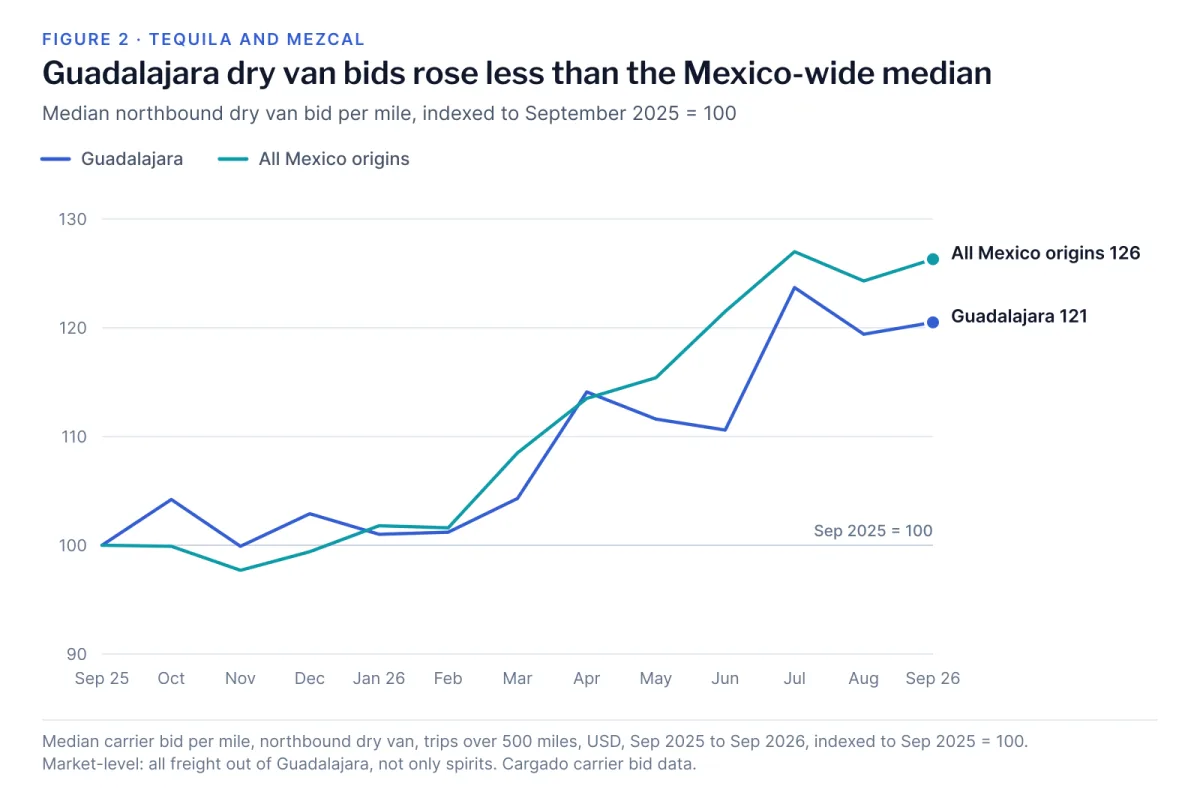
The median carrier bid per mile on northbound dry van freight out of Guadalajara was 21% higher in September 2026 than in September 2025, and 0.8% higher than in August. These are market-level figures: medians of carrier bids on all freight out of Guadalajara, not only spirits.
Guadalajara rose less than the northern markets. Monterrey was up 29% over the same year, Saltillo 28%, and the pooled northbound dry van median across all Mexican origins rose 26%. A Jalisco origin saw a smaller increase than Monterrey did, on a longer haul to the border.
On long northbound hauls, bids held flat from October through February, stepped up in March and April and peaked in July. A program that priced lanes in winter and ships for the holidays is buying in a different market.
Agave spirits are almost all northbound, the expensive direction. Northbound ran 15% to 53% above southbound on city pairs priced both ways on 10/10/2026. The full comparison is in the automotive parts article.
What to confirm before the first agave spirits shipment
- Weight at origin. Build the trailer to 80,000 lb gross for the U.S. leg, and agree who pays if it is lightened at the border.
- Certificates before booking. CRT certificate, certificate of age if needed, a COLA for every label, the importer's permit.
- Destination state. Is product registration approved, and is it a control state with its own delivery rules?
- Excise cash flow. Put the tax due at entry and the quarterly refund timing in the landed-cost model.
- USMCA on every qualifying entry. Since July the Section 301 duty makes the origin claim worth 10% of entered value.
- Route and parking on the Mexico leg. Ask carriers how they run Guadalajara to the Texas border and what monitoring is on the trailer.
Monthly lane watch
Median carrier bids, September 2026. We update this block each month.
Guadalajara rose less than Monterrey and Saltillo over the year and was close to flat in September.
| Market | Direction and equipment | vs September 2025 | vs August 2026 |
|---|---|---|---|
| Guadalajara | Northbound dry van | +21% | +0.8% |
| Pooled northbound dry van (all Mexico origins) | Northbound dry van | +26% | +1.7% |
Source: Median carrier bid per mile, northbound dry van, origin market Guadalajara, trips over 500 miles, USD, September 2026 against August 2026, September 2025 and October 2025. Market-level, all freight out of Guadalajara. Cargado carrier bid data.
See what carriers bid on your Jalisco lanes
Send us the Guadalajara and Los Altos lanes you are pricing and we will show you what carriers have bid on them, including where the data is thin or missing.
Related links
- Shipping food and beverage between Mexico and the U.S.
- How to move packaged food and beverages between Mexico and the U.S.
- Shipping automotive parts between Mexico and the U.S.
- Market Rates for your Mexico and Canada freight
- How rate confidence scores work
- How to read a Mexico fuel surcharge
Sources
- Tequila exports, first half of 2026: EFE, "México produce 302 millones de litros de tequila," 7/27/2026 (via swissinfo). 214.4 million liters exported, up 3.3%; the U.S. 83% of export sales.
- 70% from Jalisco: Share of northbound tequila and mezcal postings by origin market, 10/10/2025 to 10/9/2026, Cargado posting data. Guadalajara and Tepatitlán de Morelos combined.
- Laredo as the leading destination market: Northbound tequila and mezcal postings by destination market, same window, Cargado posting data. Destination market, not crossing field.
- Denomination of origin counts: Universidad de Guadalajara, CUCEA, "Mercado laboral y día del tequila," July 2025; SADER, "Denominación de Origen: distinción que protege y valora al mezcal del Estado de México," 1/12/2026 (twelve states); DOF resolution adding four Sinaloa municipalities to the mezcal denomination of origin, signed 9/30/2021, published 10/12/2021; Consejo Mexicano Regulador de la Calidad del Mezcal, denomination of origin page (appeal status).
- $13.50 per proof gallon and $2.70 reduced rate: 26 U.S.C. 5001. Worked example calculated from those rates; assumptions 1,000 cases, 12 x 750 ml, 80 proof, full rate paid at entry, reduced rate assigned by the producer.
- Quarterly refund: TTB, CBMA Imports, last updated 9/29/2025; TTB final rule, 90 FR 45325 (9/22/2025).
- Texas registration: Texas Alcoholic Beverage Commission, Product Registration ($25 fee as listed by TABC, retrieved 10/10/2026).
- Mexican exporter registry: SAT, RGCE 2026 Anexo 10, Fracción II, Padrón de Exportadores Sectorial, sector 3 (tequila) and sector 5 (distilled spirits, mezcal), DOF 1/14/2026.
- 53% IEPS and the export exemption: Ley del Impuesto Especial sobre Producción y Servicios, Cámara de Diputados consolidated text, last reform DOF 11/7/2025, Art. 2 and Art. 8 II.
- Two-hour prior notice: 21 CFR 1.279; TTB, Importing Bottled Alcohol Beverages into the United States, 9/29/2026.
- Control states: National Alcohol Beverage Control Association, Control State Directory.
- Weight: NOM-012-SCT-2-2017, Tabla B-2 (DOF 12/26/2017); 23 CFR 658.17.
- Theft share: Overhaul Q2 2026 Mexico cargo theft report, as reported by Mexico Business News, 8/26/2026.
- 10% Section 301 duty: CBP CSMS 69326983, 7/23/2026; 91 FR 47318; HTSUS Rev. 21 chapter 99, U.S. note 52(h) and heading 9903.05.94; USITC Harmonized Tariff Schedule for the regular duty rates; In re Section 301 Forced Labor Cases, Consol. Ct. No. 26-03555 (CIT; docket checked 10/11/2026).
- USMCA review: USMCA Art. 34.7 (term and joint review) and Art. 34.6 (withdrawal); USTR, Ambassador Greer statement on the USMCA joint review, 7/1/2026; Federal Register 2026-20341, request for public comments on the 2027 review, 10/5/2026 (comments due 1/12/2027).
- Guadalajara +21%, +0.8%, +16%; Monterrey +29%; Saltillo +28%; pooled +26%: Median carrier bid per mile, northbound dry van, trips over 500 miles, USD, September 2026 against September 2025, August 2026 and October 2025, by origin market. Market-level, all freight out of each market. Cargado carrier bid data.
- Seasonality: Median carrier bid per mile, northbound dry van, trips of 1,000 to 2,200 miles, by month, October 2025 to September 2026, Cargado carrier bid data.
- Northbound 15% to 53% above southbound: Median carrier bid from Cargado Market Rates, dry van via Laredo, nine city pairs priced in both directions on 10/10/2026.