The story
Part of our guide to food and beverage freight between Mexico and the U.S.
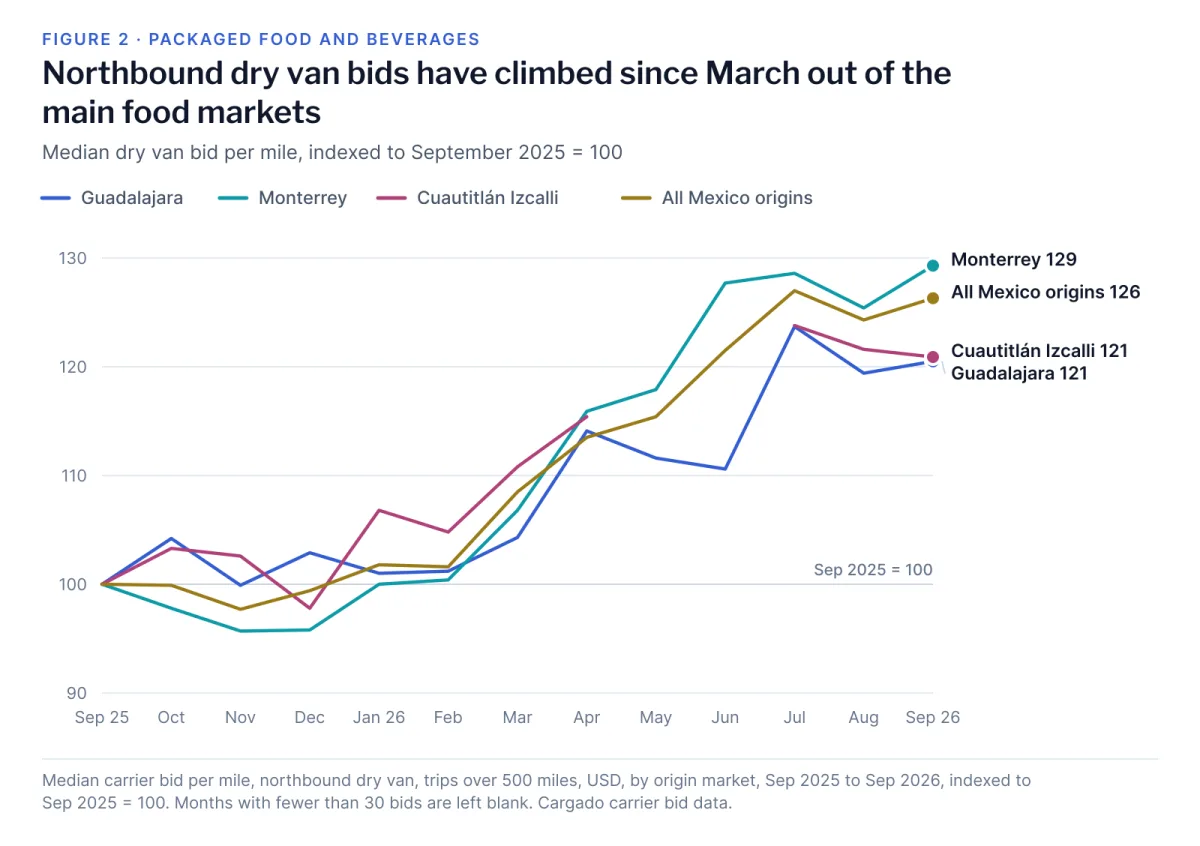
Packaged food moves north in dry vans from Guadalajara, Monterrey and the Mexico City area to Texas, the Midwest and Los Angeles. Northbound dry van bids out of those markets are up 21% to 29% in a year. Watch the border weight gap, FDA's two-hour prior notice window and the USMCA claim.
Where packaged food leaves Mexico, and where it lands
This page covers three origin markets for packaged food freight posted northbound in Cargado: Guadalajara, Monterrey, and Cuautitlán Izcalli on the north edge of Mexico City. Toluca and Mexicali appear as origins as well. Beverage origins are not shown; the beverage items below cover documents and duties, not markets.
The freight is shelf-stable goods in food-grade dry vans. The food-grade requirement itself is covered on the food and beverage hub. Beer is not covered here, and tequila and mezcal have their own article because the excise tax and certificate stack changes the shipment's economics.
Laredo is the leading destination market in Cargado postings for this freight. Monterrey is a few hours from the bridge; Guadalajara and the Mexico City area are a full day or more away, and that distance is in the rate.
On northbound dry van bids into the Southeast over the last 12 months, the Mexico leg was about a sixth of the door-to-door rate from northern Mexico and a bit over a third from central Mexico.
Source: Median of each leg's share of the door-to-door bid, northbound dry van bids into the Southeast that itemized all three legs, October 2025 to October 2026, Cargado carrier bid data.
North of the border the freight splits three ways: Texas (Laredo as a transload point, then Dallas and Houston), Chicago and the Midwest, and Southern California through Los Angeles. Southbound food freight is thinner, from Laredo, El Paso and the Southeast into Monterrey, the Mexico City area and Ciudad Juárez, and buys the cheaper direction.

What adds cost to a dry van of packaged food
The weight gap at the border
Mexico's weight norm, NOM-012-SCT-2-2017, lets a five-axle tractor-semitrailer gross 46.5 metric tons on the ET and A highway classes, about 102,500 lb. The U.S. federal cap on the Interstate is 80,000 lb. A trailer built to Mexican legal weight is roughly 22,500 lb too heavy for the U.S. leg, and dense canned and bottled goods are the shipments most exposed.
Each fix has a cost: less payload on the Mexican leg, a transload and its dwell at the border, or a Texas overweight corridor. Decide where the trailer gets built to 80,000 lb before the truck is booked; a carrier who finds out at the scale will bill the fix.
The Hidalgo County corridor permits trucks up to 125,000 lb from the Pharr-Reynosa, Anzalduas and Progreso bridges; among its conditions, both ends of the trip have to be inside the corridor. It covers a short move inside the Rio Grande Valley, not a Laredo crossing and not a long haul.
FDA prior notice runs on a two-hour window
The hub covers that prior notice exists. The cost is in the timing. For food arriving by road, FDA must confirm the notice no less than two hours before the truck reaches the port of arrival. Food with no, inaccurate or late notice is subject to refusal and is held within the port unless CBP agrees to immediate export.
That means detention, port storage and a missed appointment. Two hours is the floor, not the plan. Notice filed through ACE can go in up to 30 days ahead, and through FDA's PNSI portal up to 15. File repeat lanes early and leave the two-hour window for exceptions. Alcoholic beverages count as food here and carry the same timing.
Who owes the carrier written specs under FSMA
The FSMA Sanitary Transportation rule puts written duties on whoever arranges the move. The rule's "shipper" is whoever arranges transportation, and it names a freight broker as an example.
That party gives the carrier written sanitary specifications for the vehicle, cleaning procedures included, and an operating temperature where food needs one, and keeps those records for 12 months after the agreement with the carrier ends.
Shelf-stable goods carry a lighter burden. The rule exempts food completely enclosed by a container unless it needs temperature control for safety. Confirm the exemption product by product; a Mexican plant handing an intact trailer to a U.S. truck is inside the rule's scope.
Route and parking on the central corridors
Food and beverages were the most targeted cargo category in Mexico in the second quarter of 2026, at 30% of recorded incidents (Overhaul's Q2 2026 report, via Mexico Business News), while Mexico's SESNSP counted 46% fewer thefts from freight carriers in 2025 than in 2019.
The step that reduces the exposure is in the tender. Ask each carrier which highways it runs out of the Mexico City area and Guadalajara, where the truck stops, what monitoring is on the trailer, and whether the declared value and insurance match the shipment. No public source prices those measures, so they sit inside the bid.
Source, in order of the items above: NOM-012-SCT-2-2017 (DOF 12/26/2017), Tabla B-2; 23 CFR 658.17; Hidalgo County Regional Mobility Authority overweight truck corridor page; 21 CFR 1.279 and 1.283; TTB page on importing bottled alcohol beverages (updated 9/29/2026); 21 CFR 1.904, 1.908 and 1.912; FDA Sanitary Transportation rule page; Overhaul Q2 2026 cargo theft report as reported by Mexico Business News (8/26/2026); SESNSP data as reported by El Universal (3/30/2026). Retrieved 10/10/2026.
As of October 2026
Everything here decays; check the date.
- Section 301 tariff. Since July 24, 2026, most goods of Mexico pay an additional 10% duty under Section 301 unless entered at zero duty under USMCA. A list of products is exempt (HTSUS chapter 99, U.S. note 52), and it includes many food lines, among them coffee, cocoa and some juices. Tequila and beer are not on that list. They carry a zero general duty rate, so since July 24 a skipped USMCA claim on them costs 10% at entry. The relief is for products of Mexico entered free of duty under USMCA (U.S. note 52(h), heading 9903.05.94). The 10% is under challenge at the U.S. Court of International Trade, which heard arguments on 9/30/2026 and had not ruled as of 10/11/2026. It is still collected.
- USMCA review. The U.S. declined to extend USMCA at the July 1, 2026 joint review. Unless the parties agree to extend it, the agreement ends in July 2036 (USMCA Art. 34.7), with a review every year until then, and any party can withdraw on six months' notice (Art. 34.6); USTR opened comment for the 2027 review on October 5, 2026, and comments are due January 12, 2027.
- IEEPA refunds. After the Supreme Court's February 20, 2026 ruling, importers can file refund claims for IEEPA duties paid on Mexican goods through CBP's CAPE tool (open since April 20, 2026); confirm each entry's eligibility with your customs broker.
- Food traceability. FDA has proposed moving the Food Traceability Rule (FSMA 204) compliance date to July 20, 2028, and Congress directed FDA not to enforce before then. The rule setting the new date was not final as of October 10, 2026.
- Sugar. U.S. imports of Mexican sugar stay under antidumping and countervailing duty suspension agreements, continued from 9/9/2025. Southbound, Mexico has required a prior import permit for listed sugar lines since 9/28/2026, with strict application to 2106.90.99 food preparations from 11/2/2026, per the Economy Ministry as reported in the Mexican trade press; whether U.S. sugar under USMCA is exempt was not confirmed.
- Hidalgo County overweight permit. $206 per permit, valid 24 hours, certified scale ticket required, 55 mph cap.
Source, in order of the items above: CBP CSMS 69326983; Presidential memorandum 91 FR 47717; Federal Register 91 FR 47318; HTSUS Revision 21 (2026), chapter 99, U.S. note 52(b) (exempt products) and 52(h) (USMCA duty-free entries); In re Section 301 Forced Labor Cases, Consol. Ct. No. 26-03555 (CIT; docket checked 10/11/2026); USITC Harmonized Tariff Schedule (tequila, mezcal and beer general duty rates); Supreme Court slip opinion, Learning Resources, Inc. v. Trump, No. 24-1287 (2/20/2026); CBP trade remedies page (CAPE); USTR statement on the USMCA joint review (July 2026) and Federal Register 2026-20341 (10/5/2026); USMCA Art. 34.7 (term and joint review) and Art. 34.6 (withdrawal); FDA Food Traceability Rule page and Federal Register 2025-14967; sugar suspension agreements A-201-845 and C-201-846, 90 FR 45182 and 90 FR 45189; Mexican sugar permit as reported by Crónica (10/2/2026) and Tax Today Mexico, citing SE Comunicado 94 (secondary; DOF text not located); Hidalgo County Regional Mobility Authority overweight truck corridor page. Retrieved 10/10/2026 and 10/11/2026.
General information as of 10/11/2026, not legal, tax or customs advice. Confirm classification and duty with a licensed customs broker.
How dry van rates moved out of the packaged food markets
Northbound dry van bids out of the packaged food origin markets are up 21% to 29% in a year. These are market-level figures: the median of carrier bids on all freight out of each origin market, not only food and beverage freight, on trips over 500 miles.
| Origin market | Change vs September 2025 | Change vs August 2026 |
|---|---|---|
| Monterrey | +29% | +3.1% |
| Guadalajara | +21% | +0.8% |
| Cuautitlán Izcalli | +21% | -0.6% |
| Toluca | +29% | +2.4% |
| All Mexico origins, northbound dry van | +26% | +1.7% |
Source: Median carrier bid per mile, northbound dry van, trips over 500 miles, USD, September 2026 against September 2025 and August 2026, by origin market. Cargado carrier bid data. Markets shown only where September bidding was deep enough to publish.
Direction. The same road is two markets, one in each direction, and packaged food is mostly in the expensive one. On nine city pairs priced both ways on October 10, 2026, dry van through Laredo, northbound ran 15% to 53% above southbound. The full comparison is in the automotive parts article.
Source: Median carrier bid from Cargado Market Rates, dry van via Laredo, priced in both directions on October 10, 2026, nine city pairs from central and northern Mexico origins where both directions carried a confidence score of 60 or higher.
Season. Long-haul northbound dry van bids stayed flat from October 2025 through February 2026, stepped up in March and April and kept rising into July. Between February and September the median bid rose about 26% into the Upper Midwest and about 15% into Texas. A canned-goods lane into Chicago repriced in July would have carried that rise; one into Dallas, about half.
Source: Median carrier bid per mile, northbound dry van, trips of 1,000 to 2,200 miles, by destination region and month, October 2025 to September 2026; changes measured February to September 2026. Cargado carrier bid data.
Domestic Mexico is a different market. In Cargado bid data, cross-border and domestic Mexico lanes moved in opposite directions this year. Over the 13 weeks ending October 4, median northbound cross-border bids per mile rose about 7% while domestic Mexico bids fell about 7% in pesos. Price a cross-border lane and a domestic Mexico lane off separate histories.
Source: Median carrier bid per mile, dry van, July 6 to October 4, 2026 against April 6 to July 5, 2026. Cross-border: northbound into the U.S., trips over 500 miles, USD. Domestic: origin and destination in Mexico, trips over 250 miles, pesos. Cargado carrier bid data.
Cargado rates are all-in carrier bids, fuel included, so add fuel to a linehaul routing guide before comparing, and keep pesos out of the dollar column. See How to read a Mexico fuel surcharge.
What we see benchmarking food freight
We run rate benchmarks with companies that ship across the border. These are patterns from that work, shared without names or rates.
- The data is deepest on export lanes out of the Bajío. Short domestic runs into Mexico City and Guadalajara are thinner. Ask how much real bid history sits under any number you are shown.
- Read the range, not only the endpoint. One long-haul export lane swung widely from peak to trough inside a single quarter and still ended only slightly up. A rate taken on one day can sit far from where the lane settles.
Source: Cargado rate benchmarking engagements, anonymized.
Six things to settle before the tender goes out
- Where the trailer gets built to 80,000 lb, whether at the plant, at a border transload or inside an overweight corridor. Put the answer in the tender so the carrier prices it.
- Who files prior notice and how far ahead. "The customs broker, the morning of" is planning around the two-hour floor.
- Who holds the FSMA "shipper" role on each lane, and whether written vehicle specs are on file with the carrier.
- Which Mexican highways the shipment uses out of the Mexico City area or Guadalajara, where the truck stops, and what the carrier includes for monitoring on them.
- Whether every qualifying entry since July 24 claims USMCA. Look for entries carrying the Section 301 heading without the USMCA exemption heading beside it.
- Whether your benchmark is northbound against northbound, all-in against all-in and dollars against dollars, and when each lane last repriced. The same history lets both sides start from the same place.
Monthly lane watch
Median carrier bids, September 2026. We update this block each month.
| Market | Direction and equipment | vs September 2025 | vs August 2026 |
|---|---|---|---|
| Guadalajara | Northbound dry van | +21% | +0.8% |
| Monterrey | Northbound dry van | +29% | +3.1% |
| Cuautitlán Izcalli | Northbound dry van | +21% | -0.6% |
| Toluca | Northbound dry van | +29% | +2.4% |
| Pooled northbound dry van (all Mexico origins) | Northbound dry van | +26% | +1.7% |
Source: Cargado carrier bid data.
Check your packaged food lanes against carrier bids
Related links
- Food and beverage freight to Mexico and Canada, the hub
- Market Rates for your Mexico and Canada freight
- How rate confidence scores work
- How to read a Mexico fuel surcharge
- Tequila and mezcal freight from Mexico to the U.S. (/insights/tequila-mezcal-mexico-to-us, draft, article 2a; link once live)
- Frozen, dairy and meat across the border (/insights/frozen-dairy-meat-cross-border, draft, article 3; link once live)
- Fresh produce from Mexico, reefer in season (/insights/fresh-produce-mexico-us-reefer, draft, article 4; link once live)
- Shipping automotive parts between Mexico and the U.S. (/insights/automotive-parts-mexico-us, draft, article 1; carries the full direction comparison; link once live)