
How do I post an empty truck?
Click Post under Posted Trucks, enter where the truck is, its trailer and the day it is available, add one destination or several, and see loads that fit. Same days every week? Check Recurring. Or upload a screenshot or photo of your list.
Every way to post trucks, on one page: How to post your trucks.
Step 1: Click Post
In Find Freight, find Posted Trucks in the blue sidebar and click Post.
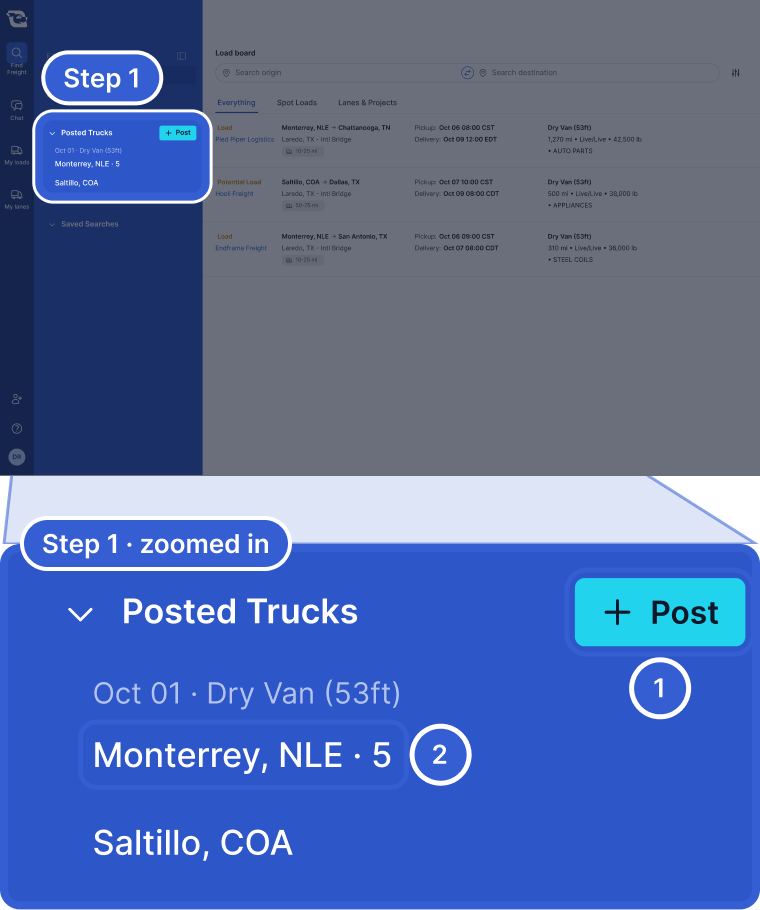
- Post opens the form for a new truck.
- A posted truck. The number is how many trucks you posted there.
Step 2: Fill in the truck and post it
Type the city in Truck location. Choose the Trailer type and the day the truck is available. If you have more than one truck there, click + to raise the count. The destination starts as your company's service area. Change it to one place or several where you want to go, or leave it. Same days every week? Check Recurring and pick the days. To add the border crossings you use or your requirements, click More filters, the button with a number at the end of the trailer row. Then click Post and Search.

- The city where the truck is now.
- Where you want to go: one place or several. It starts as your company's service area; change it or leave it.
- More filters: the border crossings you use and your requirements. The number is how many are set.
- Post and Search posts the truck and shows loads near it.
Destination and More filters are optional. Anything you don't change comes from your company profile. Cargado uses them to match your truck with loads.
Step 3: Open the truck to see its loads
The truck now shows under Posted Trucks, grouped by date and trailer type. Click it. The list shows loads near that truck. If you set a destination or filters, the top of the page shows the Destination and how many filters the truck has.
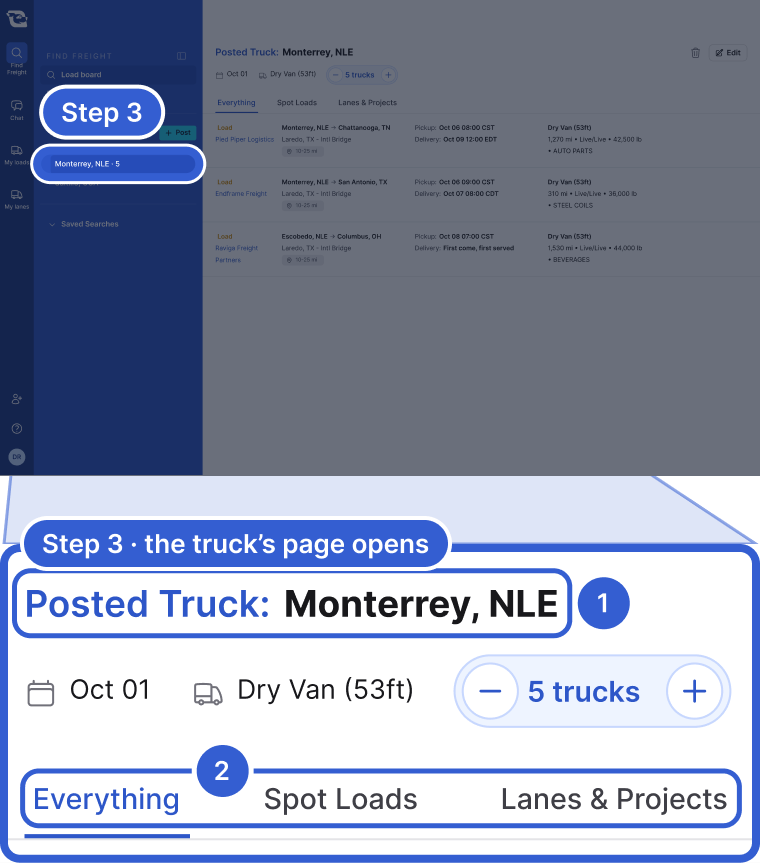
- Posted Truck: and the city where the truck is.
- Everything, Spot Loads and Lanes & Projects narrow the list.
Tip: Logistics companies see your posted trucks when they post loads that match. They can reach you through Cargado chat.
Same locations every week?
If you have recurring trucks, say which days when you send your trucks by email or WhatsApp, or set up Recurring in the app. We'll look for loads for those trucks on those days, every week.
- In the Post a truck window, open the date.
- Check Recurring, then pick the days under Which days?
- Click Post and Search. Under Posted Trucks, the truck reads like Every M, W, F.
Post trucks from a screenshot or photo
Skip the typing. Post the trucks from a screenshot or photo of your list.
- Click Post under Posted Trucks. At the bottom of the form, click Upload a screenshot or photo. On the Post a truck page, the Upload trucks button opens the same thing.
- Drop the image on Drop a screenshot or photo of your trucks, or click Browse files. It takes a JPG, PNG, or WebP image.
- Wait while it reads and posts the trucks, usually within a minute.
- When you see Nice work! and how many trucks are posted, click Done. The trucks show under Posted Trucks, like trucks you post one by one.
The same window also has Email your list and Send on WhatsApp, if you'd rather send the list.
You can also drag a screenshot or photo onto Posted Trucks in the blue sidebar to post its trucks.
If the upload stops: the window says why. If it shows Try again or Choose another image, click it. We read one upload at a time, so if another upload is still being read, wait for it to finish, then upload again. There's a daily limit on uploads. If you reach it, try again tomorrow. You can always post a truck by hand or send us your truck list.
The truck tag on the Load board
On the Load board, a gray tag with a truck icon under the route means the pickup is near one of your posted trucks.

- How far the pickup is from your truck, as a range.
- Point at the tag to see your nearest truck's city.
Edit or remove a truck
Click the truck under Posted Trucks to open its page.
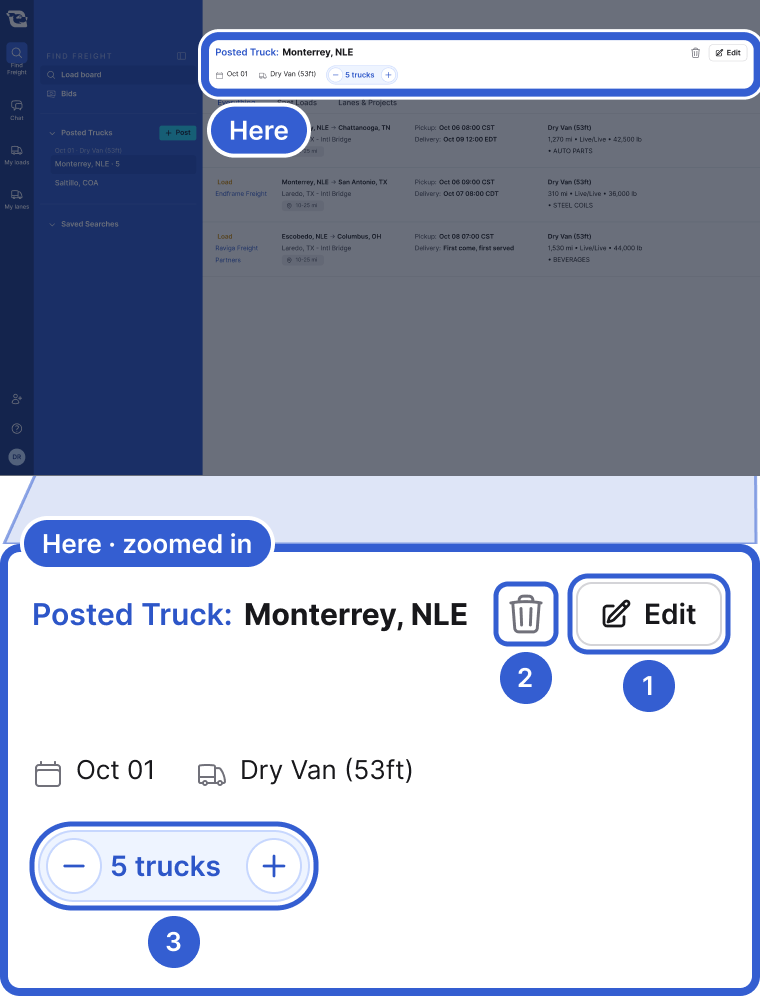
- Edit, make the change, then click Update truck twice. You can change the destination and filters here too.
- The trash icon, then Remove truck, takes the truck down.
- - and + change how many trucks.
Good to know
- From a search: if you search one route and post a truck from the results, the truck keeps that search's destination, crossings and requirements.
- All your trucks at once: point at Posted Trucks, click ... and choose View all trucks.
- From the Post a truck page: click View matching loads to see loads for every truck.
- Long list: click Show all at the bottom of Posted Trucks.
- Removed trucks: they leave your list, stop matching loads, and logistics companies no longer see them.
- A pin instead of a truck: when you search from a city you typed, or open one truck's page, the distance is from that place.
- Alerts: for a route you run often, save the search and turn on alerts.
Still stuck?
Email us and a person on our team will answer. Send the posting link or a screenshot if you have one.